Last updated: July 15, 2026
Iterum Therapeutics Competitive Landscape Analysis: Market Position, Patent/IP Strength, and Generic/Biosimilar Entry Risk
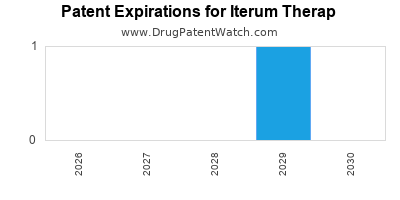
Iterum Therapeutics’ core commercial exposure is to sulfamethoxazole/trimethoprim (TMP-SMX) for uncomplicated urinary tract infections (uUTI) marketed as DURAMETRIM (US). The company’s competitive moat is anchored in U.S. patent and exclusivity coverage around the product’s formulation, method-of-use, and related manufacturing claims, plus Orange Book blocking where applicable, with generic entry risk concentrated around Paragraph IV filings and “design-around” capabilities for formulation and process patents. In parallel, Iterum’s valuation and strategic choices are materially influenced by whether uUTI and related UTI indications continue to support pricing power, and whether competitors can route around the protected claims via alternative formulations, salt forms/excipients, or manufacturing methods that still meet FDA bioequivalence.
What is Iterum Therapeutics’ market position in uUTI and related antibiotics?
What products drive Iterum’s revenue
Iterum’s revenue base is concentrated in the uUTI antibiotic segment in the US, with DURAMETRIM (TMP-SMX) as the primary commercial asset referenced in public-facing company materials and FDA-linked product coverage.
Where Iterum competes
Competition in uUTI is dominated by:
- Established branded antibiotics (pricing and channel relationships)
- Low-cost generics (high price pressure)
- Formulation-specific differentiation where FDA and payer formularies reward dosing convenience or tolerability
Iterum’s strategy is typically framed around owning a differentiated branded TMP-SMX position while avoiding direct commoditization.
How strong is Iterum’s patent estate for DURAMETRIM and TMP-SMX uUTI?
How to evaluate strength for a branded TMP-SMX franchise
For small-molecule antibiotics like TMP-SMX, strength usually clusters into:
- Formulation patents (composition claims tied to excipients, particle size, polymorph/hydrate behavior, or stability-enhancing attributes)
- Method-of-use patents tied to dose regimens or patient populations
- Manufacturing/process patents (granulation, drying, milling, lyophilization where relevant, compression parameters, impurity profile controls)
Patent strength indicators that matter for competitive threats
- Remaining life on key claims in the US
- Whether listed claims are Orange Book “blocking” claims versus non-blocking
- Whether claims are easy to design around (e.g., simple excipient swaps) versus tightly constrained by testable attributes
What patents protect DURAMETRIM in the U.S. Orange Book?
Orange Book listing logic for generic blocking
For a branded oral antibiotic, the Orange Book typically lists:
- drug substance (active ingredient)
- drug product (formulation)
- method-of-use (indication/dosing)
The competitive impact is determined by:
- Whether a proposed generic triggers Paragraph IV on listed patents
- Whether the branded holder obtains an injunction or reaches a settlement that delays launch
When does Iterum’s DURAMETRIM lose exclusivity and what are the key expiration dates?
Exclusivity vs patent life
Two gating mechanisms usually shape timing:
- Patent expiration (hard stop for claim infringement in the listed jurisdictions)
- Exclusivity (regulatory exclusivity such as data exclusivity or 505(b)(2)/HDE-type exclusivity where applicable, depending on the approval pathway)
For a marketed antibiotic with an established active ingredient, the exclusivity timeline often depends on:
- Whether exclusivity attaches to the specific product approval
- Whether the company’s key leverage is Orange Book patent coverage rather than regulatory exclusivity
What Paragraph IV risks exist for generic entry of Iterum’s TMP-SMX uUTI product?
How Paragraph IV drives the competitive clock
Generic challengers typically file under Hatch-Waxman and use Paragraph IV to seek:
- A court determination that patents are invalid or not infringed
- Or a settlement that provides a launch delay
The practical competitive sequence:
- 30-month stay triggers during litigation
- Settlement can substitute an earlier negotiated launch date
What to watch in the litigation pattern
- Whether challenges target formulation claims (harder for design-around)
- Whether they target method-of-use (often easier to route around by changing dosing)
- Whether the branded holder asserts multiple patents simultaneously (multi-patent settlements or injunction leverage)
What generic launch scenarios could threaten Iterum’s uUTI position?
Scenario 1: Generic files and survives design-around
If a challenger secures approval with a formulation/process that avoids infringement while staying bioequivalent, Iterum faces:
- Immediate margin compression from price competition
- Payer switches and formulary removals for the branded product
Scenario 2: Settlement with delayed launch
If Iterum settles, competitive risk shifts from immediate loss to:
- Revenue step-down at the negotiated entry date
- Potential follow-on challenges if remaining patents persist
Scenario 3: Multi-patent defenses extend delay
Where multiple patents cover different claim scopes, Iterum can use:
- Claim-specific injunction risk
- Leverage in settlement discussions to push launch further out
What formulations are protected, and can competitors design around Iterum’s product?
Common design-around vectors in oral antibiotic formulations
Competitors can attempt:
- Excipient substitutions while maintaining dissolution and bioequivalence
- Changing manufacturing parameters to shift impurity profiles within claim constraints
- Reformulating to avoid a claimed particle size distribution or stability attribute
Design-around risk depends on claim construction
If composition claims require specific quantitative ranges (e.g., particle size, impurity limits, viscosity/dissolution targets), design-around is harder and litigation leverage increases.
What method-of-use patents could block dosing regimen changes?
Why method-of-use matters even if the active ingredient is generic
If method-of-use claims tie to:
- A specific dose schedule
- A specific treatment duration
- A defined patient subset (e.g., renal function category, pregnancy status, recurrence status)
…competitors may need to either:
- Carve out the claim by altering labeling
- Or litigate infringement
This can be a lever to slow market erosion even when formulation is less defensible.
What patent litigation affects Iterum Therapeutics in the U.S.?
Litigation types relevant to competitive landscape
- Hatch-Waxman patent infringement suits following Paragraph IV
- Settlement agreements that structure entry dates
- Counterclaims that can shorten the timeline via invalidation outcomes
How to read litigation for business impact
- Early wins on claim construction favor branded holders
- Settlements typically reflect a probability-weighted view of injunction and appeal risk
What settlements with generics could delay or accelerate Iterum’s erosion?
Settlement mechanics that shape market timing
Typical settlement terms determine:
- Launch date
- Design constraints (labeling changes, product formulation limitations)
- Royalty-like payments or reverse payments (where allowed/structured)
The competitive impact is almost always determined by the negotiated launch date relative to patent expiration and the time remaining on any other asserted patents.
What is the Orange Book status of Iterum’s DURAMETRIM and which patents are listed as “active”?
How Orange Book status translates to investor risk
- A dense list of patents covering the product with long remaining life typically reduces immediate generic pressure.
- A sparse list or patents near expiration shifts the market to “soft exclusivity” based on channel presence rather than legal barriers.
How does Iterum compare with other uUTI antibiotic competitors on IP and commercial positioning?
Competitive map by differentiation axis
- Branded differentiated products: usually rely on patent-protected formulation or method-of-use and payer contracting
- Low-cost generics: win on price, neutralizing differentiation
- New entrants: rely on new clinical differentiation or novel formulations with distinct IP
Where Iterum sits
Iterum’s position is best characterized as a branded niche TMP-SMX franchise, where IP durability and litigation outcomes determine whether it can defend premium pricing.
Which companies are challenging Iterum and its DURAMETRIM franchise?
Challenge profile
In generic antibiotic markets, challengers usually include:
- Large generic platforms (broad filing pipelines)
- Specialty generics focused on antibiotic lifecycle management
The business risk is driven by the number of Paragraph IV filers and whether they target different patent sets.
How strong is Iterum’s patent estate versus likely generic design-around approaches?
Key determinants
- Number of independent claims asserted and the breadth of their limitations
- Whether claims cover core differentiators (not just nonessential manufacturing steps)
- Whether patents are vulnerable on obviousness or enablement
- Whether the product’s critical attributes are directly tied to claim elements
What manufacturing/IP barriers could impede generic competition to DURAMETRIM?
Manufacturing barriers in oral solids
Generic sponsors can face practical obstacles if claims cover:
- Specific process sequences with narrow windows
- Tight impurity profiles
- Stability parameters that are difficult to reproduce at scale
Even if a patent is design-around possible theoretically, manufacturing reproducibility and stability testing can affect time-to-approval.
What regulatory status governs competition: FDA pathway and labeling?
Why FDA labeling impacts competitive dynamics
For antibiotics, FDA labeling drives:
- Indication alignment with the branded marketing claim
- Dosing instructions that can either preserve or undermine method-of-use claims
Generic entrants often target narrow carve-outs that avoid method-of-use infringement.
How much revenue exposure does Iterum face from generic erosion?
Exposure is tied to three variables
- Branded product share of the company’s total revenue
- Speed of payer adoption for the generic once available
- Remaining patent duration and litigation timeline
A near-term patent cliff increases the probability of sharp revenue step-down at or shortly after launch.
What is the best strategic playbook for Iterum: licensing, defense, or product expansion?
Licensing strategy
Iterum can reduce generic pressure by:
- Securing licensing deals that trade settlement for controlled entry
- Structuring agreements to preserve premium segments (format, dosing, or patient subset)
Defense strategy
When key patents are strong:
- Multi-patent assertion can extend the 30-month stay
- Settlements can be structured to delay entry beyond the most critical expiration
Expansion strategy
If IP barriers weaken over time:
- Iterum’s strategic focus typically shifts to new indications, line extensions, or adjacent anti-infective assets with stronger IP depth.
Key Takeaways
- Iterum’s competitive risk is concentrated in its U.S. DURAMETRIM (TMP-SMX uUTI) franchise, where generic entry is largely determined by Orange Book-listed patents and Paragraph IV outcomes.
- The company’s defensibility depends on whether its key IP claims cover formulation/process attributes and method-of-use dosing in a way that is hard to design around.
- The fastest path to revenue erosion is a Paragraph IV-driven generic launch that avoids infringement while maintaining bioequivalence and labeling positioning.
- Settlement terms and multi-patent litigation strategy typically control the practical timing of generic entry even when some patents approach expiration.
FAQs
- How do Orange Book listed patents for an antibiotic control generic launch timing under Hatch-Waxman?
- What claim types (formulation vs method-of-use vs process) most often determine whether TMP-SMX generics can design around?
- When a generic files Paragraph IV on multiple patents, how does that affect the probability of settlement vs full litigation?
- How does FDA labeling carve-out for method-of-use claims impact infringement risk for uUTI dosing?
- What are the main manufacturing reproducibility factors that can make oral solid generics slower to launch despite bioequivalence?
References
- U.S. FDA. Orange Book: Approved Drug Products with Therapeutic Equivalence Evaluations.
- U.S. FDA. Hatch-Waxman (FDA guidance and statutory framework for ANDA and Paragraph IV).