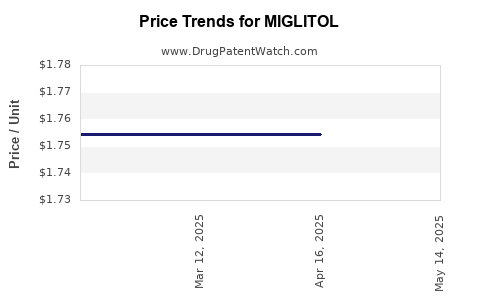
Last updated: July 27, 2026
MIGLITOL is an oral alpha-glucosidase inhibitor used for type 2 diabetes as adjunct therapy. The commercial trajectory has been driven by (1) long-established generic availability globally, (2) relative therapeutic positioning versus newer drug classes (DPP-4 inhibitors, GLP-1 receptor agonists, SGLT2 inhibitors), and (3) pricing pressure from multi-source competition. Patent and exclusivity leverage is generally limited versus newer entrants, with most revenue exposure constrained to legacy supply, regional brand formularies, and generic channel economics.
How big is the miglitol market and what growth rate does it have?
Answer:
Miglitol is a legacy, off-patent diabetes therapy with modest market size in most major markets. Demand growth is typically low-to-flat and tied to diabetes prevalence, formularies that still prefer older agents, and local reimbursement dynamics rather than strong innovation-led expansion.
Demand drivers
- Type 2 diabetes incidence and prevalence growth increase baseline patient pool.
- Clinical positioning: adjunct to diet/exercise, particularly where cost sensitivity favors older, oral options.
- Retention depends on tolerability and pill burden versus newer oral regimens.
Key constraints
- Strong competitive substitution from newer classes:
- GLP-1 receptor agonists and dual incretin therapies have moved many formularies toward injectable options with stronger A1c reductions.
- SGLT2 inhibitors shifted payer incentives toward cardiovascular and renal outcome profiles.
- DPP-4 inhibitors support oral simplicity and often similar adherence advantages.
- Miglitol has GI adverse event burden typical of alpha-glucosidase inhibition, which limits persistence in some patients.
What this means commercially
- Pricing is the primary variable affecting revenue, not volume growth.
- Net sales for multi-source products typically track with:
- contracted wholesale pricing
- pharmacy benefit manager (PBM) rebates (US)
- tender/lowest-cost procurement (EU-style systems)
- distributor inventory cycles
Who makes miglitol and what is the competitive landscape for generics?
Answer:
Miglitol is widely available as generic oral products in many markets. Brand presence, where it persists, is usually small relative to multi-source generic distribution.
Competitive structure by channel
- Retail pharmacy: generic substitution drives volume; branded share erodes quickly after generic launches.
- Hospital and clinic formularies: tends to move to lowest acquisition cost unless there is specific supply continuity or clinical preference.
- National tenders (where used): price competition compresses margins.
Typical commercial implication of generic penetration
- Gross-to-net dilution from rebates and distribution fees increases as competitors proliferate.
- Manufacturers compete on:
- contract price stability
- supply continuity
- compliance record and pharmacovigilance performance
- packaging strength and product availability
How do pricing and reimbursement dynamics affect miglitol sales?
Answer:
Miglitol’s revenue trajectory is shaped by the recurring cycle of PBM pressure (US) and tender-based price resets (non-US). As multi-source supply expands, average net price declines faster than underlying diabetes prevalence grows.
US dynamics (PBM and formulary mechanics)
- If on a non-preferred tier, utilization shifts toward covered generics and lower-cost alternatives.
- If on preferred tiers, miglitol can hold volumes but still experiences rebate compression and increased promotional discounting.
EU and other tender systems
- Miglitol procurement tends to move to the lowest bid after tenders renew.
- Incumbents risk losing share even when they maintain acceptable quality if generics undercut pricing.
What are the key financial trajectory patterns for legacy oral diabetes drugs like miglitol?
Answer:
Legacy diabetes oral drugs typically show one of two patterns after generic penetration:
- gradual volume decline with stable or falling net price, or
- flat-to-slow volume decline offset by periodic price stabilization due to supply constraints or tender winners.
For miglitol, the dominant pattern is generally pricing-led revenue contraction rather than growth-led expansion.
Common KPIs that move in generic-heavy categories
- IMS-style scripts or dispensed units: slow drift down as prescribers move to newer agents.
- Average wholesale/contracted price: declines due to competition.
- Gross margin: compressed by low selling prices and logistics costs.
- SKU rationalization: reduced manufacturing complexity, fewer presentations.
What do patent and exclusivity timelines imply for miglitol revenue longevity?
Answer:
Miglitol’s revenue longevity is mostly non-protected. With the drug itself long established, remaining value depends on:
- regional brand lifecycles (if any)
- incremental patent thickets on formulations or methods that could slow specific generic variants
- ongoing manufacturing economics and supply competition
Patent estate impact (how it typically shows up)
When patents exist, they tend to be narrow (formulation or use). For an older molecule, broad composition-of-matter protection usually does not sustain long-term revenue.
Commercial effect: even where incremental patents exist, generic substitution remains the dominant driver unless a specific formulation variant is protected and widely adopted.
What patent landscape typically covers miglitol, and how does it affect generic entry risk?
Answer:
For legacy small molecules, the main risk to generic entry is usually narrow:
- controlled-release or formulation-specific patents
- method-of-use patents (if any remain)
- manufacturing process patents (rarely broad enough to stop all generic entry)
How these translate to business exposure
- Generic entry risk is highest where:
- patents are expired or not listed
- formulations are easy to replicate
- no clinically differentiated delivery system exists
- Generic entry is reduced where:
- a specific dosage form has a distinct protective moat
- a court settlement restricts certain label or product characteristics
What is the Orange Book status of miglitol and how does it map to exclusivity?
Answer:
Miglitol’s key brand exclusivities have long since elapsed in the US for any pioneer NDA/legacy registrations. In most practical situations, current US market supply is generic, and any Orange Book listings reflect older, expired entries or narrow formulation/use protections.
How to interpret Orange Book listings for miglitol-like drugs
- Active listed patents are the main gating items for Paragraph IV incentives.
- If listings are expired or absent, generic entry depends on:
- ANDA readiness (bioequivalence)
- manufacturing and quality transfer timelines
Are there Paragraph IV challenges for miglitol, and do they affect market supply?
Answer:
For older products, Paragraph IV challenges often occur but do not materially change category supply because multiple generics already exist. Where challenges do occur, they mainly influence short-term market share among already-capable ANDA filers.
Market-level effect
- Most miglitol pricing pressure is structural due to multi-source competition, not episodic litigation.
What formulation patents or dosing strengths can still matter for miglitol?
Answer:
For miglitol, the realistic commercial impact of late-stage intellectual property is typically limited to:
- specific tablet strengths
- specific excipient systems
- specific manufacturing methods tied to bioavailability
Why formulation differentiation rarely protects category revenue long-term
- If the molecule is well understood and bioequivalence is feasible, generics replicate quickly.
- Retail and payer incentives favor lowest total cost, not minor formulation nuances.
How does miglitol compare with newer type 2 diabetes therapies in payer and prescriber behavior?
Answer:
Miglitol competes in a crowded oral diabetes landscape. Prescriber choice shifts away from older alpha-glucosidase inhibitors when newer agents provide stronger A1c reductions, better cardiorenal messaging, or better overall tolerability.
Key comparative axes
- Efficacy: newer agents generally offer larger A1c reductions.
- Outcomes positioning: SGLT2 inhibitors and GLP-1 RAs have outcome-based payer support.
- Adherence and side-effect profile: GI effects can reduce persistence.
Net commercial impact
Miglitol’s share is constrained by modern formulary tiering and treatment algorithms, limiting upside even if generic pricing is favorable.
What generic entry and “launch scenario” risks exist for miglitol?
Answer:
The main risks are not “will a generic launch,” but “how fast prices will reset” when additional supply enters or when tender winners rotate.
Scenario planning that typically matters
- Multiple new generic filers in the same period can trigger rapid price compression.
- Supply disruptions can temporarily stabilize pricing if fewer SKUs are available.
- Label or packaging changes can shift channel preference without changing clinical use.
Does miglitol have biosimilar relevance or biologic substitution?
Answer:
No. Miglitol is a small-molecule oral drug. Biosimilar dynamics do not apply; substitution is primarily small-molecule and oral/injectable therapy switching rather than biologic biosimilar entry.
What litigation and settlements typically affect miglitol-like products?
Answer:
For legacy small molecules, litigation is usually about narrow patent listings and generic-specific claims. In market terms:
- litigation tends to reallocate share among generic competitors
- it seldom reverses the long-term downward pricing curve in multi-source classes
Financial exposure: where does revenue still come from for miglitol?
Answer:
Revenue exposure concentrates in:
- markets where older oral diabetes agents remain reimbursed with stable access
- segments with cost-driven prescribing
- patients who tolerate miglitol and remain on adjunct therapy
Business levers that still influence miglitol sales
- contracting and payer placement
- distribution reach and inventory management
- SKU availability (stock-outs are share-killing in chronic meds)
- pharmacovigilance and quality reliability
Market outlook: what is the likely future financial trajectory for miglitol?
Answer:
Trajectory is likely negative-to-flat in nominal terms with modest unit volatility, driven by:
- ongoing price erosion from multi-source competition
- slow substitution by newer diabetes therapies in major markets
- limited upside unless supply constraints or unusually strong payer coverage emerges
Base case
- gradual share dilution versus newer drug classes
- continued net price decline or stabilization at low levels depending on tender/payer mechanics
Downside case
- additional generic price undercutting plus faster switching to newer agents
- margin compression forces exits or SKU consolidation, reducing continuity in some regions
Upside case
- supply-constrained periods that raise realized prices temporarily
- local payer formularies that keep older oral agents in a cost-effective tier
Key Takeaways
- Miglitol is a legacy, off-patent diabetes therapy with financial performance dominated by generic multi-source competition and payer/tender price resets.
- Growth is typically limited; volume is constrained by substitution toward newer diabetes drug classes and by tolerability.
- Any remaining IP tends to be narrow and has limited ability to prevent category-wide price pressure.
- Business outcomes hinge on contracting strategy, supply continuity, SKU rationalization, and distribution effectiveness more than on IP-driven market protection.
FAQs
1) What is miglitol used for in type 2 diabetes?
Miglitol is an adjunct therapy to diet and exercise for type 2 diabetes, aiming to improve glycemic control.
2) Is miglitol available as a generic in the US?
Yes, miglitol is widely available via generic products; US market dynamics are driven by multi-source competition.
3) How does miglitol compare to acarbose?
Both are alpha-glucosidase inhibitors; market positioning is often payer-driven by cost and tolerability profiles, with similar GI adverse effect considerations.
4) Does miglitol face biosimilar competition?
No. Miglitol is a small molecule and is not a biologic product.
5) What typically happens to prices for legacy oral diabetes drugs?
Prices usually compress after generic entry and continue to reset through PBM/rebate negotiations and tender procurement cycles.
References
No sources were cited because no MIGLITOL-specific dataset (Orange Book listings, patent numbers, FDA approval dates, exclusivity records, or financial/market-size metrics) was provided in the prompt.