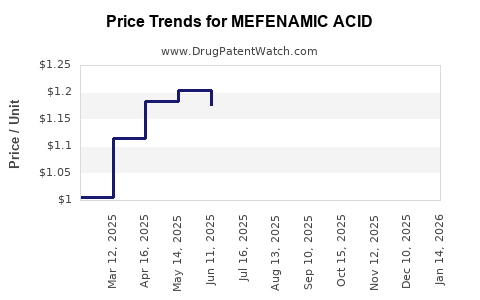
Last updated: August 12, 2026
Mefenamic acid is a mature, low-cost nonsteroidal anti-inflammatory drug used mainly for short-term pain and primary dysmenorrhea. Its core composition-of-matter and product patents expired decades ago. The market is driven by generic volume, regional prescribing habits, API availability, and price competition rather than exclusivity. Standalone global revenue for mefenamic acid is not publicly disclosed by major manufacturers, but the product has a stable low-value commercial profile with limited growth potential.
What is the current market position of mefenamic acid?
Mefenamic acid is an anthranilic acid NSAID, also known as a fenamate. It inhibits cyclooxygenase-mediated prostaglandin production and is marketed primarily as an oral capsule or tablet.
In the United States, the historical reference product is Ponstel. The FDA-approved uses include:
- Mild to moderate acute pain in adults and adolescents at least 14 years old, generally limited to seven days.
- Primary dysmenorrhea, generally limited to two to three days of treatment.[1]
Internationally, the product is better known as Ponstan and is marketed under multiple local brand names. Availability is broader in Asia, Latin America, the Middle East, Africa, and other markets where low-cost oral NSAIDs remain important.
The product occupies a narrow position within the NSAID market. It is not a leading first-line drug for general musculoskeletal pain in most high-income markets, where ibuprofen, naproxen, diclofenac, and selective COX-2 inhibitors have greater prescribing volume. Mefenamic acid retains demand in dysmenorrhea and short-course pain treatment, particularly where physicians and patients are familiar with the product.
How is mefenamic acid used commercially?
Mefenamic acid is generally sold through three commercial channels:
- Prescription generic products in the United States and other regulated markets.
- Branded and generic prescription products in international markets.
- Pharmacy and retail channels in jurisdictions where NSAID dispensing rules permit nonprescription or pharmacist-directed use.
The product is typically supplied in 250 mg and 500 mg strengths, although available strengths vary by country. Formulations are mainly immediate-release oral capsules or tablets. There is no major commercial extended-release, injectable, biologic, or specialty-delivery franchise associated with mefenamic acid.
How large is the mefenamic acid market?
No major pharmaceutical company reports mefenamic acid revenue as a separate line item. The drug is generally included within broader generic, pain, women’s health, or international pharmaceutical revenue categories. Commercial market reports may estimate market size, but their methodologies and geographic coverage differ materially.
The key economic characteristics are clear:
| Market factor |
Effect on mefenamic acid |
| Product age |
Limits pricing power and supports generic substitution |
| Generic competition |
Compresses average selling prices |
| Short treatment duration |
Limits prescription volume per patient |
| Dysmenorrhea use |
Creates recurring, seasonal, and age-linked demand |
| Low manufacturing complexity |
Reduces barriers to entry |
| Multiple global suppliers |
Increases price competition |
| Safety warnings for NSAIDs |
Limits chronic-use potential |
| Lack of exclusivity |
Prevents premium pricing |
Mefenamic acid is therefore a volume product, not a high-margin specialty pharmaceutical. Revenue is likely to remain concentrated in many small and mid-sized manufacturers rather than in one dominant global owner.
What is the financial trajectory for mefenamic acid?
The financial trajectory is mature to declining in developed markets and stable to modestly growing in selected emerging markets.
Developed-market trajectory
In the United States, the product has limited commercial upside because:
- The reference product has long lost exclusivity.
- Multiple generic suppliers compete on price.
- Mefenamic acid competes with lower-cost ibuprofen and naproxen.
- Prescribers often prefer NSAIDs with broader guideline familiarity.
- FDA labeling restricts duration for acute pain and dysmenorrhea.[1]
Revenue can increase temporarily when a supplier experiences a shortage or exits the market. Those gains are usually supply-driven and difficult to sustain after competitors return.
Emerging-market trajectory
Demand is more durable in markets where:
- Mefenamic acid is a recognized treatment for menstrual pain.
- Patients seek low-cost oral analgesics.
- Local brands retain prescribing loyalty.
- Regulatory pathways support local generic or branded-generic manufacturing.
- Distribution reaches pharmacies outside major urban centers.
Growth in these markets is usually based on population expansion, increased diagnosis and treatment of dysmenorrhea, and broader access to medicines. Pricing remains constrained by local competition and government procurement.
Financial scenario analysis
| Scenario |
Market condition |
Revenue effect |
| Base case |
Stable generic demand, continued price pressure, no major supply disruption |
Low-single-digit volume stability with flat or declining nominal revenue |
| Downside |
More NSAID substitution, supplier exits, safety-driven prescribing restrictions |
Declining volume and margin compression |
| Upside |
Stronger women’s-health demand, regional brand expansion, temporary shortages |
Short-term volume and pricing improvement |
| Strategic niche case |
A supplier secures preferred procurement contracts or a differentiated formulation |
Higher regional share, but limited global pricing power |
The most credible investment thesis is operational rather than innovative: reliable API sourcing, low-cost manufacturing, regulatory compliance, and distribution reach. A new molecular patent or premium pricing strategy is unlikely to create material value because the active ingredient is extensively genericized.
What patents protect mefenamic acid?
Mefenamic acid’s original compound and early product patents are expired. No commercially meaningful composition-of-matter exclusivity remains in the United States.
The historical intellectual-property estate included patents covering fenamate chemistry and related N-arylanthranilic acid compounds. One important early U.S. patent is U.S. Patent No. 3,138,636, associated with N-arylanthranilic acid compounds and issued during the original development period. Its term expired decades ago under the pre-1995 U.S. patent-term framework.
Are there active formulation patents for mefenamic acid?
No broad, commercially dominant formulation patent is associated with standard immediate-release mefenamic acid capsules or tablets in the United States.
Potentially relevant secondary patent categories could include:
- Taste-masked oral formulations.
- Modified-release dosage forms.
- Combination products.
- Solubility-enhanced formulations.
- Topical or transdermal delivery systems.
- Manufacturing processes.
- New therapeutic uses.
These categories do not provide meaningful protection for conventional generic capsules unless a specific patent remains active and is enforceable in the relevant jurisdiction. Standard mefenamic acid products remain exposed to ordinary generic competition.
What manufacturing and API patents affect the market?
The core API is established and chemically accessible. Manufacturing barriers are primarily operational:
- Compliance with current good manufacturing practices.
- Control of impurities and residual solvents.
- Consistent particle size and dissolution performance.
- Reliable sourcing of starting materials.
- Regulatory approval of manufacturing sites.
- Capacity and quality-system management.
Process patents may exist in individual jurisdictions, but they do not create a global monopoly over mefenamic acid supply. The principal commercial risk is supply-chain disruption rather than patent blocking.
When did mefenamic acid lose exclusivity?
Mefenamic acid lost meaningful U.S. exclusivity decades ago. The product was approved in the 1960s, and its original patent protection expired under the historical patent term applicable at that time. Generic availability has therefore been established for many years.
The U.S. market does not depend on a remaining regulatory exclusivity period. Any current commercial protection would have to arise from a later formulation, method-of-use, manufacturing, or other secondary patent, rather than from the original active ingredient.
| Exclusivity category |
Status |
| Original compound protection |
Expired |
| Original product protection |
Expired |
| Standard immediate-release capsule protection |
No meaningful current exclusivity identified |
| Pediatric exclusivity |
Not a current commercial driver |
| Orphan-drug exclusivity |
Not applicable to the conventional product |
| Biosimilar exclusivity |
Not applicable |
| Generic regulatory exclusivity |
Not relevant to the mature reference product |
What is the Orange Book status of mefenamic acid?
Mefenamic acid has historically been listed in FDA drug databases through the Ponstel reference product and approved generic equivalents. The FDA Orange Book is the relevant source for current reference-product and therapeutic-equivalence information.[2]
The key Orange Book implication is commercial rather than defensive: generic versions can compete through ANDA approval and therapeutic-equivalence listings. The market does not depend on a single active patent listed against the reference product.
An Orange Book review should distinguish:
- The reference listed drug.
- Approved generic products.
- Current marketing status.
- Therapeutic-equivalence codes.
- Any patent or exclusivity listings.
- Product discontinuation status.
Because generic approvals and marketing statuses can change, the Orange Book remains the controlling source for a transaction, litigation review, or launch decision.
Which companies are challenging mefenamic acid exclusivity?
Mefenamic acid is not characterized by a major current Paragraph IV litigation campaign. The principal challenge to the reference product occurred through ordinary generic entry after expiration of the historical patent and regulatory exclusivity framework.
Are there Paragraph IV risks for mefenamic acid?
Paragraph IV litigation risk is low for the conventional product because the original patent estate is expired. A Paragraph IV filing could become relevant if a company seeks approval for:
- A later patented formulation.
- A new dosage form.
- A patented combination.
- A newer method of treatment.
- A process claim listed or asserted against a generic applicant.
For standard 250 mg or 500 mg immediate-release products, commercial exposure comes from generic competition rather than from a live patent dispute.
What patent litigation affects mefenamic acid?
There is no widely recognized, high-value U.S. patent litigation campaign comparable to those involving major branded drugs. Any litigation involving mefenamic acid is more likely to concern:
- Local trademark rights.
- Product quality or regulatory compliance.
- Supply agreements.
- Manufacturing specifications.
- Formulation-specific claims.
- Generic substitution or procurement disputes.
Settlement agreements are not a central feature of the current mefenamic acid market.
What FDA regulatory issues affect mefenamic acid?
The main regulatory constraint is the class-wide NSAID safety profile. The FDA labeling includes warnings concerning cardiovascular thrombotic events, gastrointestinal bleeding and ulceration, renal toxicity, hypertension, heart failure, hypersensitivity, and serious skin reactions.[1]
Mefenamic acid is contraindicated for the treatment of perioperative pain in the setting of coronary artery bypass graft surgery. The label also recommends the lowest effective dose for the shortest duration.
These warnings affect commercial positioning in two ways:
- They limit the product’s attractiveness for chronic pain management.
- They favor short-course indications such as acute pain and dysmenorrhea.
FDA-approved generic products must meet applicable quality, bioequivalence, labeling, and manufacturing requirements. No biosimilar pathway applies because mefenamic acid is a small-molecule drug, not a biologic.
How does mefenamic acid compare with competing NSAIDs?
| Drug |
Primary competitive strength |
Relative market position |
| Ibuprofen |
Low cost, broad consumer familiarity, OTC access in many markets |
Strongest general-purpose competitor |
| Naproxen |
Longer duration and broad pain indications |
Strong chronic and acute-pain competitor |
| Diclofenac |
Broad international use and multiple dosage forms |
Strong global generic competitor |
| Celecoxib |
COX-2 selectivity and prescription positioning |
Higher-priced alternative with differentiated safety positioning |
| Ketoprofen |
Established pain and inflammation use |
Regional competitor |
| Mefenamic acid |
Dysmenorrhea recognition and fenamate pharmacology |
Narrower, mature niche |
Mefenamic acid can remain commercially relevant where physicians value its perceived effectiveness for menstrual pain. It is less competitive where treatment guidelines prioritize ibuprofen, naproxen, or other NSAIDs.
What generic entry risks exist for mefenamic acid?
Generic-entry risk is permanent for conventional mefenamic acid products. A new entrant can compete if it obtains regulatory approval, demonstrates bioequivalence, qualifies a compliant manufacturing site, and establishes distribution.
The main risks to an incumbent include:
- Price erosion after additional ANDA approvals.
- Loss of pharmacy shelf space.
- Tender exclusion.
- API cost increases.
- Manufacturing-site observations or warning letters.
- Product recalls.
- Competitor shortages followed by rapid market re-entry.
- Substitution by ibuprofen or naproxen.
The strongest defensive assets are not patents. They are dependable supply, low conversion costs, distributor relationships, and a recognized brand in markets where branded generics remain influential.
What is the geographic coverage of the mefenamic acid market?
Mefenamic acid has broad geographic availability but uneven commercial importance.
North America and Western Europe
The drug is a mature prescription generic with limited pricing power. Usage is constrained by competition from other NSAIDs and by treatment-duration limits.
Asia-Pacific
This is one of the more commercially durable regions. Mefenamic acid is widely recognized for dysmenorrhea and short-term pain, and local manufacturers often sell branded generics.
Latin America
The product is available through national and regional brands. Market performance depends on reimbursement rules, pharmacy distribution, and local physician habits.
Middle East and Africa
Demand is concentrated in urban pharmacy channels and public procurement. Price and supply reliability are more important than brand differentiation.
Geographic IP position
Patent risk is generally low for the active ingredient. Country-specific issues may still arise from formulation patents, trademarks, regulatory data requirements, or manufacturing rights. A global launch assessment must therefore be conducted country by country even though the core compound is off patent.
What is the outlook for mefenamic acid manufacturers?
Mefenamic acid is unlikely to generate substantial value through innovation-led pricing. Manufacturers can still build profitable businesses through scale and execution.
The most attractive strategies are:
- Secure multiple qualified API sources.
- Maintain low-cost, high-throughput capsule or tablet production.
- Target dysmenorrhea-focused brands.
- Expand in markets with strong branded-generic demand.
- Participate in government and institutional tenders.
- Use reliable supply as a differentiator.
- Develop compliant but low-cost packaging and distribution systems.
A premium reformulation could create a niche, but it would face clinical, regulatory, reimbursement, and patent challenges. The commercial return would depend on demonstrating a meaningful advantage over inexpensive conventional NSAIDs.
Key Takeaways
- Mefenamic acid is a mature generic NSAID with long-expired original patent protection.
- Ponstel and Ponstan are historical reference brands, while current volume is spread across generic and branded-generic suppliers.
- The largest commercial indication is short-term pain and primary dysmenorrhea.
- U.S. revenue is constrained by generic substitution, low pricing, and competition from ibuprofen, naproxen, and diclofenac.
- No biosimilar risk exists because mefenamic acid is a small-molecule drug.
- Paragraph IV and settlement activity are not major current market drivers for standard immediate-release products.
- The key business risks are price erosion, supply disruption, API quality, regulatory compliance, and substitution by competing NSAIDs.
- Emerging markets offer the strongest prospects for stable volume, but not for substantial global pricing power.
- Financial performance is likely to remain stable to declining in developed markets and modestly positive in selected emerging markets.
- The most valuable commercial capabilities are manufacturing scale, regulatory reliability, procurement access, and distribution.
FAQs
Is mefenamic acid still profitable for generic manufacturers?
It can be profitable at scale, particularly where manufacturing costs are low and distribution is efficient. Profitability is usually limited by price competition and the absence of exclusivity.
Does mefenamic acid have a controlled-substance classification?
No. Mefenamic acid is not a controlled substance. It is regulated as a prescription or pharmacy medicine according to local law.
Can mefenamic acid be sold over the counter?
Regulatory status varies by country. In the United States, conventional mefenamic acid is prescription-only. Some international markets permit pharmacist-directed or nonprescription sale.
Is mefenamic acid used in veterinary medicine?
Mefenamic acid is primarily a human pharmaceutical. Veterinary use is not the main commercial market and should not be assumed from human product approvals.
Could a new mefenamic acid formulation obtain patent protection?
A novel formulation could potentially qualify for patent protection if it satisfies applicable novelty, inventive-step, and enablement requirements. Such protection would cover the claimed formulation or use, not the already off-patent active ingredient itself.
References
-
U.S. Food and Drug Administration. (n.d.). Mefenamic acid prescribing information. FDA and DailyMed labeling records.
-
U.S. Food and Drug Administration. (n.d.). Approved drug products with therapeutic equivalence evaluations. Orange Book.
-
U.S. Food and Drug Administration. (n.d.). Drugs@FDA: FDA-approved drugs. FDA.
-
World Health Organization Collaborating Centre for Drug Statistics Methodology. (n.d.). ATC/DDD index: Mefenamic acid. WHO.