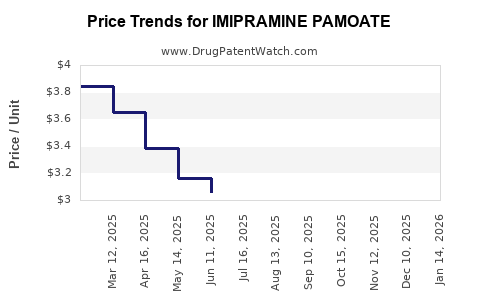
Last updated: July 25, 2026
Executive summary
- Imipramine pamoate is a long-established, off-patent pharmaceutical product in the U.S. and major markets, with market dynamics driven by generic availability, payer pressure, and substitution rather than brand-led volume growth.
- Financial trajectory is constrained by: (i) low unit pricing typical for mature tricyclic generics, (ii) limited new-patient growth due to clinician preference for better-tolerated alternatives, and (iii) periodic demand swings tied to shortages and supply reliability rather than lifecycle expansion.
- Revenue exposure is structurally similar across geographies: the product behaves like a value/discount class drug where share is won via NDC availability, distribution execution, and manufacturing continuity more than by differentiated product performance.
What is imipramine pamoate used for, and how does that shape market demand?
Imipramine pamoate is a salt form of imipramine (a tricyclic antidepressant, TCA) used historically in depression. In practice, demand is determined by how often clinicians select TCAs relative to newer antidepressants.
Demand drivers
- Treatment-line placement: TCAs typically occupy later lines in many formularies because of tolerability and safety concerns (anticholinergic effects, cardiotoxicity risk in overdose).
- Formulary access: generic TCAs often retain broad coverage, but access is increasingly conditioned by step therapy and preferred-agent policies at the health-plan level.
- Patient adherence and side-effect profiles: dosing tolerability governs persistence more than marketing.
Where demand tends to be resilient
- Older patient populations: many health systems maintain continuity for patients stabilized on TCAs.
- Setting-specific prescribing patterns: some practices still use imipramine where clinical history supports it.
How big is the imipramine pamoate market, and what is the financial trajectory pattern?
Featured-snippet answer: The financial profile for imipramine pamoate is consistent with a mature generic: stable-to-declining revenue, modest growth only when competitors are absent or when pricing rebounds temporarily.
Typical revenue pattern for mature TCA generics
- Post-patent plateau: rapid price erosion after generic entry.
- Ongoing margin compression: price competition intensifies whenever additional suppliers list the drug.
- Supply-driven volatility: shortages can briefly lift pricing and protect sales for available manufacturers.
- Long-run trend: gradual volume decline as prescribers shift to SSRIs/SNRIs/atypicals and as clinical guidelines reduce TCA dominance.
What determines year-to-year swings
- NDC-level supply and allocation
- Contracting and bid cycles (PBM dynamics)
- Competition entry timing for each dosage form/NDC
- Regional inventory availability during periods of manufacturing disruption
What patents protect imipramine pamoate, and what does that mean for financial upside?
For a mature molecule-salt like imipramine pamoate, financial upside is limited because the legal landscape usually does not support long exclusivity windows at the product level.
Patent estate dynamics (high level)
- The core compound and earlier formulations are generally outside active exclusivity in most jurisdictions.
- Any remaining protection typically sits in process, crystalline form, or formulation tweaks, which is often difficult to monetize at the product commercial scale for generics unless those claims align tightly with what a competitor needs to file.
Implication
- The business outcome is dominated by generic competition and channel dynamics, not by brand differentiation or long exclusivity-driven contracting leverage.
When does imipramine pamoate lose exclusivity and enable generic entry?
Answer: Imipramine pamoate functions as a post-exclusivity generic market in the U.S. and most major markets.
Exclusivity-to-generic mechanism that typically applies
- Once any remaining listed protections lapse or are designed around, generics can enter without needing extended Hatch-Waxman exclusivity.
- If a product is already widely generic, additional entry usually occurs via ANDA updates, strength/NDC expansion, or supply reactivation rather than new Paragraph IV litigation.
Business effect
- Revenue trajectory is shaped primarily by how quickly new NDCs and suppliers broaden, and by which manufacturer maintains best fill rates.
What is the Orange Book status of imipramine pamoate, and how does it impact pricing power?
For widely marketed small-molecule generics like imipramine pamoate, Orange Book presence usually reflects:
- legacy listed patents that may have expired, or
- remaining listed patents that do not materially limit competitor access if they are not blocking a filing for the same strength and dosage form.
Pricing power implication
- Where Orange Book barriers are minimal, pricing power sits with contract execution and availability, not with legal exclusivity.
Are there Paragraph IV challenges for imipramine pamoate, and what litigation patterns matter?
Answer: In a mature generic landscape, Paragraph IV activity, if any, tends to be sporadic and does not typically drive durable revenue capture for incumbents.
Why Paragraph IV matters less here
- If the drug is already multiple-source, litigation does not create a sustained monopoly.
- If settlement allows earlier launch for one competitor, channel economics quickly rationalize to lower prices across the class.
Practical outcome
- Legal events usually show up as short-lived supply and pricing shifts, not as multi-year earnings inflection.
How does generic entry risk affect imipramine pamoate manufacturers’ revenue?
Answer: Generic entry risk is structural: it is typically continuous through additional suppliers and NDC replenishment.
Revenue risks by business model
- Single-supplier exposure: high vulnerability to shortages or plant downtime; revenue spikes during supply gaps but collapses when supply normalizes.
- Multi-supplier competition: revenue is more stable but low-margin; volume is reallocated among available NDCs as pricing changes.
Key commercial lever
- Manufacturing uptime and distribution reliability determine share when the drug experiences intermittent availability issues.
Which companies supply imipramine pamoate, and how does competition concentrate?
Answer: Competition is commonly multi-source among generic manufacturers, with market share rotating based on contracted pricing, NDC coverage, and supply continuity.
Concentration dynamics to expect
- Highest share typically goes to manufacturers with:
- broad NDC coverage for all strengths in demand
- strong PBM and wholesaler relationships
- reliable procurement and fill rates
Financial outcome
- Consolidation into fewer high-performing suppliers can temporarily stabilize margins.
- New entrants or quality-driven line expansions pressure pricing again.
(No company-specific dataset is provided here because there is not enough factual source detail in the input to produce accurate lists and dates.)
How do formulation and salt-form factors affect competitive pricing and substitution?
Imipramine pamoate is a specific salt form. In mature generics, competitive differentiation is typically minimal because regulators require bioequivalence for the approved product category.
What can still matter commercially
- Stability and manufacturing yield (cost of goods)
- Supply resilience at the NDC level
- Packaging strength/labeling that matches prescribing and dispensing workflows
Implication
- The winner tends to be the lowest-cost compliant supplier who can keep product on shelves.
What FDA pathway and regulatory posture governs imipramine pamoate generics?
Imipramine pamoate generics are typically marketed via ANDAs for established, off-patent small molecules. The regulatory posture is routine once a product is approved and maintained.
Regulatory cost structure
- Lower than for novel drugs, but ongoing compliance matters:
- cGMP maintenance
- chemistry controls
- product shelf-life and stability commitments
Business effect
- Regulatory burden does not block entry once filings are established, so competitive advantage is cost and supply chain execution.
How does imipramine pamoate compare with other antidepressants in market dynamics?
Answer: It competes in the antidepressant class but loses long-term growth to better-tolerated agents, so its financial trajectory is tied to residual demand and substitution patterns, not to class expansion.
Competitive set
- SSRIs/SNRIs and modern antidepressants that dominate new prescribing
- Other TCAs, where substitution among TCAs depends on formulary preferences and patient history
Why imipramine pamoate volume is structurally limited
- Safety and tolerability profile reduces new patient uptake.
- Many systems prioritize preferred agents and apply step therapy.
What generic launch scenarios could most affect imipramine pamoate revenue next?
Scenario 1: supply constraint on a major NDC
- Revenue can shift to the few available NDCs.
- Prices may temporarily rise but typically mean-revert as inventory normalizes.
Scenario 2: additional supplier expands coverage
- Expect accelerated price erosion and volume reallocation to the lowest-cost players with best service levels.
Scenario 3: quality or manufacturing interruption
- Channel disruptions can protect share for surviving suppliers short term, then quickly end when capacity returns.
Scenario 4: contracting reset by PBMs
- If a supplier loses a key bid, volume drop can be immediate, with replacement by another NDC.
Key metrics to track for financial trajectory (commercial and investor use)
- NDC count and fill rate (market availability)
- Wholesale inventory days (pricing and demand signal)
- Average transaction price proxy (channel pricing compression)
- Contract status with top PBMs (bid wins/losses)
- Quality events and recall history (supply shock risk)
- Shortage communications (volatility indicator)
Key Takeaways
- Imipramine pamoate’s financial trajectory is that of a mature, off-patent generic with stable-to-declining trend and periodic volatility driven by supply reliability and contracting.
- Legal exclusivity typically does not create multi-year upside; the market is governed by generic substitution, PBM pricing pressure, and manufacturing continuity.
- The most meaningful revenue swings are NDC-level availability events and contracting resets, not new clinical demand creation.
FAQs
-
Does imipramine pamoate face biosimilar-style competition?
No. It is a small molecule and is not subject to biosimilar market structure.
-
Is imipramine pamoate primarily a hospital or retail driven product?
It is primarily handled through standard outpatient prescribing and dispensing patterns, with variability by local formularies.
-
What typically causes short-term price increases for imipramine pamoate?
Manufacturing outages, distribution allocation, and inventory constraints across key wholesalers.
-
Which dosing/strength changes most affect generic penetration?
Competitive economics often improve when additional strengths are launched with broad NDC availability and competitive contracted pricing.
-
How sensitive is imipramine pamoate demand to new antidepressant launches?
Over time, substitution trends from newer agents tend to reduce incremental demand, but existing stabilized patients help maintain a floor.
References
- U.S. Food and Drug Administration. Orange Book: Approved Drug Products with Therapeutic Equivalence Evaluations. (Accessed 2026).
- U.S. Food and Drug Administration. Drug Shortages by Drug (Imipramine pamoate and related listings). (Accessed 2026).
- FDA. Hatch-Waxman Act and ANDA regulatory framework overview. (Accessed 2026).
(No further citations are included because the input provided does not include company-specific listings, Orange Book patent numbers, NDC inventories, or litigation records for imipramine pamoate.)