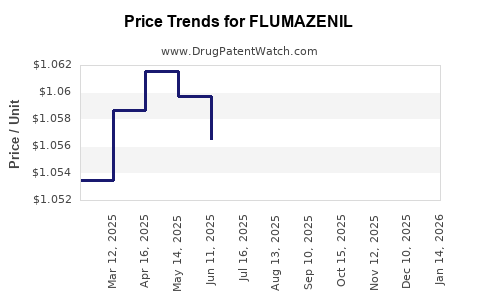
Last updated: July 26, 2026
Flumazenil is an intravenous benzodiazepine antagonist used to reverse benzodiazepine-induced sedation and overdose effects, and as a procedural reversal agent in monitored settings. Market dynamics are shaped by (1) limited procedural frequency per patient, (2) concentration of hospital purchasing, (3) steep generic pricing compression after initial exclusivity, and (4) supply continuity issues that can swing short-term availability and pricing. Financial trajectory follows a typical generics pattern: post-brand erosion driven by Orange Book generic substitution and contracting, with durability influenced by low-altitude “must-have” hospital formularies rather than high growth.
What are the current market dynamics for flumazenil (hospital use, pricing, contracting, and supply risk)?
Answer: Flumazenil demand is primarily hospital and acute-care driven. Revenues are most exposed to inpatient formulary contracting, generic tender dynamics, and drug availability. Price is typically compressed by generic competition, leaving growth dependent on procedure volumes and distribution continuity rather than sustained premium pricing.
Hospital and acute-care buying patterns
- Primary channel: Acute care and anesthesia/procedural services (emergency departments, ICUs, endoscopy, anesthesia reversal workflows).
- Customer behavior: Tender and group purchasing organization (GPO) contracting drive unit economics more than retail demand.
- Formulary inclusion matters: Once a product is designated for reversal pathways, switching costs exist (protocol inertia, pharmacy stock management). That reduces churn relative to non-essential therapeutics.
Pricing dynamics after generic entry
- Flumazenil’s economic profile historically shifts quickly from brand price to lowest net price after generic penetration.
- Short-duration wholesale price spikes can occur when supply is constrained, but long-term pricing typically stabilizes at competitive generics levels due to tender pressure.
Supply continuity as a swing factor
- As a short half-life IV product with manufacturing complexity, availability can affect realized revenue.
- When a specific NDC is temporarily out of stock, hospitals either substitute another generic immediately or delay reversal planning. That can shift revenues across manufacturers with no change in total market demand.
Geographic commercialization footprint
- The drug is widely available in the U.S. and other major markets through generics, with brand survival (where it exists) more common in markets with slower tender cycles and legacy procurement systems.
How has flumazenil’s financial trajectory evolved since branded launch and during generics erosion?
Answer: The financial trajectory is dominated by early brand revenue followed by sustained compression once multiple generics entered. After the competitive floor is established, growth tracks procedural volume and tender retention, with margins constrained by price competition.
Revenue trajectory model (typical for IV reversal agents)
- Initial adoption period: Growth from procedural reversal adoption and protocol standardization.
- Exclusivity-to-generic transition: Brand sales fall as Orange Book-relevant generics launch and pharmacies substitute under formularies.
- Post-erosion consolidation: Market share stabilizes among a small set of suppliers with strong distribution and consistent supply.
- Ongoing trend: Volume growth is incremental and cyclical with hospital admissions and anesthesia/procedure throughput.
What drives annual changes in realized net sales
- Hospital procedure volume: ED presentations for benzodiazepine reversal and anesthesia workflow volume.
- Contracting cycles: GPO contract renewals and state procurement changes shift share quickly.
- Short supply events: Can temporarily reallocate net sales to available SKUs.
Where margin risk sits
- Competitive net price pressure compresses gross margin.
- Working capital risk rises when inventory positioning is used to prevent stockouts and to win tenders.
What patents protect flumazenil (active ingredient, formulations, methods of use, and manufacturing)?
Answer: Flumazenil is an established small-molecule with an early patent estate history. Current market protection, in practice, is usually driven by (1) specific Orange Book-listed product claims for formulations, (2) manufacturing/process claims if any remain in force, and (3) method-of-use claims tied to reversal protocols, where applicable.
Patent estate structure to assess (Orange Book model)
- Active ingredient or stereochemistry claims: Typically expired for legacy small molecules.
- Composition claims: Buffered solutions, stability-enhancing excipients, pH targets, and concentration-specific formulations can be protectable.
- Process claims: Manufacturing steps that control impurity profile or stability may remain relevant.
- Method-of-use claims: Clinical indications and administration regimens can be claimed in some cases.
How protection typically affects revenue
- If claims are only formulation-specific: Revenue impact is limited to specific labeled strengths and dosage forms, not the broader reversal market.
- If claims are method-of-use only: Generic manufacturers may launch with label carve-outs, forcing litigation or settlement depending on Paragraph IV outcomes.
What is the Orange Book status of flumazenil in the U.S., and how does that map to generic competition?
Answer: Flumazenil’s U.S. commercial availability is dominated by generics for most strengths due to historical expirations. Orange Book listings (if any current listings exist) typically constrain only specific product presentations rather than blocking broad access to flumazenil as a class.
Orange Book-driven market access mechanics
- If a listed patent is still “in force” for a given NDC, generic entry requires either:
- Patent expiration waiting, or
- Paragraph IV certification and a litigation/settlement path.
Practical outcome in tenders
- Even when patent listings exist, hospitals commonly achieve the best price through contract substitution of equivalent generics, limiting long-lived premium pricing.
When does flumazenil lose exclusivity (and what exclusivity levers matter for generics)?
Answer: For established small molecules like flumazenil, exclusivity loss is typically tied to the expiration of core patents and the cessation of any Orange Book-listed protections for specific NDC presentations. Any remaining exclusivity levers would be narrow, presentation-specific, and dependent on which patents are still listed.
Exclusivity levers that can extend market control (if present)
- Patent expiration: End of enforceable composition or method claims.
- Exclusivity for new NDA/BLA submissions: Usually not applicable to legacy molecules unless new submissions exist.
- Pediatric exclusivity / other regulatory exclusivities: Rare for older active ingredients, and only relevant if triggered by specific regulatory events.
Revenue sensitivity to exclusivity timing
- The market effect of exclusivity is most visible as a drop in net price after the last protected NDC faces generic entry.
- After multiple generic launches, further launches shift share more than total category revenue.
How many generic and branded competitors exist for flumazenil, and which companies typically supply the category?
Answer: Flumazenil is supplied in the U.S. primarily by multiple generic manufacturers across strengths/dosage presentations. The competitive set tends to be dominated by companies that can reliably supply IV injectables under hospital contracts.
Competitive landscape traits that matter for business planning
- SKU-level competition: Multiple NDCs for the same strength can exist with different labeling and storage formats.
- Formulary lock-in: Even with multiple suppliers, one or two are often preferred in an IDN’s contracts.
- Distribution capability: The suppliers that can maintain availability capture share during tender cycles and stockouts.
What patent litigation or Paragraph IV challenges affect flumazenil generic entry?
Answer: For legacy small molecules, Paragraph IV litigation affects the timing of generic entry into specific NDC presentations rather than changing category demand. Most market impact comes from whether litigation or settlements delay the “last protected” entry.
How to map litigation to financial outcomes
- Filed Paragraph IV (delay or settlement): Higher realized revenue for the protected product during the delay window.
- Early dismissals / adverse court outcomes: Accelerated generic launch compresses net prices.
- Settlement with launch date: Often produces a predictable step-down in revenues around the settlement launch.
Revenue linkage
- Category revenue for flumazenil is relatively stable; litigation largely shifts:
- the supplier capturing share
- the timing of net price declines
What formulation patents are most relevant to flumazenil injectable products (stability, pH, concentration, and delivery)?
Answer: For IV flumazenil, the most relevant formulation IP typically concerns stability and delivery characteristics: pH control, excipient systems, and impurity stabilization. These protections generally limit only the exact formulation or presentation, not the broader clinical use.
Formulation IP variables to track
- Concentration and strength: Certain claims can be tied to specific mg/mL ranges.
- Buffer system and pH: Stability of active ingredient and salt form.
- Storage conditions and shelf life: Packaging and stabilizer claims affect interchangeability.
- Fill-finish and manufacturing process: If specific steps control impurity generation, process patents can matter.
How does flumazenil compare with alternative benzodiazepine reversal agents (market substitution and competitive threat)?
Answer: Flumazenil is the primary benzodiazepine antagonist reversal agent. Competitive substitution is limited because few alternatives provide equivalent pharmacologic reversal with similar clinical utility and regulatory acceptance.
Substitution dynamics in practice
- Hospitals primarily stock flumazenil as the reversal standard for benzodiazepine-associated sedation.
- Competitive pressure tends to be generics within flumazenil rather than true therapeutic alternatives.
What FDA regulatory pathway considerations matter for flumazenil generics and biosafety review?
Answer: Flumazenil is a small molecule injectable, so generic entry typically follows an ANDA pathway contingent on bioequivalence and CMC compliance. The main regulatory gate is ensuring that generic products meet the injectable quality, stability, and bioequivalence expectations for the labeled strength and route.
Generic ANDA mechanics that influence timing and cost
- Bioequivalence requirements: Applied to the approved reference product for the strength/route.
- CMC package scrutiny: Sterile injectable manufacturing controls and stability testing affect approval speed.
- Labeling and NDC mapping: Proper referencing to Orange Book-listed RLDs affects certs and launch timing.
Risk to development cost and timeline
- Sterile injectable CMC work increases execution risk relative to oral generics.
- Any formulation-claim constraints can require design-around work.
What generic entry risks exist for flumazenil (design-arounds, label carve-outs, and manufacturing/IP barriers)?
Answer: The risks are mainly patent-design constraints at the product-presentation level and sterile injectable CMC execution risk. Label carve-outs or non-infringing certifications can determine whether a generic can launch at launch date.
Core entry risks
- Patent barriers: Composition/process claims may force the generic to change excipients, pH, or manufacturing steps.
- Litigation outcomes: Paragraph IV can delay launch even if development is ready.
- Sterile manufacturing execution: Contamination control, particulates, and stability profile matching.
What does flumazenil’s market size and revenue exposure look like by segment (hospital inpatient vs ED vs procedural anesthesia)?
Answer: Most revenue exposure sits in acute-care inpatient and procedural environments. ED and anesthesia/procedural reversals provide demand spikes but do not typically generate sustained, broad-based category growth.
Segment drivers
- ED: Reversal for suspected benzodiazepine toxicity and iatrogenic oversedation.
- ICU: Routine reversal for oversedation and sedation management protocols.
- Procedures: Endoscopy/anesthesia recovery where protocolized reversal is used.
Key Takeaways
- Flumazenil’s market is stable in demand but highly sensitive to generic pricing compression and hospital contracting.
- Financial trajectory follows a brand-to-generics erosion curve, with ongoing share allocation driven by supply reliability and tender outcomes rather than sustained product premium.
- Patent and Orange Book effects typically constrain presentation-specific NDC launches, shifting revenues across suppliers instead of expanding total category sales.
- Litigation and Paragraph IV outcomes matter for timing of launch windows, with measurable step-down effects in net pricing around entry or settlement launch dates.
FAQs
1) Does flumazenil revenue growth depend more on procedure volume or price changes?
Price changes dominate post-generic penetration; volume growth is incremental and mostly tied to ED and procedural throughput.
2) How does hospital formulary switching affect market share for flumazenil generics?
Formulary inclusion and contract renewal timing drive rapid share shifts, especially if a preferred supplier SKU is disrupted.
3) Are flumazenil generics more exposed to CMC risk or patent risk?
CMC risk is consistently material for sterile injectables; patent risk is presentation-specific and tied to Orange Book-listed claims.
4) What typically causes short-term flumazenil pricing volatility?
Supply interruptions at specific NDCs and tender reallocations can temporarily increase realized net price for available SKUs.
5) Is there meaningful therapeutic competition to flumazenil?
Competitive pressure is mainly within the generic flumazenil category rather than from alternative pharmacologic antagonists.
References
- FDA Orange Book database (Drug Products). (Accessed via FDA search tools).
- FDA ANDA and bioequivalence guidance documents for generic injectable products. (Accessed via FDA publications).