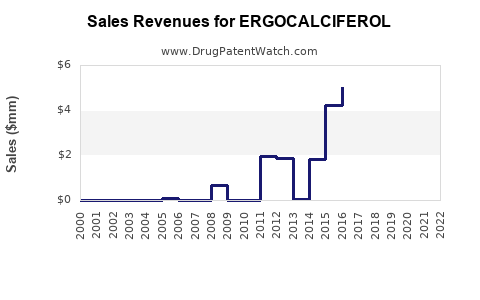
Last updated: June 28, 2026
Executive summary: Ergocalciferol (vitamin D2) is a mature, broadly genericized active ingredient with recurrent demand tied to nutrition, supplementation, and deficiency treatment. The financial trajectory is dominated by (1) low margin behavior driven by generic competition and commodity-like sourcing, (2) persistent regulatory and label updates across OTC and prescription segments, and (3) product-formulation and dosage-form differentiation (drops, tablets, capsules, injectable equivalents in some markets). Patent-driven upside is limited versus patent-protected novel vitamin D analogs; investment returns skew toward channel control, supply reliability, and lifecycle management rather than exclusivity capture.
What is the market size and demand drivers for ergocalciferol (vitamin D2) in 2024-2029?
Answer: Demand is stable-to-growing in line with vitamin D deficiency prevalence, aging demographics, and guideline-based supplementation. Growth is also supported by nonprescription consumption and chronic-care prescribing. Pricing generally trends downward in mature markets due to generics and OTC competition.
Key demand drivers
- Deficiency screening and guideline adherence: Vitamin D testing and supplementation remain standard components of deficiency management in multiple regions.
- Aging populations: Increased risk of low vitamin D levels drives higher supplementation rates.
- Comorbidity correlations: Observed prescribing linkages with osteoporosis risk management and musculoskeletal health.
- OTC consumption and caregiver purchasing: Over-the-counter vitamin D products keep baseline volume even when prescription channels soften.
Segment split that affects revenue
- OTC supplements: Typically volume-led, price-sensitive, and highly competitive at the SKU level.
- Prescription products: More durable demand but constrained by substitution to generics and therapeutically equivalent vitamin D2 products.
- Clinical-use formulations: Injectable or high-dose regimens exist in some geographies, but market share is highly dependent on local formulary dynamics.
Where growth is most likely
- Emerging markets: Higher baseline prevalence of deficiency plus less saturated distribution can support incremental volume.
- Healthcare system formularies: Where dosing regimens align with national protocols.
How do pricing and gross margin dynamics work for ergocalciferol vs other vitamin D products?
Answer: Ergocalciferol pricing is shaped by commodity-like supply and intense generic competition. Gross margins are usually limited unless a company owns differentiating distribution, packaging, or a locally protected specialty presentation.
Competitive pricing forces
- Generic substitution: Multiple marketed equivalents compress price across both OTC and prescription channels.
- Ingredient sourcing: Vitamin D2 is sourced from bulk intermediates and fermentation or extraction chains depending on supplier models. Supplier switching reduces leverage.
- Channel pressure: Pharmacy reimbursement and OTC retailers drive promotional pricing and private label penetration.
Relative position vs vitamin D3 (cholecalciferol)
- Vitamin D3 products often win on perceived potency and preference in some markets, creating mix headwinds for vitamin D2 unless dosing protocols specify D2.
- Ergocalciferol retains use where D2-specific regimens remain entrenched (especially high-dose schedules in certain guideline frameworks and clinician preferences).
What is the competitive landscape for ergocalciferol: who sells it and what are the share drivers?
Answer: The competitive field is dominated by established generics companies and OTC brands, with share driven by distribution coverage, retailer access, pharmacy contracting, and SKU-level differentiation.
Typical competitor archetypes
- Bulk generics and contract manufacturers: Supply multiple branded and private-label products.
- Global OTC vitamin brands: Compete on dosing formats and brand trust.
- Regional prescription suppliers: Hold formulary positions and manage tender cycles.
Share drivers
- Form factor: Softgels, tablets, capsules, drops, and high-dose concentrates influence willingness to purchase and adherence.
- Dose strength and convenience: Once-weekly or once-monthly regimens can improve compliance and retention within clinical protocols.
- Regulatory labeling: Claims, strength expression (IU vs mcg), and directions influence conversion from physician advice to patient purchase.
How does ergocalciferol’s exclusivity and patent estate compare to vitamin D analogs?
Answer: Ergocalciferol is a known, broadly generic active ingredient. Patent estate value is typically limited to formulation, manufacturing process, packaging, or method-of-use life cycles in specific markets rather than broad compound exclusivity.
Practical impact on financial trajectory
- Low pricing power: Without strong exclusivity, revenue growth depends on volume expansion and conversion rather than premium pricing.
- Short competitive cycles: When a manufacturer can launch an equivalent quickly through standard pathways, revenue retention becomes fragile.
Patent estate realities for a commodity API
- The main monetization routes tend to be:
- Dosing regimen IP (where enforced in a limited jurisdiction and tied to label).
- Manufacturing process improvements for cost or yield.
- Formulation and stability improvements that improve shelf life and patient experience.
When does ergocalciferol lose exclusivity and what is the likely generic entry risk?
Answer: For most marketed ergocalciferol presentations, exclusivity is effectively exhausted at the product level, and the dominant risk for revenue is ongoing substitution pressure rather than a discrete “end of exclusivity” event.
Generic entry pattern
- OTC and prescription equivalents: New entrants can often rely on bioequivalence and regulatory equivalency for standard vitamin D products.
- SKU-specific switching: Even where branded SKUs exist, they face competitive replacement through private label or lower-priced generics.
Revenue sensitivity to generic entry
- High sensitivity in packaged prescription products: Tender and formulary switching can rapidly reduce share.
- Lower sensitivity in physician-led high-retention regimens: But still constrained by substitution rules and patient price sensitivity.
What is the FDA regulatory status of ergocalciferol and how does it affect market access?
Answer: In the US, ergocalciferol is regulated as a vitamin active ingredient. Market access depends on whether products are marketed as dietary supplements or drug products under the relevant FDA framework.
Regulatory pathways and implications
- OTC / dietary supplements: Driven by DSHEA framework for supplements, with claims constraints. Competitive intensity is high because standards support broad market participation.
- Drug products: If marketed as a drug, the approval pathway typically involves NDA or ANDA for generic forms depending on the specific product history and labeling.
- Labeling and strength compliance: Conversion of mcg and IU labeling, dosing directions, and excipient listing influence marketability and retailer acceptance.
Manufacturing and quality
- Vitamin D product quality is sensitive to:
- Potency specification
- Stability
- Content uniformity
- Analytical method validation
These issues affect batch release timelines and supply continuity, which can override price competition at the margin.
Orange Book status of ergocalciferol: what listings typically exist and why does it matter?
Answer: Most ergocalciferol products in the US are not associated with long-lived, high-value patents. Orange Book listings, where present, tend to be formulation- or product-specific and often expire without preventing generic substitution in practice.
How Orange Book status changes financial outcomes
- Fewer enforceable barriers: Limits ability to sustain premium pricing.
- Regulatory and litigation “tail” is short: Even when patents exist, generic entry tends to proceed via non-infringing presentations or design-arounds.
What formulations are protected for ergocalciferol and what does that protection typically cover?
Answer: When IP exists, it often covers:
- Specific dosage forms (capsules, tablets, drops, injectables where applicable)
- Stability and formulation improvements
- Manufacturing/process conditions
- Packaging for dose accuracy and shelf life
Typical “protected around the edges” categories
- Excipients and dissolution profiles that reduce variability.
- High-concentration formulations with improved stability.
- Multi-dose packaging and tamper-evidence that improves retail acceptance.
Business implication
Protection rarely blocks alternative equivalents for long. It more often affects:
- product launch sequencing,
- cost and yield,
- retailer shelf placement through supply reliability.
What method-of-use or dosing-regimen IP exists for ergocalciferol and how enforceable is it?
Answer: Method-of-use protection for vitamin D has historically been limited by prior art and by the fact that standard deficiency treatment and supplementation protocols are widely described in clinical literature.
Where method-of-use claims can still matter
- Specific therapeutic regimens tied to label language in certain jurisdictions.
- Combination uses (ergocalciferol in fixed combinations with calcium or other agents), if those combinations have protectable features.
Enforceability constraints
- Broad clinical knowledge of vitamin D deficiency treatment reduces novelty and claim scope.
- Even with IP, practical litigation risk must justify time and cost against low-margin products.
What ergocalciferol patent litigation and Paragraph IV challenges occur, and what do they signal for investors?
Answer: For vitamin D2 products, litigation and Paragraph IV challenges, when they occur, usually reflect incremental formulation or product presentation disputes rather than compound-level battles.
Financial signal
- If litigation activity is low: Market behaves as a commodity, with returns governed by volume and cost discipline.
- If litigation activity increases: It tends to be tied to specific presentations or label language, which can create short-term pricing lifts only for the protected SKU.
What settlement patterns typically reduce long-term financial upside for ergocalciferol?
Answer: Settlements for mature generics typically lead to:
- delayed launches for specific SKUs,
- then rapid reversion to price competition after the settlement end date.
Where settlements show up
- formulation SKUs with narrower market coverage,
- timing-based shelf stability or product configuration disputes.
Investor implication
Settlement-driven delay creates temporary revenue protection but rarely sustains multi-year premium margins for an API as established as ergocalciferol.
How does ergocalciferol manufacturing cost and supply chain affect revenue stability?
Answer: Revenue stability depends heavily on ingredient availability, manufacturing yield, potency testing turnaround, and distribution continuity.
Main cost levers
- Bulk raw material sourcing and supplier diversification
- Yield and cost of goods (COGS) for conversion to final dosage forms
- Quality system cost (stability testing, analytical method validation)
- Packaging and labeling compliance costs
- Freight and cold-chain needs: Generally less burdensome than biologics, but lead times can still be material in tight supplier markets.
Supply-driven market share
When supply constrains, volume shifts quickly to available SKUs. Companies with reliable manufacturing and fast batch release can gain share even without premium pricing.
What is the expected financial trajectory for ergocalciferol products in major markets (US/EU/UK/Asia)?
Answer: The overall trajectory is stable revenue with declining or flat ASPs in price-competitive segments, plus modest growth in volume where dosing protocols and supplementation patterns support increased use.
US
- OTC and generic prescription pressure: Typically keeps pricing low.
- Growth via compliance and retailer distribution: SKUs that win shelf placement and maintain supply consistency can protect unit volumes.
EU and UK
- Tender-based pharmacy procurement: Strongly impacts prescription pricing.
- Supplement category competitiveness: Brand and retailer dynamics matter more than IP.
Asia
- Higher deficiency prevalence: Supports volume growth potential.
- Regulatory and distribution maturity variance: Can create pockets of higher pricing before full generic saturation.
How does ergocalciferol compare financially with branded vitamin D3 and with calcifediol or calcitriol products?
Answer: Ergocalciferol typically underperforms financially against branded vitamin D3 or more specialized vitamin D products where prescribers perceive different pharmacokinetics or where products face fewer substitution constraints.
Comparison matrix (directional financial impact)
| Product class |
Typical substitution barrier |
Pricing power |
Revenue trajectory |
| Ergocalciferol (vitamin D2) |
High (broad generic availability) |
Low |
Flat to modest volume-led growth |
| Cholecalciferol (vitamin D3) |
Medium to high (market-specific preferences) |
Low to medium |
Often stronger mix position |
| Calcifediol |
Medium |
Medium |
More resilient pricing vs D2 in some systems |
| Calcitriol/active analogs |
Medium |
Medium to high |
Higher value but smaller patient pool |
What revenue exposure does ergocalciferol face from retailer private label and pharmacy contracting?
Answer: High exposure. As vitamin D is commonly sold as a repeat-purchase product, private label and contracting can rapidly pressure margins, forcing manufacturers to compete on COGS and supply reliability.
Mechanisms
- Private label: Retailers capture margin by offering lower price points with acceptable potency and tolerability.
- Contract pharmacy substitution: Lower-cost equivalents win under formulary and reimbursement dynamics.
- Promotion cycles: Discounting compresses quarterly profitability.
Key Takeaways
- Ergocalciferol is a mature, commodity-like vitamin active ingredient where revenue is driven primarily by volume, channel access, and supply reliability.
- Pricing and margins face structural pressure from extensive generic and OTC competition.
- IP upside is typically limited to SKU-level formulation, manufacturing, or stability improvements, which rarely prevent long-term substitution.
- The financial trajectory is best characterized as stable revenue with constrained ASP growth, plus modest growth potential in markets or channels with less saturation or stronger guideline-driven supplementation.
- The dominant risk is not “loss of exclusivity” at a single date, but ongoing substitution enabled by regulatory equivalency and contracting.
FAQs
1) What differentiates ergocalciferol revenue performance from other supplements when OTC competition is high?
Differentiation comes from dose convenience, retailer penetration, and supply continuity rather than patent protection.
2) Do injectable or high-dose ergocalciferol products behave differently commercially than oral drops/tablets?
Yes. Injectable/high-dose products can be more formulary and procurement dependent, creating episodic pricing swings tied to tender cycles.
3) Can manufacturing scale and yield improvements materially change ergocalciferol profit margins?
Yes. In commodity vitamin products, small COGS changes can translate into meaningful margin impact because ASPs are compressed.
4) How do guideline updates on vitamin D deficiency alter demand for ergocalciferol?
Guideline changes affect testing and dosing behaviors, shifting volume across vitamin D2 vs vitamin D3 depending on label-preferred regimens in local practice.
5) What litigation or exclusivity events would most likely impact an ergocalciferol business case?
SKU-level disputes that delay a specific presentation’s generic entry can matter short term, but long-term value is typically limited by broad substitutability.
References
- FDA. Orange Book: Approved Drug Products with Therapeutic Equivalence Evaluations. U.S. Food and Drug Administration.
- FDA. Dietary Supplements. U.S. Food and Drug Administration.
- EMA. Guidelines and regulatory framework for medicinal products and active substances (context for generic substitution and manufacturing standards). European Medicines Agency.