Share This Page
DIFLUPREDNATE - Generic Drug Details
✉ Email this page to a colleague
What are the generic drug sources for difluprednate and what is the scope of patent protection?
Difluprednate
is the generic ingredient in two branded drugs marketed by Alembic, Amneal, Caplin, Cipla, Dr Reddys, Epic Pharma Llc, Mylan Labs Ltd, Upsher Smith Labs, and Sandoz, and is included in nine NDAs. Additional information is available in the individual branded drug profile pages.Ten suppliers are listed for this compound.
Summary for DIFLUPREDNATE
| US Patents: | 0 |
| Tradenames: | 2 |
| Applicants: | 9 |
| NDAs: | 9 |
| Drug Master File Entries: | 4 |
| Finished Product Suppliers / Packagers: | 10 |
| Raw Ingredient (Bulk) Api Vendors: | 68 |
| Clinical Trials: | 23 |
| Patent Applications: | 7,719 |
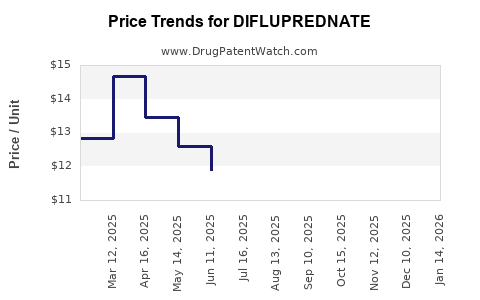
| Drug Prices: | Drug price trends for DIFLUPREDNATE |
| Patent Litigation and PTAB cases: | See patent lawsuits and PTAB cases for DIFLUPREDNATE |
| What excipients (inactive ingredients) are in DIFLUPREDNATE? | DIFLUPREDNATE excipients list |
| DailyMed Link: | DIFLUPREDNATE at DailyMed |
Recent Clinical Trials for DIFLUPREDNATE
Identify potential brand extensions & 505(b)(2) entrants
| Sponsor | Phase |
|---|---|
| Stanford University | PHASE3 |
| Federal University of São Paulo | PHASE3 |
| University of California, San Francisco | PHASE3 |
Anatomical Therapeutic Chemical (ATC) Classes for DIFLUPREDNATE
Paragraph IV (Patent) Challenges for DIFLUPREDNATE
| Tradename | Dosage | Ingredient | Strength | NDA | ANDAs Submitted | Submissiondate |
|---|---|---|---|---|---|---|
| DUREZOL | Ophthalmic Emulsion | difluprednate | 0.05% | 022212 | 1 | 2014-05-01 |
US Patents and Regulatory Information for DIFLUPREDNATE
| Applicant | Tradename | Generic Name | Dosage | NDA | Approval Date | TE | Type | RLD | RS | Patent No. | Patent Expiration | Product | Substance | Delist Req. | Exclusivity Expiration |
|---|---|---|---|---|---|---|---|---|---|---|---|---|---|---|---|
| Sandoz | DUREZOL | difluprednate | EMULSION;OPHTHALMIC | 022212-001 | Jun 23, 2008 | AB | RX | Yes | Yes | ⤷ Start Trial | ⤷ Start Trial | ⤷ Start Trial | |||
| Cipla | DIFLUPREDNATE | difluprednate | EMULSION;OPHTHALMIC | 211776-001 | Aug 9, 2021 | AB | RX | No | No | ⤷ Start Trial | ⤷ Start Trial | ⤷ Start Trial | |||
| Mylan Labs Ltd | DIFLUPREDNATE | difluprednate | EMULSION;OPHTHALMIC | 212566-001 | Mar 20, 2025 | AB | RX | No | No | ⤷ Start Trial | ⤷ Start Trial | ⤷ Start Trial | |||
| Amneal | DIFLUPREDNATE | difluprednate | EMULSION;OPHTHALMIC | 211526-001 | Nov 17, 2021 | AB | RX | No | No | ⤷ Start Trial | ⤷ Start Trial | ⤷ Start Trial | |||
| >Applicant | >Tradename | >Generic Name | >Dosage | >NDA | >Approval Date | >TE | >Type | >RLD | >RS | >Patent No. | >Patent Expiration | >Product | >Substance | >Delist Req. | >Exclusivity Expiration |
Difluprednate Market Dynamics, Patent Exclusivity, Generic Competition, and Financial Trajectory
Difluprednate is a mature ophthalmic corticosteroid marketed primarily as Durezol 0.05% ophthalmic emulsion. FDA approval came in 2008 for postoperative ocular inflammation and pain. The product’s commercial protection has largely expired, and generic difluprednate has shifted the market from branded exclusivity to price, formulary access, distributor reach, and ophthalmology prescribing patterns.
Alcon remains associated with Durezol commercialization, but Alcon does not disclose Durezol revenue separately. Public financial data therefore support a directional assessment rather than a product-level revenue estimate. The main commercial risks are generic substitution, low unit volume relative to larger ophthalmic franchises, and competition from prednisolone acetate, loteprednol etabonate, and other postoperative steroid products.
What is difluprednate and how is it used?
Difluprednate is a topical ophthalmic corticosteroid formulated as a 0.05% emulsion. The branded product is Durezol. FDA labeling covers treatment of inflammation and pain associated with ocular surgery. The labeled regimen is generally one drop four times daily beginning 24 hours after surgery and continuing through the first two postoperative weeks, subject to physician direction. [1]
Difluprednate is a fluorinated corticosteroid and is generally considered more potent than prednisolone acetate on a drop-for-drop basis. Its emulsion formulation supports ocular delivery but also increases the importance of suspension or emulsion handling, bottle design, and preservative composition in generic competition.
What are the main clinical competitors?
| Product | Active ingredient | Typical role | Commercial position |
|---|---|---|---|
| Durezol and generic difluprednate | Difluprednate 0.05% | Postoperative inflammation and pain | Higher-potency branded and generic option |
| Pred Forte and generic prednisolone acetate | Prednisolone acetate 1% | Broad postoperative and inflammatory use | Established, low-cost incumbent |
| Lotemax and generic loteprednol etabonate | Loteprednol etabonate | Postoperative inflammation and ocular surface use | Steroid option with a lower perceived intraocular-pressure burden |
| Maxidex and generic dexamethasone | Dexamethasone | Ocular inflammation | Older, price-sensitive alternative |
| FML and generic fluorometholone | Fluorometholone | Mild-to-moderate ocular inflammation | Lower-potency alternative |
Difluprednate competes on potency, dosing convenience, and clinician preference. Generic prednisolone acetate remains a major pricing constraint because it is widely available and typically inexpensive.
When did difluprednate receive FDA approval?
The FDA approved Durezol ophthalmic emulsion 0.05% in 2008 under New Drug Application 022212. The sponsor and commercial development history involved Sirion Therapeutics, with Alcon commercializing the product. [1,2]
The FDA-approved indication is postoperative inflammation and pain. Difluprednate is also used in other inflammatory eye conditions in clinical practice, including anterior uveitis, but such use should be distinguished from the original labeled indication.
What is the FDA regulatory status of generic difluprednate?
Generic difluprednate ophthalmic emulsion 0.05% has entered the U.S. market through abbreviated new drug applications. Generic approval depends on demonstrating pharmaceutical equivalence and bioequivalence to the reference product, together with compliance with applicable manufacturing and quality requirements. [3]
The regulatory pathway is commercially meaningful because ophthalmic emulsions can present greater formulation and equivalence challenges than simple ophthalmic solutions. Generic manufacturers must control particle or droplet characteristics, viscosity, pH, preservative performance, container compatibility, and dose delivery.
What patents protect Durezol and difluprednate?
Historical Orange Book listings for Durezol included formulation-related patents associated with difluprednate ophthalmic emulsion. Public patent records identify U.S. Patent No. 5,807,929 and U.S. Patent No. 6,071,941 among patents associated with the product and its formulation technology. [4,5]
| Patent | General subject | Strategic relevance |
|---|---|---|
| U.S. Patent No. 5,807,929 | Difluprednate and ophthalmic pharmaceutical compositions | Historical composition and formulation protection |
| U.S. Patent No. 6,071,941 | Ophthalmic emulsion technology involving corticosteroid delivery | Historical formulation protection |
The relevant patent terms have expired or reached the end of their enforceable commercial life. The patent estate therefore does not provide the type of remaining exclusivity associated with a recently approved ophthalmic product.
Patent protection historically focused on the active ingredient and ophthalmic emulsion rather than a complex device or biologic manufacturing platform. That structure limited the long-term ability to block alternative generic products after core patent expiry.
What formulations are protected by difluprednate patents?
The protected technology centered on ophthalmic compositions containing difluprednate in an emulsion or related pharmaceutical vehicle. Relevant formulation parameters included:
- Difluprednate concentration.
- Oil and aqueous phases.
- Surfactant or emulsifying components.
- Preservative systems.
- Physical stability.
- Ocular delivery characteristics.
Formulation patents can delay generic entry when they remain enforceable and are listed in the Orange Book. For difluprednate, the commercial effect of those patents has diminished because the principal historical patent terms have expired.
What is the Orange Book status of Durezol?
Durezol was listed in the FDA Orange Book as the reference product for generic difluprednate ophthalmic emulsion 0.05%. The historical listed patents did not create a continuing barrier to generic competition after expiration. [4]
The Orange Book distinguishes between the reference listed drug, patent information, exclusivity, and therapeutic-equivalence ratings. Once applicable patents and regulatory exclusivity expire, approved ANDA products can receive an AB rating when the FDA determines that the generic is therapeutically equivalent to the reference product.
Does Durezol have remaining regulatory exclusivity?
No major regulatory exclusivity barrier remains associated with the original 2008 approval. Any initial new-drug exclusivity and pediatric exclusivity periods have ended. The market is therefore governed primarily by patent expiry, ANDA approvals, reimbursement, and brand retention.
When did difluprednate lose exclusivity?
Difluprednate lost meaningful U.S. market exclusivity as its historical formulation and composition patents expired and generic manufacturers obtained FDA approval. The commercial transition occurred after the end of the principal patent period rather than through a new indication or a major device-based extension.
Exact generic launch timing has varied by manufacturer and market channel. The important business conclusion is that Durezol no longer operates as a protected, single-source product in the United States.
What Paragraph IV challenges affected difluprednate?
Generic applicants commonly use Paragraph IV certifications when they assert that listed patents are invalid, unenforceable, or not infringed. Public FDA Orange Book records and ANDA litigation disclosures should be reviewed by applicant and docket because the existence, timing, and resolution of individual challenges can differ across manufacturers.
The difluprednate market has not developed the high-value, multi-defendant Paragraph IV litigation profile associated with blockbuster oral medicines. The principal commercial event has been the transition to generic availability after historical patent expiry.
Which companies are challenging the Durezol market?
Generic ophthalmic manufacturers and specialty pharmaceutical companies have competed with Durezol through ANDA approvals and commercial launches. The U.S. generic ophthalmology field has included companies such as Akorn, Amneal, Dr. Reddy’s Laboratories, Apotex, and other manufacturers across different products and periods. Product-specific marketing status changes frequently because ophthalmic companies may discontinue, transfer, or temporarily suspend products.
The competitive threat comes from approved generic difluprednate, not from biosimilars. Difluprednate is a small-molecule drug and does not require a biosimilar pathway.
Is there biosimilar risk for difluprednate?
No. Difluprednate is not a biologic. Its competitive pathway is generic substitution under the ANDA framework, not biosimilar approval under the Public Health Service Act.
How strong is the difluprednate patent estate?
The current patent estate is weak as a barrier to generic entry because the principal historical patents have expired and the product is a mature small-molecule ophthalmic medicine.
Patent-strength assessment
| Factor | Assessment | Commercial effect |
|---|---|---|
| Core active ingredient | Expired historical protection | Does not block generic entry |
| Ophthalmic emulsion formulation | Historical patents expired or commercially exhausted | Limited current exclusivity |
| Method-of-use patents | No widely recognized remaining Orange Book barrier | Limited ability to prevent substitution |
| Delivery device | No dominant proprietary device moat publicly associated with Durezol | Low barrier |
| Manufacturing complexity | Moderate for ophthalmic emulsions | Can affect quality and supply, but does not create durable exclusivity |
| Regulatory exclusivity | Expired | ANDA competition permitted |
| Litigation leverage | Limited compared with an active patent estate | Lower settlement value |
The remaining technical barrier is execution. Ophthalmic emulsions require reliable manufacturing, sterility assurance, container closure, and consistent dose delivery. Those requirements can reduce the number of commercially reliable suppliers, but they do not recreate patent exclusivity.
What patent litigation affects difluprednate?
Difluprednate has not generated a publicly prominent, continuing patent-litigation structure comparable with major pharmaceutical products facing multiple Paragraph IV defendants. Historical patent disputes, if any, were tied to generic entry and listed formulation patents. After patent expiry, the litigation value of the estate declined sharply.
For investors and licensing teams, the relevant issue is less ongoing infringement exposure than the absence of a durable patent-based defense against generic price erosion.
How has the financial trajectory of difluprednate changed?
Durezol’s financial trajectory follows a conventional mature ophthalmic lifecycle:
- Launch and physician adoption after the 2008 approval.
- Brand differentiation through potency and postoperative use.
- Inclusion in Alcon’s ophthalmic portfolio.
- Patent expiry and generic entry.
- Reduced brand pricing power and lower expected market share.
- Ongoing residual demand from prescribers, patients, and payers that favor the branded product.
Alcon reports sales by broader business categories and product franchises rather than disclosing a separate Durezol revenue line. As a result, Durezol-specific annual revenue, operating margin, and cash-flow contribution cannot be reliably extracted from public Alcon reporting. Alcon’s global business includes surgical, vision-care, and pharmaceutical products, but Durezol is not identified as a standalone material reporting segment. [6]
What is the revenue exposure from Durezol?
Durezol is unlikely to be a material driver of Alcon’s consolidated revenue. The product is a mature, single-ingredient ophthalmic steroid competing with low-cost generic alternatives. Its revenue exposure is more relevant at the product and ophthalmology-franchise level than at the consolidated-company level.
The main financial variables are:
- Generic penetration.
- Average selling price after substitution.
- Brand formulary status.
- Postoperative cataract and refractive-surgery volumes.
- Physician preference for higher-potency steroids.
- Supply continuity among generic manufacturers.
- Reimbursement differences across Medicare, commercial insurance, and cash-pay channels.
How does difluprednate compare with prednisolone acetate and loteprednol?
| Dimension | Difluprednate | Prednisolone acetate | Loteprednol |
|---|---|---|---|
| Potency perception | High | Established high-potency standard | Moderate-to-high |
| Formulation | Ophthalmic emulsion | Suspension | Suspension or gel, depending on product |
| Generic availability | Yes | Extensive | Yes |
| Price pressure | High after generic entry | Very high | High |
| Postoperative use | Strong | Strong | Strong |
| Ocular hypertension concern | Requires monitoring | Requires monitoring | Often positioned as having a lower risk profile, though monitoring remains necessary |
| Market differentiation | Potency and dosing profile | Familiarity and price | Safety positioning and formulation variety |
Difluprednate can retain use where physicians value potency or prefer the product’s dosing profile. Prednisolone acetate remains the strongest cost-based competitor. Loteprednol competes where clinicians prioritize steroid tolerability and ocular-surface considerations.
What generic launch scenarios exist for difluprednate?
Base case: continued generic price erosion
Multiple approved suppliers gradually reduce average selling prices. Durezol retains a smaller branded segment supported by physician familiarity, payer exceptions, and patients who remain on the branded product.
Upside case: constrained generic supply
Sterile ophthalmic manufacturing problems, recalls, or supplier exits reduce generic availability. Temporary shortages can increase brand demand and improve pricing, although such effects are usually short-lived.
Downside case: rapid substitution
Payers place generic difluprednate on preferred tiers and substitute generic prednisolone acetate where clinically acceptable. Durezol volume declines faster, and the product becomes a limited niche brand.
Stable niche case
Difluprednate maintains durable use in postoperative ophthalmology because some surgeons prefer its potency and administration profile. Generic products capture most volume, but the active ingredient remains commercially relevant.
What manufacturing and intellectual-property barriers remain?
The principal barriers are operational rather than patent-based:
- Sterile ophthalmic manufacturing capacity.
- Emulsion consistency.
- Container and dropper performance.
- Microbial control and preservative effectiveness.
- Stability through distribution.
- FDA inspection compliance.
- Reliable supply of active pharmaceutical ingredient and excipients.
These barriers can produce temporary supply advantages for established manufacturers. They do not support a durable premium unless tied to a protected formulation, device, or regulatory exclusivity period.
What is the geographic coverage of difluprednate protection?
The United States is the most commercially important patent and regulatory market for Durezol because the product received FDA approval and generated a branded U.S. market. Patent protection in Europe, Japan, and other jurisdictions depended on separate national or regional filings and local patent terms.
Global commercial protection is therefore not uniform. Patent expiry, generic approval, reimbursement, and product availability must be assessed country by country. A U.S. patent expiry does not itself determine the status of difluprednate in Canada, Europe, Japan, or emerging markets.
Key Takeaways
- Difluprednate is marketed primarily as Durezol 0.05% ophthalmic emulsion.
- FDA approval was granted in 2008 for postoperative ocular inflammation and pain.
- Historical Durezol patents included U.S. Patent Nos. 5,807,929 and 6,071,941.
- Core patent and regulatory exclusivity has expired, allowing generic competition.
- Difluprednate is a small molecule and faces generic, not biosimilar, competition.
- Alcon does not publicly report Durezol revenue as a standalone line item.
- The product’s financial trajectory is consistent with mature ophthalmic brands: declining price power, lower branded share, and residual demand based on clinical preference.
- The strongest competitive threats are generic difluprednate, generic prednisolone acetate, and generic loteprednol.
- Current barriers are manufacturing and quality-control requirements, not a durable patent moat.
- Product-level revenue and current supplier shares cannot be inferred reliably from public company filings.
FAQs About Difluprednate Market and Exclusivity
Is Durezol still commercially protected?
No material original regulatory or patent exclusivity remains. Durezol competes with FDA-approved generic difluprednate products.
Is difluprednate stronger than prednisolone acetate?
Difluprednate is generally regarded as a high-potency ophthalmic corticosteroid and may provide strong anti-inflammatory activity. Product selection depends on the indication, ocular-pressure risk, physician preference, and payer economics.
Can a generic manufacturer launch difluprednate without a license from Alcon?
An ANDA applicant can seek FDA approval without a commercial license from Alcon, subject to patent certifications, applicable exclusivity, FDA requirements, and any enforceable litigation-related restrictions.
Does difluprednate have a new formulation opportunity?
Potential opportunities could involve preservative-free delivery, improved container systems, alternative concentrations, or differentiated postoperative packaging. Commercial value would depend on clinical differentiation and whether the formulation qualifies for enforceable intellectual-property or regulatory protection.
Why does Durezol retain demand after generic entry?
Residual demand can result from surgeon preference, perceived potency, prior patient response, formulary exceptions, supply interruptions affecting generics, and use in clinical settings where physicians prefer difluprednate over lower-cost steroid alternatives.
References
- U.S. Food and Drug Administration. (2008). Durezol (difluprednate ophthalmic emulsion) 0.05% prescribing information.
- Sirion Therapeutics, Inc. (2008). FDA approval announcement for Durezol ophthalmic emulsion.
- U.S. Food and Drug Administration. (n.d.). Approved drug products with therapeutic equivalence evaluations: Orange Book.
- U.S. Patent and Trademark Office. (1998). U.S. Patent No. 5,807,929: Ophthalmic pharmaceutical compositions.
- U.S. Patent and Trademark Office. (2000). U.S. Patent No. 6,071,941: Ophthalmic compositions.
- Alcon Inc. (2024). Annual report for the fiscal year ended December 31, 2023.
More… ↓
