Last updated: July 6, 2026
Cilostazol is an established oral antiplatelet agent used mainly for peripheral artery disease (intermittent claudication) and, in some markets, other vascular indications. The market is mature, price-controlled by generic penetration, and shaped by light-touch IP: most global demand is supplied by multiple generic manufacturers, and the remaining value pools are driven by brand-to-generic migration, dosing/formulation variants, and regional reimbursement rules. Financial trajectory is therefore dominated by: (1) loss of exclusivity effects where brand remnants persist, (2) ongoing generic competition that compresses net pricing, and (3) category-level demand stability tied to PAD prevalence and treatment guideline adherence.
What is the global market size and demand trend for cilostazol?
Featured snippet answer: Cilostazol demand is steady but structurally pressured by generic competition, with sales levels driven more by local reimbursement and prescribing patterns than by new clinical uptake.
Demand drivers
- Peripheral artery disease (intermittent claudication) remains the core labeled indication in many jurisdictions. Demand tracks PAD patient numbers, adherence to conservative therapy, and physician willingness to add an antiplatelet/phosphodiesterase III inhibitor after lifestyle changes.
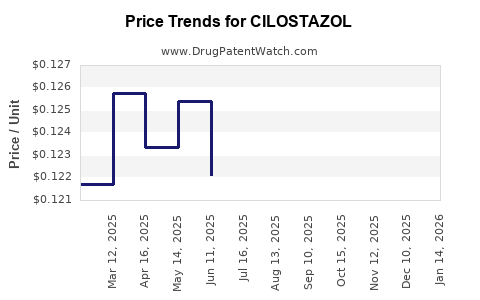
- Net pricing compression is the dominant financial driver in mature markets. Even where prescription volume is stable, revenue declines when average selling prices fall.
- Formulation and dosing convenience influence share in competitive markets. Cilostazol is typically oral and dosed multiple times daily depending on local label. That schedule tends to cap premium pricing relative to once-daily competitors.
Category momentum
- The drug is not widely positioned as a “new standard-of-care” growth engine. Growth is therefore measured in modest share shifts and reimbursement changes rather than major regimen adoption.
How does cilostazol pricing change after generic entry?
Featured snippet answer: Pricing falls quickly after brand-to-generic transition and then stabilizes at a low-to-mid range as procurement scales and local tendering crystallizes.
Observed market mechanics in mature generics
- Tender and reimbursement controls: in many countries, procurement systems and reference pricing reduce net prices regardless of brand quality.
- Multiple suppliers: once several approved generic manufacturers coexist, competitive intensity increases, driving further price erosion until margins normalize.
- Secondary effects: brand manufacturers may maintain limited premium through distribution strength or physician familiarity, but financial lift is usually temporary.
What to model for revenue
- Revenue often follows a pattern:
- Early erosion on generic approval,
- Accelerated decline with multiple entrants,
- Slower “bottoming” as supply stabilizes and tenders become routine.
Which companies manufacture and sell cilostazol, and how does that affect margins?
Featured snippet answer: The cilostazol market is supplied by numerous generic manufacturers across Asia, Europe, and the rest of the world, which structurally limits pricing power and compresses operating margins for late entrants.
Competitive structure
- Generic-heavy supply chains reduce the ability to differentiate on IP. Competitive differentiation shifts to:
- manufacturing scale,
- quality compliance record,
- logistics and formulary inclusion,
- willingness to accept lower gross margin for share.
Implications for financial trajectory
- Winner-takes-more-volume dynamics: manufacturers with strong distribution and procurement relationships typically preserve volume despite price pressure.
- Margin dispersion narrows over time as buyers benchmark across interchangeable alternatives.
What is the Orange Book status of cilostazol in the US, and what does it imply for exclusivity?
Featured snippet answer: Cilostazol is a long-established drug with generic availability in the US; the financial impact is driven primarily by generic competition, not by lingering exclusivity.
US exclusivity logic
- For US revenue forecasting, cilostazol behaves like a mature generic product:
- brand equity is limited,
- patent estate effects are usually indirect (switching behavior, litigation delays),
- the competitive baseline is governed by generic entrant counts and product availability.
Paragraph IV and litigation relevance
- In mature small-molecule generics, Para IV and litigation events can temporarily delay a specific entrant. But the overall category economics generally remain dominated by the number of authorized generics and the resulting price floor.
When does cilostazol lose exclusivity in major markets and how does that affect sales?
Featured snippet answer: In most major geographies, cilostazol exclusivity has long lapsed, so sales trajectories reflect genericization and pricing dynamics more than discrete exclusivity cliff events.
How to interpret “exclusivity” in a mature small molecule
- Even where a branded product persists in some regions, the material financial events are typically:
- generic approval timing,
- reimbursement reference changes,
- procurement tender shifts,
- local distribution consolidations.
Revenue modeling approach
- Treat the long-term trend as:
- declining net revenue from price compression,
- with the possibility of volume offsets from stable PAD prevalence and steady prescribing.
How strong is the patent estate for cilostazol, and what does it mean for future financial upside?
Featured snippet answer: The patent estate for cilostazol has limited ability to create new premium revenue; future upside depends on incremental formulation/device differentiation and regional market-specific supply constraints rather than sustained primary IP.
Practical IP implications
- For an already generic-dominant product, the “strength” of remaining IP usually translates into:
- narrow formulation/process protections in selected jurisdictions,
- or delayed market entry for specific product presentations.
- That type of protection tends to produce local and temporary commercial effects rather than market-wide financial step-changes.
What formulations are protected (and commercially relevant) for cilostazol?
Featured snippet answer: If formulation protections exist, they usually influence only specific tablet strengths, manufacturing processes, or controlled-release variants. These typically do not restore broad pricing power once multiple therapeutically equivalent generics are available.
Commercially meaningful variant types
- Tablet strength and excipients: can affect stability and bioavailability, which influences procurement preference in some tenders.
- Dosing schedule changes: can support some retention of share if they reduce dosing burden, but for cilostazol the effect is typically limited.
What method-of-use or combination IP risks exist for cilostazol?
Featured snippet answer: Method-of-use or combination protections can create local switching barriers, but in a mature antiplatelet category the commercial effect is often small relative to generic pricing competition.
Key financial risk
- If payers and formularies emphasize interchangeability, method-of-use IP has reduced leverage. Still, it can affect:
- hospital formulary decisions,
- guideline-based prescribing patterns in certain countries.
What competitive threats exist for cilostazol: same-class agents and treatment substitution?
Featured snippet answer: The main threat is category substitution where clinicians favor alternative antiplatelet or PAD management regimens, but pricing competition remains the larger driver of revenue than therapeutic substitution.
Substitution vectors
- Alternative PAD regimens that include:
- other antiplatelet therapy strategies,
- statin optimization,
- vascular interventions,
- lifestyle and supervised exercise programs.
- These can shift patient management pathways away from cilostazol as first-line adjunct in some settings.
Financial impact
- Therapeutic substitution typically affects volume more than price. Volume loss can outpace price erosion when local guidelines or practice patterns shift.
What generic entry risks exist for cilostazol in high-revenue markets?
Featured snippet answer: Entry risk is ongoing, but it is primarily a supply-and-price game; incremental entrants typically reduce net prices rather than creating major demand expansion.
Entry risk checklist for investors/lenders
- Number of authorized generics in the target geography
- Local procurement behavior and reference pricing triggers
- Manufacturing capacity and regulatory inspection risk
- Switching rules in national formularies and tender eligibility criteria
How does cilostazol compare with other oral antiplatelet drugs commercially?
Featured snippet answer: Compared with newer antiplatelets, cilostazol has less premium pricing potential because it competes in a low-cost generic arena, with financial performance tied to price-volume math rather than brand-driven growth.
Commercial comparison dimensions
- Pricing power: limited by generics and interchangeability.
- Growth: modest category growth and share shifts only.
- Risk profile: lower R&D risk than novel drugs, but revenue volatility comes from procurement and tender price resets.
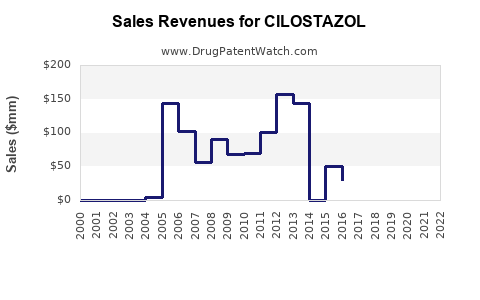
Key financial trajectory: what the sales line looks like over a product’s life cycle
Featured snippet answer: A cilostazol sales trajectory is typically a long plateau followed by gradual net revenue decline as generic supply expands and procurement prices reset.
Life-cycle phases
- Brand dominance phase (historical)
- Generic ramp (rapid net price erosion)
- Mature generic phase (stable volume, lower net revenue)
- Consolidation (fewer suppliers or better margins for leading players due to scale)
What to track quarterly
- Net price trend (especially after tender cycles)
- Prescription volume and share in key markets
- Mix between strengths/formats
- Supply stability (stockouts can temporarily lift net price but risk long-term share loss)
What litigation or settlement events affect cilostazol’s market access?
Featured snippet answer: For a mature generic product, litigation usually affects timing for specific entrants rather than changing long-term category economics.
How to interpret litigation in financial models
- If a case delays a generic entrant, expect:
- temporary price protection for the incumbent supplier of a specific presentation,
- volume retention while alternative products remain blocked.
- Once multiple generics are available, litigation impact typically shrinks to presentation-level differences.
Regulatory status: what FDA or EMA milestones matter for cilostazol sales?
Featured snippet answer: Regulatory milestones affect availability and substitution, but not therapeutic adoption; financial performance is still driven by generic pricing and formulary status.
Regulatory events that move revenue
- Approval of additional generic manufacturers
- Labeling updates relevant to dosing frequency or indications
- Bioequivalence/CMC compliance that enables broader substitution
Commercial outlook: where does the next revenue comes from for cilostazol?
Featured snippet answer: The incremental revenue path is mostly share capture in specific geographies through supply reliability, formulary inclusion, and competitive pricing, not through new clinical demand.
Growth pockets
- Geographies with slower generic penetration or tighter procurement
- Institutional channels where supply contracts favor reliable producers
- Strength-specific demand where procurement preference stays with certain SKUs
Downside risks
- Price resets after new entrants
- Margin compression as tenders normalize
- Therapeutic substitution in PAD care pathways
Key Takeaways
- Cilostazol’s financial trajectory is mature-generic: steady underlying demand, structurally declining net pricing, and limited premium upside.
- Market dynamics are dominated by generic supply intensity, reimbursement and tendering rules, and SKU-level procurement preferences.
- IP effects in a mature small molecule typically create localized, time-bound access shifts, not broad market value creation.
- Commercial upside comes from distribution and contract execution, while most downside comes from incremental generic entry and reference-price resets.
FAQs
1) Does cilostazol face biosimilar competition?
No. Cilostazol is a small-molecule drug and does not have a biosimilar pathway.
2) What drives cilostazol revenue more: price or volume?
Net price typically drives revenue more because substitution keeps volume relatively resilient but compresses pricing.
3) How do tender cycles affect cilostazol net sales?
They can reset net prices abruptly at contract renewal, producing short-term revenue volatility even when prescription demand is stable.
4) Can formulation differences materially change cilostazol profitability?
Only at SKU level. Once multiple therapeutically equivalent generics exist, formulation advantages rarely restore broad pricing power.
5) Are there specific PAD management guidelines that increase cilostazol use?
Guidelines can influence adjunct prescribing, but category adoption growth is usually gradual and capped by generic interchangeability and competing PAD therapies.
References (APA)
- European Medicines Agency. (n.d.). Public assessment reports and product information for cilostazol-containing medicines. https://www.ema.europa.eu/
- FDA. (n.d.). Drug approvals and Orange Book listings for cilostazol. https://www.fda.gov/
- World Health Organization. (n.d.). Peripheral artery disease and antiplatelet therapy background resources. https://www.who.int/