Last updated: September 7, 2026
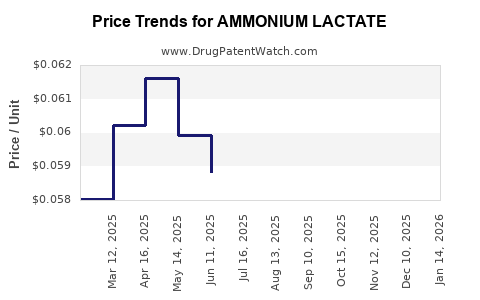
Ammonium lactate is a mature, low-cost topical dermatology ingredient with two commercial channels: prescription generic products, primarily 12% lotion or cream, and consumer-facing OTC moisturizers. The market has low patent protection, limited product differentiation, fragmented manufacturing and sustained price pressure. Revenue growth is more likely to come from branded OTC skincare, distribution expansion and premium formulations than from prescription volume.
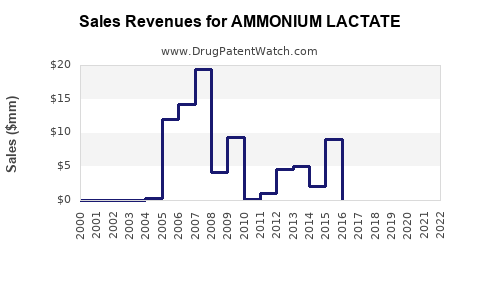
Product-level revenue is not separately reported by major public companies. Financial analysis therefore depends on market structure, product pricing, manufacturer participation, prescription trends and consumer skincare demand rather than audited ammonium lactate sales.
What is ammonium lactate used for?
Ammonium lactate is a topical alpha-hydroxy acid formulation used to treat xerosis, dry skin and ichthyosis vulgaris. Prescription products commonly contain 12% ammonium lactate in lotion or cream form. The active ingredient increases skin hydration and may reduce scaling through its keratolytic effect.
| Attribute |
Market profile |
| Active ingredient |
Ammonium lactate |
| Common strength |
12% |
| Primary dosage forms |
Lotion, cream |
| Main prescription uses |
Xerosis, ichthyosis vulgaris |
| Main consumer use |
Dry, rough or scaly skin |
| Therapeutic category |
Medical dermatology, emollient and keratolytic therapy |
| Delivery system |
Topical dermal application |
| Biologic status |
Not a biologic |
| Generic substitution |
High in prescription channels |
| Patent dependence |
Low |
The FDA-approved label for ammonium lactate lotion identifies xerosis and ichthyosis vulgaris as indications and warns that alpha-hydroxy-acid products can increase photosensitivity. Patients are advised to limit sun exposure and use sunscreen during treatment.[1]
How large is the ammonium lactate market?
The ammonium lactate market is a niche within the broader topical dermatology and moisturization markets. Published market reports often group ammonium lactate with urea, lactic acid, salicylic acid, ceramides and other keratolytic or emollient ingredients. Those reports do not provide a consistent, auditable global figure for ammonium lactate alone.
The commercial market has three revenue pools:
- Prescription generic lotion and cream.
- OTC or consumer-branded ammonium lactate moisturizers.
- Institutional and dermatology distribution, including pharmacies, clinics and long-term-care channels.
Prescription products have lower prices and high substitution. Consumer products can command higher gross margins when sold under recognizable brands, with premium packaging, larger sizes, fragrance-free positioning or claims directed at rough and bumpy skin.
The most relevant demand drivers are:
- Rising diagnosis and treatment of chronic dry-skin conditions.
- Growth in dermatology and self-care spending.
- Aging populations with xerosis and ichthyosis-related symptoms.
- Consumer demand for exfoliating moisturizers.
- E-commerce distribution.
- Expansion of private-label and retailer skincare products.
The main constraints are weak clinical differentiation, inexpensive substitutes and limited physician dependence on a particular manufacturer.
What companies manufacture and sell ammonium lactate?
The supply base includes generic prescription manufacturers, contract manufacturers, private-label suppliers and consumer skincare companies. FDA labeling records and DailyMed listings identify multiple ammonium lactate 12% products, including products supplied under generic labels and products marketed through established dermatology or consumer-health channels.[2]
The competitive structure is fragmented:
| Supplier type |
Commercial position |
Pricing power |
| Generic prescription manufacturer |
12% lotion or cream, pharmacy distribution |
Low |
| Consumer skincare brand |
Branded lotion, cream or body-care product |
Moderate |
| Private-label retailer |
Retail and online channels |
Low to moderate |
| Contract manufacturer |
Formulation and filling for third parties |
Low |
| Specialty dermatology supplier |
Physician and specialty-pharmacy distribution |
Moderate in narrow channels |
Known participants in the broader generic topical market include Perrigo and Taro Pharmaceuticals, alongside other ANDA holders and contract manufacturers. Consumer ammonium lactate products may be sold under brand structures that differ from the prescription label sponsor. Ownership and commercialization arrangements should be assessed at the individual National Drug Code level because the same active ingredient can appear under multiple sponsors.
What is the FDA regulatory status of ammonium lactate?
Ammonium lactate 12% lotion and cream products have long-standing FDA-approved prescription labeling for xerosis and ichthyosis vulgaris. The original branded product, Lac-Hydrin, established the prescription market before generic competition expanded.
Consumer products containing ammonium lactate are marketed through a separate commercial pathway from prescription generic labels. Some are positioned as OTC drug products, while others emphasize cosmetic moisturization and skin-conditioning claims. The regulatory status depends on the specific label, claims, manufacturer and product listing.
The core regulatory risks are manageable but material:
- Manufacturing consistency in lotion and cream emulsions.
- Control of pH, viscosity and preservative systems.
- Stability of the finished formulation.
- Labeling compliance for photosensitivity and irritation warnings.
- Separation between cosmetic claims and therapeutic drug claims.
- State and federal requirements for establishment and product registration.
FDA’s drug-labeling and product-listing systems should be reviewed by product and NDC rather than by active ingredient alone.[2][3]
What is the Orange Book status of ammonium lactate?
Ammonium lactate does not have a commercially meaningful active patent barrier comparable with newer dermatology drugs. The relevant value lies in approved formulations, manufacturing know-how, brand recognition and distribution.
The Orange Book records approved drug products, patents and exclusivity periods. For mature ammonium lactate products, the principal commercial reality is generic availability rather than ongoing listed patent protection.[3]
| Exclusivity issue |
Ammonium lactate position |
| New chemical entity exclusivity |
Expired or not relevant to current products |
| Orphan-drug exclusivity |
Not applicable |
| Pediatric exclusivity |
No material current barrier identified |
| Active ingredient patent |
No meaningful current barrier |
| Formulation patent |
Limited commercial significance |
| Method-of-use patent |
No material current barrier |
| Generic substitution |
Established |
| Biosimilar pathway |
Not applicable |
The financial consequence is direct: manufacturers cannot rely on exclusivity to sustain premium prescription pricing. A new entrant generally competes through supply reliability, wholesaler access, contract economics and product-level differentiation.
When does ammonium lactate lose exclusivity?
Ammonium lactate lost practical market exclusivity years ago. The original prescription brand faced generic competition after the relevant regulatory and patent protections expired. Current products compete in a mature generic environment.
The product does not have a forward-looking loss-of-exclusivity event comparable with a branded small-molecule drug approaching patent expiry. The primary risk is continuing price erosion, not a single post-LOE revenue collapse.
What formulation patents protect ammonium lactate products?
Formulation protection is limited. A company may seek protection for:
- Lotion viscosity and spreadability.
- Preservative systems.
- Fragrance-free or low-irritancy compositions.
- Combination products with urea, ceramides or other moisturizers.
- Packaging that improves stability or dosing.
- Controlled-release or specialized delivery systems.
- Cosmetic compositions with improved sensory properties.
These features can create commercial differentiation, but they do not necessarily block a conventional ammonium lactate 12% generic. A competitor can often design around a narrow formulation claim while retaining the same active ingredient and therapeutic purpose.
The strongest practical barriers are process controls and scale. Manufacturing an emulsion with consistent texture, pH, microbial stability and shelf life can be more important than patent ownership.
Are there Paragraph IV challenges or generic litigation?
Ammonium lactate has no known current Paragraph IV litigation that materially changes the market outlook. Paragraph IV litigation is most relevant when an ANDA applicant challenges an unexpired listed patent. The mature ammonium lactate market has little apparent Orange Book patent value to support a sustained challenge.
Litigation risk can still arise from:
- Product liability claims involving irritation or photosensitivity.
- Trademark disputes involving brand names.
- False advertising claims over cosmetic or therapeutic benefits.
- Manufacturing and current good manufacturing practice issues.
- Distributor and supply agreements.
- Patent disputes over a newly developed combination formulation.
There is no meaningful biosimilar risk because ammonium lactate is a chemically defined small-molecule topical product, not a biologic.
How strong is the ammonium lactate patent estate?
The patent estate is weak for the conventional product and potentially stronger for differentiated combinations or delivery systems.
| Patent asset |
Strength for conventional ammonium lactate |
Commercial value |
| Basic composition of matter |
Very low |
Minimal |
| 12% lotion formulation |
Low |
Limited |
| Cream or lotion vehicle |
Low to moderate |
Product-specific |
| Combination with ceramides or urea |
Moderate |
Potentially meaningful |
| Packaging and dispensing |
Low |
Defensive |
| Manufacturing process |
Moderate if difficult to reproduce |
Operational value |
| New dermatology indication |
Low unless supported by strong clinical data |
Uncertain |
A company seeking durable value would need to build a broader platform around formulation, brand, clinical evidence or distribution. The active ingredient alone does not provide a strong moat.
What is the financial trajectory for ammonium lactate?
The financial trajectory is best described as stable to slowly declining in prescription value and potentially growing in consumer skincare.
Prescription channel
Prescription revenue is constrained by:
- Generic reimbursement pressure.
- Pharmacy substitution.
- Multiple approved suppliers.
- Low switching costs.
- Limited physician loyalty to a manufacturer.
- Retail and mail-order purchasing concentration.
Revenue can rise temporarily during shortages or manufacturer exits. Those gains are generally supply-driven and difficult to sustain.
OTC and consumer channel
Consumer products have better pricing potential. Revenue depends on:
- Brand awareness.
- Placement in mass retail, pharmacy and e-commerce.
- Product claims for rough, bumpy or dry skin.
- Package size and price architecture.
- Repeat purchase rates.
- Advertising and influencer marketing.
- Competition from lactic acid, urea, salicylic acid and ceramide products.
Consumer demand is more resilient when ammonium lactate is marketed as part of a daily body-care routine rather than only as a treatment for a diagnosed condition.
Margin outlook
Gross margins are likely to be higher in branded consumer products than in reimbursed prescription generics. Net margins remain sensitive to:
- Petroleum-derived and specialty excipient costs.
- Tubes, pumps and bottles.
- Contract filling costs.
- Retailer fees.
- Returns and chargebacks.
- Promotional spending.
- Regulatory compliance.
A manufacturer with an efficient emulsion platform can produce ammonium lactate at relatively low cost. The economic challenge is distribution and customer acquisition rather than active-ingredient scarcity.
What generic launch scenarios exist for ammonium lactate?
Three scenarios define the market:
Base case: mature price competition
Existing suppliers retain market share, prescription volume remains stable, and pricing declines gradually. Consumer sales offset some prescription weakness.
Downside case: accelerated generic erosion
Additional ANDA suppliers, wholesaler consolidation or payer pressure drives lower prices. Retail brands lose shelf space to private label and competing exfoliating moisturizers.
Upside case: consumer reformulation and channel expansion
A branded supplier grows through premium textures, fragrance-free products, larger e-commerce distribution or combinations with ceramides and urea. Revenue grows without requiring a new therapeutic indication.
A supply interruption can create short-term upside for remaining manufacturers, but the market’s low entry barriers make durable scarcity unlikely.
How does ammonium lactate compare with urea and lactic acid products?
| Factor |
Ammonium lactate |
Urea |
Lactic acid |
| Main role |
Moisturizer and keratolytic |
Humectant and keratolytic |
Exfoliating acid and moisturizer |
| Common strengths |
12% |
10% to 40% |
Multiple concentrations |
| Prescription use |
Xerosis, ichthyosis |
Xerosis, hyperkeratosis |
Dermatology and cosmetic |
| Consumer appeal |
Established but niche |
Strong in specialty skincare |
Strong in exfoliating skincare |
| Patent strength |
Low |
Low for standard products |
Low for standard products |
| Differentiation |
Texture, brand and combinations |
Concentration and vehicle |
Sensory profile and claims |
| Competitive threat |
Urea and ceramides |
Ammonium lactate and salicylic acid |
Glycolic acid and other AHAs |
Ammonium lactate is positioned between medical dermatology and consumer skincare. Urea products often compete more directly in severe dryness and hyperkeratosis, while lactic acid and glycolic acid products compete in cosmetic exfoliation.
What licensing deals affect ammonium lactate?
No major publicly disclosed licensing transaction appears to drive the current ammonium lactate market. Licensing value is more likely to arise from:
- Private-label manufacturing.
- Brand acquisition.
- Retail distribution agreements.
- Contract development and manufacturing.
- Combination formulations.
- Dermatology portfolio transactions.
The absence of a major licensing structure reinforces the market’s fragmented and product-level economics.
What geographic markets offer the strongest opportunity?
The United States has the clearest split between prescription generic products and branded consumer skincare. Europe and other developed markets have established emollient and keratolytic categories, but regulatory classification and reimbursement differ by country.
Geographic expansion depends on:
- Local approval or notification requirements.
- Whether the product is regulated as a medicine or cosmetic.
- Reimbursement of prescription dermatology products.
- Retail pharmacy penetration.
- E-commerce logistics.
- Local competition from urea and lactic acid products.
Emerging markets may offer volume growth, but price sensitivity and local manufacturing often reduce revenue per unit.
Key Takeaways
- Ammonium lactate is a mature topical dermatology ingredient, usually sold at 12% strength.
- The prescription market is generic, fragmented and price-sensitive.
- Consumer-branded products provide the strongest opportunity for margin and revenue growth.
- No material current patent, Paragraph IV or biosimilar barrier defines the market.
- Conventional formulation patents have limited exclusionary power.
- Manufacturing quality, emulsion technology, supply reliability and distribution are more important than active-ingredient ownership.
- Prescription revenue is likely to remain stable to declining, while consumer skincare revenue has greater growth potential.
- Public companies generally do not report ammonium lactate revenue separately, preventing a reliable product-level revenue forecast from public filings alone.
FAQs
Is ammonium lactate a profitable pharmaceutical product?
It can be profitable at scale, particularly in branded OTC skincare, but conventional prescription ammonium lactate has limited pricing power. Profit depends on manufacturing efficiency, channel mix and distribution.
Is ammonium lactate available as a generic drug?
Yes. Ammonium lactate 12% lotion and cream products are available from multiple generic suppliers, subject to product-specific FDA approval and market availability.
Does ammonium lactate have patent protection?
The conventional active ingredient and standard 12% topical formulation have little practical current patent protection. Narrow patents may apply to specific combinations, vehicles, packaging or manufacturing methods.
Is ammonium lactate the same as lactic acid?
No. Ammonium lactate is a salt formed from lactic acid and ammonium hydroxide. Both provide moisturizing or exfoliating effects, but their formulations, labeling and product positioning differ.
What products compete directly with ammonium lactate lotion?
Direct alternatives include urea lotions, lactic acid products, glycolic acid products, salicylic acid formulations and ceramide-based moisturizers. The closest medical competitors are urea and lactic acid products for xerosis and hyperkeratosis.
References
-
U.S. Food and Drug Administration. (n.d.). Ammonium lactate lotion, 12%: Prescribing information. FDA labeling database.
-
National Library of Medicine. (n.d.). DailyMed: Ammonium lactate lotion, 12%. DailyMed.
-
U.S. Food and Drug Administration. (n.d.). Approved drug products with therapeutic equivalence evaluations: Orange Book. FDA.