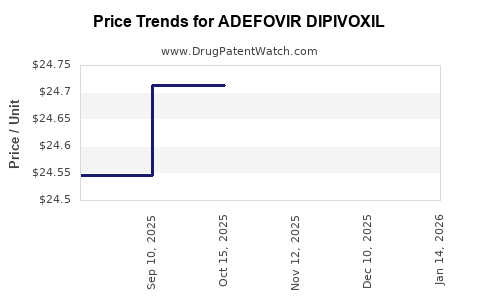
Last updated: September 7, 2026
Adefovir dipivoxil is a mature oral antiviral whose commercial value has largely collapsed. Gilead Sciences launched Hepsera in the United States in 2002 for chronic hepatitis B, but the drug lost strategic importance as tenofovir disoproxil fumarate, tenofovir alafenamide, and entecavir offered stronger viral suppression, higher resistance barriers, or better renal and bone safety profiles. Gilead no longer reports Hepsera as a material standalone revenue product. Generic competition and therapeutic substitution now define the market.
What is adefovir dipivoxil and how is it used?
Adefovir dipivoxil is an oral prodrug converted to adefovir, an acyclic nucleotide analogue that inhibits hepatitis B virus DNA polymerase. The U.S. product, Hepsera, contains 10 mg of adefovir dipivoxil and is administered once daily for chronic hepatitis B in adults and, in certain markets, pediatric patients [1].
The drug is not approved in the United States for HIV treatment. Higher-dose adefovir development for HIV was abandoned because of renal toxicity, while the 10-mg hepatitis B dose became the commercial product.
| Attribute |
Adefovir dipivoxil |
| Brand |
Hepsera |
| Active moiety |
Adefovir |
| Drug class |
Nucleotide reverse-transcriptase inhibitor |
| Primary indication |
Chronic hepatitis B |
| U.S. dosage form |
10-mg oral tablet |
| Original U.S. sponsor |
Gilead Sciences |
| FDA approval |
2002 |
| Current commercial position |
Mature, largely generic product |
| Biosimilar exposure |
None; this is a small-molecule drug |
Adefovir has activity against hepatitis B virus, including some strains resistant to lamivudine. Its commercial weakness is its relatively narrow therapeutic margin. Long-term treatment can produce proximal renal tubulopathy, increased serum creatinine, and reduced kidney function. These risks require renal monitoring and dose adjustment [1].
How large is the adefovir dipivoxil market?
The global market is now small relative to the hepatitis B antiviral market. Adefovir remains available in selected countries, especially where low-cost generic treatment is prioritized, but it has been displaced in major markets by newer agents.
The addressable hepatitis B market is much larger than the adefovir market. The World Health Organization estimated that approximately 254 million people were living with chronic hepatitis B in 2022, with substantial unmet treatment need [2]. That epidemiology supports continued demand for oral antivirals, but it does not translate into material growth for adefovir because treatment guidelines generally favor tenofovir or entecavir.
Regional market dynamics
Adefovir’s commercial status differs sharply by geography:
| Region |
Market position |
| United States |
Generic, low-volume, limited strategic relevance |
| European Union |
Mature product with declining use and country-specific availability |
| China |
Historically important in chronic hepatitis B, but increasingly displaced by tenofovir and entecavir |
| India |
Generic availability and price competition; use persists in selected patients |
| Southeast Asia |
Continued availability in some national markets, with use constrained by guideline preference |
| Lower-income markets |
Cost and supply can support residual demand |
In countries with constrained access to newer antivirals, adefovir may remain commercially viable at low prices. In higher-income markets, the product is generally a legacy option rather than a growth product.
What drove the decline in adefovir dipivoxil sales?
Adefovir’s decline resulted from clinical substitution rather than a collapse in hepatitis B prevalence.
The main factors were:
- Tenofovir disoproxil fumarate offered stronger antiviral potency and a higher resistance barrier.
- Entecavir became a preferred first-line therapy for many treatment-naive patients.
- Adefovir’s renal toxicity limited long-term use.
- Lamivudine-resistant patients increasingly moved to tenofovir-based regimens.
- Generic competition reduced price and product-level revenue.
- Updated treatment guidelines narrowed the population for which adefovir was clinically attractive.
The European Association for the Study of the Liver and the American Association for the Study of Liver Diseases generally identify tenofovir and entecavir as preferred high-potency agents with low resistance risk. Adefovir is not positioned as a leading first-line therapy in current treatment algorithms [3, 4].
How does adefovir compare with competing hepatitis B drugs?
| Drug |
Main commercial advantage |
Main limitation |
Current position |
| Adefovir dipivoxil |
Low-cost legacy option; activity against some resistant HBV |
Renal toxicity; weaker potency; lower resistance barrier |
Niche or fallback therapy |
| Tenofovir disoproxil fumarate |
High potency; high resistance barrier; broad availability |
Renal and bone safety concerns |
Major generic first-line product |
| Tenofovir alafenamide |
Improved renal and bone safety versus TDF |
Higher cost in some markets; access limitations |
Premium and guideline-supported option |
| Entecavir |
Potency and favorable tolerability |
Resistance risk after lamivudine exposure |
Major first-line product |
| Lamivudine |
Very low cost and simple administration |
High resistance rate |
Largely superseded |
The most important competitive threat was not a single generic entrant. It was the broader tenofovir franchise, including Gilead’s own Viread and later Vemlidy. Gilead’s portfolio transition shifted clinical and commercial attention away from Hepsera.
What was the financial trajectory of Hepsera?
Hepsera generated meaningful revenue during its early commercial years but entered structural decline soon after launch. Gilead’s annual reports identified Hepsera as a separate product during the period when chronic hepatitis B treatment was expanding and before tenofovir-based substitution became dominant [5-8].
The trajectory can be summarized in four phases:
| Period |
Financial phase |
Principal driver |
| 2002-2004 |
Rapid launch growth |
New oral chronic hepatitis B therapy and limited competition |
| 2005-2007 |
Peak or near-peak commercial period |
Broad prescribing before full tenofovir substitution |
| 2008-2012 |
Sustained decline |
Viread and entecavir displacement; renal safety concerns |
| 2013 onward |
Low-value legacy product |
Generic pressure, patent expiry, and limited guideline use |
Gilead’s public reporting later stopped treating Hepsera as a material driver of company revenue. That reporting treatment is itself a commercial signal: Hepsera became immaterial compared with products such as Sovaldi, Harvoni, Biktarvy, Vemlidy, and Truvada.
The financial model for adefovir is now based on unit volume, not pricing power. Revenue depends on:
- Continued generic prescriptions in countries where adefovir remains listed.
- Institutional procurement and tender pricing.
- Availability through local distributors.
- Use in patients with limited access to newer medicines.
- Residual demand where physicians continue legacy treatment.
There is no credible basis for expecting a return to branded peak sales. The product has no major clinical differentiation capable of supporting premium pricing.
When did adefovir dipivoxil lose exclusivity?
U.S. market exclusivity expired years ago, and generic entry removed the principal commercial protection for Hepsera. The FDA’s five-year new chemical entity exclusivity associated with the 2002 approval would have expired in 2007, subject to the precise regulatory qualification of the approved product and any pediatric or other extensions [9].
Patent protection lasted beyond regulatory exclusivity. The relevant Hepsera patent estate covered the active compound, prodrug chemistry, pharmaceutical compositions, and use in hepatitis B. The practical U.S. exclusivity period ended after the principal patent barriers expired and abbreviated new drug applications became commercially viable.
What is the Orange Book status of Hepsera?
Hepsera’s Orange Book relevance is historical rather than strategic. The product was listed with patent information during its protected commercial period, but the expiration of core exclusivity and the presence of approved generic alternatives mean that the Orange Book no longer provides a meaningful barrier to market entry.
For small-molecule products such as adefovir dipivoxil, the key Orange Book questions are:
- Whether a listed patent remains unexpired.
- Whether the patent covers the approved 10-mg product or only a narrower use.
- Whether an applicant must certify under Paragraph IV.
- Whether any 30-month stay or litigation-related delay remains relevant.
Those barriers are no longer material for ordinary U.S. entry into the adefovir dipivoxil market.
What patents protected adefovir dipivoxil?
The original patent strategy centered on the adefovir molecule and its dipivoxil prodrug, followed by formulation and therapeutic-use claims. The important commercial distinction is between compound patents and later, narrower patents.
| Patent category |
Commercial purpose |
Current effect |
| Adefovir compound claims |
Protect the active antiviral molecule |
Expired or commercially exhausted |
| Adefovir dipivoxil prodrug claims |
Improve oral delivery and bioavailability |
Expired or commercially exhausted |
| Pharmaceutical composition claims |
Cover tablet and excipient combinations |
Limited current blocking value |
| Method-of-use claims |
Cover treatment of chronic hepatitis B |
Narrow and difficult to enforce against ordinary prescribing |
| Manufacturing claims |
Cover synthesis or purification processes |
May remain relevant to specific suppliers, but not to the general market |
The patent estate was commercially effective during Hepsera’s launch period but is weak as a current strategic asset. Expired composition and compound claims cannot support premium pricing. Narrow process patents may affect individual manufacturers but do not recreate product-level exclusivity.
Were there Paragraph IV challenges to Hepsera?
Generic applicants could challenge Hepsera patents through Paragraph IV certifications under the Hatch-Waxman Act. The commercial significance of those challenges was greatest before core patent expiry, when a successful challenge could have produced an early generic launch.
The public record does not indicate a current, material Paragraph IV dispute capable of changing the market outlook. Any historical certification litigation is no longer a meaningful constraint on generic availability. The relevant market outcome is established generic access, not pending patent litigation.
What patent litigation affects adefovir dipivoxil today?
No active U.S. patent dispute appears to have material relevance to the product’s current revenue trajectory. The principal litigation risk has shifted from brand-versus-generic exclusivity disputes to ordinary commercial risks, including:
- Supplier interruptions.
- Manufacturing compliance.
- Local registration status.
- Tender exclusion.
- Substitution by tenofovir or entecavir.
- Product withdrawal in low-volume markets.
Does adefovir dipivoxil face biosimilar competition?
No. Adefovir dipivoxil is a chemically synthesized small molecule, not a biologic. It is subject to generic approval pathways, including ANDA procedures in the United States, rather than biosimilar approval under the Public Health Service Act.
The relevant competition is therefore:
- Generic adefovir dipivoxil tablets.
- Generic tenofovir disoproxil fumarate.
- Generic entecavir.
- Tenofovir alafenamide products.
- Country-specific combination or differentiated formulations.
A biosimilar framework does not create a separate risk category for adefovir.
What formulations are protected by adefovir patents?
The commercial product is an immediate-release 10-mg oral tablet. The principal formulation value was the oral dipivoxil prodrug, which improved delivery of adefovir compared with the parent compound.
No major extended-release, injectable, implantable, or long-acting adefovir formulation has created a significant second product cycle. This limits lifecycle-management potential. A formulation patent covering a specific excipient combination or manufacturing process would have limited value unless it delivered a clinically meaningful advantage, which the market has not demonstrated.
Are there licensing deals associated with adefovir dipivoxil?
Adefovir’s development involved intellectual-property rights originating outside Gilead’s own discovery platform, including rights associated with academic and public-sector research. Gilead commercialized Hepsera, but the product did not generate a durable licensing ecosystem comparable with major oncology, immunology, or biologics franchises.
The commercial importance of any historical license is now limited because:
- Core product exclusivity has expired.
- Generic manufacturers operate at low margins.
- Royalty economics are unlikely to materially affect the market.
- The product has no significant new indication pipeline.
What generic launch scenarios exist?
The likely launch scenarios are straightforward.
Base case: continued low-volume generic supply
Multiple suppliers maintain registration and sell adefovir at low prices. Volume declines gradually as physicians switch patients to tenofovir or entecavir.
Downside case: market exit
One or more suppliers discontinue the product because of low margins, procurement complexity, or regulatory costs. Availability becomes uneven, particularly in smaller markets.
Limited upside case: residual demand in price-sensitive markets
Adefovir retains a small role where generic pricing, local guidelines, or supply constraints favor an older therapy. This can support stable unit demand but not substantial revenue growth.
A new branded launch is unlikely to be commercially rational without a major safety, delivery, or combination-product improvement.
How strong is the current adefovir dipivoxil patent estate?
The current patent estate is weak from an investment or licensing perspective.
| Factor |
Assessment |
| Core compound protection |
Expired or no longer commercially effective |
| Product-level exclusivity |
Absent in major markets |
| Orange Book leverage |
Low |
| Paragraph IV exposure |
Historical rather than current |
| Formulation differentiation |
Limited |
| Manufacturing barriers |
Supplier-specific, not market-wide |
| Generic competition |
Established |
| Clinical differentiation |
Poor versus tenofovir and entecavir |
| Revenue growth potential |
Minimal |
| Licensing attractiveness |
Low unless bundled with regional rights or supply assets |
Adefovir may still have strategic value in a portfolio focused on emerging-market access, tender supply, or hepatitis B treatment packages. It has little standalone value as a protected pharmaceutical asset.
What is the FDA regulatory status of adefovir dipivoxil?
Hepsera received FDA approval for chronic hepatitis B in adults in 2002. The regulatory product remains a prescription oral antiviral, but current clinical positioning is constrained by safety and comparative efficacy considerations [1].
The FDA label emphasizes renal monitoring, dose adjustment in renal impairment, and risks associated with long-term nucleotide analogue therapy. These requirements reduce convenience and increase the clinical burden compared with products with more favorable renal profiles.
Regulatory value is therefore stable but limited. There is no obvious FDA-driven catalyst, such as a new indication, pediatric expansion, or novel formulation, likely to reverse the product’s commercial decline.
What revenue exposure remains for Gilead?
Gilead’s direct exposure is minimal. The company’s hepatitis B revenue is now associated primarily with newer products, particularly tenofovir-based therapies, rather than Hepsera. Hepsera does not represent a material portion of Gilead’s current consolidated revenue.
For generic manufacturers, exposure is also limited. Adefovir can provide incremental revenue in selected markets, but the product lacks the volume and pricing profile of high-demand generic antivirals such as tenofovir disoproxil fumarate or entecavir.
The main financial risk is product discontinuation rather than patent litigation. A supplier may retain the product for portfolio completeness, but low demand can make manufacturing and regulatory maintenance uneconomic.
Key Takeaways
- Adefovir dipivoxil is a mature chronic hepatitis B antiviral with minimal current commercial momentum.
- Hepsera launched in the United States in 2002 and generated meaningful early revenue before declining under pressure from tenofovir and entecavir.
- U.S. regulatory exclusivity and core patent protection have expired or lost practical market effect.
- Generic competition is established, and no material current Paragraph IV dispute changes the outlook.
- Adefovir is a small molecule, so biosimilar competition does not apply.
- Renal toxicity, lower potency, and guideline preference for newer agents limit demand.
- Residual value exists in price-sensitive and emerging markets, but the product has little standalone licensing or investment appeal.
- The most probable financial trajectory is continued low-volume generic sales followed by gradual market contraction.
FAQs
Is adefovir dipivoxil still prescribed?
Yes, but use is limited. It remains available in some markets for chronic hepatitis B, particularly where price or access constrains treatment choices. It is generally less favored than tenofovir or entecavir.
Is adefovir dipivoxil the same as tenofovir?
No. Both are nucleotide analogues, but they are different active substances. Tenofovir has stronger antiviral performance and a higher resistance barrier, which drove much of adefovir’s commercial decline.
Can a generic company still launch adefovir dipivoxil?
Yes. The principal U.S. exclusivity barriers have expired, and generic products have entered the market. Current launch feasibility depends mainly on manufacturing economics, regulatory maintenance, and expected volume.
Why did Gilead replace Hepsera with Viread and Vemlidy?
Tenofovir products provided a stronger commercial and clinical position. Vemlidy was developed to deliver tenofovir with improved renal and bone safety relative to tenofovir disoproxil fumarate, further reducing the rationale for continued Hepsera use.
Does adefovir dipivoxil have value in a hepatitis B licensing deal?
Only in narrow circumstances. Potential value could arise from regional distribution, low-cost manufacturing, or bundled access agreements. A standalone deal based on patent exclusivity or premium pricing has limited economic rationale.
References
-
U.S. Food and Drug Administration. (2022). Hepsera (adefovir dipivoxil) prescribing information. FDA.
-
World Health Organization. (2024). Global hepatitis report 2024. World Health Organization.
-
European Association for the Study of the Liver. (2017). EASL 2017 clinical practice guidelines on the management of hepatitis B virus infection. Journal of Hepatology, 67(2), 370-398.
-
Terrault, N. A., Lok, A. S. F., McMahon, B. J., Chang, K.-M., Hwang, J. P., Jonas, M. M., Brown, R. S., Jr., Bzowej, N. H., & Wong, J. B. (2018). Update on prevention, diagnosis, and treatment of chronic hepatitis B: AASLD 2018 hepatitis B guidance. Hepatology, 67(4), 1560-1599.
-
Gilead Sciences, Inc. (2004). 2003 annual report. Gilead Sciences.
-
Gilead Sciences, Inc. (2008). 2007 annual report. Gilead Sciences.
-
Gilead Sciences, Inc. (2010). 2009 annual report. Gilead Sciences.
-
Gilead Sciences, Inc. (2013). 2012 annual report. Gilead Sciences.
-
U.S. Food and Drug Administration. (2024). Approved drug products with therapeutic equivalence evaluations: Orange Book. FDA.