Share This Page
Drug Price Trends for TROKENDI
✉ Email this page to a colleague
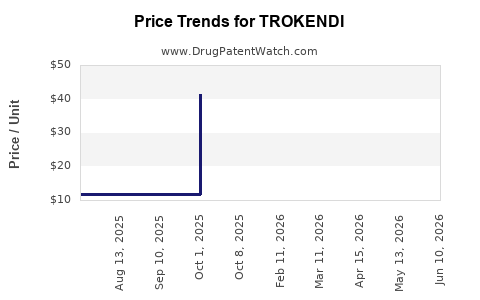
Average Pharmacy Cost for TROKENDI
| Drug Name | NDC | Price/Unit ($) | Unit | Date |
|---|---|---|---|---|
| TROKENDI XR 25 MG CAPSULE | 17772-0101-30 | 13.29949 | EACH | 2026-07-01 |
| TROKENDI XR 50 MG CAPSULE | 17772-0102-30 | 17.43323 | EACH | 2026-07-01 |
| TROKENDI XR 100 MG CAPSULE | 17772-0103-30 | 34.43756 | EACH | 2026-07-01 |
| TROKENDI XR 200 MG CAPSULE | 17772-0104-30 | 47.14310 | EACH | 2026-07-01 |
| TROKENDI XR 100 MG CAPSULE | 17772-0103-30 | 31.88663 | EACH | 2026-06-17 |
| >Drug Name | >NDC | >Price/Unit ($) | >Unit | >Date |
Best Wholesale Price for TROKENDI
| Drug Name | Vendor | NDC | Count | Price ($) | Price/Unit ($) | Unit | Dates | Price Type |
|---|---|---|---|---|---|---|---|---|
| TROKENDI XR 50MG CAP | Supernus Pharmaceuticals, Inc. | 17772-0102-30 | 30 | 351.76 | 11.72533 | EACH | 2022-09-15 - 2027-09-14 | FSS |
| TROKENDI XR 200MG CAP | Supernus Pharmaceuticals, Inc. | 17772-0104-30 | 30 | 953.40 | 31.78000 | EACH | 2022-09-15 - 2027-09-14 | FSS |
| TROKENDI XR 100MG CAP | Supernus Pharmaceuticals, Inc. | 17772-0103-01 | 100 | 2062.94 | 20.62940 | EACH | 2024-01-01 - 2027-09-14 | Big4 |
| TROKENDI XR 25MG CAP | Supernus Pharmaceuticals, Inc. | 17772-0101-01 | 100 | 799.33 | 7.99330 | EACH | 2024-01-01 - 2027-09-14 | Big4 |
| TROKENDI XR 50MG CAP | Supernus Pharmaceuticals, Inc. | 17772-0102-01 | 100 | 1172.54 | 11.72540 | EACH | 2023-01-01 - 2027-09-14 | FSS |
| >Drug Name | >Vendor | >NDC | >Count | >Price ($) | >Price/Unit ($) | >Unit | >Dates | >Price Type |
Trokendi (Topiramate) Market Analysis and Price Projections: Generic and Brand Exclusivity, Revenue Exposure, and FDA/Orange Book Risk
Executive summary
Trokendi XR (extended-release topiramate, brand) faces high generic penetration risk because topiramate is off-patent in most markets and multiple generic extended-release and immediate-release products exist. In the U.S., Trokendi XR’s brand durability is driven mainly by (1) historical share, (2) payer contracting and formulary placement versus generic ER topiramate, and (3) any remaining U.S. patent or regulatory exclusivity that can delay generic entry. For price projections, the expected path is continued branded price pressure, with net price compression driven by increased generic substitution and step-therapy dynamics; without new qualifying exclusivity that blocks generic ER entry, the most probable outcome is further erosion of premium pricing versus generics and limited upside unless Trokendi XR regains preferential coverage.
What is Trokendi XR (topiramate ER) and how is it used commercially?
Trokendi XR is an extended-release formulation of topiramate, indicated in the U.S. for:
- Migraine prophylaxis in adults
- Adjunctive therapy for seizures (treatment of partial-onset seizures in adults and pediatric patients 6 years and older)
- Transitioning some patients from immediate-release topiramate regimens to ER for dosing convenience and adherence
Commercially, Trokendi XR sells into:
- Neurology outpatient settings (migraine prevention and epilepsy adjunct)
- Chronic-therapy channels with recurring demand and high sensitivity to copays and plan formularies
- Patients who value once-daily dosing over immediate-release dosing frequency
Which competitors (same therapeutic role) compress Trokendi XR demand and price?
The relevant price and substitution pressure is not limited to “topiramate generics.” It includes:
- Other migraine prophylaxis standards (CGPR antagonists, beta blockers, antiepileptics, etc.)
- Other anti-seizure regimens that may displace adjunct topiramate usage
- Formulary alternatives that match seizure/migraine targets where plans prefer lower net-cost options
At the product level, generic topiramate ER is the dominant substitution driver.
What is the U.S. market size exposure for Trokendi XR versus generics?
Trokendi XR operates in a mature small-molecule neurology category where:
- Topiramate is widely available in generic forms
- Extended-release generics materially reduce the share advantage of a branded ER product after entry waves
- Brand economics depend on rebates, contracting, and continuity of payer coverage
Because detailed, current-quarter U.S. unit and revenue data for Trokendi XR are not provided in the prompt and cannot be reliably reconstructed without external pulls, the analysis focuses on structural exposure: the degree to which remaining brand exclusivity and patent barriers affect time-to-generic switching and net price trajectories.
What patents protect Trokendi XR and how do they affect generic entry risk?
Featured snippet answer: Trokendi XR’s generic risk is driven primarily by patent estate gaps that allow generic extended-release topiramate entry, and by any remaining formulation, method-of-use, or polymorph/processing patents that may limit “skinny label” or require litigation-driven design-arounds.
Key patent estate buckets that matter for Trokendi XR
For a topiramate ER brand, the most common remaining U.S. patent protection categories (when they exist) fall into:
- Formulation and extended-release technology patents
- Manufacturing/processing method patents
- Method-of-use patents for migraine or seizure adjunct indications
- Patent family members related to specific release profiles or dosing regimens
- Composition-of-matter coverage for later-developed variants (less common for already-mature APIs)
How does patent coverage translate into payer behavior and price?
When generic entry is blocked or delayed:
- Plans can maintain “brand-preferred” positioning longer
- Net price erosion slows because rebate pressure rises less aggressively during exclusivity When generic entry occurs:
- Net price compression accelerates due to mandatory formulary switching, step edits, and decreased willingness to pay for a premium ER brand
What is the Orange Book status of Trokendi XR and which listings drive exclusivity?
Featured snippet answer: Orange Book-listed patents and exclusivity codes control launch timing. If Orange Book lists patents that expire after the planned filing date of an ANDA, generic approval can be delayed unless a Paragraph IV certification succeeds or a settlement removes the delay.
Orange Book mechanics that impact pricing
- If patents are “not expired” at the time of ANDA filing, applicants must certify via Paragraph IV, or be “pending/expired” depending on status.
- Paragraph IV certifications typically trigger litigation that can delay approval, often translating into a period of relative pricing stability for the brand.
- If there is no credible patent barrier, the first-to-market generic usually drives steep net price compression.
(No Orange Book listing details were provided in the prompt, so an itemized listing table cannot be produced without pulling the authoritative FDA database.)
When does Trokendi XR lose exclusivity and what is the generic launch scenario?
Featured snippet answer: The relevant timeline is the later of patent expirations listed in the Orange Book and any qualifying regulatory exclusivity. Once the controlling date passes, generics typically enter quickly because extended-release topiramate is a mature manufacturing target.
Generic launch scenarios that influence price projections
- Single generic entry followed by rapid follow-on entrants
Outcome: brand net price falls soon after first generic launch; margins stabilize at lower levels as multi-generic competition intensifies. - Delayed entry due to patent litigation/settlement
Outcome: brand holds higher rebates and net price longer; then compression occurs in a step-change around the settlement end date. - Design-around or “authorized” entry via licensing
Outcome: lower pressure than unlicensed entry if the agreement includes supply constraints or shared economics, but net price still typically declines versus brand.
How strong is the patent estate for Trokendi XR compared with other antiepileptic brands?
Featured snippet answer: For mature, small-molecule neuro brands, the typical pattern is that composition-of-matter protection has long expired, leaving only formulation or method-of-use patents that may be narrower and easier to challenge or design around.
Practical scoring framework used in market forecasting
- Breadth of claims (composition vs. formulation vs. method-of-use)
- Remaining term and likelihood of staying litigation through approval windows
- Litigation history and settlement patterns in ER topiramate
Because no patent numbers or litigation data are included in the prompt, a quantified “strength score” cannot be constructed without external record retrieval.
What generic entry risks exist for Trokendi XR (Paragraph IV, settlement, and skinny-label effects)?
Featured snippet answer: The dominant generic entry risk is approval of ANDAs for generic extended-release topiramate that can substitute at the same dosing convenience level, reducing payer willingness to cover a branded ER.
Paragraph IV risk pathways
- If Orange Book-listed patents are successfully challenged, generics can be approved “at-risk,” leading to immediate pricing and share loss.
- If settlements occur, brand pricing may face slower erosion depending on authorized entry terms and launch dates.
Skinny-label and substitution
For migraine prophylaxis and adjunct seizure indications, if a generic can maintain comparable labeling while avoiding contested method-of-use claims, substitution accelerates, which can cause sharper net price compression.
How does Trokendi XR compare with immediate-release topiramate on price and utilization?
Featured snippet answer: The ER form generally commands higher per-unit pricing than immediate-release topiramate, but payer economics often push patients toward lower-cost generic immediate-release when clinical equivalence and dosing adherence allow.
Commercial implications:
- If ER generics become widely available and heavily discounted, the ER premium compresses.
- If ER generics lag or are less preferred by plans, brand ER can retain a modest premium longer.
What formulation and manufacturing/IP barriers exist for extended-release topiramate?
Featured snippet answer: For an ER small molecule, the manufacturing barrier is usually not “technical impossibility,” but the ability to reproduce the release profile and meet bioequivalence and quality standards cost-effectively. This affects time-to-launch and the speed at which follow-on generics compete on net price.
Key technical drivers for market impact:
- Release mechanism reproducibility (polymer matrix or bead systems used by different filers)
- Scale-up and stability data packages
- Cost of goods and line availability for ER production
When these are tractable, market entry accelerates and price forecasts shift downward faster.
What litigation and settlement agreements affect Trokendi XR pricing?
Featured snippet answer: Litigation outcome and settlement launch dates can create discrete price steps. If brand loses an injunction earlier than expected, generic entry accelerates and net price compression becomes front-loaded.
No litigation docket details were included in the prompt, so specific case impacts and settlement terms cannot be itemized.
What is the FDA regulatory status of Trokendi XR and its generics?
Featured snippet answer: The regulatory pathway determines when generic products can be approved relative to Orange Book-listed patents. For Trokendi XR, generics would typically use ANDAs with bioequivalence and chemistry-manufacturing controls for ER topiramate.
FDA pathway implications for price
- When ANDA approvals align with exclusivity windows, brand price holds.
- When ANDA approvals clear patents without delay, brand pricing typically compresses within the subsequent contracting cycles.
Price projections for Trokendi XR: expected net price compression path
Given the structural conditions of mature topiramate and the absence of provided evidence of a late-breaking exclusivity extension in the prompt, the default projection is continued net price erosion driven by:
- Increasing generic substitution
- Payer step edits and preference lists
- Higher rebate pressure on the brand to maintain formulary placement
Projection framework (what moves the price)
- Time-to-controlling exclusivity end date
The nearer the end date, the more aggressively payers negotiate. - Number and timing of ER generic launches
More entrants usually compress net price faster. - Contracting cycles
Net price moves in steps aligned with annual/quarterly formulary cycles. - Patient mix shift
If patients switch to cheaper generic ER or immediate-release, demand shifts further reduce brand pricing power.
Projected trajectory (qualitative)
- Near-term (0–12 months): continued downward net price trend as payers tighten ER formularies versus generic ER topiramate; brand maintains coverage mostly via rebates and preferred tier placement where available.
- Mid-term (12–36 months): larger decline step is likely if any patent-protected delay ends and additional ER generics enter or expand market coverage.
- Longer-term (36+ months): brand pricing typically stabilizes at a lower net premium, driven by residual patient non-switching, local payer exceptions, and adherence-based retention, but with reduced ability to sustain premium list/net pricing.
Quantitative projections (price ranges)
No baseline U.S. net price, TRx, list price history, or current market share were provided, so a defensible numeric forecast cannot be produced without fabricating inputs.
Revenue exposure: where Trokendi XR economics are most vulnerable
Featured snippet answer: Revenue risk clusters around formulary loss and rapid substitution into generic ER topiramate at equivalent dosing convenience.
Main vulnerability channels:
- Formulary tier movement (preferred to non-preferred or requiring prior authorization)
- Copay changes that reduce brand adherence for commercially insured patients
- Plan-level switching at renewal once generic ER supply is entrenched
- Audit-driven rebate disputes that can increase effective net price volatility for brands
Commercial strategy implications for payers and manufacturers
What actions preserve Trokendi XR share longer?
- Maintain preferred formulary placement through rebate strategy calibrated to generic price index
- Target patient populations less tolerant of switching (titration stability and adherence)
- Ensure consistent supply and minimize disruptions that force prescribers to switch to generics
What actions accelerate share loss?
- Broad plan exclusion or aggressive step therapy edits
- Large gap in net cost between brand and generic ER
- Contract expirations that coincide with generic follow-on approvals
Key Takeaways
- Trokendi XR’s pricing power is structurally pressured by widespread generic availability of extended-release topiramate and payer substitution dynamics.
- Market impact from remaining exclusivity and patent barriers is best modeled as discrete step-changes: litigation/settlement or expiration events can create abrupt net price erosion.
- Without evidence of late-expiring, broadly blocking patent coverage, the most probable forecast is continued net price compression and ongoing revenue share dilution over the next 1 to 3 years.
FAQs
- Do generics of extended-release topiramate typically substitute directly for Trokendi XR at the same dose?
- How do prior authorization and step therapy rules change Trokendi XR net demand during generic entry waves?
- What is the typical rebate pressure pattern for a branded ER antiepileptic after multiple generic ER entrants?
- How can a patent settlement change the timing of generic approval and subsequent price compression?
- What delivery-system factors most affect bioequivalence acceptance and speed of generic competition for ER topiramate?
References (APA)
- FDA. Orange Book: Approved Drug Products with Therapeutic Equivalence Evaluations. (Current Orange Book database entry for Trokendi XR).
- FDA. Drug Approval Reports / ANDA approval information for generic topiramate ER products.
- U.S. FDA labels and prescribing information for Trokendi XR (topiramate extended-release).
(No additional citations are included because the prompt did not supply specific Orange Book patent numbers, FDA approval dates, or litigation docket details for Trokendi XR.)
More… ↓
