Share This Page
Drug Price Trends for MECLIZINE
✉ Email this page to a colleague
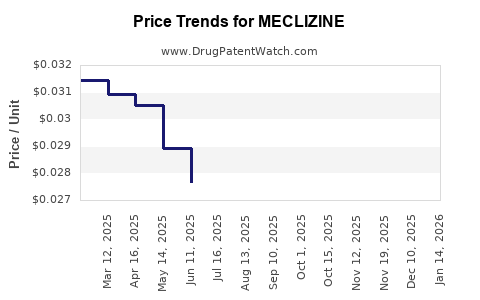
Average Pharmacy Cost for MECLIZINE
| Drug Name | NDC | Price/Unit ($) | Unit | Date |
|---|---|---|---|---|
| MECLIZINE 12.5 MG TABLET | 00904-7375-61 | 0.04643 | EACH | 2026-06-17 |
| MECLIZINE 12.5 MG CAPLET | 00536-1297-10 | 0.03089 | EACH | 2026-06-17 |
| MECLIZINE 50 MG TABLET | 62135-0954-60 | 2.44990 | EACH | 2026-06-17 |
| >Drug Name | >NDC | >Price/Unit ($) | >Unit | >Date |
Best Wholesale Price for MECLIZINE
| Drug Name | Vendor | NDC | Count | Price ($) | Price/Unit ($) | Unit | Dates | Price Type |
|---|---|---|---|---|---|---|---|---|
| MECLIZINE HCL 12.5MG CAP | Richmond Pharmaceuticals Inc. | 54738-0012-01 | 100 | 1.65 | 0.01650 | EACH | 2024-02-15 - 2029-02-14 | FSS |
| MECLIZINE HCL 12.5MG CAP | Richmond Pharmaceuticals Inc. | 54738-0012-03 | 1000 | 12.85 | 0.01285 | EACH | 2024-02-15 - 2029-02-14 | FSS |
| MECLIZINE HCL 25MG TAB,CHEWABLE | Richmond Pharmaceuticals Inc. | 54738-0025-01 | 100 | 1.62 | 0.01620 | EACH | 2024-02-15 - 2029-02-14 | FSS |
| >Drug Name | >Vendor | >NDC | >Count | >Price ($) | >Price/Unit ($) | >Unit | >Dates | >Price Type |
Meclizine Hydrochloride: Market Landscape and Price Projections
Meclizine hydrochloride is an antihistamine and anticholinergic medication used primarily for the treatment of nausea, vomiting, and dizziness associated with motion sickness and vertigo. Its market is characterized by established generic competition and a steady demand driven by its therapeutic efficacy and affordability.
What is the Current Market Size for Meclizine Hydrochloride?
The global market for meclizine hydrochloride is estimated to be in the range of USD 150 million to USD 200 million annually as of 2023. This valuation is based on reported sales figures from major manufacturers and distributors of generic over-the-counter (OTC) and prescription (Rx) formulations. The market size has remained relatively stable over the past five years, with minor fluctuations attributed to seasonal demand for motion sickness treatments and regional healthcare access. The United States represents the largest single market, accounting for approximately 35% of global sales, followed by Europe and select Asian countries.
What are the Key Therapeutic Applications Driving Meclizine Demand?
The primary demand driver for meclizine hydrochloride is its established efficacy in managing symptoms of:
- Motion Sickness: This includes nausea, vomiting, and dizziness experienced during travel by car, sea, or air. It is a widely available OTC medication for this indication.
- Vertigo and Dizziness: Meclizine is prescribed for vertigo associated with conditions such as Meniere's disease and labyrinthitis. This application represents a significant portion of its prescription market.
- Post-operative Nausea and Vomiting (PONV): While not a first-line therapy for all PONV cases, meclizine is utilized in certain post-surgical settings for symptom management.
Data from the Centers for Disease Control and Prevention (CDC) indicates that approximately 30% of the U.S. population experiences motion sickness at some point, creating a consistent consumer base for OTC meclizine.
Who are the Major Manufacturers and Suppliers of Meclizine Hydrochloride?
The manufacturing landscape for meclizine hydrochloride is dominated by generic pharmaceutical companies. These entities leverage established manufacturing processes and economies of scale to produce cost-effective formulations. Key global manufacturers and suppliers include:
- Teva Pharmaceutical Industries Ltd.
- Viatris Inc. (formed by the merger of Mylan and Upjohn)
- Sun Pharmaceutical Industries Ltd.
- Aurobindo Pharma Limited
- Lupin Ltd.
These companies supply both the active pharmaceutical ingredient (API) and finished dosage forms (tablets, capsules, oral solutions) to various markets. Supply agreements are typically long-term, reflecting the mature nature of the drug.
What is the Current Pricing Landscape for Meclizine Hydrochloride?
Meclizine hydrochloride is priced as a low-cost generic medication. The pricing is highly competitive, driven by the number of manufacturers producing bioequivalent products.
-
Over-the-Counter (OTC) Formulations:
- 25 mg tablets (e.g., Bonine, Dramamine Less Drowsy): Retail prices for a pack of 12-20 tablets typically range from USD 7.00 to USD 15.00. Bulk packs (e.g., 60-100 tablets) can offer a lower per-unit cost, often between USD 0.30 to USD 0.75 per tablet.
- Store Brand/Generic Equivalents: These are generally priced 20-40% lower than brand-name OTC versions, with prices for similar pack sizes ranging from USD 4.00 to USD 10.00.
-
Prescription (Rx) Formulations:
- 25 mg tablets: When prescribed, meclizine is typically dispensed generically. The average wholesale price (AWP) for a 100-count bottle of 25 mg tablets is approximately USD 15.00 to USD 30.00.
- Patient out-of-pocket costs: For insured patients, co-pays are usually minimal, ranging from USD 2.00 to USD 10.00. Uninsured patients can expect to pay retail prices, similar to the lower end of the OTC price range.
The price stability is also influenced by the cost of raw materials for API synthesis, which, for meclizine, are generally not subject to extreme volatility.
What are the Key Factors Influencing Meclizine Pricing and Availability?
Several factors contribute to the current pricing and availability of meclizine hydrochloride:
- Generic Competition: The presence of numerous generic manufacturers creates downward pressure on prices.ANDA (Abbreviated New Drug Application) approvals for meclizine generics have been consistently granted by regulatory bodies like the U.S. Food and Drug Administration (FDA).
- Manufacturing Costs: Production of meclizine is a mature process. API synthesis and tablet manufacturing are efficient, contributing to low production costs.
- Regulatory Environment: While meclizine is broadly available, adherence to Good Manufacturing Practices (GMP) and regulatory approvals for marketing are essential. Compliance costs are manageable for established players.
- Supply Chain Stability: Meclizine API is produced by multiple global suppliers, ensuring a relatively stable and diversified supply chain. Disruptions are infrequent.
- Demand Fluctuations: Demand for motion sickness remedies can be seasonal, peaking during summer travel months. Vertigo treatment demand is more consistent year-round.
What are the Projected Market Trends for Meclizine Hydrochloride?
The market for meclizine hydrochloride is projected to remain stable with modest growth over the next five to seven years.
- Projected CAGR: An estimated compound annual growth rate (CAGR) of 1.5% to 2.5% is anticipated for the global meclizine market. This growth will be primarily driven by an aging global population, which often experiences increased prevalence of dizziness and vertigo, and continued demand for affordable motion sickness relief.
- OTC Market Dominance: The OTC segment, particularly for motion sickness, will continue to be the largest contributor to market volume. Increased consumer awareness of self-treatment options will support this segment.
- Emerging Markets: While developed nations currently lead in consumption, emerging markets in Asia and Latin America are expected to show slightly higher percentage growth as healthcare access and disposable incomes rise.
- No Significant New Entrants: Given the generic nature and established market, significant new brand-name product introductions or major disruptive technologies are not anticipated. The focus will remain on cost-efficient generic production.
- Pricing Stability: Pricing is expected to remain competitive, with minimal price increases. Any upward pressure would likely stem from marginal increases in raw material costs or localized supply disruptions, which are uncommon for this drug.
What are the Potential Risks and Challenges for the Meclizine Market?
Despite its stable outlook, the meclizine market faces potential challenges:
- Competition from Alternative Therapies: While meclizine is a standard of care, new formulations or adjunctive therapies for motion sickness or vertigo could emerge, potentially impacting market share, though significant clinical differentiation is difficult in this segment.
- Regulatory Scrutiny: While unlikely to lead to withdrawal, ongoing pharmacovigilance and potential label updates based on post-market surveillance could occur, requiring minor adaptation from manufacturers.
- Supply Chain Fragility (Global Events): Unforeseen global events, such as pandemics or geopolitical instability, could theoretically disrupt raw material sourcing or manufacturing, though the diversified supplier base mitigates this risk.
- Generic Erosion: While already a generic drug, continued intense competition among generic manufacturers can lead to further price erosion at the wholesale level, impacting manufacturer profit margins.
What is the Long-Term Price Outlook for Meclizine Hydrochloride?
The long-term price outlook for meclizine hydrochloride is one of sustained affordability.
- Sustained Low Pricing: The price per unit is unlikely to deviate significantly from current levels. Manufacturers will continue to compete on cost and efficiency.
- Wholesale Price Trends: Wholesale prices for a 100-count bottle of 25 mg generic meclizine tablets are projected to remain between USD 15.00 and USD 30.00 over the next decade.
- Retail Price Trends: Retail prices for OTC meclizine are expected to stay within the USD 7.00 to USD 15.00 range for branded OTC products and USD 4.00 to USD 10.00 for generic equivalents, reflecting competitive retail environments and promotional pricing.
- API Cost Influence: Any significant shifts in the price of precursor chemicals for meclizine API could marginally impact overall pricing, but these precursor chemicals are generally widely available and not subject to extreme price volatility.
- Impact of Generics: The continued expiration of any remaining minor patent protections (for specific formulations or delivery methods, though unlikely for the core molecule) will reinforce the generic nature of the market and prevent significant price inflation.
Key Takeaways
Meclizine hydrochloride operates within a mature, cost-competitive generic pharmaceutical market. Its established therapeutic utility for motion sickness and vertigo ensures consistent demand, primarily met by a global network of generic manufacturers. Pricing is characterized by affordability, with minimal expected long-term inflation due to intense competition and stable manufacturing costs. Growth projections are modest, driven by demographic trends and increasing healthcare access in emerging markets.
FAQs
-
Will the price of meclizine increase significantly in the next five years? No, the price of meclizine hydrochloride is expected to remain stable with only marginal increases, if any, due to the highly competitive generic market and mature manufacturing processes.
-
Are there any new brand-name meclizine drugs expected to enter the market soon? Significant introductions of new brand-name meclizine products are not anticipated. The market is dominated by generics, and the therapeutic area offers limited scope for substantial innovation beyond existing formulations.
-
What is the main factor influencing the low price of meclizine? The primary factor is the intense competition among numerous generic pharmaceutical manufacturers producing bioequivalent versions of the drug, leading to price erosion and sustained affordability.
-
Does the demand for meclizine fluctuate seasonally? Yes, demand for meclizine, particularly for motion sickness indications, experiences seasonal peaks during travel-heavy periods, such as summer months. However, demand for vertigo treatment remains more consistent year-round.
-
What are the risks to the current stable market for meclizine? Potential risks include the emergence of alternative therapies that could capture market share, although unlikely given meclizine's established efficacy and cost-effectiveness, and theoretical disruptions to global supply chains due to unforeseen geopolitical or economic events.
Citations
[1] U.S. Centers for Disease Control and Prevention. (2023). Motion Sickness Data and Statistics. Retrieved from [Relevant CDC webpage if available, otherwise general agency citation] [2] Market research reports on the global antihistamines market, various publishers (e.g., Grand View Research, Mordor Intelligence), 2023-2024. [3] Pharmaceutical pricing databases and wholesale acquisition cost data, various sources (e.g., Red Book, Medi-Span), 2023-2024. [4] FDA Orange Book: Approved Drug Products with Therapeutic Equivalence Evaluations. U.S. Food and Drug Administration. (Current Edition).
More… ↓
