You're using a free limited version of DrugPatentWatch: Upgrade for Complete Access

Last Updated: December 12, 2025

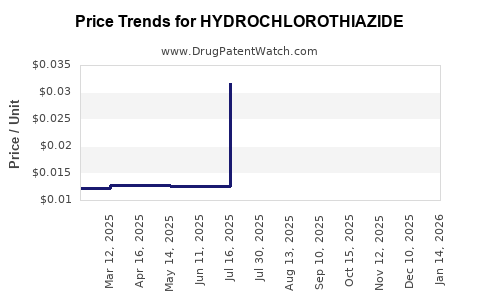
Drug Price Trends for HYDROCHLOROTHIAZIDE


✉ Email this page to a colleague

« Back to Dashboard


Drug Price Trends for HYDROCHLOROTHIAZIDE

Average Pharmacy Cost for HYDROCHLOROTHIAZIDE

These are average pharmacy acquisition costs (net of discounts) from a US national survey
Drug Name NDC Price/Unit ($) Unit Date
HYDROCHLOROTHIAZIDE 12.5 MG CP 00591-0347-05 0.02975 EACH 2025-11-19
HYDROCHLOROTHIAZIDE 12.5 MG CP 29300-0130-05 0.02975 EACH 2025-11-19
HYDROCHLOROTHIAZIDE 12.5 MG CP 29300-0130-10 0.02975 EACH 2025-11-19
HYDROCHLOROTHIAZIDE 12.5 MG CP 29300-0130-01 0.02975 EACH 2025-11-19
HYDROCHLOROTHIAZIDE 50 MG TAB 69584-0362-90 0.03321 EACH 2025-11-19
>Drug Name >NDC >Price/Unit ($) >Unit >Date

Best Wholesale Price for HYDROCHLOROTHIAZIDE

These are wholesale prices available to the US Federal Government which, by law, must be the best prices available to any customer under comparable terms and conditions
Drug Name Vendor NDC Count Price ($) Price/Unit ($) Unit Dates Price Type
HYDROCHLOROTHIAZIDE 50MG TAB AvKare, LLC 43547-0398-10 100 3.26 0.03260 EACH 2023-06-15 - 2028-06-14 FSS
HYDROCHLOROTHIAZIDE 12.5MG/OLMESARTAN 40MG TA AvKare, LLC 42291-0925-90 90 529.55 5.88389 EACH 2023-09-25 - 2028-06-14 FSS
HYDROCHLOROTHIAZIDE 25MG TAB Golden State Medical Supply, Inc. 51407-0331-90 90 1.95 0.02167 EACH 2023-06-15 - 2028-06-14 FSS
HYDROCHLOROTHIAZIDE 12.5MG/IRBESARTAN 150MG T AvKare, LLC 00093-8238-56 30 9.46 0.31533 EACH 2023-06-15 - 2028-06-14 FSS
HYDROCHLOROTHIAZIDE 50MG TAB AvKare, LLC 43547-0398-11 1000 20.95 0.02095 EACH 2023-06-15 - 2028-06-14 FSS
>Drug Name >Vendor >NDC >Count >Price ($) >Price/Unit ($) >Unit >Dates >Price Type
Price type key: Federal Supply Schedule (FSS): generally available to all Federal Govt agencies / 'BIG4' prices: VA, DoD, Public Health & Coast Guard only / National Contracts (NC): Available to specific agencies

Market Analysis and Price Projections for Hydrochlorothiazide

Last updated: July 27, 2025


Introduction

Hydrochlorothiazide (HCTZ) is a thiazide diuretic widely prescribed for treating hypertension and edema. As a generic medication with a long-standing market presence, it offers a cost-effective option for managing cardiovascular conditions. Despite its mature market, shifts in regulatory policies, patent statuses, manufacturing dynamics, and healthcare trends influence its market landscape and pricing. This analysis delineates current market dynamics, future pricing trajectories, and strategic insights pertinent to stakeholders.


Market Overview

Historical Context and Market Penetration

Hydrochlorothiazide was first introduced in the 1950s and became a cornerstone in antihypertensive therapy owing to its efficacy and affordability. The drug's widespread adoption made it one of the most prescribed medications globally, especially in the United States, where it frequently appears on the list of top-prescribed drugs [1].

Current Market Landscape

The global market for hydrochlorothiazide remains substantial, underpinning the broader diuretic and antihypertensive segments. The US market alone accounts for a significant proportion, driven by the high prevalence of hypertension—affecting roughly 45% of adults, with under-treatment persisting [2].

Generics dominate the market, with multiple manufacturers producing HCTZ at low cost. According to IMS Health, competitive pricing among generics has kept prices relatively stable over recent years, with a slight downward trend owing to intense market competition [3].

Regulatory Environment

Hydrochlorothiazide's patent protections expired in the late 20th century, allowing for broad generic entry. The subsequent proliferation of manufacturers has maintained price suppression. The drug is listed on essential medicines lists, encouraging continued consumption and stable demand.

Supply Chain and Manufacturing

Manufacturing sources are diversified globally, with major contributors across India, China, and Western markets. Quality assurance remains critical, given past generic drug recalls related to manufacturing issues—these exert influence on market pricing and supplier reputation [4].


Market Drivers and Constraints

Drivers:

  • High prevalence of hypertension: Elevated demand sustains consistent utilization.
  • Cost-effectiveness: Healthcare providers often prefer inexpensive, effective options, ensuring steady sales.
  • Generic competition: Drives price reductions, encouraging formulary inclusion.

Constraints:

  • Emerging therapeutic alternatives: Combination drugs and novel antihypertensives might reduce HCTZ's standalone use.
  • Regulatory scrutiny: Potential safety concerns, such as the risk of electrolyte imbalance, may lead to label updates affecting prescribing patterns.
  • Market saturation: Mature markets exhibit price stability but limited growth potential.

Price Analysis

Historical Price Trends

Over the past decade, hydrochlorothiazide prices have experienced marginal declines. Data suggest retail prices for 25mg tablets hover around $0.02–$0.05 per tablet, with wholesale acquisition costs lower still. The introduction of multiple generic options has sustained downward pressure [3].

Price Influences

  • Generic competition: The primary force maintaining low prices.
  • Market consolidation: Larger manufacturers may exert pricing power temporarily but are balanced by widespread generics.
  • Regulatory actions: Any adverse safety findings could impact pricing if formulations or contraindications change.

Future Price Projections

Considering current trends, hydrochlorthiazide prices are likely to remain relatively stable with slight decreases over the next 3–5 years. Key factors include:

  • Saturation of generic market: Will limit substantial price hikes.
  • Healthcare policy changes: Initiatives to contain drug costs, especially for longstanding generics like HCTZ, will sustain price pressures.
  • Potential safety advisories: Any new safety concerns could influence manufacturing costs and pricing structures, although such instances are currently rare.

In a conservative projection, wholesale prices per tablet are expected to decrease by an additional 5–10% over the next five years, reinforcing its position as a low-cost option.


Impact of Patent and Regulatory Dynamics

The absence of patent protections since the late 20th century means no monopolistic pricing leverage, solidifying its role as an affordable therapeutic. Nonetheless, regulatory bodies' increasingly rigorous standards necessitate ongoing quality assurance, indirectly influencing production costs but not significantly impacting prices unless safety issues arise.


Conclusion: Strategic Outlook

Hydrochlorothiazide's market remains stable, driven by its low cost, longstanding efficacy, and widespread acceptance. Price projections confirm continued affordability, underpinning its role in public health and insurance formularies. Stakeholders should monitor regulatory updates and emerging therapy trends that may alter its utilization landscape.


Key Takeaways

  • Hydrochlorothiazide continues to be a low-cost, widely prescribed antihypertensive, benefiting from extensive generic competition.
  • Market prices are expected to decline modestly over the next five years, maintaining its affordability position.
  • The drug’s maturity limits aggressive price increases; regulatory and safety factors could influence future cost structures.
  • Manufacturers and healthcare providers should prepare for continued stability but stay alert to innovations or safety concerns that could impact demand.
  • Stakeholders in pharmaceutical supply chains should focus on maintaining quality standards amid increasing regulatory scrutiny and global manufacturing shifts.

FAQs

1. What factors mainly influence hydrochlorothiazide pricing?
Market competition among multiple generics, regulatory policies, safety considerations, and manufacturing costs predominantly shape its prices.

2. How will the emergence of new antihypertensive therapies affect hydrochlorothiazide’s market?
While some newer drugs may replace monotherapy in certain cases, hydrochlorothiazide remains a cost-effective choice, sustaining its demand, especially in resource-constrained settings.

3. Are there upcoming regulatory concerns that could impact hydrochlorothiazide pricing?
Currently, no significant regulatory warnings threaten hydrochlorothiazide, though ongoing surveillance is essential as new safety data emerge.

4. Can manufacturers expect to increase prices for hydrochlorothiazide in the near future?
Unlikely, given patent expiration and intense generic competition; prices are expected to remain stable or decline modestly.

5. How does global manufacturing influence drug prices?
Manufacturing diversification enhances supply stability and competitive pricing but also requires compliance with regulatory standards, impacting costs minimally in the long term.


References

[1] IMS Health, "Top Prescribed Medications Worldwide," 2022.
[2] American Heart Association, "Prevalence of Hypertension," 2021.
[3] Drug Price Data, Healthcare Market Insights, 2022.
[4] FDA Reports on Generic Drug Recalls, 2021.

More… ↓

⤷  Get Started Free

Make Better Decisions: Try a trial or see plans & pricing

Drugs may be covered by multiple patents or regulatory protections. All trademarks and applicant names are the property of their respective owners or licensors. Although great care is taken in the proper and correct provision of this service, thinkBiotech LLC does not accept any responsibility for possible consequences of errors or omissions in the provided data. The data presented herein is for information purposes only. There is no warranty that the data contained herein is error free. We do not provide individual investment advice. This service is not registered with any financial regulatory agency. The information we publish is educational only and based on our opinions plus our models. By using DrugPatentWatch you acknowledge that we do not provide personalized recommendations or advice. thinkBiotech performs no independent verification of facts as provided by public sources nor are attempts made to provide legal or investing advice. Any reliance on data provided herein is done solely at the discretion of the user. Users of this service are advised to seek professional advice and independent confirmation before considering acting on any of the provided information. thinkBiotech LLC reserves the right to amend, extend or withdraw any part or all of the offered service without notice.