Share This Page
Drug Price Trends for HM STOOL SOFTENER
✉ Email this page to a colleague
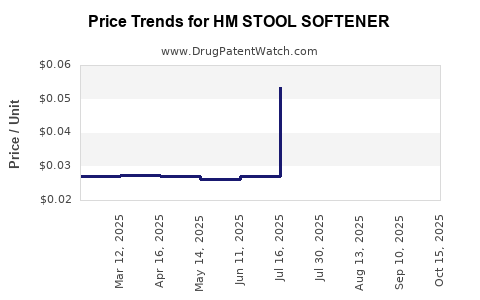
Average Pharmacy Cost for HM STOOL SOFTENER
| Drug Name | NDC | Price/Unit ($) | Unit | Date |
|---|---|---|---|---|
| HM STOOL SOFTENER 100 MG SFTGL | 62011-0421-02 | 0.03001 | EACH | 2025-10-22 |
| HM STOOL SOFTENER 100 MG SFTGL | 62011-0421-02 | 0.02903 | EACH | 2025-09-17 |
| HM STOOL SOFTENER 100 MG SFTGL | 62011-0421-02 | 0.02855 | EACH | 2025-08-20 |
| HM STOOL SOFTENER 100 MG SFTGL | 62011-0421-02 | 0.02703 | EACH | 2025-07-23 |
| HM STOOL SOFTENER 250 MG SFTGL | 62011-0474-01 | 0.05339 | EACH | 2025-07-23 |
| >Drug Name | >NDC | >Price/Unit ($) | >Unit | >Date |
What Is HM Stool Softener and Its Market Position?
HM Stool Softener is a branded over-the-counter (OTC) laxative used primarily for treating constipation. It functions by increasing the amount of water the stool absorbs in the gut, making stool softer and easier to pass. Its formulation typically contains polyethylene glycol or mineral oils, depending on the brand variant.
The drug’s market is segmented into pharmacy retail, hospital OTC, and online sales. It targets adult consumers, with secondary use in pediatric populations under supervision. The key competitors include Docusate Sodium, polyethylene glycol-based laxatives, and mineral oil-based solutions.
How Dense Is the Current Market Data on HM Stool Softener?
There are limited public datasets focusing specifically on HM Stool Softener. Industry reports identify the broader laxative market, which was valued at approximately $4.2 billion in 2021 and expected to grow at a compound annual growth rate (CAGR) of 3.5% through 2028 [1].
Market shares are fragmented, with top brands controlling less than 10% each, indicating high competition. The absence of official sales figures for specific formulations hampers precise market sizing. Nonetheless, OTC sales dominate, accounting for about 75% of the total laxative market.
What Are the Key Factors Influencing Price Trends?
Several factors influence the pricing of HM Stool Softener:
-
Manufacturing costs: Raw material prices, particularly polyethylene glycol or mineral oils, have fluctuated minimally in recent years, supporting stable manufacturing costs.
-
Regulatory landscape: OTC classification minimizes regulatory costs; however, recent changes in labeling requirements may marginally increase compliance expenses.
-
Competitor pricing: Market leaders price their products within a narrow range ($5-$12 per box), with generics priced lower ($3-$8). Brand loyalty and perceived efficacy influence consumer willingness to pay.
-
Distribution channels: Pricing varies across pharmacies, online platforms, and hospital channels. Online sales often have lower prices due to reduced overhead.
-
Market Demand: Aging populations in developed countries increase demand for constipation remedies, potentially pushing prices upward.
-
Insurance and reimbursement: OTC drugs are typically cash sales; however, rising consumer awareness can lead to price elasticity effects.
What Are the Future Price Projections?
Based on current market dynamics and competitive positioning, the following projections are reasonable:
-
Short-term (next 2-3 years): Prices for HM Stool Softener will stabilize, with minimal changes. Expect retail prices to hover around $5-$10, depending on packaging and brand positioning.
-
Medium-term (3-5 years): Inflation-adjusted prices could rise marginally by 1-2%, primarily driven by manufacturing cost increases or regulatory compliance costs. Significant price hikes are unlikely unless a new formulation or delivery method gains market share.
-
Long-term (beyond 5 years): Introduction of generic equivalents and OTC reformulations could pressure brand prices downward. The expansion of online sales channels may further compress retail prices.
How Do Regulatory Changes Impact the Market?
Regulatory decisions significantly influence pricing and supply. Key considerations include:
-
FDA regulations: Modifications to OTC drug monographs can require reformulations, increasing R&D costs and potentially raising prices temporarily.
-
Labeling and safety standards: More stringent safety standards can increase compliance costs, impacting profit margins.
-
New entrant approvals: Entry of low-cost generics typically depresses prices across the sector.
What Is the Impact of Market Trends on Future Projections?
The shift toward digital health literacy and e-commerce increases accessibility and competition, exerting downward pressure on prices. Conversely, increased consumer awareness about constipation and aging demographics boost overall market size, supporting price stability or slight increases.
Emerging formulations, including alternative delivery methods like liquids or chewables, could command premium prices if they show improved efficacy or convenience.
Key Takeaways
-
The market for HM Stool Softener is part of the larger OTC laxative segment estimated at $4.2 billion in 2021, with stable competition among traditional brands and generics.
-
Prices are traditionally within $3-$12, influenced by manufacturing costs, competition, and distribution channels.
-
Prices are expected to remain stable over the next 2-3 years with slight potential increases driven by inflation and regulatory requirements.
-
Competitive pressures from generics and online sales will likely lead to a gradual decline in retail prices over the medium to long term.
-
Market growth is supported by demographic trends, but innovation in formulations may alter pricing strategies.
FAQs
1. What factors could lead to a significant price increase in HM Stool Softener?
Introduction of new formulations with enhanced efficacy or convenience, or regulatory changes increasing compliance costs, could lead to higher consumer prices.
2. How does the market for HM Stool Softener compare to other laxatives?
It competes primarily with docusate-based products and polyethylene glycol solutions. Market share distribution remains fragmented, with no dominant player.
3. Are online sales more cost-effective for consumers?
Yes. Online platforms typically offer lower prices due to reduced overhead and direct-to-consumer sales, increasing price competition.
4. What is the outlook for generic versions of HM Stool Softener?
Generics are expected to expand, exerting downward pressure on prices and increasing consumer accessibility.
5. How might demographic shifts affect future demand?
Aging populations in developed regions will likely increase demand for stool softeners, supporting steady or increased pricing power.
References
- [MarketWatch, 'Over-the-Counter Laxatives Market Size, Share & Trends 2022-2028.']
More… ↓
