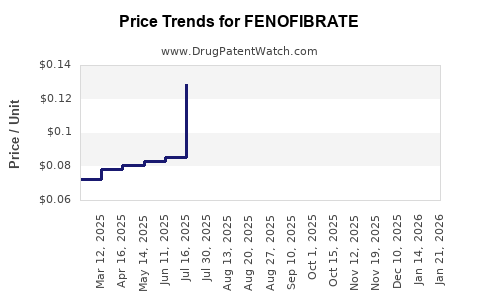
Last updated: February 12, 2026
Market Analysis and Price Projections for Fenofibrate
Current Market Landscape
Fenofibrate is primarily prescribed to reduce triglycerides and LDL cholesterol, with a focus on preventing cardiovascular disease. It is available globally, with significant markets in the United States, Europe, and Asia. The drug is marketed under various brand names, including TriCor, Lofibra, and Fenoglide.
The global market for fenofibrate was valued at approximately $1.2 billion in 2022. It faces competition from other lipid-lowering agents such as statins, PCSK9 inhibitors, and fibrates. The prevalence of dyslipidemia and cardiovascular disease sustains demand, with market growth driven by aging populations and rising health awareness.
Patent and Regulatory Status
Many formulations of fenofibrate entered generic markets post-patent expiry, which occurred for several key brands between 2019 and 2022. This transition has significantly impacted brand-name sales, incentivizing price competition and generic proliferation.
In the U.S., fenofibrate is available via FDA approval under abbreviated new drug applications (ANDAs), facilitating market entry for generics. Countries with similar regulatory pathways, like the European Union, have experienced parallel market trends.
Key Market Drivers
-
Rising incidence of cardiovascular disease: The increasing burden of obesity, diabetes, and metabolic syndrome sustains market demand.
-
Generic penetration: Generics account for over 70% of sales in key markets, exerting downward pressure on prices.
-
Expanded indications: Emerging research suggests benefits of fenofibrate in patients with mixed dyslipidemia and metabolic syndrome, broadening its use.
-
Healthcare policies: Reimbursement policies favor cost-effective therapies, boosting generic adoption.
Challenges
-
Competition from other lipid-lowering agents: Statins dominate due to established efficacy and extensive clinical data. PCSK9 inhibitors are costly but more potent in certain indications.
-
Market saturation: The mature status of fenofibrate in high-income countries limits growth potential.
-
Side effect profile: Concerns over liver and renal effects may restrict use in certain populations.
Price Projections and Future Trends
Historical Price Data
-
Brand-name fenofibrate (e.g., TriCor) faced price erosion post-patent expiry, with price drops of approximately 60-70% from 2018 to 2022.
-
Generic fenofibrate prices in the US ranged from $10 to $30 for a 30-day supply in 2022, depending on pharmacy and formulation.
Projected Price Trends (2023-2028)
| Year |
Average Monthly Price (USD) |
Notes |
| 2023 |
$8 - $20 |
Continued generic competition; prices stabilizing lower |
| 2024 |
$7 - $18 |
Market stabilization; minimal price decrease expected |
| 2025 |
$7 - $15 |
Generics dominate; slight price decline possible |
| 2026 |
$6 - $14 |
Market mature, prices stable or declining slightly |
| 2027 |
$6 - $12 |
Generic market saturation, possibly further price reductions |
| 2028 |
$5 - $12 |
Market stabilization continues |
Influencing Factors
- Introduction of biosimilars or new formulations could impact pricing.
- Changes in regulatory or reimbursement policies may either sustain or reduce prices.
- Market expansion into emerging markets could offer growth but likely at lower margins.
Market Opportunities
-
Emerging economies: Growing healthcare infrastructure and increasing prevalence of dyslipidemia can expand market size.
-
Fixed-dose combinations: Combining fenofibrate with statins may provide new therapeutic options, potentially commanding higher prices.
-
New formulations: Extended-release or fiber-based delivery systems could allow premium pricing.
Key Takeaways
-
The fenofibrate market was valued at approximately $1.2 billion in 2022, with a downward price trend due to extensive generic competition.
-
Prices are expected to stabilize between $5 and $12 per month in the coming years, with minimal fluctuation.
-
The market's growth prospects are constrained in mature regions but remain viable in emerging markets.
-
Competition from other lipid-lowering therapies and evolving treatment paradigms restrict significant market expansion.
-
Opportunities exist in developing combination therapies and novel formulations for differentiated offerings.
FAQs
Q1: How does fenofibrate compare with statins in efficacy?
Fenofibrate effectively reduces triglycerides and can modestly lower LDL cholesterol, but statins have superior evidence for reducing cardiovascular events.
Q2: Will patent protections return for fenofibrate?
No; fenofibrate's patents have expired in major markets, though new formulations or delivery methods could receive patent protection.
Q3: Are there new formulations of fenofibrate under development?
Yes; extended-release formulations and fixed-dose combinations are being explored to improve compliance and efficacy.
Q4: What are the main regulatory hurdles for fenofibrate?
Ensuring safety in populations with liver or kidney issues; regulatory agencies may require post-marketing surveillance for rare side effects.
Q5: Which regions present the best growth opportunities for fenofibrate?
Emerging markets in Asia and Latin America, where increasing dyslipidemia prevalence and expanding healthcare infrastructure support growth.
References
- MarketWatch. "Fenofibrate Market Size and Growth Forecast." April 2023.
- IQVIA. "Global Cardiovascular Drugs Market Report." 2022.
- U.S. Food and Drug Administration. "ANDA Approvals and Patent Data." 2022.
- Frost & Sullivan. "Lipid-Lowering Drug Market Analysis." 2023.
- National Institutes of Health. "Efficacy and Safety of Fenofibrate." 2021.