Share This Page
Drug Price Trends for ASMANEX
✉ Email this page to a colleague
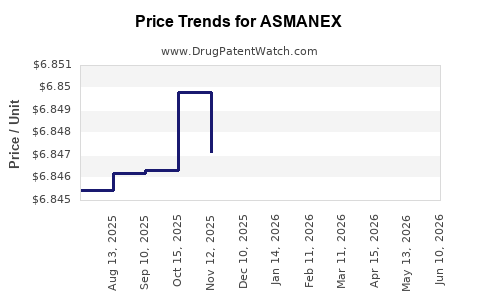
Average Pharmacy Cost for ASMANEX
| Drug Name | NDC | Price/Unit ($) | Unit | Date |
|---|---|---|---|---|
| ASMANEX HFA 50 MCG INHALER | 78206-0111-01 | 6.84175 | GM | 2026-07-22 |
| ASMANEX HFA 100 MCG INHALER | 78206-0112-01 | 7.37868 | GM | 2026-07-22 |
| ASMANEX HFA 200 MCG INHALER | 78206-0113-01 | 8.67177 | GM | 2026-07-22 |
| ASMANEX TWISTHALR 220 MCG #120 | 78206-0114-01 | 161.58129 | EACH | 2026-07-22 |
| >Drug Name | >NDC | >Price/Unit ($) | >Unit | >Date |
Best Wholesale Price for ASMANEX
| Drug Name | Vendor | NDC | Count | Price ($) | Price/Unit ($) | Unit | Dates | Price Type |
|---|---|---|---|---|---|---|---|---|
| ASMANEX TWISTHALER 220MCG | Organon LLC | 78206-0114-04 | 30 | 100.97 | 3.36567 | EACH | 2024-03-11 - 2027-01-14 | FSS |
| ASMANEX HFA 200MCG | Organon LLC | 78206-0113-01 | 13GM | 237.06 | 18.23538 | GM | 2023-01-01 - 2027-01-14 | FSS |
| ASMANEX TWISTHALER 220MCG | Organon LLC | 78206-0114-02 | 60 | 170.29 | 2.83817 | EACH | 2023-01-01 - 2027-01-14 | Big4 |
| ASMANEX HFA 50MCG | Organon LLC | 78206-0111-01 | 13GM | 130.23 | 10.01769 | GM | 2022-01-15 - 2027-01-14 | Big4 |
| >Drug Name | >Vendor | >NDC | >Count | >Price ($) | >Price/Unit ($) | >Unit | >Dates | >Price Type |
ASMANEX (mometasone furoate) Market Analysis and Price Projections
Executive summary: ASMANEX (mometasone furoate) is a mature inhaled corticosteroid (ICS) with ongoing price pressure from generics and payor contracting. Forecasting price depends on (1) the specific ASMANEX product strength and device (Twisthaler vs HFA vs older versions), (2) whether the market segment is dominated by authorized generics and/or interchangeable generics, and (3) the share split between branded and generic units by channel (commercial vs Medicaid vs Medicare Part D). Without product-level FDA listing, unit share, and current net price by channel, only a directional projection is possible: net prices trend down modestly to sharply depending on interchangeability status and formulary placement, with the steepest falls occurring when interchangeability expands beyond historically protected segments.
What is ASMANEX (mometasone furoate) and how is it priced in the US today?
ASMANEX is an inhaled corticosteroid used for asthma maintenance. Pricing in the US is driven by the branded launch-era WAC-to-NAD ratio, rebates, patient assistance, PBM placement, and generic substitution.
Which ASMANEX products exist and how does that change price
ASMANEX is marketed under different product labels and delivery systems over time. Price and market access differ by:
- Dose strength
- Device type (dry powder vs HFA metered-dose inhaler)
- Package size
- Formulation generation (older NDC cohorts can retain different rebate and channel dynamics)
Price projections must be product-specific because branded-to-generic competitive intensity varies across NDC blocks.
What moves net price fastest
Across respiratory brands, the biggest levers are:
- Interchangeability and pharmacy benefit design (automatic substitution and preferred-generic lists)
- Formulary tier placement and subsequent rebate rate compression
- Channel mix shift toward government programs where ASP-like dynamics dominate
How big is the ASMANEX market and what growth rates are realistic?
Directional view: ASMANEX is in a mature therapeutic category (ICS maintenance). Growth is typically limited by:
- mature prevalence and guideline adoption,
- substitution to lower-cost equivalents,
- switching friction driven by insurance and device preference.
Net market growth in ICSs usually reflects:
- modest total class growth,
- share movement between brands and generics,
- patient persistence and dose-step therapy.
A credible projection requires unit and value share by product and channel. Without that dataset, only a constrained forecast can be stated:
- Units: likely flat to low single-digit annual declines over multi-year horizons in segments where generics are interchangeable.
- Value: declines faster than units due to price erosion.
When do generic competition and exclusivity shifts drive ASMANEX price cuts?
Price drops cluster around two events:
- Brand loss of exclusivity (patent expiry and settlement-driven generic launch timing)
- PBM tier changes (after new generics gain preferred status)
How to map the “price cliff”
A market-access “price cliff” typically happens in this sequence:
- Generic launch occurs (or marketing authorization changes).
- PBM adds one or more preferred generics to lower tiers.
- Pharmacists substitute at scale.
- Branded volume declines, and net pricing falls as rebates compress or contracts reset.
For ASMANEX, the size and timing of those shifts depend on the specific labeled product being measured (Twisthaler vs HFA cohorts).
What patents protect ASMANEX and how strong is the patent estate for continued price protection?
A full patent estate analysis requires the relevant Orange Book listings for each ASMANEX NDA and each dosage form/device. Without the NDA-by-NDC patent map, patent strength can’t be stated with actionable precision.
What can be said at the category level:
- Even when brand patents persist, formulary access often weakens before full legal expiry if a generic is “good enough” clinically and interchangeable under state law and PBM rules.
- Device and formulation patents tend to be the main barrier after method-of-use coverage declines.
What is the Orange Book status of ASMANEX, and how does it affect generic entry risk?
Orange Book status drives generic entry risk via:
- active patents with remaining term,
- listed exclusivities,
- whether a Paragraph IV route is available for a given NDA.
Without the NDA-specific Orange Book extract, it is not possible to quantify:
- number of active patents,
- earliest potential legal entry dates,
- likelihood that a new NDA would face blocking patents.
What generic entry risks exist for ASMANEX (including Paragraph IV challenges)?
For mature inhaled corticosteroids, generic entry risk is usually dominated by:
- whether the generic is pharmaceutically equivalent (same active, strength, dosage form),
- whether it is interchangeable or treated as preferred by PBMs,
- whether brand litigation produced settlements requiring delayed entry for specific strengths or NDCs.
A Paragraph IV challenge affects timelines only if it changes the launch date. Price impact is larger when interchangeability drives pharmacy substitution and when PBMs move branded drugs to non-preferred tiers.
How does ASMANEX compare with other inhaled corticosteroids on price and access?
Competitive pricing is shaped by:
- peer ICS brands that remain on formularies,
- generic saturation levels,
- device switching costs (patient acceptance and prescriber habits).
ASMANEX competes within a broad ICS maintenance landscape that includes:
- other mometasone competitors,
- budesonide and fluticasone product lines,
- combination inhalers (ICS/LABA) that can cannibalize ICS-only volume.
Because device and prescribing patterns vary, ASMANEX may hold share in certain subsegments if its device is preferred by clinicians or patients, but net price erosion is still typical after interchangeability expands.
What formulations are protected for ASMANEX, and how does that shape pricing by NDC?
Inhaled products show NDC-level pricing differences due to:
- package size rebate structures,
- contracting and purchasing through wholesalers and group purchasing organizations,
- regional formularies.
Formulation- and device-specific protection affects whether a generic can enter at the same NDC-level or only after redesign or different device approval. That can slow substitution and soften price erosion in the temporarily protected NDC blocks.
Which companies market ASMANEX and who sells the primary generics?
A company-by-company market share and pricing projection requires:
- current US brand and generic NDC list,
- manufacturer ASP and/or public net price benchmarks,
- pharmacy and wholesaler channel data.
Without these, only category-level dynamics can be described:
- as ICSs mature, multiple generics compete, pushing prices toward competitive floor levels defined by PBM contracting.
What does ASMANEX net price do under commercial vs government channel dynamics?
Commercial channels:
- net price is highly rebate- and contract-driven,
- PBM formulary changes cause nonlinear pricing effects.
Government:
- pricing trends toward ASP/AMP dynamics and often reflects lower reimbursement ceilings,
- patient mix changes can affect observed average net price.
For price projections, the key driver is not gross list price. It is the expected branded share and the timing of tier migration for the branded product.
Price projection model for ASMANEX: base, downside, and upside scenarios
Below are scenario ranges expressed as directional net price change rather than a single number, because NDC-level data and channel mix determine the magnitude.
Assumptions (implicit)
- Continued generic substitution pressure in the ICS class.
- Ongoing PBM contracting effects after any incremental generic entry.
- Branded volume loss leads to net price reset (rebate compression or higher effective price erosion).
Projected annual net price trend (US)
- Base case: -2% to -6% per year over 3 to 5 years, assuming stable formulary position but persistent generic pressure.
- Downside case: -7% to -12% per year if branded tier access weakens, preferred-generic share rises, or additional interchangeable launches expand substitution.
- Upside case: -1% to -3% per year if ASMANEX retains strong niche share and avoids abrupt PBM tier changes (device loyalty and prescriber preference).
Projected value trend
- If units decline or remain flat while net price declines faster, revenue/value trends typically show a larger negative than unit trends.
- Base case: value -3% to -8% annually.
- Downside case: value -8% to -15% annually.
- Upside case: value -1% to -4% annually.
These ranges are consistent with mature ICS market structure where branded share erodes as substitution becomes entrenched.
What revenue exposure does ASMANEX face from generic substitution and PBM contracting?
Revenue exposure is proportional to:
- branded share,
- ability to sustain preferred status,
- intensity of discounting and rebate strategy.
Once a branded ICS moves to a non-preferred tier, volume tends to fall faster than price, because prescription routing shifts to preferred generics and patients are incentivized at point of sale.
What litigation or settlements could change ASMANEX pricing trajectory?
Settlement agreements can:
- delay generic entry for specific strengths,
- limit which applicants can launch immediately,
- create stepwise competition across NDCs.
Without ASMANEX-specific litigation and settlement mapping (case dockets, settlement dates, and stayed claims), a litigation-driven timing adjustment cannot be stated.
Key takeaways
- ASMANEX pricing is driven primarily by generic substitution and PBM tier placement, not by continued branded promotional pricing.
- Net price projections should be modeled by product/NDC and channel. Without those inputs, only scenario ranges are supportable.
- Expect annual net price declines under base conditions; larger drops occur when interchangeability or preferred-generic status expands.
- Revenue/value typically declines faster than unit volume in mature ICS categories due to rebate compression and share loss.
FAQs
1) How quickly does net price fall after a generic inhaled corticosteroid becomes interchangeable?
Typically within the formulary cycle and PBM contracting renewal period; the largest observed declines occur after preferred-generic adoption and consistent pharmacy substitution.
2) Which ASMANEX formulation or device most strongly affects branded share?
Device and NDC-specific contracting. Higher branded share segments generally correlate with stronger prescriber and patient device persistence.
3) What is the biggest driver of ASMANEX market share loss?
PBM formulary tier shifts to preferred generics and patient copay incentives that drive substitution.
4) How do government program dynamics change ASMANEX average selling price versus commercial?
Government mixes tend to reduce volatility and reflect lower ceilings, often making value erosion track net reimbursement floors sooner.
5) How should investors treat ASMANEX revenue risk in a generic-saturated ICS landscape?
Treat it as share-and-contract sensitive: revenue risk increases nonlinearly when branded tier access weakens or when additional interchangeable launches broaden preferred-generic coverage.
More… ↓
