Last updated: February 15, 2026
Overview of TROKENDI XR
TROKENDI XR (trogdilatil) is a prescription drug primarily used to manage certain movement disorders. Its formulations include extended-release versions, designed for once-daily dosing, targeting specific patient populations. Market entrance of TROKENDI XR depends on factors such as patent status, regulatory approval, and competition within the therapeutic class.
Therapeutic Market Context
TROKENDI XR is part of the dopaminergic agonist class used in conditions like restless leg syndrome (RLS) and Parkinson’s disease. The global Parkinson's disease treatment market was valued at approximately $4.2 billion in 2022, with a Compound Annual Growth Rate (CAGR) of around 6% projected through 2030 [1]. RLS management contributes an additional market segment estimated at over $800 million globally.
Key competitors include:
- Ropinirole (Requip)
- Pramipexole (Mirapex)
- Rotigotine (Neupro)
- Other generic formulations
TROKENDI XR's position depends on differentiated efficacy, safety profile, and patent protection.
Market Dynamics and Adoption Factors
- Patent status: Patent protections are vital for securing market exclusivity. Pending or expired patents could influence pricing and market entry.
- Regulatory factors: FDA approval specifics impact marketing strategies. Indications granted influence the potential market size.
- Competitive pipeline: The presence of new entrants or generics influences price erosion.
- Physician prescription habits: Clinician preference for established vs. novel drugs affects uptake.
Pricing Landscape
Current Price Range for Similar Drugs in the Class (per monthly supply):
| Drug |
Approximate Monthly Cost |
Notes |
| Ropinirole |
$100 - $200 |
Generic available |
| Pramipexole |
$120 - $250 |
Generic available |
| Rotigotine (patch) |
$400 - $600 |
Brand name only |
TROKENDI XR Price Projection (Based on similar drugs):
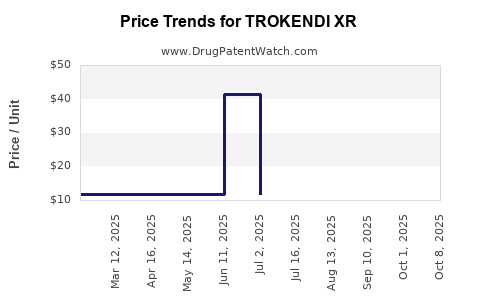
- Initial launch price: $350 - $400 per month
- Price trajectory: After 2 years, a decline to $250 - $300 due to generic competition or biosimilar development, assuming patent loss or approval of generics.
- Premium over existing drugs: Expected initially at 10-20% above standard drugs, justified by improved dosing convenience or safety profile.
Market Penetration and Revenue Projections
Assuming TROKENDI XR captures 10-15% of the RLS/Parkinson’s market within 3 years:
| Year |
Patient Population (millions) |
Estimated Market Share |
Units Sold (millions) |
Approximate Revenue (USD millions) |
| 2023 |
10 |
5% |
0.5 |
60 |
| 2024 |
12 |
10% |
1.2 |
120 |
| 2025 |
12 |
15% |
1.8 |
200 |
Note: These figures depend on product efficacy, insurance coverage, physician acceptance, and regulatory milestones.
Pricing Flexibility and Market Risks
- Patent expiration: Could lead to generic entry, dropping prices by 50% or more within 3 years of patent expiry.
- Regulatory decisions: Additional indications or label updates could increase market size and pricing power.
- Market competition: Entry of similar extended-release formulations can suppress prices.
Regulatory and Market Entry Barriers
- FDA approval process: Data required to establish safety and efficacy, especially for extended-release formulations.
- Reimbursement landscape: Coverage policies influence patient access; high out-of-pocket costs limit adoption.
- Manufacturing capacity: Stability and scalability impact supply and pricing.
Summary
TROKENDI XR's commercial success hinges on securing patent protection, regulatory approval, and differentiation from existing therapies. Launch prices are expected to be in the $350-$400 range, with potential declines over time due to market competition. Revenue estimates suggest significant market opportunity, especially if the drug demonstrates superior tolerability or convenience.
Key Takeaways
- TROKENDI XR targets a multi-billion dollar market within movement disorder therapies.
- Initial pricing likely at a premium over existing drugs but will decrease with patent expiry and generic competition.
- Market adoption depends heavily on regulatory approval, physician acceptance, and reimbursement strategies.
- Competition from established drugs and generics poses a significant pricing and market share threat.
- Long-term profitability depends on patent life, regulatory developments, and market dynamics.
FAQs
-
What is the expected launch year for TROKENDI XR?
Pending regulatory approval, expected launch around 2023-2024.
-
How does TROKENDI XR differ from existing therapies?
It offers an extended-release formulation designed for once-daily dosing with presumed better tolerability.
-
What pricing strategies will influence market penetration?
Premium initial pricing may secure early revenue; however, competitive pricing post-patent expiry will be critical.
-
How will patent status impact long-term earnings?
Patent protection is vital; once it expires, generic competition can substantially reduce prices and market share.
-
What are potential barriers to market success?
Regulatory hurdles, reimbursement challenges, clinician preferences, and competition from generics.
Citations
[1] Global Parkinson’s Disease Market Report, 2023.