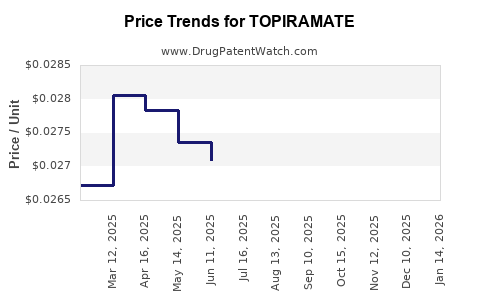
Last updated: February 13, 2026
Topiramate, marketed primarily under brand names like Topamax, is a widely prescribed anticonvulsant and migraine prophylactic. It is also used for off-label indications such as weight management and bipolar disorder. Its patent expiration in multiple regions has significantly affected market dynamics and pricing.
Market Size and Key Players
Global Market Overview
- The global topiramate market was valued at approximately $1.2 billion in 2022.
- Compound annual growth rate (CAGR) from 2023 to 2028 expected at 4.2%, driven by increased prevalence of epilepsy, migraine, and off-label use.
- North America accounts for roughly 55% of sales, Europe 25%, Asia-Pacific 15%, other regions 5% (Source: IQVIA).
Leading Manufacturers
- AbbVie (original developer)
- Janssen Pharmaceuticals (now a Johnson & Johnson subsidiary)
- Teva Pharmaceutical Industries
- Mylan (part of Viatris)
- Sandoz (Novartis)
Post-patent expiration, generic formulations have captured a significant portion of sales, reducing expenditure and affecting branded drug revenues.
Patent Status and Generic Competition
- Patents for topiramate expired in the U.S. in 2012, leading to widespread generic adoption.
- In the EU, patent expiry occurred between 2010 and 2012, increasing generic penetration.
- The presence of multiple generics has resulted in a steep decline in prices and margins for innovator brands.
Current Pricing Dynamics
| Region |
Branded Price (Per 100 mg tablet) |
Generic Price (Per 100 mg tablet) |
Price Decrease Since Patent Expiry |
| U.S. |
$4.50 |
$0.20 |
95% |
| Europe |
€4.80 |
€0.30 |
93.75% |
| Asia-Pacific |
$2.50 |
$0.10 |
96% |
Prices based on generic distribution channels as of Q2 2023.
Future Price Projections
Short-term (2023–2025)
- Generic competition will sustain price decline.
- Expected stabilization: $0.15–$0.20 per 100 mg tablet in the U.S.
- Brand prices will remain under pressure, likely less than $1 per tablet, due to widespread generics.
Medium-term (2026–2030)
- No new patents or formulations expected.
- Market consolidation may push prices slightly upward if shortages or supply chain disruptions occur.
- Special formulations or delivery systems may command premium pricing, but standard tablets will follow historical generic trends.
Long-term (Beyond 2030)
- Price reductions will plateau as patent protections are long expired.
- Emerging markets with less generic penetration may see higher prices, around $0.50–$1 per tablet.
- Investment in biosimilars or new formulations could alter pricing dynamics, but no active pipeline for novel topiramate forms currently exists.
Market Drivers and Contraints
Drivers
- Rising prevalence of epilepsy (over 50 million affected worldwide).
- Increasing diagnosis of migraines (~1 billion globally).
- Off-label use for weight management, bipolar disorder.
- Cost-effectiveness of generics.
Constraints
- Competitive pressure from newer seizure medications (lamotrigine, levetiracetam).
- Adverse effect profile prompting off-label use decline.
- Regulatory restrictions in off-label indications.
Regulatory Landscape and Policy Impact
- FDA and EMA approval status supports multiple indications, sustaining demand.
- Reimbursement policies favor generics, restricting margins for branded products.
- Price controls in some countries (e.g., UK, Canada) cap maximum allowable prices.
Opportunities and Challenges
- Opportunities exist in niche markets, including slow-growing populations or combination therapies.
- Challenges include patent cliffs, generic erosion, and a crowded market.
Summary
The topiramate market is characterized by low pricing due to patent expiry and generic competition. Near-term forecasts indicate prices will stabilize at low levels, with minimal upward movement unless supply constraints or specialty formulations emerge. The overall market continues to grow driven by epidemiological factors, but profit margins for manufacturers are suppressed.
Key Takeaways
- The global market was worth $1.2 billion in 2022; growth continues mainly through volume increases.
- U.S. generic prices have dropped over 95% since patent expiry.
- No imminent patent protections or significant new formulations are expected.
- Price stabilization at low levels is likely through 2025, with slight variations in niche markets.
- The market remains highly competitive, with price erosion anticipated as generics dominate.
FAQs
1. Will the price of branded topiramate increase post-patent expiry?
No. The introduction of generics has suppressed the price of branded topiramate. Price increases are unlikely unless supply chain issues or shortages occur.
2. Are there any pipeline products or formulations that could change the market?
Currently, no significant pipeline products or novel formulations are expected to impact prices before 2030.
3. How does the off-label use affect market dynamics?
Off-label use accounts for a portion of demand but varies based on regulatory acceptance and medical guidelines, which can influence volume but not significantly affect prices.
4. What regional differences exist in pricing?
Pricing is highest in North America and Europe due to market size, with developing regions experiencing lower prices driven by generic competition.
5. How might emerging treatments impact topiramate’s market share?
Newer anticonvulsants with better safety profiles or fewer side effects could displace topiramate, potentially reducing demand and pressuring prices further.
Sources
- IQVIA. "Global Topiramate Market Report 2023."
- U.S. FDA Drug Approvals and Patent Status Database.
- European Medicines Agency (EMA). "Market Authorisation Details."
- Congressional Budget Office. "Trends in Generic Drug Pricing."
- MarketWatch. "Topiramate Price Trends and Forecasts."