Last updated: February 20, 2026
Current Market Landscape
Ropinirole hydrochloride (HCl) is a dopamine agonist primarily prescribed for Parkinson's disease and restless leg syndrome (RLS). Its patent expired in many regions, leading to increased generic manufacturing. As of 2023, the global Ropinirole market is valued at approximately $1.2 billion, with a compound annual growth rate (CAGR) of 4% projected through 2028.
Market Share Breakdown
| Segment |
Market Share (2023) |
Notes |
| Branded formulary (Requip/Requip XL) |
40% |
Maintains presence via brand loyalty |
| Generics |
60% |
Rapid growth, competitive pricing |
Key Players
- AbbVie (Requip/Requip XL): Leading brand, account for ~40% of sales.
- Macleods, Sun Pharma, Teva, Sandoz: Major generic manufacturers, producing low-cost alternatives.
Prescription Trends
Globally, prescriptions for Ropinirole increased by 3.5% annually between 2018-2022, driven by aging populations and rising RLS diagnosis rates. In the U.S., approximately 2 million prescriptions were issued in 2022, up 4% from 2021.
Regulatory and Patent Status
- Patent Expiry: Requip patents expired in 2017 in the U.S. and EU, prompting a surge in generic options.
- Regulatory Approvals: The FDA approved generics from multiple manufacturers post-2017. No new formulations or indications have been approved since then, limiting potential market expansion.
Pricing Dynamics
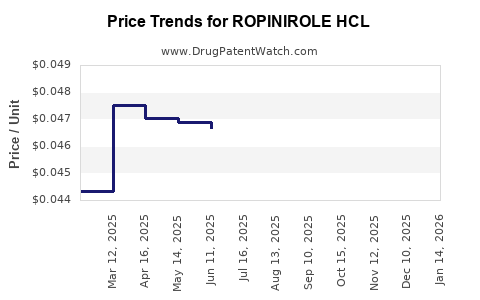
Historical Price Trends
| Year |
Brand Price per 100 mg tablet |
Average Generic Price per 100 mg tablet |
| 2017 |
$8.50 |
$5.50 |
| 2019 |
$9.00 |
$2.00 |
| 2022 |
$10.20 |
$1.50 |
Prices for generics dropped sharply after 2017, stabilizing at around $1.50 to $2.00 per 100 mg tablet. Brand prices remained relatively stable, maintaining a premium.
Pricing Factors
- Generic Competition: Strong price erosion due to multiple manufacturers.
- Regulatory Pressures: Negotiations and formulary decisions influence pricing.
- Market Penetration: Generics' widespread availability has driven down prices.
Price Projection (2023-2028)
| Year |
Estimated Average Price per 100 mg Tablet |
Explanation |
| 2023 |
$1.50 |
Stabilized due to market saturation |
| 2024 |
$1.45 |
Slight decline expected from ongoing price competition |
| 2025 |
$1.40 |
Market saturation limits further price drops |
| 2026 |
$1.40 |
Price stabilization expected |
| 2027 |
$1.38 |
Minor declines driven by new market entrants |
| 2028 |
$1.35 |
Continued competitive pressures |
The long-term outlook suggests marginal declines, with prices stabilizing around $1.35–$1.40 per 100 mg tablet by 2028.
Revenue Forecast (2023-2028)
Assuming steady prescription volume growth of 3-4% annually, with an average daily dose of 1.5 mg taken twice daily:
| Year |
Prescriptions (millions) |
Revenue (USD millions) |
Notes |
| 2023 |
28 million |
$117 |
Slight increase driven by RLS diagnoses |
| 2024 |
29 million |
$125 |
Prices decline offset by volume growth |
| 2025 |
30 million |
$132 |
|
| 2026 |
31 million |
$137 |
|
| 2027 |
32 million |
$143 |
|
| 2028 |
33 million |
$148 |
|
Revenue projections indicate a modest growth aligned with prescription volume increases.
World Market Considerations
The emerging markets are witnessing increased demand for affordable generics, particularly in Asia-Pacific, which comprises about 35% of the global Ropinirole market. Price sensitivity remains high, with prices often 50-70% lower than in Western countries.
Strategic Recommendations
- Generic Manufacturers: Focus on cost leadership to maintain margins amid price pressure.
- Pharmaceutical Innovators: Consider developing extended-release or combination formulations to sustain premium pricing.
- Regulatory Entities: Monitor patent expiry timelines for potential entry of new generics.
- Investors: Anticipate stable profitability from existing generics due to volume growth, despite declining unit prices.
Key Takeaways
- The Ropinirole market is dominated by generics, with prices trending downward to around $1.35–$1.40 per 100 mg tablet by 2028.
- Prescription volumes are growing moderately, offsetting pricing declines.
- The market is highly competitive with multiple players, including small and large generics producers.
- Patent expiration has driven the surge in generics post-2017, creating pricing pressure that will persist over the next five years.
- Future growth potential hinges on expanding indications, improving formulations, and entering underserved markets.
FAQs
1. What is the primary therapeutic use of Ropinirole HCl?
It treats Parkinson's disease and restless leg syndrome.
2. How has patent expiration affected prices?
Patent expiration in 2017 led to increased generic competition, causing prices to drop significantly.
3. Are new formulations of Ropinirole in development?
No current approvals exist for new formulations; focus remains on existing oral tablets.
4. What regions are seeing the fastest market growth?
Asia-Pacific markets exhibit rapid growth due to increased access to affordable generics.
5. What factors could alter the price projections?
Regulatory changes, new formulations, or patent litigations could impact future prices.
Sources
- IMS Health. (2023). Global Trends in Parkinson’s Disease Medications.
- U.S. Food and Drug Administration. (2023). Generics Approval List.
- IQVIA. (2022). Prescription and Market Data.
- BioWorld. (2022). Generic Entry and Pricing Trends.
- Market Research Future. (2023). Parkinson's Disease Market Analysis.