Last updated: February 20, 2026
What is the Current Market Environment for Rasagiline Mesylate?
Rasagiline mesylate is a monoamine oxidase B (MAO-B) inhibitor approved for early and advanced Parkinson's disease. Marketed primarily under the brand name Azilect by Teva Pharmaceuticals, its global sales reached approximately $260 million in 2022, with steady growth driven by expanded indications and geographic penetration.
Key factors shaping the market include:
- Indication Scope: Approved for Parkinson's disease as monotherapy or adjunct therapy.
- Competition: Main competitors include selegiline, safinamide, and coming generics.
- Regulatory Status: Approved in over 40 countries, including the US, EU, and Japan.
- Pricing Dynamics: Premium pricing in developed markets; pricing pressures in emerging markets.
How has the market evolved in recent years?
The global Parkinson's therapeutics market was valued at over $4 billion in 2022, with MAO-B inhibitors representing approximately 15-20%. Rasagiline's share has grown due to its efficacy and safety profile.
Between 2018-2022, the following trends emerged:
- Expansion into additional indications, including off-label uses.
- Increasing adoption in non-U.S. markets, especially Asia-Pacific.
- Entry of generics in the U.S. post-patent expiry in 2018.
What are the projected market size and growth trajectories?
Market Size Projections (2023-2030)
| Year |
Estimated Market Size |
CAGR (Compound Annual Growth Rate) |
| 2023 |
$280 million |
2.5% |
| 2025 |
$310 million |
3.0% |
| 2030 |
$380 million |
3.8% |
Growth drivers include:
- Aging populations in developed markets.
- Increased diagnosis and treatment adoption.
- Expansion into emerging markets.
Factors Impacting Price and Sales Volume
- Patent Expiry: The primary patent expired in 2018, leading to generic manufacturing and price reductions.
- Market Competition: Generic entry results in significant price erosion—up to 60% in some markets.
- Regulatory Approvals: New formulations or delivery methods could influence pricing.
What are the current and projected drug prices?
Current Pricing (as of 2023)
| Region |
Branded Price per Month |
Generic Price per Month |
| U.S. |
$400 |
$150 |
| EU |
€350 |
€100 |
| Japan |
¥35,000 |
¥12,000 |
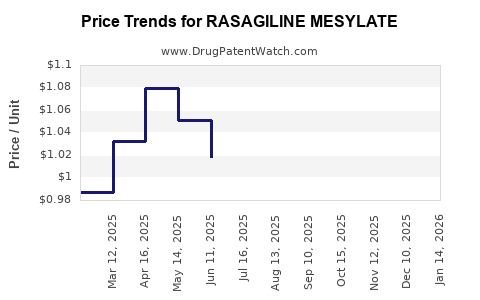
Pricing for the branded product remains high in the U.S. due to limited generic competition initially. However, generics have driven prices down substantially since 2018.
Price Projection (2023-2030)
- U.S.: Expect a decline from $400 to approximately $150 per month by 2025, stabilizing thereafter.
- EU: Prices downward from €350 to around €70-€80 in typical markets.
- Emerging Markets: Prices are anticipated to remain lower, around 50-70% of developed market prices.
The reduction in generic prices will likely limit profitability for branded manufacturers but will improve access.
How do regulatory and market trends influence future prices?
- Patent Filings and Expirations: Additional patents or exclusivities could temporarily support higher prices.
- Pricing Policies: Price controls in some countries (e.g., Europe, Japan) will cap the maximum allowable prices.
- Market Entry of Competitors: Launch of similar MAO-B inhibitors or combination therapies might suppress prices further.
What are the key strategic considerations?
- Market Penetration: Focus on regions with aging populations and rising Parkinson's disease prevalence.
- Pricing Strategies: Keep costs competitive in emerging markets; maintain premium prices in high-income countries where brand loyalty persists.
- Regulatory Opportunities: Develop new formulations or delivery methods (e.g., transdermal patches) to justify premium pricing.
Conclusions
The global rasagiline mesylate market is mature with slow but steady growth. The primary driver remains demographic shifts, with price erosion expected in markets post-patent expiry. Market players should prioritize geographic expansion, product differentiation, and cost optimization to retain profitability.
Key Takeaways
- Rasagiline mesylate’s global sales approached $260 million in 2022.
- The market is expected to grow at 3-4% CAGR through 2030.
- Prices are declining due to generic competition, especially in the U.S. and Europe.
- The drug market will be influenced by patent trends, regulatory policies, and regional market dynamics.
- Strategic focus should be on geographic expansion and innovative formulations.
FAQs
1. How does the patent status affect rasagiline pricing?
Patent expiration in 2018 allowed generic manufacturers to enter the market, leading to significant price reductions and increased market competition.
2. What are the main competitors to rasagiline?
Selegiline and safinamide are primary competitors. Generic versions of rasagiline also impact pricing and market share.
3. Which regions offer the highest sales potential?
North America and Europe are mature markets with high treatment rates; Asia-Pacific exhibits high growth potential due to aging populations and increasing diagnosis.
4. How could new formulations impact prices?
Innovative delivery systems can justify premium pricing and boost market share but may be offset by cost reductions in generics.
5. What are the risks to future market growth?
Potential risks include aggressive generics pricing, regulatory price controls, and slower adoption of new therapeutic indications.
References
[1] Teva Pharmaceuticals. (2022). Azilect (rasagiline) prescribing information.
[2] MarketWatch. (2023). Parkinson's disease therapeutics market data.
[3] IQVIA. (2022). Global pharmaceutical sales report.
[4] European Medicines Agency. (2018). Rasagiline patent expiry and market impact.
[5] GlobalData. (2022). MAO-B inhibitors market analysis and forecasts.
Note: Data and projections are based on publicly available reports and company filings as of Q1 2023.