Last updated: May 18, 2026
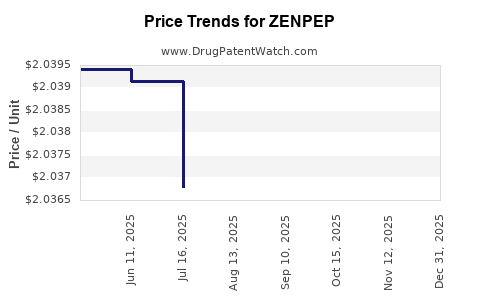
ZENPEP is a U.S.-marketed pancreatic enzyme replacement therapy (PERT) branded as delayed-release capsules. The drug’s market trajectory is shaped less by biologic-style patent exclusivity and more by (1) competitive generic and label-equivalent substitution in PERT, (2) prescriber switching behavior among enzyme products, and (3) payer coverage and contracting dynamics. The practical financial risk is sustained erosion from competitors in the same therapeutic class and channel, even when specific brand exclusivity has expired.
How has ZENPEP performed commercially versus other pancrelipase products?
ZENPEP sits in the PERT competitive set, where multiple branded enzyme products and authorized generics compete. Market outcomes in this category tend to track prescription volume and net price after payer rebates rather than one-time launch spikes typical of novel biologics.
What drives net sales for pancreatic enzyme replacement therapies (PERTs)?
Key market drivers include:
- Formularies and preferred-product lists in commercial and government plans.
- Pharmacy benefit manager (PBM) contracting and step edits.
- Dose unit economics (capsule count, strength mix, and typical daily dosing by indication).
- Switching friction for patients stabilized on a specific enzyme product.
- Compliance issues tied to delayed-release capsule handling and dosing frequency.
How do payer rules shape ZENPEP channel performance?
In PERT, payers often apply:
- Brand-preferred tiers or “therapeutic interchange” policies for FDA-labeled enzyme products.
- Coverage differentiation by product presentation (capsule strengths) and patient history.
- Prior authorization (PA) requirements for non-preferred products.
Competitive set for ZENPEP: what are the realistic substitutes?
The most relevant substitutes are other PERT brands and generic pancrelipase products approved under the same therapeutic concept (pancrelipase for exocrine pancreatic insufficiency). In practice, substitution happens when:
- A plan lists a lower-cost product as preferred.
- Patients or prescribers accept equivalence and switching guidance from gastroenterology or dietetics.
- Pharmacists substitute under state pharmacy laws and PBM policies.
What patents protect ZENPEP in the US and what parts of the product are protected?
Zenpep is not a typical “biologic” with complex biologic exclusivities; it is an enzyme product. IP for these products often concentrates on:
- Formulation and manufacturing method details.
- Delayed-release microencapsulation approach or specific composition ranges.
- Packaging, capsule composition, or process controls.
- Use-related claims (sometimes limited and harder to sustain).
Which kinds of IP claims appear for enzyme products like ZENPEP?
A PERT patent estate commonly includes:
- Formulation patents covering delayed-release matrix or coating systems.
- Manufacturing-process patents covering microsphere preparation, drying, and capsule fill parameters.
- Method-of-treatment patents for specific patient groups, dosing schedules, or outcomes, which are typically narrower than formulation coverage.
How strong is the patent estate and how does it affect financial trajectory?
For PERT, strong IP can delay branded-to-generic compression, but the financial trajectory usually reflects:
- Early erosion risk after key IP and regulatory exclusivity lapses.
- Longer tail value only when competitors face formulation or manufacturing barriers.
- Commercial durability if switching is hard and payers keep the product on-formulary.
When does ZENPEP lose exclusivity and how soon do generics enter?
ZENPEP’s exclusivity and generic-entry timing determines a substantial part of the financial curve: brand net sales often step down after legal exclusivity ends, followed by slower erosion driven by contracting and patient switching.
What are the main exclusivity levers that matter for ZENPEP?
For a branded enzyme product, the key “loss of exclusivity” concepts are:
- Regulatory exclusivity (if any) tied to approval pathway or pediatric status.
- Patent expiration and any Orange Book-listed patents that constrain 505(b)(2)/ANDA approvals and label design.
- Any granted patent terms that extend market exclusivity through patent term adjustments.
What would drive a near-term entry risk?
Generic-entry risk accelerates when:
- Multiple Orange Book-listed patents expire in a tight window.
- At least one competitor can launch with bioequivalence and label alignment.
- PA restrictions and payer incentives weaken the brand’s ability to maintain preferred status.
What is the Orange Book status of ZENPEP and which listings affect generic entry?
Orange Book listing status is the practical map for generic litigation and launch risk. For brand products, Orange Book patents define what a Paragraph IV or other challenge would target (where relevant).
How many patents typically protect a PERT brand and what coverage do they span?
PERT brand estates often span:
- One or more formulation patents.
- Manufacturing method patents.
- Potentially a limited method-of-use claim block.
Orange Book status determines:
- Whether generic applicants must design around.
- Whether a launch can be immediate upon expiration or requires a design-around strategy.
How do Orange Book listings translate into financial impact?
When an Orange Book patent expires:
- A generic can file or launch sooner if regulatory readiness exists.
- Payers quickly revise preferred lists based on acquisition costs.
- Brand net price declines through rebate pressure and contract renegotiation.
How does ZENPEP compare with competing pancrelipase brands on dosing and patient switching?
Switching is the behavioral lever that moderates revenue decline after generic entry in PERT categories.
What substitution barriers exist for ZENPEP?
Typical barriers include:
- Patient stabilization on current product.
- Gastroenterologist preference for a specific dosing conversion across product strengths.
- Clinical monitoring requirements after switching.
- Practical counseling time and adherence differences.
What factors make switching more likely in real-world settings?
Switching accelerates when:
- Patients are newly diagnosed or not stable on therapy.
- The payer provides a strong cost incentive or mandates the preferred product.
- The pharmacy has substitution protocols and patient education materials.
What FDA regulatory pathway issues affect ZENPEP and its competitors?
Regulatory pathway differences can impact how quickly competitors can market comparable pancrelipase products and whether label differences constrain interchange.
What matters for FDA review in PERT products?
FDA review focuses on:
- Potency and enzyme activity specifications (lipase/protease/amylase).
- Delayed-release performance and protection of enzymes through gastric transit.
- Stability and manufacturing consistency.
- Labeling claims tied to indications like exocrine pancreatic insufficiency.
How do generic or 505(b)(2) products compete against ZENPEP?
Competitors can gain market share if:
- They can demonstrate bioequivalence or bridge to existing data for enzyme activity outcomes.
- Their label supports interchange for the same patient groups.
- Their presentation aligns with dosing regimens that minimize titration.
What patent litigation or settlement agreements affect ZENPEP’s market access?
Patent litigation and settlements determine launch timing and can cap erosion by delaying generic availability.
What types of cases are common in PERT markets?
In the broader enzyme category, litigation patterns often involve:
- Patent disputes tied to formulation and manufacturing claims.
- Settlement agreements that delay launches or set carve-outs for certain strengths or package sizes.
How do settlements change financial trajectory?
Settlements can:
- Postpone generic entry, maintaining brand sales during the delay.
- Allocate exclusivity periods to one challenger, letting the brand slow net price pressure.
- Introduce later “second wave” competition when additional patents expire.
Which companies are challenging ZENPEP and what are the likely launch scenarios?
Generic and authorized generic entrants typically target branded enzyme products when:
- Patent barriers are expiring.
- A manufacturer can supply product at lower cost.
- Payer contracts allow substitution.
What launch scenarios usually occur after exclusivity ends?
Common scenarios in enzyme categories include:
- Immediate launch of at least one abbreviated competitor.
- Follow-on launches by additional generics within months to 1-2 years.
- Continued gradual share transfer as formularies are updated across plan renewals.
How do multiple entrants affect revenue?
With more than one entrant:
- Net price declines faster due to competitive tendering.
- Rebates often shrink for the brand.
- Prescriber switching increases with each formulary update.
What revenue exposure does ZENPEP face from patent expiry and price erosion?
ZENPEP’s revenue exposure is tied to:
- Preferred status on payer formularies.
- Competitive product availability post-expiration.
- Contracting cycle timing with PBMs and large insurers.
What is the likely financial shape of erosion in PERT?
In many mature therapies like PERT:
- A step-down occurs around first meaningful generic availability or preferred repositioning.
- Residual sales persist due to patient stability and clinician preference.
- The long tail depends on contracting and distribution channels.
How does ZENPEP’s economics compare with other PERT brands?
Comparative economics depend on:
- Net price after rebates.
- Prescriber preference by patient subgroup.
- Logistics costs and product unit margins.
What metrics are most indicative in this space?
For PERT, the actionable metrics are:
- Prescriptions or patient counts by payer segment.
- Net revenue per prescription and per enzyme unit.
- Channel mix (retail vs specialty vs institutional).
- Contracting impact: rebate rate changes after generic or preferred shifts.
Key Takeaways
- ZENPEP’s commercial trajectory is dominated by PERT class competition and payer contracting dynamics, not “biologic-style” exclusivity mechanics.
- Financial risk centers on the timing of Orange Book patent expiry and the onset of generic and therapeutic-substitute availability through PBM formularies.
- Revenue erosion is typically stepwise: initial share loss after first meaningful competitor launch or preferred-product change, followed by slower attrition driven by switching behavior and renewed contracting.
- Litigation and settlements, when present, can delay generic entry, but the longer-term pressure in PERT markets is structurally linked to price competitiveness and coverage decisions.
FAQs
- How quickly do PERT brands lose market share after the first pancrelipase generic launch?
- Do payer formularies in exocrine pancreatic insufficiency restrict switching between pancrelipase products?
- What Orange Book patent expirations most influence biosimilar-like entry risk for enzyme products such as ZENPEP?
- How do patient stabilization and dose titration affect real-world switching away from ZENPEP?
- What FDA labeling elements drive interchangeability between pancrelipase products for the same indications?
References
- U.S. Food and Drug Administration. Orange Book: Approved Drug Products with Therapeutic Equivalence Evaluations. FDA. https://www.accessdata.fda.gov/scripts/cder/daf/