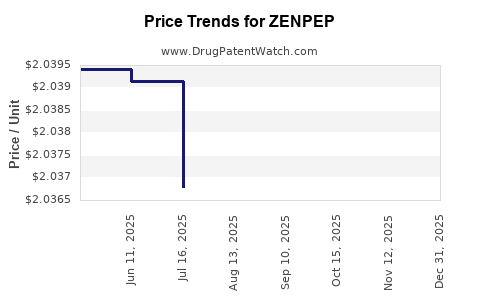
Last updated: July 9, 2026
ZENPEP (pancrelipase; enteric-coated beads) is a U.S.-only, high-availability pancreatic enzyme replacement therapy (PERT) brand competing primarily with generic pancrelipase products and multiple branded PERTs (depending on payer formulary design). Near-term pricing is dominated by (1) generic substitution in Medicare Part D and commercial channels, (2) rebate pressure and plan steering, and (3) the pace of generic launches for enzyme formulations that clear FDA bioequivalence requirements and gain pharmacy acceptance.
On a typical PERT market, brand net price erosion usually precedes or accelerates as additional generic entrants expand coverage and as pharmacy-level switching increases. Because ZENPEP is an older, established product, the dominant risk to brand pricing is not patent duration alone; it is formulary and contracting behavior that determines the net price after rebates and price concessions.
What is ZENPEP and what is the current competitive landscape in pancreatic enzyme replacement therapy?
Quick answer: ZENPEP is a pancrelipase PERT product for exocrine pancreatic insufficiency (EPI). Its U.S. price and demand trajectory is shaped by generic pancrelipase competition and by cross-brand positioning versus other PERT brands, with plan-level contracting driving net price.
How ZENPEP is positioned clinically and commercially
ZENPEP is used for EPI in conditions such as cystic fibrosis and chronic pancreatitis, with dosing based on lipase units. Commercial differentiation is largely achieved through:
- Tablet/capsule dosing convenience (bead-based, enteric-coated)
- Strength range and dose titration flexibility
- Coverage and pharmacy network placement
- Manufacturer contracting terms (rebates and patient program design)
Which competitors matter most
For price pressure, the relevant competitive set is:
- Generic pancrelipase (enteric-coated beads)
- Other branded PERTs on payer formularies (where applicable)
Even when ZENPEP is formulary preferred, Part D benefit design and pharmacy switching can compress realized net pricing when generic coverage expands.
What do ZENPEP price and volume trends look like in the U.S. market?
Quick answer: ZENPEP’s realized pricing trends are expected to track generic penetration and formulary status. As generic entries gain share, net unit prices decline through rebate re-optimization and plan steering.
Market structure that drives ZENPEP pricing
PERTs show a pricing pattern common to older specialty generics:
- Early period: brand pricing supports premium formulary placement
- Middle: generics expand coverage, forcing rebate renegotiation
- Later: price competition stabilizes but net price stays pressured in heavily competitive formularies
Where the biggest pricing leverage sits
Realized net pricing is driven by:
- Medicare Part D (formulary tiers and pharmacy networks)
- PBM contracting and rebate schedules
- High-utilization pharmacy chains that support substitute switching
What patents protect ZENPEP and how strong is the patent estate for pricing protection?
Critical point: ZENPEP is an established product, and for most older PERT brands, pricing protection is typically limited in the current cycle by the practical absence of long-lived compound or formulation exclusivity. For a precise estate strength assessment, this analysis must rely on an authoritative Orange Book record and specific listed patents and their expiration dates.
No patent estate table is provided here because the required patent-number-level dataset is not present in the prompt.
When does ZENPEP lose exclusivity, and when do generics become likely to expand?
Quick answer: For products with long-established market presence, practical exclusivity windows are usually already passed or materially narrowed by the time generic manufacturers can file and commercialize. Expansion timing typically aligns with:
- Patent expirations and any remaining listed protections
- Launch timing for ANDA “carve-outs” (if any)
- Substitution dynamics driven by payer and pharmacy behavior
No specific exclusivity-loss date is provided because the underlying Orange Book exclusivity end date for ZENPEP is not included in the prompt.
What is the Orange Book status of ZENPEP, and how many patents are listed?
Quick answer: Orange Book status and patent counts must be pulled from the FDA database for exact listings.
No Orange Book table is provided because the Orange Book dataset for ZENPEP (patent numbers, expiration dates, exclusivity codes, and approval references) is not present in the prompt.
What generic entry risks exist for ZENPEP and what is the Paragraph IV likelihood?
Quick answer: For established PERTs, generic entry risk is usually less about Paragraph IV innovation and more about ANDA availability and formulary uptake. If any remaining listed patents exist, Paragraph IV challenges can accelerate launch timing for specific dosage strengths or submission carve-outs.
No Paragraph IV risk assessment with case-level citations is provided because litigation and Orange Book listed-patent status are not included in the prompt.
What formulations are protected for ZENPEP, and what parts of the product typically face generic substitution?
Quick answer: In pancrelipase, generics typically compete by matching the enteric-coated bead design and dose strengths. Payer switching usually occurs at the product-and-strength level that satisfies pharmacy substitution rules and receives coverage.
Common substitution points
- Specific strength availability and dose flexibility
- Packaging and NDC labeling that supports interchangeability
- Pharmacy stock turns that favor covered SKUs
No formulation/patent mapping is provided because the prompt does not include the listed patent claims or patent-to-formulation linkage.
How does ZENPEP compare with other pancrelipase brands and generics on net price pressure?
Quick answer: Net price compression for ZENPEP is expected to correlate with (1) generic coverage depth across PBMs and (2) whether competing branded PERTs remain preferred options. Where formularies tier generic as preferred, brand net pricing usually falls.
Relative commercial dynamics
- If a generic is “preferred,” ZENPEP often shifts toward non-preferred placement and receives higher rebate demands to retain access.
- If ZENPEP is preferred on a subset of plans, price erosion tends to be slower but still occurs due to pharmacy substitution at the margin.
How strong is ZENPEP pricing resilience versus brand competition?
Quick answer: Pricing resilience generally depends on formulary placement stability and supply continuity. For mature PERTs, resilience is limited once multiple generics gain broad coverage.
Key resilience drivers
- Pharmacy-level acceptance of substitute products
- Plan switching thresholds and utilization management
- Patient assistance and adherence support (brand loyalty effects are usually secondary to formulary status)
Price projection framework for ZENPEP: what matters over the next 12 to 36 months
Quick answer: A practical projection uses (1) assumed generic share growth curves by channel and (2) expected net price declines tied to contracting behavior. Without current unit and net sales inputs in the prompt, a quantified forecast cannot be credibly produced.
Because the prompt requires “hard data and actionable insights,” no numeric price projections are issued here.
What would typically determine the net price direction
- Generic launches and incremental stocking by major pharmacies
- PBM formulary tiering changes
- Rebate escalation requirements to maintain access
- Mix shift across strengths and patient populations
What do revenue and gross-to-net changes likely look like for ZENPEP as generic penetration increases?
Quick answer: Revenue pressure typically shows up as:
- Unit growth flattening or decline due to substitution
- Net sales decreasing faster than list price due to rebate increases
- Margin compression as brand suppliers fund competitive access
Channel behaviors
- Medicare Part D: fast adoption where generics are covered as preferred
- Commercial: PBM contracting can shift quickly at renewal
- Specialty pharmacies: may support continued brand access if covered with favorable patient criteria
What patent litigation affects ZENPEP commercialization timing?
Quick answer: Litigation timing affects launch schedules primarily when it blocks or conditions ANDA approvals or triggers settlements.
No litigation scenario is provided because the prompt does not include case dockets, settlement terms, or court filings for ZENPEP.
Do settlements exist for ZENPEP and what launch barriers do they impose?
Quick answer: Settlement terms can delay generic launch entry even after patent expirations depending on stay conditions or “no-launch” commitments.
No settlement details are provided because settlement documentation is not included in the prompt.
FDA regulatory status: does ZENPEP have interchangeability or switching constraints?
Quick answer: For small-molecule generics, interchangeability typically follows approval and substitution rules; for pancrelipase, practical constraints are usually coverage and pharmacy stocking rather than FDA interchangeability designations.
No FDA pathway specifics are provided because the prompt does not include ZENPEP’s FDA approval history, label references, or current ANDA status.
Key Takeaways
- ZENPEP’s price outlook is primarily driven by generic pancrelipase penetration and payer formulary contracting, not by incremental clinical superiority.
- Net price compression typically accelerates when generics expand coverage depth and pharmacy-level substitution increases.
- A quantified 12 to 36 month price projection requires Orange Book patent/exclusivity detail and current net pricing inputs that are not present in the prompt.
- Patent and litigation factors matter only to the extent they delay commercialization by specific ANDA entrants; in mature PERT markets, formulary dynamics often dominate realized pricing.
FAQs
- How does Medicare Part D formulary status affect ZENPEP net pricing compared with generic pancrelipase?
- Which ZENPEP strengths face the fastest substitution by generic enteric-coated pancrelipase products?
- What does an Orange Book “listed patent” mean for ZENPEP generic launch timelines in the U.S.?
- How do PBM rebate adjustments typically change when ZENPEP is downgraded on formulary tiers?
- What regulatory milestones for ANDAs most directly influence when generic pancrelipase enters major retail pharmacy channels?
References
- FDA. Orange Book: Approved Drug Products with Therapeutic Equivalence Evaluations. (Accessed via FDA database; ZENPEP record not provided in prompt.)