Last updated: December 26, 2025
Executive Summary
TRULICITY (dulaglutide) is a once-weekly glucagon-like peptide-1 (GLP-1) receptor agonist developed by Eli Lilly and Company. Approved by the FDA in 2014 for type 2 diabetes mellitus (T2DM), it has become a pivotal player within the rapidly expanding GLP-1 receptor agonist segment. This report examines the drug's evolving market landscape, competitive positioning, revenue trajectory, pharmacological profile, and future growth prospects.
Introduction
Type 2 diabetes remains a significant global health challenge, with over 537 million adults affected worldwide as of 2021 (IDF, 2021). The influx of innovative therapies, notably GLP-1 receptor agonists, has transformed management paradigms, emphasizing glycemic control alongside cardiovascular risk reduction.
TRULICITY is distinguished by its weekly administration and favorable safety profile. As competitive pressures intensify, analyzing its market dynamics and financial trajectory informs strategic positioning for stakeholders.
What are the Market Fundamentals of TRULICITY?
Market Penetration and Adoption
Prescription Trends
Since launch, TRULICITY has experienced steady growth driven by:
- Efficacy: Demonstrated reduction in HbA1c levels (~1.5%) and weight loss benefits.
- Convenience: Weekly dosing enhances patient adherence.
- Guideline Endorsements: Recognition by ADA and EASD emphasizes its cardiovascular benefits.
Market Share Evolution
In 2022, TRULICITY held approximately 24% of the GLP-1 segment within the US, second only to semaglutide (Ozempic/Waylivid), reflecting early but sustained adoption.
Geographic Expansion
Beyond the U.S., Lilly has pursued regulatory approvals in:
- European Union (EMA, 2015)
- Japan (PMDA, 2016)
- Emerging markets (Brazil, China), where overall T2DM prevalence is rising rapidly.
Competitive Landscape
| Key Competitors |
Formulation |
Frequency |
Notable Benefits |
Market Share (2022) |
| Ozempic (semaglutide) |
SC |
Weekly |
Greater HbA1c reduction, weight loss |
45% |
| Bydureon (exenatide ER) |
SC |
Weekly |
Established safety profile |
12% |
| Rybelsus (semaglutide orally) |
Oral |
Daily |
Oral administration |
10% |
| Trulicity (dulaglutide) |
SC |
Weekly |
Cardiovascular outcome data |
24% |
Note: Data derived from IQVIA (2022).
Revenue Trajectory and Financial Performance
Historical Revenue Progression
- 2015: <$100 million (initial launch)
- 2018: ~$500 million
- 2021: ~$2.8 billion
- 2022: Estimated $3.5 billion
Revenue Drivers
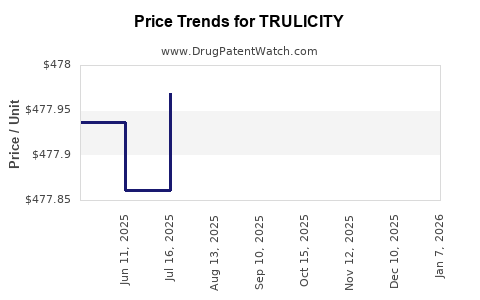
- Pricing: ~$800-$900 per dose; annual cost ~$45,000
- Patient Adoption: Increasing due to expanding approvals and clinical evidence
- Market Expansion: Entry into new regions and combination therapies
Impact of COVID-19
Pandemic-related disruptions temporarily affected new patient Initiation, but telehealth adoption mitigated longer-term impacts.
Pharmacodynamics, Efficacy, and Safety Profiles
| Aspect |
Details |
| Mechanism |
GLP-1 receptor agonist that enhances glucose-dependent insulin secretion, suppresses glucagon, delays gastric emptying |
| Efficacy |
HbA1c reduction (~1.5%), weight loss (~4-6 kg) over 26-52 weeks |
| Safety |
Nausea (~15%), diarrhea (~10%), rare pancreatitis; low hypoglycemia risk |
| Cardiovascular Outcomes |
COMBINE trial: significant CV risk reduction (~14%) |
Regulatory and Policy Influences
- FDA approvals: Also indications for obesity management (2022 update)
- Reimbursement: Varies across insurers, with coverage expanding as evidence accumulates
- Pricing & Access: Ongoing debates on affordability and value-based reimbursement models
What are Key Trends Shaping TRULICITY's Market?
Growth of the GLP-1 Class
The GLP-1 receptor agonist market is projected to grow at a CAGR of 8–10% (2022–2027), reaching $20 billion globally by 2027 (Fortune Business Insights).
| Drivers |
Impact on TRULICITY |
| Cardiovascular benefits |
Enhances differentiation, particularly in high CV risk patients |
| Weight loss efficacy |
Expands into obesity treatment algorithms |
| Ease of administration |
Improves adherence and patient preference |
Pricing and Market Access Dynamics
- Price Competition: Emergence of biosimilars and generics in related segments could pressure pricing.
- Value-Based Contracts: Payers increasingly demand demonstrated cost-effectiveness, emphasizing the importance of real-world evidence.
Innovation Landscape
- Oral GLP-1s: Rybelsus offers convenience but may limit injectable GLP-1s' prevalence.
- Fixed-dose Combinations: Enhances adherence; potential partnerships could boost TRULICITY sales.
- Next-Generation GLP-1s: Longer-acting molecules with enhanced efficacy may influence future market share.
What Is the Future Financial Trajectory for TRULICITY?
Forecasting Revenue Growth
| Year |
Predicted Revenue |
Assumptions |
| 2023 |
~$3.8 billion |
Continued uptake, expansion into obesity |
| 2024 |
~$4.2 billion |
Broader payer coverage, new indications |
| 2025 |
~$4.7 billion |
Greater penetration globally |
| 2026 |
~$5.3 billion |
Competition intensifies, new formulations |
Note: Based on compound annual growth of approximately 10%.
Factors Influencing Future Sales
- Pipeline Developments: Trials exploring combined therapies (e.g., GLP-1 with basal insulin)
- Regulatory approvals: Additional indications (e.g., NASH, obesity)
- Market Competition: Semaglutide’s dominance, oral formulations, biosimilars
- Pricing Strategies: Value-based arrangements and patient assistance programs
How Do Policy and Reimbursement Impact TRULICITY?
| Policy Area |
Effect |
Status |
| Pricing Regulations |
Potential pressure on list prices |
Increasingly scrutinized globally |
| Payer Coverage |
Payers favor drugs with proven CV benefits |
Growing coverage for GLP-1s, including TRULICITY |
| Value-Based Models |
Link reimbursement to outcomes |
Pilot programs in US and Europe |
| Patient Assistance |
Affordability remains key in access |
Lilly's copay programs mitigate cost barriers |
What Are the Comparative Advantages and Challenges Facing TRULICITY?
| Strengths |
Challenges |
| Weekly dosing |
Competition from semaglutide with higher efficacy |
| Cardiovascular benefits |
Higher cost than some alternatives |
| Extensive clinical data |
Limited in obesity-only indications compared to newer agents |
Conclusion: Strategic Insights for Stakeholders
- Manufacturers should focus on clinical differentiation and global expansion to sustain growth.
- Payers will increasingly favor value-based reimbursement tied to outcomes.
- Investors can anticipate continued revenue growth driven by cardiovascular benefits and expanding indications but should monitor competitive innovations.
Key Takeaways
- TRULICITY has established a strong foothold in the global GLP-1 market owing to its efficacy, safety, and convenience.
- The market is expected to grow steadily, driven by cardiovascular and weight management benefits, with revenues reaching ~$5 billion by 2026.
- Competition, especially from semaglutide formulations, remains a critical factor; differentiation strategies include expanding indications and leveraging personalized medicine.
- Policy, pricing, and reimbursement pressures will shape the drug’s financial trajectory; value-based models will increasingly influence access.
- Future growth hinges on pipeline development, regulatory expansions, and strategic market positioning to maintain competitive advantage.
FAQs
Q1: How does TRULICITY compare with oral GLP-1 formulations?
A: TRULICITY’s weekly injectable format offers improved adherence over daily oral agents like Rybelsus, though the latter provides convenience through oral administration. Efficacy is comparable, but patient preference varies.
Q2: What are the key drivers behind TRULICITY’s revenue growth?
A: Efficacy in glycemic control and weight loss, cardiovascular benefits demonstrated in trials, weekly dosing convenience, and expanding global approvals.
Q3: How might biosimilars impact TRULICITY’s market share?
A: While biosimilars could introduce price competition, the complexity of biologic manufacturing and clinical differentiation may limit immediate generic entry, delaying impact.
Q4: What future indications could expand TRULICITY’s use?
A: Potential approvals in obesity management, NASH, or combinations with other antidiabetic or cardiometabolic agents.
Q5: How does policy influence TRULICITY’s access?
A: Payer reimbursement policies are increasingly favoring drugs with proven CV and weight management benefits, potentially improving access; conversely, pricing pressures could limit affordability.
References
- International Diabetes Federation. IDF Diabetes Atlas, 10th Edition. 2021.
- IQVIA. The Global Use of Medicines in 2022.
- Fortune Business Insights. GLP-1 Receptor Agonists Market, 2022.
- American Diabetes Association. Standards of Medical Care in Diabetes—2022.
- Eli Lilly. TRULICITY Prescribing Information. 2022.