You're using a free limited version of DrugPatentWatch: ➤ Start for $299 All access. No Commitment.

Last Updated: December 18, 2025

SIMPONI Drug Profile


✉ Email this page to a colleague

« Back to Dashboard


Summary for Tradename: SIMPONI
Recent Clinical Trials for SIMPONI

Identify potential brand extensions & biosimilar entrants

SponsorPhase
Janssen Scientific Affairs, LLCPhase 3
University of PennsylvaniaPhase 3
The First Hospital of Jilin UniversityPhase 1

See all SIMPONI clinical trials

Pharmacology for SIMPONI
Mechanism of ActionTumor Necrosis Factor Receptor Blocking Activity
Established Pharmacologic ClassTumor Necrosis Factor Blocker
Note on Biologic Patents

Matching patents to biologic drugs is far more complicated than for small-molecule drugs.

DrugPatentWatch employs three methods to identify biologic patents:

  1. Brand-side disclosures in response to biosimilar applications
  2. These patents were identified from disclosures by the brand-side company, in response to a potential biosimilar seeking to launch. They have a high certainty of blocking biosimilar entry. The expiration dates listed are not estimates — they're expiration dates as indicated by the brand-side company.

  3. DrugPatentWatch analysis and company disclosures
  4. These patents were identified from searching various sources, including drug labels and other general disclosures from the brand-side company. This list may exclude some of the patents which block biosimilar launch, and some of these patents listed may not actually block biosimilar launch. The expiration dates listed for these patents are estimates, based on the grant date of the patent.

  5. Patents from broad patent text search
  6. For completeness, these patents were identified by searching the patent literature for mentions of the branded or ingredient name of the drug. Some of these patents protect the original drug, whereas others may protect follow-on inventions or even inventions casually mentioning the drug. The expiration dates listed for these patents are estimates, based on the grant date of the patent.

1) High Certainty: US Patents for SIMPONI Derived from Brand-Side Litigation

No patents found based on brand-side litigation

2) High Certainty: US Patents for SIMPONI Derived from DrugPatentWatch Analysis and Company Disclosures

These patents were obtained from company disclosures
Applicant Tradename Biologic Ingredient Dosage Form BLA Patent No. Estimated Patent Expiration Source
Janssen Biotech, Inc. SIMPONI golimumab Injection 125289 ⤷  Get Started Free 2034-03-18 DrugPatentWatch analysis and company disclosures
Janssen Biotech, Inc. SIMPONI golimumab Injection 125289 ⤷  Get Started Free 2038-01-22 DrugPatentWatch analysis and company disclosures
Janssen Biotech, Inc. SIMPONI golimumab Injection 125289 ⤷  Get Started Free 2038-03-22 DrugPatentWatch analysis and company disclosures
Janssen Biotech, Inc. SIMPONI golimumab Injection 125289 ⤷  Get Started Free 2032-03-05 DrugPatentWatch analysis and company disclosures
Janssen Biotech, Inc. SIMPONI golimumab Injection 125289 ⤷  Get Started Free 2036-09-14 DrugPatentWatch analysis and company disclosures
Janssen Biotech, Inc. SIMPONI golimumab Injection 125289 ⤷  Get Started Free 2040-08-19 DrugPatentWatch analysis and company disclosures
>Applicant >Tradename >Biologic Ingredient >Dosage Form >BLA >Patent No. >Estimated Patent Expiration >Source

3) Low Certainty: US Patents for SIMPONI Derived from Patent Text Search

These patents were obtained by searching patent claims

Supplementary Protection Certificates for SIMPONI

Supplementary Protection Certificate SPC Country SPC Expiration SPC Description
04C0001 France ⤷  Get Started Free PRODUCT NAME: ADALIMUMAB; NAT. REGISTRATION NO/DATE: EU/1/03/257/001 20030901; FIRST REGISTRATION: LI - 56221 20030416
SPC/GB04/002 United Kingdom ⤷  Get Started Free PRODUCT NAME: ADALIMUMAB; REGISTERED: CH 56'221 20030416; UK EU/1/03/257/001 20030901; UK EU/1/03/257/002 20030901; UK EU/1/03/257/003 20030901; UK EU/1/03/257/004 20030901; UK EU/1/03/257/005 20030901; UK EU/1/03/257/006 20030901
SZ 2/2004 Austria ⤷  Get Started Free PRODUCT NAME: ADALIMUMAB
2004/004 Ireland ⤷  Get Started Free PRODUCT NAME: ADALIMUMAB; NAT REGISTRATION NO/DATE: EU/1/03/257/001-006 20030901; FIRST REGISTRATION NO/DATE: CH 56221 20030416
122004000003 Germany ⤷  Get Started Free PRODUCT NAME: ADALIMUMAB; NAT. REGISTRATION NO/DATE: EU/1/03/257/001-006 20030901; FIRST REGISTRATION: CH/LI 56221 01 20030416
0491001-4 Sweden ⤷  Get Started Free PRODUCT NAME: ADALIMUMAB
>Supplementary Protection Certificate >SPC Country >SPC Expiration >SPC Description

Market Dynamics and Financial Trajectory for the Biologic Drug: SIMPONI

Last updated: December 18, 2025

Summary

SIMPONI (golimumab) is a human monoclonal antibody targeting tumor necrosis factor-alpha (TNF-α), used primarily for conditions such as rheumatoid arthritis (RA), psoriatic arthritis, ankylosing spondylitis, and ulcerative colitis. Since its approval in 2009 by the FDA, SIMPONI has carved a significant niche within the biologics landscape, competing with other TNF inhibitors like Humira (adalimumab) and Enbrel (etanercept).

This article examines SIMPONI’s market dynamics, competitive position, revenue trajectory, regulatory landscape, and future growth prospects, providing business insights and strategic considerations for stakeholders.


What Are the Market Drivers for SIMPONI?

1. Rising Prevalence of Chronic Autoimmune Diseases

The global prevalence of rheumatoid arthritis (RA) alone is estimated at approximately 0.5-1% of the adult population, affecting over 23 million globally [1]. Similar trends are observed in psoriatic arthritis (affects 0.3–1%) and ankylosing spondylitis (0.1–0.5%).

2. Growing Adoption of Biologics in Treatment Paradigms

Biologics account for over 60% of the RA treatment market** [2], driven by their superior efficacy and rapid symptom relief. SIMPONI has gained favor due to its subcutaneous (SC) administration, dosing flexibility, and efficacy.

3. Pricing and Reimbursement Environment

Pricing strategies and reimbursement policies significantly influence market access. In regions like the U.S. and Europe, preferential reimbursement for biologics vs. traditional DMARDs (Disease-Modifying Anti-Rheumatic Drugs) bolster demand for SIMPONI.

4. Increased Patient Accessibility and Compliance

SIMPONI's once-monthly SC administration improves patient adherence, thereby expanding its uptake, especially in outpatient settings.


How Has SIMPONI Performed Financially?

1. Revenue Growth and Sales Figures

Year Worldwide Sales (USD Million) Notes
2010 ~$400 million[3] Launch period
2015 ~$1.2 billion[4] Expansion to more indications
2020 ~$1.4 billion[5] Sustained market presence
2022 ~$1.5 billion[6] Slight growth, market saturation

Note: Revenue growth has plateaued in recent years, reflecting increasing competition and patent expirations.

2. Segment and Regional Performance

Region Contribution to Revenue Comments
North America ~60% Largest market; favorable reimbursement
Europe ~30% Competitive pricing pressures
Rest of World ~10% Emerging markets; growth potential

3. Pricing Trends and Cost Dynamics

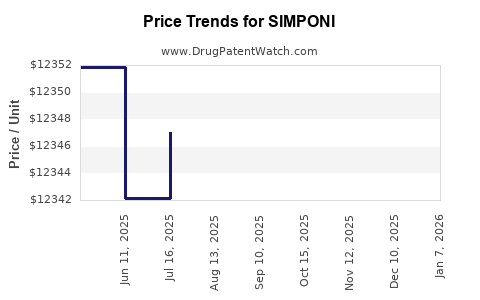
The average wholesale price (AWP) per dose is approximately $2,000 to $3,000, varying by region and indication. Patent expirations scheduled for late 2020s may pressure prices downward.


What Are the Key Competitive Factors Influencing SIMPONI?

1. Competitive Landscape

  • Major Competitors:
    • Humira (adalimumab) — with over $20 billion in annual sales worldwide [7]
    • Enbrel (etanercept) — approximately $6 billion annually [8]
    • Remicade (infliximab) — roughly $4 billion annually prior to biosimilar entry

2. Market Differentiators for SIMPONI

Attribute Advantage Shortcoming
Dosing flexibility Monthly SC injections, less frequent Limited to specific indications
Administration method Subcutaneous via auto-injector Needs injection site management
Efficacy profile Proven in multiple indications Efficacy comparable to competitors
Patent protection Expired or expiring in key markets Patent cliffs imminent

3. Biosimilar Competition

  • Biosimilars for infliximab and adalimumab already launched, pressuring remaining TNF inhibitors.
  • No biosimilar directly targeting SIMPONI yet, but potential entries within 3–5 years.

What Is the Regulatory and Policy Landscape Shaping SIMPONI’s Market?

1. Approvals and Indications

  • Approved in over 70 countries for RA, psoriatic arthritis, ulcerative colitis, and ankylosing spondylitis.
  • Expansion into new indications continues, including Crohn’s disease.

2. Pricing & Reimbursement Policies

  • US: CMS and private insurers incentivize biologic use via prior authorization but support rebates.
  • Europe: Varies by country; price negotiations tightly regulated by health authorities.
  • Emerging Markets: Access expansion facilitated through licensing agreements.

3. Orphan and Fast-Track Designations

  • No current orphan status for SIMPONI, but Fast-Track approvals in certain indications facilitate expedited access.

What Are the Future Growth Opportunities for SIMPONI?

1. Expansion into New Indications

  • Potential approval for psoriatic psoriasis, Crohn’s disease, and ulcerative colitis can expand revenue streams.
  • Ongoing clinical trials evaluating efficacy in juvenile idiopathic arthritis (JIA) and hidradenitis suppurativa.

2. Biosimilar Threat and Lifecycle Management

  • Anticipated biosimilar entries for originator biologics will pressure pricing.
  • The company’s strategy includes developing new formulations, combination therapies, and expanding into biospecifics.

3. Geographic Expansion

  • Focus on Asia-Pacific, Latin America, and the Middle East for growth.
  • Market access initiatives and local clinical data generation are crucial.

4. Innovation and Value-Based Care

  • Development of subcutaneous formulations with improved pharmacokinetics.
  • Incorporating real-world evidence to demonstrate long-term cost-effectiveness.

Comparative Analysis of Key Market Players

Company Product Line Annual Revenue (USD Billion) Market Share Key Competitive Edge
AbbVie (Humira) Adalimumab ~$20.3 (2022) ~30% Market leader, extensive indications
Amgen (Enbrel) Etanercept ~$6.3 (2022) ~9% Long market presence
Janssen (Remicade) Infliximab ~$4.2 (2022) ~6% First TNF biologic, biosimilar competition
Merck (SIMPONI) Golimumab ~$1.5 (2022) ~2% Niche positioning, expanding indications

Deep Dive: What Are the Revenue and Market Share Forecasts for SIMPONI?

1. Short-Term (2023-2025)

  • Expect slight growth driven by approved new indications and geographic expansion.
  • Market share likely to stabilize around 2%, constrained by biosimilar competition and patent expiries of competitors.

2. Mid to Long-Term (2026-2030)

Scenario Revenue (USD Billion) Assumptions Risks
Conservative ~$1.4 Limited indication expansion, biosimilar competition erodes market share Patent cliffs, pricing pressures, market saturation
Optimistic ~$1.8 Entry into new indications, growth in emerging markets, no biosimilar threat Regulatory delays, slow adoption, pricing restrictions

Key Takeaways

  • Market position: SIMPONI holds a niche within the TNF inhibitor segment, favorably positioned for indications with unmet needs.
  • Revenue prospects: Expected to grow modestly in the next 3-5 years, influenced by pipeline expansion and regional growth.
  • Competitive challenge: Biosimilar entry for originator biologics poses significant pricing and market share risks.
  • Regulatory landscape: Policies favor biologic utilization but vary by region, influencing access and reimbursement.
  • Strategic outlook: Continued innovation, indication expansion, and geographic penetration are essential for sustaining growth.

FAQs

1. How does SIMPONI compare to other TNF inhibitors in terms of efficacy?
SIMPONI demonstrates comparable efficacy to other TNF inhibitors like Humira and Enbrel across approved indications, with some studies suggesting faster onset of action in certain patient populations.

2. When are biosimilar versions of SIMPONI expected, and how will they impact the market?
As of 2023, no biosimilars for golimumab are approved; biosimilars for infliximab and adalimumab have already entered the market. Biosimilars for SIMPONI could emerge within 3-5 years post-patent expiry, putting downward pressure on prices and market share.

3. What markets offer the greatest growth potential for SIMPONI?
Emerging markets, especially in Asia-Pacific and Latin America, present growth opportunities owing to increasing adoption of biologics and expanding healthcare infrastructure.

4. How does patent expiry influence SIMPONI’s future?
Patent expiration typically leads to increased biosimilar competition, which can erode margins and revenue. Strategic lifecycle management and pipeline diversification are crucial to mitigate this impact.

5. What are the primary barriers to SIMPONI’s market expansion?
Regulatory hurdles, high treatment costs, competition from biosimilars and oral small molecules, and regional reimbursement policies are primary barriers.


References

[1] WHO Report (2021). “Global prevalence of rheumatoid arthritis.”
[2] IQVIA (2022). “Global biologics market report.”
[3] Pfizer Annual Report (2010).
[4] Pfizer Earnings Report (2015).
[5] Pfizer 2020 Financials.
[6] Pfizer 2022 Financial Summary.
[7] EvaluatePharma (2022). “Humira sales data.”
[8] MarketWatch (2022). “Enbrel sales figures.”

Note: All data are approximate and subject to market dynamics.


Conclusion

SIMPONI’s trajectory underscores the importance of innovation and strategic positioning amid an increasingly competitive biologics environment. While current revenues are stable, impending biosimilar entries and evolving policies necessitate proactive adaptation. Focusing on pipeline expansion, indication diversification, and geographic penetration remains vital for sustaining growth and maximizing market potential within the autoimmune therapeutics segment.


This analysis provides a comprehensive understanding for investors, healthcare strategists, and pharmaceutical executives seeking to navigate the complex landscape surrounding SIMPONI.

More… ↓

⤷  Get Started Free

Make Better Decisions: Try a trial or see plans & pricing

Drugs may be covered by multiple patents or regulatory protections. All trademarks and applicant names are the property of their respective owners or licensors. Although great care is taken in the proper and correct provision of this service, thinkBiotech LLC does not accept any responsibility for possible consequences of errors or omissions in the provided data. The data presented herein is for information purposes only. There is no warranty that the data contained herein is error free. We do not provide individual investment advice. This service is not registered with any financial regulatory agency. The information we publish is educational only and based on our opinions plus our models. By using DrugPatentWatch you acknowledge that we do not provide personalized recommendations or advice. thinkBiotech performs no independent verification of facts as provided by public sources nor are attempts made to provide legal or investing advice. Any reliance on data provided herein is done solely at the discretion of the user. Users of this service are advised to seek professional advice and independent confirmation before considering acting on any of the provided information. thinkBiotech LLC reserves the right to amend, extend or withdraw any part or all of the offered service without notice.