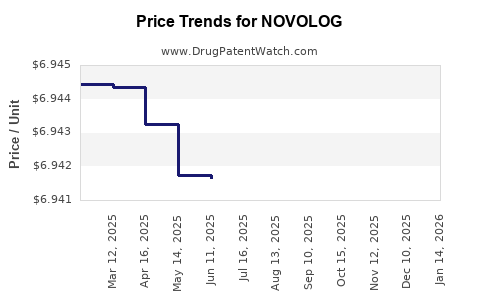
Last updated: September 8, 2026
NovoLog, Novo Nordisk's insulin aspart brand, is a mature rapid-acting insulin franchise under sustained pricing, volume, and competitive pressure. The product remains commercially important because of its established use in multiple daily injection regimens, insulin pumps, hospitals, and diabetes-care formularies. Its growth profile has weakened as US insulin prices decline, payers increase rebate demands, and lower-cost follow-on insulins enter the market.
NovoLog is sold as NovoRapid in most non-US markets. Novo Nordisk reports financial results primarily for the combined insulin aspart franchise rather than separating NovoLog from NovoRapid. Global insulin aspart sales have declined from their earlier peak, while the company's overall financial growth has shifted toward Ozempic, Wegovy, and other GLP-1 products.
What is NovoLog and how is it used?
NovoLog is insulin aspart, a rapid-acting recombinant human insulin analog approved by the FDA in 2000. It is indicated for improving glycemic control in adults and children with diabetes mellitus. The product is administered by subcutaneous injection and is also used in external insulin pumps. [1]
| Attribute |
NovoLog |
| Active ingredient |
Insulin aspart |
| Drug class |
Rapid-acting insulin analog |
| US sponsor |
Novo Nordisk |
| US NDA |
020986 |
| Initial FDA approval |
2000 |
| International brand |
NovoRapid |
| Main dosage forms |
Vials, prefilled pens, cartridges, pump-compatible presentations |
| Principal competitors |
Humalog, Lyumjev, Admelog, insulin lispro biosimilars, follow-on insulin aspart |
| Regulatory category |
Biologic under the Public Health Service Act framework |
| Primary commercial markets |
United States, Europe, Japan, China, and other diabetes markets |
NovoLog has a faster onset than regular human insulin and is generally administered around mealtimes. Its clinical utility is established, but the product has limited differentiation from other rapid-acting insulin analogs.
How have NovoLog and NovoRapid sales changed?
Novo Nordisk does not generally publish a separate global revenue line for US NovoLog. Its financial disclosures combine NovoLog and NovoRapid under insulin aspart or rapid-acting insulin products. Reported sales have declined over the long term despite continued prescription demand.
Approximate reported Novo Nordisk insulin aspart sales were in the low-to-mid DKK 10 billion range in recent years, compared with higher levels earlier in the product's commercial life. The exact product line can change with annual-report classification and currency effects.
| Period |
Novo Nordisk commercial position |
Financial direction |
| 2000s |
Rapid expansion of insulin analog adoption |
Strong growth |
| 2010s |
Mature franchise with broad formulary access |
Stable to modest decline |
| 2020-2022 |
Continued demand but increasing US rebate pressure |
Mixed |
| 2023 |
Lower insulin pricing and competitive pressure |
Decline |
| 2024 onward |
Mature insulin franchise funding growth in GLP-1 products |
Continuing structural pressure |
Novo Nordisk's total sales increased sharply in 2023 and 2024, but that growth was driven mainly by semaglutide products. The company's diabetes and obesity portfolio expanded while traditional insulin products contributed a smaller proportion of total revenue. NovoLog therefore remains strategically relevant but is no longer a primary corporate growth engine. [2,3]
What is NovoLog's estimated revenue exposure?
NovoLog's direct revenue exposure is smaller than its clinical footprint suggests because Novo Nordisk reports it within broader insulin categories. The product is exposed to:
- US gross-to-net price erosion;
- higher rebates to pharmacy benefit managers;
- Medicare and Medicaid pricing controls;
- biosimilar and authorized-generic competition;
- substitution among rapid-acting insulins;
- reduced insulin use per patient in some populations using newer technologies;
- payer preference for lower-cost lispro or aspart alternatives.
NovoLog remains important to Novo Nordisk's diabetes-care infrastructure, but its contribution to consolidated earnings is declining relative to Ozempic, Wegovy, Rybelsus, and other incretin products.
When did NovoLog lose market exclusivity?
NovoLog lost the practical benefit of new-molecule exclusivity many years ago. The FDA approved the product in 2000, so its five-year new chemical entity exclusivity would have expired no later than 2005. The product's original composition and core insulin-aspart patent protection also expired years ago.
The relevant commercial question is no longer whether NovoLog has basic exclusivity. It is whether a competitor can secure FDA approval, obtain reimbursement, establish manufacturing capacity, and gain formulary access.
| Exclusivity or protection |
Approximate status |
| FDA five-year new chemical entity exclusivity |
Expired |
| Core insulin-aspart composition patents |
Expired |
| Original product launch protection |
Expired |
| Formulation and device-related rights |
Potentially relevant by presentation and jurisdiction |
| Current commercial protection |
Brand recognition, supply scale, clinical familiarity, and contracting |
Insulin products can have complex patent and regulatory histories because different presentations, devices, manufacturing processes, and formulation changes may be covered separately. Expiration of the original active-ingredient patent does not automatically eliminate every possible patent claim related to a pen, cartridge, pump formulation, manufacturing process, or later supplement.
What is the Orange Book status of NovoLog?
NovoLog's original Orange Book position does not provide the type of long-dated protection associated with a recently launched small-molecule medicine. The product's principal commercial patents expired before the current competitive period.
The Orange Book remains relevant for determining whether a generic applicant can file an abbreviated new drug application with a Paragraph IV certification. For biologic insulin products, however, the principal competitive pathway is generally the FDA biosimilar pathway under section 351(k), rather than the traditional small-molecule ANDA pathway.
NovoLog's practical protection is therefore based on:
- brand and prescriber familiarity;
- manufacturing reliability;
- pump and delivery-system compatibility;
- payer contracts;
- distribution scale;
- switching friction for patients using established devices.
FDA labeling and product-specific regulatory history should be reviewed with the current Orange Book and Purple Book because listings can change as sponsors add or withdraw presentations. [4,5]
Which companies are challenging NovoLog?
The main competitors are Eli Lilly, Sanofi, Viatris, Biocon Biologics, and other insulin manufacturers supplying lower-cost products.
| Competitor |
Product |
Competitive position |
| Eli Lilly |
Humalog, insulin lispro |
Established rapid-acting analog |
| Eli Lilly |
Lyumjev |
Faster-acting insulin lispro |
| Sanofi |
Admelog, insulin lispro |
Follow-on rapid-acting insulin |
| Biocon Biologics/Viatris |
Kirsty, insulin aspart-szjj |
FDA-approved biosimilar to NovoLog |
| Novo Nordisk |
Authorized generic NovoLog |
Lower-priced version of the branded product |
Kirsty is the most direct regulatory challenge because it is insulin aspart rather than a different rapid-acting analog. Humalog, Admelog, and Lyumjev compete clinically but do not create direct molecule-for-molecule substitution in every setting.
What biosimilar and generic risks affect NovoLog?
Insulin competition is different from conventional generic competition. Several factors reduce the speed of substitution:
- insulin delivery devices may not be interchangeable;
- prescribers and patients may prefer a familiar pen;
- pharmacy substitution rules vary;
- biosimilar interchangeability status can differ from ordinary generic substitution;
- formularies often select one preferred insulin and impose prior authorization on others;
- manufacturing capacity and cold-chain distribution are significant barriers.
The FDA approved insulin aspart-szjj, marketed as Kirsty, as a biosimilar to NovoLog. A biosimilar approval establishes regulatory comparability but does not guarantee broad commercial uptake. The product must secure payer coverage, pharmacy distribution, clinician acceptance, and competitive net pricing.
Novo Nordisk also has used lower-priced versions and authorized-generic strategies to defend access and retain volume. That approach can protect unit share while reducing average selling price and gross margin.
What formulation patents and manufacturing rights protect NovoLog?
The highest-value remaining barriers are not likely to be the original insulin-aspart molecule. They relate to the product ecosystem.
Delivery devices
NovoLog is supplied in presentations that depend on FlexPen, FlexTouch, cartridges, vials, and pump-use configurations. Device patents can cover:
- dose-setting mechanisms;
- cartridge interfaces;
- injection-force systems;
- dose counters;
- pen assembly;
- human-factors improvements.
These rights can affect competitive presentation launches even when the active ingredient is no longer protected.
Formulation and stability
Insulin formulations can involve claims directed to:
- excipient combinations;
- pH control;
- aggregation prevention;
- storage stability;
- preservative systems;
- pump compatibility;
- concentration and container interaction.
Such claims may create manufacturing or formulation hurdles, although they do not necessarily block a biosimilar with a different formulation.
Manufacturing processes
Recombinant insulin production requires validated cell culture, purification, folding, formulation, sterile filling, and cold-chain processes. Manufacturing know-how can remain commercially important even after patent expiration. The manufacturing barrier is operational rather than a complete legal exclusivity barrier.
What Paragraph IV challenges and litigation affect NovoLog?
NovoLog does not have the current litigation profile associated with a newly launched high-value small molecule. The principal original composition patents expired long ago, and the current competitive threat comes mainly through biosimilar and follow-on insulin regulation rather than a new wave of Paragraph IV litigation.
A Paragraph IV filing would be most relevant if an applicant relied on an ANDA for a presentation treated as a generic drug. A 351(k) biosimilar applicant instead must address reference-product exclusivity and patent-dispute procedures under the Biologics Price Competition and Innovation Act.
There is no publicly prominent, current US patent settlement involving NovoLog comparable to the major settlements seen in oncology, immunology, or cardiovascular products. Commercial agreements and supply arrangements are more likely to influence market entry than a long-term patent settlement.
How strong is NovoLog's patent estate?
NovoLog's patent estate is weak as a primary exclusivity platform and moderate as a product-defense platform.
| Patent category |
Relative strength |
| Core insulin-aspart composition |
Low; expired |
| Original formulation protection |
Low to moderate; largely expired or commercially bypassed |
| Pen and delivery-device patents |
Moderate, depending on presentation |
| Manufacturing know-how |
Moderate to high operational value |
| Regulatory exclusivity |
Low |
| Brand and clinical familiarity |
High commercial value |
| Payer and distribution contracts |
High near-term commercial value |
The franchise has meaningful commercial defenses but limited ability to prevent all lower-cost competition. Its strongest assets are supply reliability, installed use, and contracting rather than patent exclusivity.
How does NovoLog compare with Humalog and Admelog?
| Factor |
NovoLog |
Humalog |
Admelog |
| Active ingredient |
Insulin aspart |
Insulin lispro |
Insulin lispro |
| Sponsor |
Novo Nordisk |
Eli Lilly |
Sanofi |
| Market age |
Mature |
Mature |
Later follow-on entrant |
| Direct biosimilar pressure |
High |
High |
Moderate to high |
| Pump use |
Established |
Established |
Product-specific |
| Main defense |
Scale, devices, contracts |
Scale, contracts, portfolio breadth |
Lower-cost positioning |
| Growth outlook |
Declining or low growth |
Mature |
Share-driven |
NovoLog and Humalog compete for the same broad rapid-acting insulin demand. Product-level clinical differences are usually less important than formulary position, patient continuity, device availability, and net price.
What generic launch scenarios exist for NovoLog?
Scenario 1: Gradual biosimilar uptake
A biosimilar captures share through selected formularies, Medicaid programs, and price-sensitive channels. Novo Nordisk retains most commercially attractive patients through contracting and device familiarity.
Scenario 2: Aggressive payer substitution
A major pharmacy benefit manager or national insurer designates a lower-cost insulin as preferred. NovoLog volume declines faster, while Novo Nordisk protects access through rebates and authorized-generic pricing.
Scenario 3: Multi-source commoditization
Several insulin aspart and insulin lispro products compete simultaneously. Net prices fall, and manufacturers prioritize production efficiency over premium branding.
Scenario 4: Brand resilience
NovoLog retains substantial share because of pump use, physician familiarity, patient stability, and reliable supply. Revenue still declines because of lower net pricing.
The most probable outcome is continued erosion rather than abrupt displacement. Insulin markets change through formulary cycles and contracting periods, not solely through patent expiry dates.
What is NovoLog's FDA regulatory status?
NovoLog is an FDA-approved insulin aspart product with established indications for diabetes treatment. Its regulatory lifecycle includes multiple presentations and delivery devices. FDA-approved biosimilar and follow-on insulin products increase competitive pressure without eliminating the need for product-specific device and labeling compliance.
The regulatory risks are limited compared with an investigational product. The primary issues are manufacturing compliance, supply continuity, presentation changes, device performance, and requirements for biosimilar or follow-on products.
What licensing deals affect NovoLog?
NovoLog is primarily an internally developed Novo Nordisk product. Its competitive landscape is more affected by manufacturing and commercialization arrangements involving follow-on insulin companies than by a major NovoLog licensing deal.
Viatris and Biocon Biologics developed and commercialized biosimilar insulin products, including insulin aspart-szjj. Changes in that relationship and the transfer of biosimilar commercial activities can affect the availability and scale of competing products.
The absence of a major external license does not reduce NovoLog's exposure. It means Novo Nordisk controls the core franchise while competitors use independent biosimilar development and manufacturing platforms.
What geographic markets are most exposed?
The United States presents the highest near-term pricing risk because of concentrated payer power, rebate dependence, Medicare reforms, and public pressure to lower insulin costs.
Europe has mature insulin use and strong price controls. Market access depends heavily on tendering and national reimbursement decisions. Japan and other Asian markets have established insulin demand but often apply formal pricing controls. Emerging markets offer volume growth but usually at lower prices and with higher tender competition.
| Region |
Main risk |
NovoLog opportunity |
| United States |
Rebates, Medicare pricing, biosimilar entry |
Scale, pump penetration, brand continuity |
| Europe |
Tendering and reference pricing |
Established clinical use |
| Japan |
Regulated pricing |
Stable diabetes demand |
| China |
Volume-based procurement and local competition |
Large patient population |
| Emerging markets |
Lower price and distribution constraints |
Long-term volume expansion |
Key Takeaways
- NovoLog is insulin aspart, marketed as NovoRapid outside the United States.
- FDA approval occurred in 2000, and core exclusivity has expired.
- Novo Nordisk reports the product within broader insulin aspart and insulin categories, limiting precise standalone revenue analysis.
- The financial trajectory is declining or mature, even as Novo Nordisk's total revenue grows rapidly through GLP-1 products.
- Biosimilar insulin aspart, including Kirsty, is the most direct competitive threat.
- Humalog, Lyumjev, and Admelog create additional rapid-acting insulin price pressure.
- NovoLog's strongest defenses are manufacturing scale, devices, pump compatibility, payer contracts, and clinical familiarity.
- The main risk is gradual net-price and volume erosion rather than a single patent-driven loss of exclusivity.
- Formulation, delivery-device, and manufacturing rights may remain relevant, but they do not recreate the original molecule-level monopoly.
- The most likely launch pattern for competitors is selective formulary penetration followed by broader price competition.
FAQs
Is NovoLog still patent protected?
The original insulin-aspart composition protection has expired. Device, formulation, and manufacturing rights may remain relevant for specific presentations, but they do not provide the original product with broad molecule-level exclusivity.
Is Kirsty interchangeable with NovoLog?
Kirsty is an FDA-approved biosimilar to NovoLog. Biosimilarity does not automatically establish pharmacy-level interchangeability in every market or payer channel.
Does NovoLog have a generic version?
Novo Nordisk has offered lower-priced versions of insulin products, and insulin aspart-szjj provides a biosimilar competitive alternative. The commercial market is more complex than ordinary tablet generic substitution because devices, formularies, and reimbursement rules matter.
Why are NovoLog sales declining while Novo Nordisk is growing?
Novo Nordisk's growth is concentrated in semaglutide and obesity medicines. Mature insulin products face price reductions, rebates, and follow-on competition, so they contribute less to total company growth.
Can a competitor launch insulin aspart without infringing NovoLog patents?
A competitor must assess current patent claims covering its formulation, device, manufacturing process, and presentation. Expiration of the core molecule patent removes the central barrier but does not eliminate every potential patent issue.
References
- U.S. Food and Drug Administration. (2000). NovoLog insulin aspart prescribing information.
- Novo Nordisk A/S. (2023). Annual report 2023.
- Novo Nordisk A/S. (2024). Annual report 2024.
- U.S. Food and Drug Administration. (2024). Approved drug products with therapeutic equivalence evaluations: Orange Book.
- U.S. Food and Drug Administration. (2024). Purple Book: Database of licensed biological products.
- U.S. Food and Drug Administration. (2021). Kirsty insulin aspart-szjj approval information.