Last updated: September 14, 2026
Novolin N is Novo Nordisk’s recombinant human insulin isophane suspension, commonly called NPH insulin. Its commercial outlook is defined by mature-product economics: low patent protection, heavy price competition, declining preference versus insulin analogs, and continued demand from cost-sensitive patients. Novo Nordisk does not disclose Novolin N revenue separately, so its financial trajectory must be assessed through portfolio disclosures, U.S. insulin pricing, formulary access, and market-share trends.
What is Novolin N and how is it used?
Novolin N is an intermediate-acting insulin used to improve glycemic control in adults and children with diabetes mellitus. It contains human insulin complexed with protamine, which delays absorption after subcutaneous administration. The product is supplied as vials and FlexPen prefilled devices in a U-100 concentration in the United States [1].
| Attribute |
Novolin N |
| Active ingredient |
Insulin human, recombinant |
| Formulation |
Isophane insulin suspension, NPH |
| Concentration |
U-100, 100 units/mL |
| Administration |
Subcutaneous injection |
| Duration |
Intermediate acting, generally about 12-18 hours, with substantial patient variability |
| U.S. manufacturer |
Novo Nordisk |
| U.S. regulatory status |
FDA-approved human insulin product |
| Principal competitors |
Humulin N, ReliOn Novolin N, insulin analogs, lower-cost human insulin products |
| Primary market position |
Mature, lower-cost basal insulin option |
Novolin N is not a long-acting insulin analog. It has a more variable absorption profile than insulin glargine, insulin detemir and insulin degludec. Its pharmacologic profile can require meal planning and dosing adjustments that are less convenient than newer basal products.
What is the FDA regulatory status of Novolin N?
Novolin N is an FDA-approved insulin product, not a newly launched biologic. The FDA approved Novolin human insulin products under the traditional drug approval framework before insulin products transitioned to regulation under the Public Health Service Act. FDA lists Novolin N labeling under Novo Nordisk’s approved product documentation [1].
The FDA completed the transition of insulin products from the Federal Food, Drug, and Cosmetic Act to the Public Health Service Act on March 23, 2020. The transition created a pathway for insulin products to be approved as biologics and for follow-on products to use the biosimilar or interchangeable biosimilar framework [2].
Does Novolin N have biosimilar competition?
There is no widely commercialized FDA-designated interchangeable biosimilar version of insulin NPH that directly substitutes for Novolin N as of the latest publicly available product information. The more immediate competitive threat is conventional price competition from Humulin N and private-label or retailer-branded Novolin N.
FDA has approved interchangeable biosimilar insulins in other categories, including insulin glargine products. Those approvals establish a regulatory route for follow-on insulin competition but do not by themselves create a direct NPH competitor [3].
What patents protect Novolin N?
Novolin N has no commercially meaningful patent exclusivity comparable to a recently launched biologic.
The original NPH insulin technology and the core human insulin product patents are long expired. Modern commercial protection is more likely to involve manufacturing know-how, formulation controls, device design, quality systems and regulatory compliance than an active composition-of-matter patent blocking competition.
| Protection category |
Current commercial relevance |
| Human insulin composition patents |
Expired |
| NPH formulation patents |
Core rights are generally expired |
| Product-specific manufacturing patents |
Potentially relevant but unlikely to block established competitors |
| Pen-device patents |
May apply to device generations, but do not protect the insulin molecule |
| Trade secrets and process know-how |
Material operational value |
| Regulatory exclusivity |
No meaningful new-product exclusivity remaining |
| Orange Book exclusivity |
Not the principal protection mechanism for this mature insulin |
What is the Orange Book status of Novolin N?
Novolin N is not protected by current small-molecule-style market exclusivity. The FDA Orange Book is less useful for analyzing the competitive position of legacy insulin products than it is for conventional pharmaceutical products with active listed patents and Hatch-Waxman exclusivity.
The practical entry barriers are manufacturing scale, sterile production, analytical characterization, regulatory compliance, device integration and payer contracting. Those barriers can delay entry, but they do not create the high-margin patent moat associated with a new molecular entity.
When did Novolin N lose exclusivity?
Novolin N’s core intellectual-property exclusivity expired many years ago. The product’s commercial position is therefore based on manufacturing scale, brand recognition, distribution, supply reliability and contracting rather than patent-protected pricing power.
No credible public financial analysis should assign a remaining patent life to Novolin N without identifying a specific active patent that materially blocks a competing NPH insulin product. Novo Nordisk’s public annual reports do not identify Novolin N as a product with a separately reported patent-expiration event driving future revenue.
How large is the Novolin N market?
The global NPH insulin market is mature and fragmented. Demand remains substantial because NPH insulin is:
- Less expensive than many insulin analogs.
- Available through retail and low-cost pharmacy channels.
- Used in public-health systems and lower-income markets.
- Familiar to clinicians and patients.
- Included in treatment protocols where cost is a primary constraint.
Demand is weaker in affluent markets where basal insulin analogs are reimbursed and where reduced nocturnal hypoglycemia, dosing flexibility and once-daily administration are prioritized.
In the United States, NPH insulin competes in two distinct segments. The first is the conventional branded segment, including Novolin N and Humulin N. The second is the low-cost retail segment, particularly Walmart’s ReliOn-branded human insulin offerings. Retail availability has made NPH a reference product for cash-pay patients and patients facing high deductibles.
How does Novolin N compare with Humulin N and insulin analogs?
| Product category |
Representative product |
Relative price position |
Clinical convenience |
Competitive threat to Novolin N |
| Human NPH insulin |
Novolin N |
Low to moderate |
Lower; variable action and meal dependence |
Direct |
| Human NPH insulin |
Humulin N |
Low to moderate |
Lower |
Direct |
| Long-acting analog |
Lantus, Basaglar, Semglee, Rezvoglar |
Moderate to high, depending on payer |
Higher |
Strong clinical substitute |
| Ultra-long-acting analog |
Tresiba |
Higher |
High dosing flexibility |
Strong clinical substitute |
| Premixed human insulin |
Novolin 70/30, Humulin 70/30 |
Low |
Moderate, with less flexibility |
Adjacent |
| Retail private-label human insulin |
ReliOn Novolin N |
Very low cash price |
Similar to Novolin N |
Direct price competitor |
The principal clinical disadvantage is variability. NPH has a pronounced peak compared with long-acting analogs, creating greater risk of hypoglycemia in some dosing patterns. The principal commercial advantage is cost.
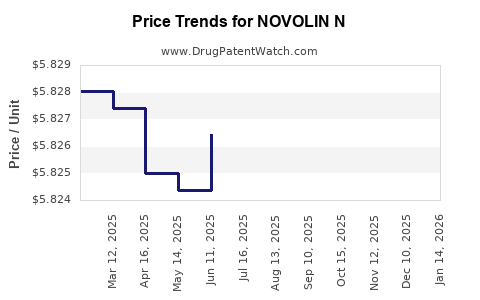
What is driving Novolin N pricing?
U.S. insulin pricing has shifted from list-price growth toward affordability programs, rebates, mandated caps and low-cost channel strategies. These changes reduce the ability of mature insulin products to generate price-driven growth.
Key pricing factors include:
- Retail cash prices and pharmacy discount programs.
- Medicare insulin cost-sharing limits.
- Commercial formulary rebates.
- Medicaid supplemental rebates.
- Employer-plan preference for lower-net-cost products.
- Competition from Walmart and other low-cost channels.
- Patient switching between human insulin and analog insulin based on coverage.
The Inflation Reduction Act limits Medicare insulin cost sharing to $35 per month for covered insulin products beginning in 2023 for Part D and 2023-2024 for specified Part B products, with broader application across Medicare insulin coverage from 2024 [4]. The cap supports access but weakens the link between list price and patient demand in the Medicare population.
Novo Nordisk has also used affordability programs and patient assistance mechanisms for U.S. insulin products. Those programs protect access but can reduce realized revenue per unit.
Does Novo Nordisk disclose Novolin N revenue?
No. Novo Nordisk reports insulin performance at broader portfolio and geographic levels rather than publishing revenue for Novolin N as a standalone product.
The company’s financial disclosures emphasize newer diabetes medicines, including GLP-1 products, modern insulin analogs and obesity treatments. Mature human insulin products are included within broader insulin or diabetes categories. Therefore:
- Novolin N revenue is not separately identifiable from public filings.
- Product-specific gross margin is not disclosed.
- Unit volume and net price are not publicly reported at the Novolin N level.
- Novolin N cannot be assigned a precise standalone revenue CAGR from Novo Nordisk filings.
The product likely contributes stable but strategically limited revenue relative to Novo Nordisk’s modern insulin and GLP-1 portfolio. Its economic value includes maintaining a complete insulin range and serving cost-sensitive channels, even if its direct margin is lower than that of newer products.
What is the financial trajectory for Novolin N?
The most supportable trajectory is mature-to-declining in high-income markets, with longer-term stability in price-sensitive regions.
Near-term trajectory
Novolin N can maintain demand where:
- Patients pay cash.
- Insurance coverage is limited.
- Public procurement emphasizes low acquisition cost.
- Clinicians use human insulin protocols.
- Supply reliability matters more than analog convenience.
Revenue growth is constrained by low pricing power and substitution into insulin analogs. Volume can remain resilient even when revenue declines because lower net prices and retailer competition compress value per unit.
Medium-term trajectory
The product is likely to experience gradual portfolio erosion in developed markets. The main causes are:
- Continued basal-analog substitution.
- Increasing use of biosimilar and interchangeable insulin glargine.
- Payer preference for contracted analog products.
- Patient preference for simpler dosing.
- Lower out-of-pocket prices for competing analogs after rebate and cap changes.
Emerging markets can offset part of that decline, but those markets generally have lower revenue per unit and greater procurement pressure.
Long-term trajectory
Novolin N is unlikely to be a major growth asset. Its long-term strategic value is defensive and access-oriented:
- It provides a low-cost insulin option.
- It supports Novo Nordisk’s presence across treatment protocols.
- It helps retain distribution relationships.
- It offers manufacturing scale utilization.
- It competes in markets where analog pricing is not sustainable.
The product’s financial profile resembles a durable legacy brand rather than a growth biologic.
What manufacturing and intellectual-property barriers affect Novolin N?
Although patent protection is weak, insulin manufacturing remains technically demanding. Relevant barriers include:
- Recombinant protein production.
- Correct folding and molecular consistency.
- Protamine complexation and suspension control.
- Sterile filling and container closure.
- Potency and purity testing.
- Batch-to-batch consistency.
- Stability throughout the product shelf life.
- Pen-device compatibility where applicable.
- FDA inspection and biologics manufacturing requirements.
These barriers favor established insulin manufacturers. They can limit the number of credible entrants even when legal exclusivity has ended.
Manufacturing disruption is a material risk. Insulin is a chronic-use product, and patients can be sensitive to supply interruptions. A reliable supply chain can therefore support market share even when the product lacks patent protection.
Which companies are challenging Novolin N?
The competitive field includes Novo Nordisk’s own lower-cost channels, Eli Lilly, Sanofi and manufacturers of follow-on insulin products.
| Company |
Product or competitive position |
Relevance |
| Novo Nordisk |
Novolin N and retail/private-label distribution |
Internal channel competition can reduce net price |
| Eli Lilly |
Humulin N |
Direct branded NPH competitor |
| Walmart and retail partners |
ReliOn human insulin offerings |
Strong cash-price pressure |
| Sanofi |
Basal insulin portfolio, including follow-on glargine competition |
Substitution away from NPH |
| Biocon Biologics and Viatris |
Semglee insulin glargine |
Interchangeable follow-on insulin competition in the basal segment |
| Lilly and Boehringer Ingelheim |
Basaglar |
Lower-cost basal analog substitute |
| Sanofi and partners |
Lantus and follow-on products |
Broad basal-insulin competition |
There is no major Paragraph IV litigation story associated with Novolin N comparable to the litigation histories of newer branded drugs. Because the product’s central patent barriers are expired and the market is mature, competitive activity is more likely to occur through price, formulary contracts and regulatory approvals than through patent challenges.
What generic entry risks exist for Novolin N?
The principal entry risk is follow-on biologic competition rather than a conventional generic filed under a standard ANDA pathway.
Potential competitive routes include:
- A biosimilar or interchangeable insulin NPH product.
- A conventional follow-on insulin approved under the biologics framework.
- A private-label arrangement using an established manufacturer.
- Retail substitution from branded Novolin N to lower-priced versions.
- Formulary migration from NPH to low-cost insulin glargine.
A new NPH entrant would face technical and commercial hurdles, including clinical comparability, manufacturing validation, pharmacodynamic characterization, supply reliability and payer adoption. Even so, the absence of strong patent protection means the main defense is cost-efficient production and contracting.
What litigation and settlement agreements affect Novolin N?
No major active patent litigation or settlement agreement is publicly associated with Novolin N as a central product. The commercial risk is litigation-light compared with patented specialty medicines.
The absence of prominent litigation does not eliminate competitive pressure. It indicates that the principal disputes are more likely to concern:
- Pricing and rebate practices.
- Product liability.
- Manufacturing and supply.
- Regulatory compliance.
- Distribution agreements.
- Insurance coverage and affordability.
How strong is the Novolin N patent estate?
The patent estate is weak from a blocking-rights perspective and moderate from an operational perspective.
| Dimension |
Assessment |
| Composition-of-matter protection |
Weak or expired |
| Formulation protection |
Weak for the core NPH concept |
| Device protection |
Potentially relevant to specific delivery systems |
| Manufacturing know-how |
Important but generally nonpublic |
| Regulatory exclusivity |
No meaningful remaining exclusivity |
| Litigation leverage |
Low |
| Supply-chain leverage |
Moderate |
| Brand and channel value |
Moderate |
| Long-term pricing power |
Low |
What is the commercial outlook for Novolin N?
Novolin N should remain commercially relevant as a low-cost human insulin, but it is unlikely to produce meaningful growth for Novo Nordisk. Its demand base is durable because diabetes treatment requires insulin and many patients cannot absorb analog pricing. Its revenue base is vulnerable because payers, retailers and competitors continue to lower the cost of alternative basal insulins.
The most likely scenario is stable-to-declining volume in cost-sensitive channels, declining net price in the United States, and gradual share loss to basal analogs in higher-income markets. Revenue exposure is strategically modest relative to Novo Nordisk’s GLP-1 and modern insulin franchises, but the product remains useful for access, portfolio completeness and emerging-market penetration.
Key Takeaways
- Novolin N is a mature recombinant human NPH insulin product marketed by Novo Nordisk.
- Its core patent protection has expired, and no material remaining product exclusivity is evident.
- Novo Nordisk does not report Novolin N revenue separately.
- The product faces direct competition from Humulin N and ReliOn human insulin.
- Its strongest substitutes are lower-cost and interchangeable basal insulin analogs.
- Price competition, Medicare cost caps and formulary contracting limit revenue growth.
- Manufacturing quality, supply reliability and distribution are more important than patent rights.
- The likely financial trajectory is stable-to-declining, with stronger resilience in cost-sensitive markets than in affluent markets.
- Paragraph IV litigation is not the principal risk; follow-on insulin entry and payer-driven substitution are more important.
- Novolin N is a defensive access product, not a growth biologic.
FAQs About Novolin N Market and Financial Outlook
Is Novolin N still commercially important?
Yes. It remains important for patients seeking lower-cost insulin, although it is less strategically important than Novo Nordisk’s analog insulin and GLP-1 products.
Is Novolin N interchangeable with insulin glargine?
No. NPH insulin and insulin glargine have different pharmacokinetic profiles, dosing characteristics and regulatory identities. Substitution requires clinical and prescribing consideration.
Can a company launch a generic version of Novolin N?
A competitor would generally need to pursue an applicable biologic or follow-on insulin regulatory pathway rather than rely on a conventional small-molecule generic strategy.
Does Novolin N have a biosimilar threat?
Yes, in a broad commercial sense. The principal threat is a future follow-on NPH insulin or low-cost basal insulin substitute. Direct FDA-designated interchangeable NPH competition has not been the dominant market development.
Will Novolin N revenue grow over the next five years?
Sustained revenue growth is unlikely. The more probable trajectory is stable or declining revenue, driven by lower net pricing, analog substitution and competition from low-cost human insulin channels.
References
- U.S. Food and Drug Administration. (2023). Novolin N prescribing information. Novo Nordisk Inc. https://www.accessdata.fda.gov
- U.S. Food and Drug Administration. (2020). Insulin and insulin biosimilars. https://www.fda.gov/drugs/biosimilars/insulin-and-insulin-biosimilars
- U.S. Food and Drug Administration. (2024). Biosimilar product information. https://www.fda.gov/drugs/biosimilars/biosimilar-product-information
- Centers for Medicare & Medicaid Services. (2024). Medicare insulin cost-sharing limits. https://www.cms.gov
- Novo Nordisk A/S. (2024). Annual report 2023. Bagsværd, Denmark: Novo Nordisk A/S. https://www.novonordisk.com/investors/annual-report.html