Last updated: September 7, 2026
Neupogen, Amgen’s filgrastim product, is a mature biologic with limited remaining exclusivity and substantial biosimilar competition. Its commercial trajectory has shifted from originator-led growth to price erosion, formulary substitution, and declining brand utilization. The principal U.S. competitors are Zarxio, Nivestym, Releuko, and Granix. Neulasta and its biosimilars also compete indirectly by replacing short-acting filgrastim with once-per-cycle pegfilgrastim.
What is Neupogen and how is it used?
Neupogen is recombinant human granulocyte colony-stimulating factor, or G-CSF. Its active ingredient is filgrastim, a nonglycosylated recombinant protein produced in E. coli. The product increases neutrophil production and is administered by subcutaneous or intravenous injection.
The FDA approved Neupogen in 1991. Its principal indications include:
- Reduction of infection duration in patients receiving myelosuppressive chemotherapy
- Reduction of neutropenia-related complications in patients with acute myeloid leukemia
- Mobilization of peripheral blood progenitor cells
- Treatment of severe chronic neutropenia
- Use in patients receiving myeloablative therapy followed by bone marrow transplantation
Neupogen is generally administered daily during the period of neutropenia risk. That dosing profile differentiates it from pegfilgrastim products, including Neulasta, which are normally administered once per chemotherapy cycle.[1]
When does Neupogen lose exclusivity?
Neupogen lost meaningful U.S. market exclusivity years before the current biosimilar market developed. The core recombinant filgrastim patent estate expired by 2013, based on the applicable U.S. patent terms and public patent records. Neupogen was approved before the Biologics Price Competition and Innovation Act established the modern 12-year reference-product exclusivity framework.[2]
Neupogen exclusivity timeline
| Event |
Date |
Commercial significance |
| FDA approval of Neupogen |
1991 |
Established filgrastim as a standard G-CSF |
| Core product patent protection |
Expired by 2013 |
Removed the principal U.S. patent barrier |
| First U.S. biosimilar approval, Zarxio |
March 2015 |
Created direct filgrastim biosimilar competition |
| Nivestym approval |
July 2018 |
Added Pfizer’s interchangeable-positioned competitor |
| Releuko approval |
February 2022 |
Expanded approved filgrastim biosimilar supply |
| Current U.S. position |
Mature, multi-source market |
Brand protection depends mainly on contracting and clinical preference |
The principal commercial barrier is no longer a blocking Neupogen patent. Manufacturing know-how, regulatory compliance, supply reliability, payer contracting, and provider purchasing agreements are more important than composition-of-matter protection.
What patents protect Neupogen?
Neupogen’s historic protection centered on patents covering recombinant G-CSF molecules, DNA sequences, host-cell expression systems, and production methods. Those patents supported the original product and manufacturing platform but are no longer a durable barrier to U.S. filgrastim competition.
Biologics do not have an Orange Book listing structure equivalent to small-molecule drugs. The FDA identifies licensed biological products and biosimilar relationships in the Purple Book rather than listing biologic patents in the Orange Book.[3]
Does Neupogen have Orange Book patents?
No. Neupogen is a biologic and is not protected through a conventional Orange Book patent listing. Biosimilar applicants do not use the small-molecule Hatch-Waxman Paragraph IV certification process for filgrastim products.
The relevant framework is the BPCIA patent-exchange process, often called the “patent dance,” followed by potential federal patent litigation. Because the core Neupogen patents expired before the current biosimilar wave, later filgrastim approvals did not face the type of patent challenge associated with newer biologics.
Which companies are challenging Neupogen?
The U.S. filgrastim market has several approved competitors.
| Product |
Active ingredient |
Company |
FDA pathway or status |
Market role |
| Neupogen |
Filgrastim |
Amgen |
Reference biologic |
Originator brand |
| Zarxio |
Filgrastim-sndz |
Sandoz |
Biosimilar to Neupogen |
First U.S. biosimilar |
| Nivestym |
Filgrastim-aafi |
Pfizer |
Biosimilar to Neupogen |
Hospital and oncology-channel competitor |
| Releuko |
Filgrastim-ayow |
Kashiv Biosciences / Amneal commercial arrangement |
Biosimilar to Neupogen |
Additional multisource competitor |
| Granix |
Tbo-filgrastim |
Teva |
Biologic approved under the standalone BLA pathway |
Direct clinical substitute, not a Neupogen biosimilar |
Zarxio was the first biosimilar approved in the United States and became the most commercially important early threat to Neupogen. Nivestym expanded price competition and improved buyer leverage. Releuko added another source in a market where hospitals and specialty pharmacies can move volume rapidly when reimbursement and supply are favorable.[4][5][6]
What is the FDA and Purple Book status of Neupogen?
Neupogen remains an FDA-approved reference product. Its biosimilar relationship is recorded through FDA biological-product resources rather than Orange Book listings.
The main U.S. regulatory distinctions are:
- Zarxio is biosimilar to Neupogen.
- Nivestym is biosimilar to Neupogen.
- Releuko is biosimilar to Neupogen.
- Granix is a related filgrastim-class product but is not a biosimilar designation to Neupogen.
- Biosimilar approval does not automatically establish pharmacy-level substitution in every state.
- Interchangeability and substitution depend on the product designation, state law, payer rules, and institutional policy.
The market has therefore developed through provider and payer selection rather than automatic generic substitution.
How has Neupogen’s financial trajectory changed?
Neupogen’s financial trajectory follows the normal pattern for an aging biologic: initial expansion, displacement by a longer-acting formulation, then price and volume pressure from biosimilars.
1. Early growth and clinical adoption
Neupogen established the prophylactic and therapeutic G-CSF market. Its clinical value was linked to fewer chemotherapy-related neutropenia complications, reduced hospitalization risk, and improved treatment continuity.
2. Internal substitution by Neulasta
Amgen’s pegfilgrastim product Neulasta reduced the administration burden associated with daily filgrastim. This created internal cannibalization. Neulasta was more convenient for many chemotherapy regimens because it generally required one administration per cycle rather than repeated daily injections.
Neupogen retained use in situations where clinicians wanted shorter exposure, flexible dosing, stem-cell mobilization, or rapid discontinuation after neutrophil recovery.
3. Biosimilar price pressure
Zarxio entered the U.S. market in 2015. The launch changed the economic structure of the category by giving hospitals and payers an approved, lower-cost alternative to the reference product.
Price competition is strongest in:
- Hospital outpatient departments
- Community oncology clinics
- Integrated delivery networks
- European tender markets
- Government and 340B purchasing channels
- Accounts with centralized formulary management
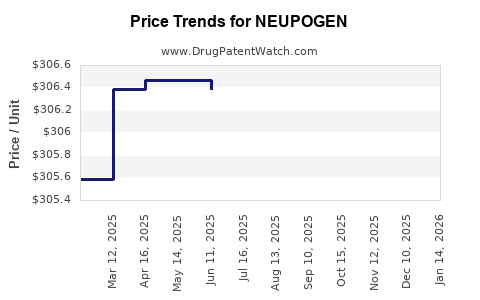
Neupogen’s unit and net-price exposure has consequently declined. Amgen’s public filings have historically reported product sales and competitive effects, but recent filings do not provide a consistent standalone global revenue series for Neupogen. That limits precise reconstruction of annual brand revenue without proprietary prescription, invoice, or IQVIA data.[7]
Financial trajectory
| Period |
Financial direction |
Main driver |
| 1990s to early 2000s |
Strong growth |
Broad oncology adoption and limited competition |
| 2002 onward |
Mix shift |
Neulasta reduced demand for some short-acting filgrastim use |
| 2015 to 2018 |
Accelerating pressure |
Zarxio and later biosimilar competition |
| 2019 to 2022 |
Continued erosion |
Multiple suppliers, contracting, and price reductions |
| 2023 onward |
Mature residual brand market |
Clinical preference, supply reliability, and account-specific contracting |
The relevant financial metric is no longer peak product revenue. It is residual brand share, net price, manufacturing economics, and the ability to retain accounts that value Amgen’s supply history or prefer the reference product.
How strong is the Neupogen patent estate?
Neupogen’s current patent strength is weak as a commercial exclusivity matter.
| Factor |
Assessment |
| Core composition protection |
Expired |
| U.S. Orange Book protection |
Not applicable |
| Biologic exclusivity |
Long expired |
| Method-of-use protection |
No known current broad barrier capable of blocking filgrastim biosimilars |
| Formulation protection |
Limited practical significance relative to product maturity |
| Manufacturing know-how |
Relevant to cost, yield, consistency, and supply |
| Litigation leverage |
Low for the reference product compared with newer biologics |
| Biosimilar entry risk |
High and already realized |
The remaining value of Neupogen is commercial rather than patent-based. Amgen can compete through manufacturing scale, physician familiarity, distributor relationships, contracting, and supply performance.
What formulations are protected by Neupogen?
Neupogen is supplied primarily as an injectable solution in prefilled syringes and single-dose vials. The clinically important product distinction is not a novel delivery technology but the short-acting filgrastim dosing schedule.
Formulation-related barriers are weaker than they would be for an extended-release product, device-led product, or complex combination system. Biosimilar competitors have established comparable injectable presentations, and buyers generally evaluate products on price, availability, handling, reimbursement, and institutional protocols.
The Neupogen presentation also competes with on-body and prefilled delivery systems associated with pegfilgrastim products. Those products may carry device or presentation patents, but those rights do not restore broad exclusivity to short-acting Neupogen.
What patent litigation affects Neupogen?
There is no current, widely recognized U.S. patent dispute that creates a material barrier to approved filgrastim biosimilar commercialization. The major competitive events were regulatory approvals, contracting decisions, and market-access negotiations rather than a prolonged originator-versus-biosimilar patent case.
Are there Paragraph IV challenges to Neupogen?
No conventional Paragraph IV challenge applies because Neupogen is a biologic, not a small-molecule drug listed in the Orange Book. Filgrastim biosimilar developers use the BPCIA pathway and may litigate relevant patents under the biologics framework.
For Neupogen, the age of the product and expiry of core patents reduced the litigation value of that process.
What generic and biosimilar launch risks exist?
The principal risk is continued erosion of Amgen’s residual filgrastim volume and net price.
High-probability scenarios
- Further biosimilar share gains: Payers and hospitals continue shifting volume to lower-cost filgrastim products.
- Contracting-driven price compression: Suppliers discount to secure national oncology networks and hospital systems.
- Brand retention in narrow segments: Neupogen remains in accounts that value reference-product continuity or have established Amgen contracts.
- Greater substitution by pegfilgrastim: Longer-acting products reduce the addressable market for daily filgrastim.
- Supply-led reversals: Manufacturing interruptions or shortages can temporarily restore demand for alternative suppliers, including the originator.
Lower-probability scenario
A broad Neupogen revenue recovery is unlikely without a supply disruption affecting competitors, a major clinical change favoring short-acting filgrastim, or a meaningful contraction in pegfilgrastim use.
How does Neupogen compare with Neulasta and filgrastim biosimilars?
| Attribute |
Neupogen |
Neulasta |
Filgrastim biosimilars |
| Active ingredient |
Filgrastim |
Pegfilgrastim |
Filgrastim or filgrastim variant |
| Dosing |
Usually daily during risk period |
Usually once per chemotherapy cycle |
Usually daily |
| Patent position |
Mature and expired |
More recent historical exclusivity, now also biosimilarized |
No originator patent burden |
| Main economic advantage |
Clinical flexibility |
Convenience and reduced administration |
Lower acquisition cost |
| Main commercial risk |
Price and volume erosion |
Biosimilar pegfilgrastim competition |
Price competition among suppliers |
| Primary buyers |
Oncology providers, hospitals, specialty channels |
Oncology providers and clinics |
Hospitals, clinics, payers, group purchasing organizations |
Neupogen retains a role where short-acting pharmacology is useful. Its competitive disadvantage is the combination of daily administration and multiple lower-priced alternatives.
What licensing and commercial arrangements affect Neupogen?
The most important commercial arrangements concern competitors rather than a continuing Neupogen license. Sandoz commercializes Zarxio, Pfizer commercializes Nivestym, and Amneal has been involved in commercialization of Releuko with Kashiv-related development interests. These arrangements provide biosimilar developers with manufacturing, regulatory, and distribution infrastructure.[4][5][6]
Amgen’s strategic value in filgrastim is tied to the original product, manufacturing platform, oncology distribution, and broader supportive-care portfolio. The company’s stronger current growth drivers are not mature Neupogen sales but newer products and therapeutic franchises.
What geographic markets remain important?
The United States remains the most commercially visible market because of its large oncology spending base, hospital purchasing structure, and high biosimilar policy activity. Europe has experienced earlier and more aggressive filgrastim competition through national tenders and hospital procurement.
Geographic dynamics include:
- United States: Biosimilar contracting, 340B exposure, buy-and-bill economics, and payer formularies.
- European Union: Tendering and national reimbursement controls produce faster price compression.
- Emerging markets: Access expansion can increase unit demand while keeping net prices low.
- Japan and other regulated markets: Filgrastim and biosimilar uptake depends on local reimbursement and approval standards.
Global volume can remain substantial even as originator revenue declines because lower prices expand access and increase biosimilar utilization.
Key Takeaways
- Neupogen is the original filgrastim biologic, approved by the FDA in 1991.
- Its core U.S. patent protection expired by 2013.
- Neupogen has no conventional Orange Book patent listing because it is a biologic.
- Zarxio, Nivestym, and Releuko are FDA-approved biosimilar competitors.
- Granix is a related filgrastim-class product approved outside the biosimilar pathway.
- The main economic pressure is biosimilar price competition, reinforced by Neulasta and pegfilgrastim substitution.
- Amgen’s recent public filings do not provide a consistent standalone Neupogen revenue series, preventing a precise current brand-revenue estimate from public disclosures alone.
- Neupogen’s residual value depends on contracting, physician familiarity, product availability, and manufacturing reliability rather than patent exclusivity.
- The probability of broad revenue recovery is low absent a major supply disruption or clinical shift toward short-acting filgrastim.
FAQs
Is Neupogen still commercially available?
Yes. Neupogen remains an FDA-approved filgrastim reference product, although many accounts use biosimilar or alternative filgrastim products.
Is Zarxio interchangeable with Neupogen?
Zarxio is biosimilar to Neupogen. Pharmacy-level substitution depends on the product’s regulatory designation, state law, payer policy, and institutional rules.
Does Neupogen have a patent beyond 2025?
No broad, commercially meaningful core Neupogen patent barrier is generally recognized as extending beyond 2025 in the United States.
Is Granix a Neupogen generic?
No. Granix contains tbo-filgrastim and was approved as a standalone biologic rather than as a biosimilar to Neupogen.
What is the largest financial threat to Neupogen?
The largest threat is cumulative net-price and market-share erosion from filgrastim biosimilars, combined with the use of pegfilgrastim products that reduce demand for daily filgrastim.
References
- U.S. Food and Drug Administration. (1991). Neupogen prescribing information.
- U.S. Food and Drug Administration. (2024). Biologics Price Competition and Innovation Act of 2009.
- U.S. Food and Drug Administration. (2024). Purple Book: Database of licensed biological products.
- U.S. Food and Drug Administration. (2015). Zarxio approval information.
- U.S. Food and Drug Administration. (2018). Nivestym approval information.
- U.S. Food and Drug Administration. (2022). Releuko approval information.
- Amgen Inc. (2024). 2023 annual report. Thousand Oaks, CA: Amgen.