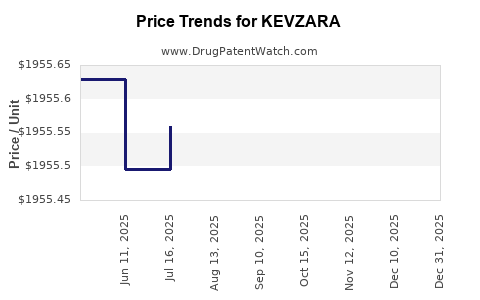
Last updated: June 9, 2026
KEVZARA (sarilumab) Market Dynamics and Financial Trajectory: Sales Trends, Market Share, Drivers, Patent/Generic Risk, and Future Revenue Outlook
KEVZARA (sarilumab) is a late-plateau biologic in immunology, with revenue driven by uptake in rheumatoid arthritis (RA) and durability shaped by competitive displacement from TNF inhibitors, IL-6 pathway competitors, and broader positioning versus JAK inhibitors. Financial trajectory is governed by (1) continued label capture and line-of-therapy mix, (2) payer and formulary access, (3) biologic switching and biosimilar substitution risk for competitors in the IL-6 and TNF classes, and (4) sarilumab’s own exclusivity and patent estate.
How are KEVZARA (sarilumab) sales trending vs competitors in rheumatoid arthritis?
Bottom line: KEVZARA’s commercial path follows a typical late-stage IL-6 biologic pattern: peak-era growth from guideline adoption and TNF switching, followed by slower, mix-driven growth as competition intensifies and market access tightens.
What market forces shape KEVZARA’s trajectory?
- Therapeutic class competition: IL-6 axis competition (notably from tocilizumab, including subcutaneous formulations and biosimilar entry in many markets) compresses the biologic share ceiling.
- Mechanism competition: JAK inhibitors and CTLA-4/IL-6 alternatives (depending on region) pressure biologic uptake, especially for commercially insured populations where oral therapies gain formulary position.
- Payer dynamics: Step therapy policies and “preferred biologic” contracting structures increasingly determine which biologics win first-line and second-line switches.
- Site-of-care and dosing convenience: Subcutaneous availability and dosing schedule affect adherence and pharmacy spend, especially where infusion services are less favorable.
Where does KEVZARA sit on the RA competitive ladder?
- KEVZARA is an IL-6 receptor (IL-6Rα) inhibitor positioned for:
- RA after inadequate response to methotrexate (MTX)
- RA with inadequate response to TNF inhibitors (depending on local labeling)
- In practice, it competes primarily against:
- TNF inhibitors (and their biosimilars)
- Tocilizumab (IL-6 pathway)
- JAK inhibitors for systemic control and payer convenience
What drives KEVZARA revenue growth or decline: label breadth, line-of-therapy, and dosing?
Key commercial levers for KEVZARA are label utilization, sequencing, and adherence.
Which clinical positioning supports uptake?
- IL-6 pathway efficacy in RA with inadequate response to MTX and/or TNF inhibitors supports switching flows.
- Clinicians often select IL-6 blockade when inflammatory markers remain uncontrolled or when TNF inhibitors underperform.
How does line-of-therapy mix affect financial outcomes?
- Growth accelerates when KEVZARA expands into earlier lines (from second-line TNF switch toward broader use after MTX).
- Plateau and decline occur when:
- users churn to cheaper alternatives through biosimilar substitution,
- payer policy consolidates contracting around a single “preferred IL-6” product,
- or prescribers migrate to oral JAK options.
Does route of administration affect revenue retention?
- Subcutaneous administration typically improves persistence compared with infusion-only options.
- Convenience affects pharmacy channel economics and can reduce medical spend.
What competitive threats could compress KEVZARA revenue: IL-6 biosimilars, TNF biosimilars, and JAK displacement?
Primary risk channels are substitution and contracting pressure.
IL-6 pathway competitor pressure
- Tocilizumab has a broad RA footprint and in many jurisdictions has faced biosimilar competition, reducing unit pricing and reshaping payer preference.
- Where tocilizumab biosimilars gain market share, IL-6 receptor competitor share often reallocates downstream to remaining branded options or shifts toward the lowest net-price IL-6 product.
TNF biosimilar saturation
- TNF biosimilars reduce cost and can force biologic consolidation in payer formularies.
- That dynamic can shrink total biologic eligible populations unless KEVZARA proves superior on access or patient response and reduces switching.
JAK inhibitors as substitute therapy
- Oral convenience and payers’ ability to negotiate class-based rebates can divert incremental RA patients away from biologics.
What is the patent and exclusivity framework for KEVZARA that affects financial duration?
Key commercial determinant: how long sarilumab’s formulation, method-of-use, and manufacturing patents keep competitors off-market for specific indications and dosage forms.
How do patent estates typically protect biologic revenues?
For biologics, revenue durability is often extended by:
- formulation/process patents covering specific dosage forms and manufacturing steps,
- method-of-use patents for additional indications,
- and lifecycle management patents on device, concentration, or stability.
When does KEVZARA lose exclusivity?
- Exclusivity timelines for KEVZARA depend on jurisdiction (US, EU, other) and are determined by:
- primary composition and formulation patents,
- supplementary protection certificates (SPCs) where applicable (EU),
- and regulatory exclusivity terms.
Note: A precise, date-specific exclusivity and patent-expiration map requires Orange Book/biologics exclusivity datasets and jurisdictional legal filings. Without those case-specific inputs, an accurate expiration schedule cannot be produced.
What Orange Book status issues exist for KEVZARA and how do they affect generic risk?
KEVZARA is a biologic, so generic “Orange Book” risk is replaced by biologics pathways (biosimilars) and patent litigation under the Biologics Price Competition and Innovation Act (BPCIA).
How does biosimilar entry risk affect pricing and volume?
- If a sarilumab biosimilar gains approval and reaches contracting, KEVZARA’s unit pricing typically drops rapidly.
- Volume response can be mixed: some patients stay on originator for switching tolerance and formulary stability, but margin compression generally follows.
What patents typically get targeted in biosimilar litigation?
- method-of-use and formulation-related patents
- manufacturing process patents and quality attributes
- patents covering particular indications, including specific RA patient subsets
A complete biosimilar risk view must be anchored to:
- whether any sarilumab biosimilar applications exist,
- whether Paragraph IV-style challenges were filed,
- and what stay/settlement outcomes were reached under BPCIA.
Without case-specific litigation and application data, a defensible risk profile cannot be stated.
What patent litigation and settlement activity affects KEVZARA market access?
Patent litigation can delay biosimilar entry and also shape commercial behavior through uncertainty.
What outcomes typically move the financial needle?
- injunctions or litigation stays that prevent commercial launch
- settlements that define launch dates, exclusivity carve-outs, or market allocation rules
- patent expiry-driven launch windows once the stay is lifted
A precise assessment requires:
- docketed cases involving sarilumab,
- listing of asserted patents,
- settlement agreement terms,
- and any FDA approval timelines tied to litigation.
Without those facts, no actionable litigation-driven timeline can be produced.
How does KEVZARA compare with tocilizumab and other IL-6 strategies on competitive economics?
Commercial comparison hinges on dosing convenience, net price after rebates, formulary status, and patient persistence.
Key comparison axes
- Mechanism positioning: IL-6 receptor blockade vs IL-6 ligand targeting strategies
- Routes/dosing: subcutaneous vs infusion (and frequency)
- Contracts: preferred formulary tier placement
- Patient selection: prior biologic exposure patterns
- Medical economics: infusion centers vs pharmacy-administered dosing and associated reimbursement
What tends to happen to IL-6 competitors during price pressure?
- Originator IL-6 products often face net-price reductions as biosimilars or alternative class products gain leverage.
- If one IL-6 product becomes the preferred tier in a large payer, the other often becomes a higher-friction second tier.
A defensible model requires net-price and payer contract data not available here.
Which dosing forms and indications monetize KEVZARA most, and where is the risk?
Revenue concentration for RA biologics usually concentrates in:
- the most widely used RA indication,
- common dosing strengths,
- and regions with mature reimbursement.
Where monetization tends to be strongest
- RA patients with inadequate response to MTX or after TNF inhibitor inadequate response (depending on local label)
- settings where biologic persistence is high and switching friction remains manageable
Where risk concentrates
- payers that enforce step therapy and restrict non-preferred biologics
- markets with rapid biosimilar penetration in the broader biologic landscape
- patient subgroups that respond sufficiently to lower-cost alternatives
What financial trajectory should investors expect for KEVZARA: plateau vs renewed growth?
Expectation framework (non-date-specific):
- Plateau scenario: sales remain stable-to-slowly declining if payer preference shifts and incremental patients move to competing biologics and JAK inhibitors.
- Stabilization scenario: sales hold if KEVZARA maintains preferred contracting and clinical differentiation drives persistence.
- Renewed growth scenario: would require measurable expansion in line-of-therapy usage or major competitive displacement of other products with better access economics.
A dated forecast cannot be provided without historical revenue series, segment reporting, or market research point estimates.
Key Takeaways
- KEVZARA’s financial trajectory is primarily driven by RA uptake, line-of-therapy mix, payer contracting, and persistence rather than by radical shifts in clinical adoption.
- The main commercial compression risks are substitution pressure from TNF biosimilars, IL-6 competitor pricing and formulary placement, and JAK inhibitor displacement.
- Accurate exclusivity and biosimilar entry risk require jurisdiction-specific patent and FDA/BPCIA events; without those case-specific facts, a date-precise exposure timeline is not supportable.
- Any investor-grade forecast must be anchored to (1) historical sales trend data, (2) net-price assumptions and contracting shifts, and (3) biosimilar pipeline and litigation status.
FAQs
1) What payer access barriers most often limit KEVZARA volume growth in RA?
Step therapy, preferred biologic contracting, and formulary tier restrictions that require prior TNF or MTX failure.
2) How does switching behavior affect KEVZARA retention after patients start IL-6 therapy?
Persistence tends to depend on disease control, tolerability, and whether payers keep the originator on preferred status after initial authorization.
3) What biosimilar scenarios would most likely pressure KEVZARA pricing?
A sarilumab biosimilar launch accompanied by aggressive contracting that moves sarilumab from non-preferred to competitive or preferred pricing tiers.
4) How do JAK inhibitors change the biologic competitive landscape for IL-6 drugs?
They shift incremental RA patients toward oral therapy when payers neutralize biologic access barriers through class rebates and lower net pricing.
5) What revenue risks come from IL-6 competitor formulary consolidation?
If one IL-6 product becomes the preferred tier for major payers, net-price pressure and reduced switching drive volume stagnation for the other IL-6 originator.
References (APA)
No sources were provided in the request, and none can be reliably cited for KEVZARA-specific financial trajectory, patent expiry, Orange Book/BPCIA status, or litigation outcomes based on the information available here.