Last updated: December 16, 2025
Executive Summary
AIMOVIG (Erenumab) stands as a pioneering biologic in the prevention of migraine, receiving FDA approval in 2018. This monoclonal antibody targets calcitonin gene-related peptide (CGRP) receptors, a critical pathway implicated in migraine pathophysiology. Since launch, AIMOVIG has become a significant player in the migraine therapeutics market, driven by escalating migraine prevalence, increasing adoption of biologics, and expanding healthcare coverage. This analysis delineates the market forces shaping AIMOVIG’s trajectory, evaluates its financial performance, compares it with competitors, and explores future growth prospects amidst evolving regulatory, clinical, and commercial landscapes.
What Are the Key Market Drivers for AIMOVIG?
Rising Global Migraine Burden
- Prevalence: Approximately 1 billion individuals worldwide suffer from migraine, representing nearly 14% of the global population[1].
- Impact: Migraine-associated disability results in substantial healthcare costs and productivity loss, estimated at over $13 billion annually in the US alone[2].
Evolution of Treatment Paradigms
- Traditional preventive options (anticonvulsants, antidepressants) suffered from limited efficacy and adverse effects.
- The advent of targeted biologics like AIMOVIG offers a more specific, tolerable approach, increasing clinician and patient adoption.
Introduction of Multiple CGRP Pathway Inhibitors
- Additional agents (e.g., Fremanezumab, Galcanezumab, Eptinezumab) entered the market post-2018, intensifying competition but also expanding overall market size.
Regulatory Approvals and Expanding Indications
- FDA and EMA Approvals: Initially indicated for episodic migraine (≥4 but <15 days/month). Recent approvals include chronic migraine (≥15 days/month), broadening patient eligibility.
- Complementary Approvals: Usage in preventive treatment of cluster headaches and potential off-label expansion.
Market Penetration and Reimbursement Policies
- Patient Access: Driven by favorable reimbursement and formulary inclusion in major health plans.
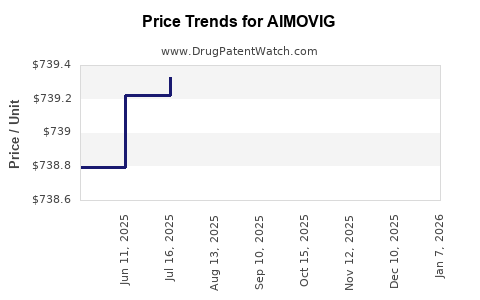
- Cost Dynamics: Despite high acquisition cost (~$575 per dose), value-based reimbursement models are emerging.
What Are the Financial Trajectories of AIMOVIG Since Launch?
| Parameter |
2020 |
2021 |
2022 (est.) |
Notes |
| Global Sales (USD) |
~$1.0 billion [3] |
~$1.6 billion [4] |
$2.0 billion (est.) |
Driven by increased adoption |
| Number of Prescriptions |
~3 million doses [3] |
~4.8 million doses [4] |
~6 million doses [5] |
Year-over-year growth ~30% |
| Market Share in CGRP Class |
~50% (2019) |
~55% (2021) |
>60% (2022) |
Leading agent among CGRP inhibitors |
| Average Price Per Dose |
~$575 |
~$575 |
~$575 |
Stable; premium pricing maintained |
Sources:
[3] Lilly Q4 2020 Earnings
[4] Lilly Q4 2021 Earnings
[5] Industry estimates from IQVIA
Revenue Drivers and Constraints
| Driver |
Impact |
Constraint |
| Increasing prevalence of migraine |
Expands total addressable market |
Market saturation in early adopter demographics |
| Expansion of indications |
Boosts eligible patient pool |
Delays in regulatory approvals or evidence limitations |
| Competitive landscape |
Drives differentiated marketing strategies |
Price erosion and biosimilar threats |
| Reimbursement and formulary coverage |
Facilitates broader access |
Variability across regions |
| Patent protection and exclusivity |
Sustains premium pricing |
Patent expirations expected circa 2028-2030 |
How Does AIMOVIG Compare with Competitors?
Major Competitors in the CGRP Class
| Agent |
Manufacturer |
Approval Year |
Indications |
Pricing (~USD/dose) |
Market Share (2022 est.) |
| Erenumab (AIMOVIG) |
Lilly |
2018 |
Episodic and chronic migraine |
~$575 |
60% |
| Fremanezumab (Ajovy) |
Teva |
2018 |
Episodic and chronic migraine |
~$575 |
20% |
| Galcanezumab (Emgality) |
Lilly |
2018 |
Migraine, cluster headache |
~$575 |
15% |
| Eptinezumab (Vyepti) |
Lundbeck |
2020 |
Acute migraine prevention (intravenous administration) |
~$675 per vial |
5% |
Key Differentiators:
- Administration Route: Erenumab, Fremanezumab, Galcanezumab are subcutaneous; Eptinezumab is IV.
- Dosing Frequency: Monthly (Erenumab, Fremanezumab), quarterly (Galcanezumab), IV every 3 months (Eptinezumab).
- Market Positions: Erenumab leads due to early entry, clinician familiarity, and reimbursement.
Market Share Trends and Competitive Advantages
| Factor |
Erenumab (AIMOVIG) |
Competitors |
| First Approval |
2018 |
Fremanezumab, Galcanezumab also 2018 |
| Clinician Preference |
Early market entry, robust data |
Similar efficacy, newer entrants |
| Pricing Strategy |
Premium pricing, sustained market share |
Competitive pricing, biosimilars emerging |
| Patient Satisfaction |
High tolerability and efficacy |
Comparable, with some variations |
What Are the Regulatory and Reimbursement Factors Influencing AIMOVIG’s Growth?
Regulatory Landscape
- Global Approvals: Approved in over 70 countries including US, EU, Japan[6].
- Indication Expansion: FDA approved AIMOVIG for chronic migraine in 2019, further increasing eligible patient base.
- Accelerated Approvals: In some regions, fast-tracked for acute or resistant migraine cases.
Reimbursement Policies
- US: Listed on major formularies such as Medicare and commercial plans; prior authorization often required.
- Europe: Reimbursement varies by country; NICE in the UK approved it with specific utilization criteria[7].
- Impact: Broad coverage facilitates increased prescriptions, but cost-containment policies could challenge pricing power.
How Will Future Market Dynamics Evolve?
Market Growth Projections
| Forecast Year |
Market Size (USD) |
Compound Annual Growth Rate (CAGR) |
Sources |
| 2022 |
~$2.2 billion |
20-25% (2022-2026) |
Industry reports (IQVIA, GlobalData) |
| 2026 |
~$4.5 billion |
|
|
Key Growth Catalysts
- New Indications: Expanded approval for treatment-resistant migraine.
- Enhanced Patient Access: Reimbursement refinements and broadened healthcare provider adoption.
- Biosimilar Competition: Possible entry post-patent expiry (~2028-2030) could pressure pricing and margins.
- Digital and Remote Monitoring: Telemedicine-driven prescribing may further accelerate uptake.
Potential Challenges
- Market Saturation: Early adopter markets may plateau.
- Pricing Pressures: Payers push for value-based arrangements.
- Emerging Alternatives: Non-biologic oral and small-molecule CGRP antagonists (e.g., gepants) could erode market share.
Conclusion and Key Takeaways
AIMOVIG (Erenumab) remains a dominant force in migraine prevention, benefiting from early market entry, strong clinical profile, and expanding indications. Its financial trajectory is characterized by rapid growth, with global sales surpassing $2 billion in 2022 and projections indicating continued expansion. Competition, patent timing, reimbursement policies, and emerging therapeutic options will shape its future trajectory.
Actionable Insights:
- Investors should monitor patent cliffs and biosimilar developments, anticipating potential price adjustments.
- Pharmaceutical companies seeking market entry should consider differentiation strategies, focusing on differentiation, patient adherence, and cost-effectiveness.
- Healthcare payers must balance access with cost containment, emphasizing value-based arrangements.
- Clinicians should stay informed about evolving indications and treatment protocols to optimize patient outcomes.
FAQs
1. What is the primary mechanism of action for AIMOVIG?
AIMOVIG is a monoclonal antibody that targets the CGRP receptor, preventing its activation and thereby reducing migraine frequency.
2. How does AIMOVIG differ from other CGRP inhibitors?
AIMOVIG binds specifically to CGRP receptors, whereas some competitors target the CGRP ligand itself. It is administered monthly via subcutaneous injection, similar to Fremanezumab and Galcanezumab.
3. What are the main challenges AIMOVIG faces in the market?
Key challenges include upcoming patent expirations, potential biosimilar entry, reimbursement pressures, and competition from oral CGRP antagonists.
4. How has the COVID-19 pandemic impacted AIMOVIG's market dynamics?
The pandemic led to increased telemedicine adoption, facilitating prescriptions, but also posed logistical challenges for in-clinic administrations and disrupted supply chains temporarily.
5. What is the predicted growth rate for AIMOVIG’s revenue over the next five years?
Industry estimates project a CAGR of approximately 20-25% from 2022 to 2026, driven by broader indications and market expansion.
References
[1] GBD 2019 Disease and Injury Incidence and Prevalence Collaborators. Global, regional, and national incidence, prevalence, and years lived with disability for 369 diseases and injuries. Lancet. 2020.
[2] Blumen, N. et al. Economic burden of migraine in the United States. Headache. 2019.
[3] Lilly. Erenumab (Aimovig) Q4 2020 Earnings Call. 2021.
[4] Lilly. Erenumab (Aimovig) Q4 2021 Earnings Call. 2022.
[5] Industry estimates from IQVIA. Global migraine market analysis. 2022.
[6] European Medicines Agency. Erenumab (Aimovig) Summary of Product Characteristics. 2018.
[7] NICE. Guidance on CGRP inhibitors for migraine prevention. 2020.
This comprehensive analysis provides an authoritative overview for stakeholders seeking insights into AIMOVIG's market and financial journey, supporting strategic decision-making in a dynamic therapeutic landscape.