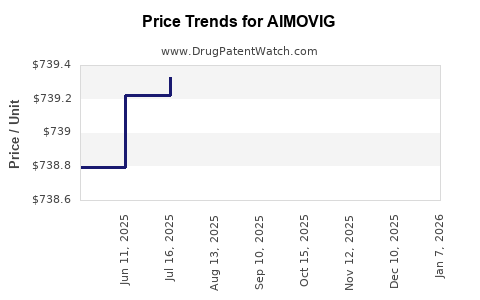
Last updated: September 8, 2026
Aimovig, the brand name for erenumab-aooe, remains a durable but mature migraine-prevention product. Amgen commercializes Aimovig in the United States, while Novartis commercializes the product in many markets outside the United States under a 2015 collaboration. Sales growth has slowed as Eli Lilly's Emgality, Teva's Ajovy, oral CGRP products and branded acute-treatment drugs have expanded the preventive migraine market. The product retains commercial value because it was the first FDA-approved CGRP-pathway monoclonal antibody, has monthly or quarterly dosing options, and has a relatively low near-term biosimilar threat.
What is Aimovig and how does it work?
Aimovig is a fully human monoclonal antibody that blocks the calcitonin gene-related peptide receptor, or CGRP receptor. CGRP is involved in migraine signaling and vasodilation. Aimovig is administered subcutaneously for the preventive treatment of migraine in adults.
| Attribute |
Aimovig detail |
| Active ingredient |
Erenumab-aooe |
| FDA application |
BLA 761077 |
| Initial FDA approval |
May 17, 2018 |
| Initial indication |
Preventive treatment of migraine in adults |
| Mechanism |
CGRP-receptor blockade |
| Standard doses |
70 mg once monthly or 140 mg once monthly |
| Device |
Prefilled autoinjector and prefilled syringe presentations |
| Originator |
Amgen and Novartis |
| US commercial rights |
Amgen |
| Key competitors |
Emgality, Ajovy, Vyepti, Qulipta, Nurtec ODT |
| Regulatory class |
Biologic license application product |
The FDA approved Aimovig before the later CGRP antibodies Emgality, Ajovy and Vyepti. The product's clinical and commercial positioning is based on preventive efficacy, monthly administration and a differentiated receptor-targeting mechanism relative to ligand-binding antibodies such as Emgality and Ajovy. [1]
How has Aimovig revenue changed since launch?
Aimovig experienced rapid early adoption followed by a flattening sales curve. The product benefited from substantial unmet need in migraine prevention, but reimbursement restrictions and competition limited its ability to sustain launch-period growth.
Public filings report partner-level sales rather than a single consolidated global Aimovig revenue figure. Amgen reports US revenue, while Novartis reports sales in its commercial territories. The combined public disclosures indicate a product with global annual sales in the high hundreds of millions of dollars rather than a multibillion-dollar franchise.
| Period |
Financial trajectory |
Main driver |
| 2018 |
Launch year with limited partial-year revenue |
FDA approval and early payer access |
| 2019-2020 |
Rapid expansion |
New preventive-migraine category and physician adoption |
| 2021-2022 |
Maturity and slower growth |
CGRP competition and payer controls |
| 2023-2024 |
Flat to declining trend in major territories |
Market crowding, oral CGRP alternatives and pricing pressure |
Amgen's Aimovig sales have represented a small share of total company revenue. Amgen reported 2023 total revenue of approximately $28.2 billion, making Aimovig a sub-2% product even before considering Novartis' international sales. [2] Novartis' diversified portfolio also limits Aimovig's effect on consolidated company results. [3]
The financial trajectory is therefore commercially meaningful at the brand level but not material to the overall financial profile of either company. The principal value is recurring cash flow from an established biologic, not high-growth expansion.
What drives Aimovig market demand?
Preventive migraine treatment remains a large market
Migraine is a chronic neurological disorder with a large diagnosed and treated population. Patients with frequent migraine days, treatment failure with oral preventives or poor tolerability are the principal target population for CGRP antibodies.
Aimovig's demand is supported by:
- Patients who do not respond adequately to beta blockers, topiramate, valproate or antidepressants.
- Patients who cannot tolerate older oral preventive medicines.
- Physicians seeking a treatment with monthly administration.
- Patients with high-frequency or chronic migraine who require sustained preventive therapy.
- Growing recognition of migraine as a disabling neurological disease.
The commercial constraint is that many payers require prior authorization and documented failure of older generic preventive drugs. Some plans also require failure of one or more CGRP products before approving another.
Administration convenience supports retention
Aimovig provides monthly administration and, at the 140 mg dose, may be administered as two consecutive 70 mg injections or one 140 mg injection depending on the available device and market presentation. Monthly dosing is less burdensome than daily oral treatment, but the product competes against quarterly injectable options and oral CGRP medicines.
Qulipta offers oral preventive dosing, while Vyepti is administered intravenously every three months. These alternatives divide the market by patient preference, adherence profile, disease severity and payer coverage.
Pricing and rebates limit net sales growth
Aimovig launched in the United States with an annual list price of approximately $6,900 for the original monthly regimen. Net pricing is lower because of commercial rebates, government discounts, patient assistance and payer negotiations. [4]
The product's commercial performance depends more on:
- Formulary tier placement.
- Prior-authorization requirements.
- Copay support.
- Switching rates from competing CGRP drugs.
- Persistence after six to twelve months.
- Physician access to specialty pharmacies.
List-price increases are unlikely to provide a major growth engine in a crowded preventive market. Volume retention and payer access are more important.
How does Aimovig compare with Emgality, Ajovy and Vyepti?
| Product |
Company |
Target |
Administration |
Commercial implication |
| Aimovig |
Amgen/Novartis |
CGRP receptor |
Monthly subcutaneous |
First-mover advantage and established brand |
| Emgality |
Eli Lilly |
CGRP ligand |
Monthly or quarterly subcutaneous, depending on indication |
Strong migraine franchise and broad Lilly commercial infrastructure |
| Ajovy |
Teva |
CGRP ligand |
Monthly or quarterly subcutaneous |
Flexible dosing and direct preventive competition |
| Vyepti |
Lundbeck |
CGRP ligand |
Intravenous every three months |
Infusion-center channel and adherence advantage |
| Qulipta |
AbbVie |
Small-molecule CGRP receptor antagonist |
Oral daily |
Competes for patients preferring oral prevention |
| Nurtec ODT |
Pfizer |
Small-molecule CGRP receptor antagonist |
Oral preventive or acute use |
Dual acute and preventive positioning |
Aimovig's receptor mechanism does not create a clear clinical monopoly. Physicians commonly choose among CGRP antibodies based on formulary access, dosing preference, prior response and tolerability. Head-to-head differentiation is limited, which increases the importance of contracting and patient-support programs.
What is the FDA regulatory status of Aimovig?
Aimovig is FDA-approved for the preventive treatment of migraine in adults. The product is not approved as a biosimilar or interchangeable biologic, and it does not have an FDA-approved pediatric migraine indication in the core US label as of the latest public labeling cited here. [1]
The FDA label includes warnings and precautions concerning constipation with serious complications and new or worsening hypertension. These label issues can affect prescribing, particularly in patients with gastrointestinal or cardiovascular risk factors.
Aimovig is regulated under a BLA rather than a conventional small-molecule NDA. That distinction affects patent disclosure, generic substitution and market-entry timing.
What is the Orange Book status of Aimovig?
Aimovig does not have a conventional Orange Book listing because the product is licensed under a biologics license application. The relevant FDA reference-product framework is the Purple Book, not the Orange Book.
This means:
- There is no standard ANDA pathway for a generic Aimovig.
- A competing product would generally need to use the biosimilar pathway under section 351(k) of the Public Health Service Act.
- Patent information is not presented through the Orange Book in the same manner as for small-molecule drugs.
- Automatic pharmacy substitution depends on an FDA interchangeability designation and state substitution law.
The absence of an Orange Book listing does not mean Aimovig lacks patent protection. It means the commercial and legal framework differs from that used for conventional tablets and capsules.
When does Aimovig lose biologic exclusivity?
Aimovig received a 12-year period of reference-product exclusivity under the Biologics Price Competition and Innovation Act. Based on the May 17, 2018 approval date, the statutory exclusivity period runs to approximately May 2030, subject to the detailed statutory calculation and any applicable regulatory adjustments.
Biosimilar entry before 2030 would face regulatory and patent barriers. After the exclusivity period, a biosimilar applicant could pursue FDA approval, but commercial launch would still depend on patent strategy, settlement terms, manufacturing capability and litigation outcomes.
The timing distinction is important:
| Protection category |
Aimovig implication |
| FDA reference-product exclusivity |
Approximately through May 2030 |
| Patent protection |
Depends on individual US and foreign patents |
| Regulatory pathway |
351(k) biosimilar application |
| Automatic substitution |
Not available unless FDA designates interchangeability |
| Practical launch timing |
Could occur after exclusivity, subject to patent and settlement rights |
What patents protect Aimovig?
Aimovig's protection is based on a combination of biologic exclusivity, composition-of-matter claims, antibody and receptor-binding claims, manufacturing know-how, formulation protection and potentially method-of-use claims.
The key patent categories are:
- Antibodies that bind the human CGRP receptor.
- Antibody sequences and variable-region structures.
- Antibody-receptor binding sites.
- Methods of preventing or reducing migraine.
- Pharmaceutical formulations and stable liquid compositions.
- Cell lines, expression systems and manufacturing processes.
Because Aimovig is a complex antibody, process know-how can be commercially important even after core composition claims expire. A biosimilar applicant must demonstrate analytical similarity, manufacturing consistency and clinical comparability. The reference sponsor can use process-related patents and formulation claims to increase development and litigation costs.
A definitive patent-expiration date cannot be inferred from the BLA approval date alone. US and foreign patent terms vary by filing date, patent-term adjustment, patent-term extension and claim scope. The Purple Book does not provide a complete patent-family map for the product.
Are there Paragraph IV challenges to Aimovig?
Paragraph IV certification applies to patents listed in the Orange Book for small-molecule products. Aimovig is a biologic, so a conventional Paragraph IV ANDA challenge is not the standard route.
A biosimilar applicant would instead operate under the BPCIA patent-exchange process, often called the patent dance, or could use alternative litigation strategies if the statutory procedures are not followed.
As of the public regulatory and company materials cited here, Aimovig had no widely reported commercial biosimilar launch and no major publicly disclosed BPCIA settlement comparable to the high-profile settlements involving some blockbuster biologics. The principal near-term competitive risk is therefore branded and oral CGRP competition rather than an immediate generic or biosimilar launch.
What patent litigation affects Aimovig?
The public risk profile is different from that of many small-molecule brands. Aimovig has not been defined by a large, well-publicized Orange Book patent litigation campaign. Its main legal risks are likely to arise later from:
- Biosimilar patent challenges.
- Antibody sequence and receptor-binding claims.
- Formulation and device patents.
- Manufacturing-process patents.
- Patent-term disputes.
- Licensing or collaboration disputes between commercial partners.
The absence of a major disclosed challenge does not eliminate future risk. It indicates that market access is currently driven more by clinical competition, payer controls and commercial execution than by active generic litigation.
How strong is the Aimovig patent estate?
Aimovig's estate is moderately strong from a commercial perspective because biologic development is difficult, the product has a long regulatory exclusivity period and manufacturing is complex. Its legal strength is less clear without a complete, claim-by-claim review of every issued patent and terminal disclaimer.
Factors supporting strength
- Complex monoclonal-antibody manufacturing.
- Long development timelines for biosimilars.
- Regulatory exclusivity through approximately 2030.
- Potential sequence, binding-site and formulation claims.
- High switching and interchangeability barriers.
Factors limiting strength
- Several competing antibodies target the same biological pathway.
- Clinical differentiation is limited.
- Oral CGRP drugs can bypass direct biosimilar substitution dynamics.
- Core antibody claims may face validity and written-description challenges.
- Product value could decline before patent expiry through payer-driven switching.
Commercial durability is therefore stronger than pure patent durability. Aimovig can remain profitable even if its practical market share declines, provided manufacturing costs and patient-support spending remain controlled.
Which companies are challenging Aimovig commercially?
The main commercial challengers are:
- Eli Lilly, with Emgality and Qulipta.
- Teva, with Ajovy.
- Lundbeck, with Vyepti.
- AbbVie, with Qulipta and Nurtec ODT.
- Pfizer, through its ownership and commercialization of Nurtec ODT.
These products compete for the same preventive migraine population but use different channels. Emgality and Ajovy challenge Aimovig directly in injectable CGRP prevention. Vyepti competes through infusion delivery. Qulipta and Nurtec ODT create substitution pressure through oral administration and, for Nurtec, dual acute-preventive use.
What licensing deals govern Aimovig?
Amgen and Novartis entered a collaboration covering migraine and related CGRP programs. Amgen retained US commercial responsibility for Aimovig, while Novartis obtained rights in many markets outside the United States. The structure gives Aimovig broad geographic reach but divides commercial control and revenue reporting between two companies.
The collaboration reduces the need for a single company to fund all global commercialization. It also creates dependence on coordinated pricing, regulatory execution, supply planning and lifecycle management. Public filings do not provide a simple consolidated Aimovig profit-and-loss statement across both partners. [2,3]
What generic and biosimilar launch scenarios exist?
Scenario 1: No meaningful biosimilar launch before 2030
This is the most likely near-term outcome. Reference-product exclusivity, manufacturing complexity and a crowded class reduce the incentive for an early biosimilar investment.
Scenario 2: Launch shortly after regulatory exclusivity
A biosimilar could enter after approximately May 2030 if it completes development, resolves patents and obtains FDA approval. Initial uptake would depend on interchangeability, payer contracting and discounts.
Scenario 3: Earlier negotiated entry
Amgen could settle with a biosimilar developer and permit a launch before the practical end of all patent rights. The timing would depend on confidential settlement provisions and cannot be inferred from the approval date.
Scenario 4: Branded erosion without biosimilar entry
This is the most immediate risk. Aimovig can lose share to Emgality, Ajovy, Vyepti, Qulipta and Nurtec while remaining fully protected from biosimilar competition.
What is the commercial outlook for Aimovig?
Aimovig is likely to remain a profitable mature brand with declining or low-single-digit growth prospects in major markets. Its performance will depend on maintaining payer access, preventing excessive switching to oral CGRP products and retaining patients who value monthly self-administration.
The principal value drivers are:
- Installed physician familiarity.
- Long-term safety and real-world experience.
- Monthly dosing.
- International market penetration.
- Manufacturing scale.
- Patient-support programs.
- Limited near-term biosimilar pressure.
The principal downside drivers are:
- Payer preference for competing CGRP products.
- Oral preventive alternatives.
- Rebates and net-price compression.
- Class-level clinical commoditization.
- Declining treatment persistence.
- Future biosimilar entry after regulatory exclusivity.
Aimovig is not a high-growth asset at this stage. It is a cash-generating biologic facing progressive market-share erosion before the end of its regulatory exclusivity period.
Key Takeaways
- Aimovig is erenumab-aooe, a CGRP-receptor monoclonal antibody approved by the FDA in May 2018.
- Amgen commercializes the product in the United States; Novartis commercializes it in many international markets.
- Global revenue has matured in the high hundreds of millions of dollars, with growth constrained by competition and payer controls.
- Aimovig is a biologic and does not follow the standard Orange Book or Paragraph IV framework.
- Reference-product exclusivity is expected to run approximately through May 2030.
- No major commercial biosimilar launch or widely disclosed BPCIA settlement has defined the product's current market.
- The immediate competitive threat is branded and oral CGRP therapy, not conventional generic substitution.
- Aimovig's commercial durability is stronger than its growth profile.
- The product remains financially relevant to the brands but is not material to the consolidated revenue of Amgen or Novartis.
FAQs
Does Aimovig have an Orange Book patent listing?
No. Aimovig is licensed under a BLA, so it is not treated like a conventional small-molecule drug with standard Orange Book patent listings.
Can a pharmacy automatically substitute a biosimilar for Aimovig?
Not automatically. Substitution would generally require an FDA interchangeability designation and compliance with applicable state law.
Is Aimovig still growing?
The product's growth phase has largely ended. Current performance is better characterized as mature, stable-to-declining revenue under pressure from competing CGRP antibodies and oral therapies.
Which Aimovig competitor poses the greatest commercial threat?
The answer varies by market. Emgality and Ajovy are the closest injectable competitors, while Qulipta and Nurtec ODT create the strongest oral-substitution pressure.
Will Aimovig lose exclusivity in 2030?
The statutory biologic reference-product exclusivity period is expected to end approximately 12 years after the May 2018 approval. Actual biosimilar launch timing will also depend on patents, litigation, settlements and FDA approval.
References
- U.S. Food and Drug Administration. (2024). Aimovig (erenumab-aooe) prescribing information.
- Amgen Inc. (2024). 2023 annual report and Form 10-K.
- Novartis AG. (2024). 2023 annual report.
- U.S. Food and Drug Administration. (2018). FDA approves new treatment for patients with migraine.
- U.S. Food and Drug Administration. (2024). Purple Book: Database of licensed biological products.
- Congressional Research Service. (2023). Biologics and biosimilars: Background and key issues.