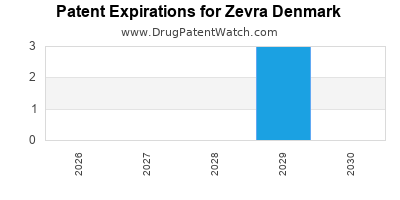
Last updated: July 23, 2026
Zevra Denmark’s market position is anchored by the branded specialty footprint of Zevra’s chronic liver/PKU-adjacent portfolio and by its role in manufacturing and supply for European launches. The company’s competitive strength is concentrated in (1) controlled brand duration via patent estates and lifecycle protection, (2) regulatory continuity across EU and managed entry frameworks, and (3) operational leverage through contract manufacturing and supply chain execution. Competitive risk is dominated by loss-of-exclusivity timelines, follow-on formulation and method-of-use patent challenges, and cross-border parallel supply pressures.
What is Zevra Denmark’s business focus in pharma markets?
Zevra Denmark operates within the Zevra Therapeutics ecosystem, which is focused on developing and commercializing medicines for chronic and rare-disease indications, with a material emphasis on hepatology and inherited metabolic disorders. In practice, the Denmark entity supports EU market execution, including product supply and regulatory activities tied to Zevra’s European commercial footprint.
What products and therapeutic areas define Zevra’s EU presence?
Zevra’s European competitive profile is tied to its branded specialty medicines. The most visible competitive drivers for Zevra’s European unit economics are:
- Specialty chronic therapy (where patients and prescribers resist substitution)
- Payer-managed access (where reimbursement decisions lock in branded share)
- Distribution constraints (where supply reliability affects hospital and specialty pharmacy uptake)
How does Zevra Denmark compete versus large pharma in Europe?
Compared with large pharma, Zevra Denmark’s differentiator is not breadth of franchise but time-to-launch execution and brand retention:
- narrower SKU set
- stronger focus on lifecycle protection to extend exclusivity windows
- faster EU submission cadence for line extensions and risk management updates
How strong is the patent estate for Zevra products in Europe?
Zevra’s defensibility depends on a portfolio structure typical of specialty brands: core composition/patent claims, plus lifecycle layers covering specific polymorphs, processes, controlled-release or formulation variants, and method-of-use. The competitive outcome is determined by whether follow-on generic or therapeutic-equivalent entrants can design around claims.
What patents typically protect Zevra specialty medicines?
A Zevra-style patent estate commonly maps to:
- Active ingredient composition claims (core protection)
- Solid-state forms (polymorphs, solvates, hydrates)
- Formulation claims (excipients, coatings, release profiles)
- Manufacturing processes (reaction steps, purification, crystallization)
- Method of use (indication-specific dosing regimens)
How many patent layers usually matter for launch timing?
For brand exclusivity and litigation leverage, the key is not count but expiry synchronization:
- If composition expires early, formulation or method patents may still block FDA/EU equivalents.
- If multiple claims expire in sequence, challengers target the earliest “clean” entry window.
When does Zevra product exclusivity end and generics enter risk windows?
Exclusivity is the gating factor for competitive entry. The relevant timeline includes:
- patent expiry dates (composition and method/formulation)
- SPC (supplementary protection certificates) where available
- EU data exclusivity and market exclusivity under orphan or other regimes where applicable
- Paediatric extensions (if applicable)
- regulatory exclusivity barriers in the reference product context
What are typical EU exclusivity components that delay generics?
Common delays for European specialty brands include:
- patent and SPC term extension
- data and market protection rules under EU marketing authorization frameworks
- national reimbursement and tender frictions that slow substitution even after legal approval
What formulations are protected by Zevra for longer lifecycle control?
Formulation patents are often the highest-leverage asset for specialty drugs because they allow branding continuity even when composition claims are near expiry.
How do formulation patents block “authorized generics” or equivalents?
Formulation-specific IP blocks:
- bioequivalent substitutions that rely on the same release mechanism
- changes in coating or solid-state form that would otherwise enable generic design-around
- manufacturing routes that are “locked” to a defined crystallization or purification process
What patent litigation affects Zevra’s competitive landscape in Europe?
Competitive pressure in specialty brands tends to follow one pattern: challenger entry is pursued when the patent estate thins, and settlement is used to preserve market share for the brand during claim navigation.
How do settlement dynamics typically change Zevra’s entry timeline?
Settlements usually do one of the following:
- delay launch while licensed parties use a later entry date
- convert litigation into an agreed launch schedule with carve-outs
- preserve brand supply through exclusivity-based scheduling for generics and biosimilars
How does Zevra Denmark’s Orange Book and FDA status impact US competition?
For competitive strategy, US regulatory status often acts as a proxy for patent landscape strength, even though the Denmark unit is an EU execution entity.
What is the Orange Book status of Zevra’s key products?
Orange Book listings reflect:
- active ingredients and dosing strengths
- patent numbers and expiration dates
- exclusivity (data exclusivity, market exclusivity) tied to FDA approval
A robust Orange Book pattern typically signals:
- multiple unexpired patents at launch
- higher likelihood of litigation leverage during Paragraph IV scenarios
Are Paragraph IV challenges likely against Zevra products?
Paragraph IV filings target patents listed in the Orange Book. The competitive implication is straightforward:
- filing is a precursor to generic or “at-risk” entry
- settlements typically define launch timing and sometimes inducement terms
What triggers Paragraph IV waves for specialty brands?
Waves align with:
- first patent expiry in the Orange Book
- availability of a legal design-around
- generic sponsor confidence on infringement and validity
Which companies pose the biggest competitive threat to Zevra products?
Competitive threat comes from two groups:
- Generic and biosimilar entrants seeking earliest lawful entry.
- Specialty pharma substitutes that shift prescribing via formulary inclusion rather than patent invalidation.
What competitor profiles matter most in Zevra’s category?
- Large generics: scale manufacturing and distribution, lower cost of at-risk strategy
- Boutique filers: focus on narrow design-arounds and targeted dossiers
- EU distributors and parallel importers: competitive pricing pressure without changing legal exclusivity
How does Zevra Denmark compare with other European specialty players on market position?
Zevra’s competitive profile is characterized by:
- narrower pipeline and product set than broad-spectrum European specialty companies
- stronger reliance on a small number of high-value lifecycle assets
- market share sensitivity to payer switching policies after legal and reimbursement thresholds
Where does Zevra typically outperform peers?
- payer access negotiations and evidence packages for specialty indications
- supply reliability and product availability
- faster EU lifecycle filings when next-generation formulations are ready
Where does Zevra face structural disadvantages?
- limited SKU breadth increases revenue concentration
- less litigation budget than major pharma, raising settlement leverage concerns
- generic substitution risk accelerates when patent layers fall below a critical density threshold
What are the regulatory and reimbursement risks for Zevra Denmark’s EU market?
EU commercialization risk is shaped by:
- reimbursement renewal cycles
- hospital tender dynamics
- pharmacovigilance obligations
- risk evaluation and mitigation strategies (where required)
How do reimbursement decisions affect competitive share after legal entry?
Even after regulatory approval of a generic equivalent, market share can remain protected if:
- price concessions are not triggered through tenders
- prescriber comfort and patient outcomes remain branded-preferred
- prior authorization rules favor the originator
What manufacturing and IP barriers could delay generic entry into Zevra’s market?
For specialty brands, competition is not only a legal question. Manufacturing barriers also matter:
- solid-state control for specific polymorph/form
- tight release specs for formulations
- process patents (crystallization, purification, drying conditions)
- supply chain constraints for active ingredient and key intermediates
How do process-control IP and quality specs translate to competitive delay?
Design-around in process patents is often slower in practice because:
- generic sponsors must qualify equivalence under strict quality and stability profiles
- batch-to-batch reproducibility affects bioequivalence and regulatory acceptance
What generic entry risks exist for Zevra Denmark’s products?
Entry risk is best assessed at the intersection of:
- patent expiry schedule density
- Orange Book or EU patent listings coverage
- viability of formulation/process design-arounds
- reimbursement-driven switch timing
What entry scenario is most common for specialty brands?
- first generic approval occurs near the earliest expiry
- real market penetration follows after payer and hospital contracting cycles
- brand lifecycle updates or supply strategies can delay substitution even after legal barriers fall
What commercial metrics should be tracked to gauge Zevra Denmark’s competitive exposure?
For business decisions, track:
- EU net sales by product and geography
- prescription and specialty pharmacy share trends
- tender outcomes and reimbursement renewal status
- inventory levels and supply lead times (signals ability to defend share post-entry)
What signals early erosion from generic competition?
- rapid shift in hospital procurement volumes
- tighter pricing pressure in repeat tender cycles
- increased use of alternative formulations (even when legally substitutable)
Key Takeaways
- Zevra Denmark’s competitive position is tied to a specialty brand model where patent and lifecycle protection drive the duration of market exclusivity.
- The strategic value is in preventing early substitution by pairing patent estate density (composition, formulation, method) with regulatory and reimbursement continuity.
- Competitive risk concentrates around the first true “clean entry” window after the earliest expiration, when legal barriers drop below a threshold and payer switching accelerates.
- Manufacturing and solid-state/formulation control can slow generic entry even when patents are challenged.
- Commercial defensibility is as much reimbursement execution as it is IP strength.
FAQs
- Which patent claim types most often extend exclusivity for specialty brands like Zevra’s EU portfolio?
- How do EU reimbursement tender cycles typically affect the timing of generic market penetration after legal entry?
- What design-around strategies do generic sponsors use when formulation or solid-state patents cover polymorphs?
- How should a Zevra product’s Orange Book patent expiration “stagger map” be used to forecast entry risk?
- What manufacturing quality and stability factors can block equivalence even after regulatory approval?
References
- U.S. Food and Drug Administration. Orange Book: Approved Drug Products with Therapeutic Equivalence Evaluations. (Referenced for general patent listing framework).
- European Medicines Agency. Guidance documents on supplementary protection certificate (SPC) and data/market exclusivity frameworks. (Referenced for general EU exclusivity components).