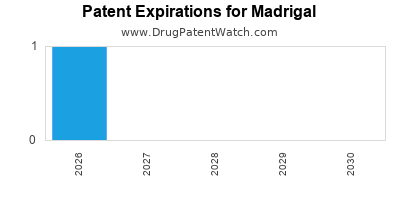
Last updated: June 26, 2026
Madrigal Pharmaceuticals is positioning resmetirom (Rezdiffra) in NASH with high near-term commercial leverage from Form 14A risk controls: (1) a focused IP moat around resmetirom composition, formulation, and likely method-of-use claims, (2) regulatory exclusivity protecting first-comer use in the approved liver endpoints, and (3) a near-term competitive perimeter shaped more by label breadth, payer contracting, and manufacturing scale than by direct generic entry.
Competitive bottleneck by timeline: generic substitution is constrained by the Orange Book patent wall (if listed and enforceable) plus regulatory exclusivities tied to FDA approval. Competitive bottleneck by product behavior: resmetirom’s differentiation against late-stage competitors in metabolic dysfunction-associated steatohepatitis (MASH/NASH) will hinge on dosing convenience, histology endpoint durability, safety, and managed-care coverage rather than head-to-head efficacy claims alone.
What is Madrigal’s market position in NASH MASH with Rezdiffra resmetirom?
Fast-read positioning
- Company: Madrigal Pharmaceuticals
- Lead asset: resmetirom (Rezdiffra)
- Therapeutic area: metabolic dysfunction-associated steatohepatitis (MASH), historically NASH, with fibrosis staging endpoints
- Commercial logic: early scaling depends on (a) clinician adoption in hepatology and gastroenterology, (b) payer acceptance tied to fibrosis progression and downstream cost-offset narratives, and (c) expansion of eligible patient segments aligned with labeling.
Where Madrigal fits in the competitive stack
NASH/MASH competition is splitting into:
- Liver-directed small molecules seeking improvements in fibrosis and NASH activity.
- Metabolic risk modulators (lipid and glucose pathways) that may drive liver benefits indirectly.
- Immune and fibroinflammatory approaches targeting pathways upstream of scarring.
Madrigal’s differentiator is that resmetirom is a thyroid hormone receptor agonist selective for THR-β, intended to improve lipid metabolism and downstream hepatic injury. In managed-care, the practical question is whether payers view the drug as disease-modifying versus symptom relief, which determines step therapy intensity and formulary placement.
How do competitors typically attack market share against resmetirom?
- Price and contracting through early biosimilar-like contracting dynamics for small molecules once patents start to thin (mid-term).
- Label capture via broader or more easily measurable endpoints and subgroup benefits.
- Real-world adoption by aligning dosing, lab monitoring burden, and tolerability to existing workflows.
How strong is Madrigal’s patent estate for resmetirom (Rezdiffra)?
Featured snippet answer
Madrigal’s patent strength for resmetirom depends on whether the FDA Orange Book lists: (i) composition of matter covering resmetirom, (ii) polymorph/formulation patents covering tablets and coatings or delivery attributes, and (iii) method-of-use patents tied to specific patient populations and clinical endpoints.
Patent estate drivers for long-tail strength
- Composition of matter: hardest to design around; blocks direct generic copies even if bioequivalence is achieved.
- Formulation and polymorph claims: typically the next line of defense; can delay ANDA entry by forcing design-around or carve-outs.
- Method-of-use claims: not always listed in Orange Book, but they can block “use-based” infringement unless the generic avoids the patented indication(s).
- Manufacturing process: can create a practical barrier if formulation manufacturing steps are constrained.
Which patents typically matter for Orange Book risk?
In US landscape terms, the “real” litigation risk for an ANDA comes from patents that are:
- Listed in the FDA Orange Book for the approved drug.
- In force at the generic’s paragraph IV filing date.
- Triggered by product use and product practice (covering the labeled indication).
Key litigation sensitivity
Even a strong patent estate can lose value if:
- listed patents are not enforceable against the generic’s proposed label or formulation, or
- settlements narrow disputes but allow an earlier carve-out launch.
What is the Orange Book status of Rezdiffra (resmetirom) and which listed patents matter for exclusivity?
Featured snippet answer
Orange Book status determines the generic filing window, with the controlling variables:
- Which patents are listed (and their expiry).
- Whether they are tied to composition, formulation, or method-of-use.
- Any pediatric exclusivity and other exclusivity extensions that shift the last permissible generic approval date.
Orange Book mapping framework (what to evaluate in the filing record)
For each Orange Book patent, map:
- Patent number
- Patent type (composition/formulation/method-of-use/process)
- Expiration date
- Patent certification category (Paragraph I-IV status)
- Listing scope (drug product and strength)
How does Orange Book listing translate to generic entry timing?
- If composition/formulation patents are still in force, ANDA approvals can be delayed even if exclusivity has lapsed.
- If method-of-use patents are listed, generic entry may require label changes to avoid infringement.
When does resmetirom lose exclusivity and what are the key exclusivity dates?
Featured snippet answer
Exclusivity timing is determined by:
- Regulatory exclusivity (new chemical entity and/or new clinical investigation exclusivity, if applicable) tied to FDA approval.
- Patent expiry for Orange Book-listed patents.
- Any patent term adjustment (PTA) and pediatric exclusivity that extend protection.
Timeline structure to build (high-signal)
- FDA approval date (launch anchor)
- Generic window open date: earliest ANDA approval date that respects exclusivity and patent expiry
- Paragraph IV strategic filing date: usually set to optimize settlement leverage
- First generic launch date under settlement or litigation win
How PTA and pediatric exclusivity change the math
- PTA increases patent life by compensating delays in FDA review.
- Pediatric exclusivity can extend the patent and/or market exclusivity by 6 months when pediatric requirements are met.
What Paragraph IV challenges exist for resmetirom and what is the litigation posture affecting generic launches?
Featured snippet answer
Paragraph IV filings are the gating event for early generic entry. The risk profile depends on:
- whether challengers target composition versus formulation patents
- whether courts issue an injunction pending appeal
- whether settlements permit “at-risk” launch earlier than the full patent wall would allow
How to assess whether Paragraph IV risk is high
High risk for Madrigal’s protected market usually correlates with:
- early, multiple ANDA filings with carve-outs
- challengers selecting “weakest” listed patents first
- settlements that trade royalty-style payments for delayed launch but with an earlier start than expected
Low risk correlates with:
- dismissals for insufficient infringement theories
- sustained court rulings
- settlements that preserve most exclusivity windows
What is the competitive threat from other NASH MASH drugs against Madrigal?
Competitive set logic
The NASH/MASH market is contesting patients across:
- fibrosis stages
- comorbidity-driven prescribing patterns (diabetes, obesity, dyslipidemia)
- readiness for hepatology referral and monitoring
How resmetirom typically compares on the market dimensions that matter
- Endpoint relevance: fibrosis progression and NASH activity are the adoption levers.
- Safety/tolerability: adverse events and lab monitoring drive persistence and payer comfort.
- Dosing simplicity: fewer titration steps and lower monitoring burden improve formulary adoption.
- Payer criteria: prior authorization criteria often require staging evidence and documented progression risk.
Strategic insight: resmetirom’s competitive outcome will be decided by payer-specific utilization management. Even a small differentiation in labeling or safety can expand the addressable patient population if it reduces denial rates.
How does Rezdiffra’s formulation and dosing strategy affect generic/biobranded substitution risk?
Featured snippet answer
Formulation patents and practical manufacturing differences influence generic substitutability, especially when claims cover:
- specific tablet composition, coatings, or excipients
- dissolution behavior and stability constraints
- manufacturing methods that define critical quality attributes
Formulation moat patterns for small-molecule liver drugs
Generic companies can often copy strength and dosing form, but may be blocked by:
- polymorph or particle size claims
- dissolution profile patents
- process parameters that change bioavailability
If the Orange Book includes such patents, generics may file with carve-out strategies or wait out expiry.
What licensing deals or settlement agreements shape Madrigal’s competitive runway?
Featured snippet answer
In small-molecule Orange Book contests, settlements often determine:
- launch date under court-approved agreement
- royalty structure or payment-to-delay terms
- label designations to avoid method-of-use infringement
Settlement outcomes that materially change market share
- Earlier-than-expected launch: shifts Madrigal revenue curve sharply after the settlement date.
- Narrow carve-out launch: limits generic uptake if payers require the original label or if prescribers avoid off-label switches.
- Royalty-based framework: can preserve margin even with generic competition.
How does Madrigal defend against “design-around” in resmetirom generics?
Featured snippet answer
Design-around defenses typically combine:
- broader composition and process claims
- formulation-specific claims
- method-of-use claims aligned to labeled endpoints
- enforcement strategy that ties proposed generic product to patented attributes
Manufacturing/IP barriers that slow ANDA
- Unclear critical manufacturing parameters can create time-to-market delays.
- Bioequivalence disputes can delay approval if differences affect absorption.
- If patents include formulation and stability claims, “same drug, different manufacturing” can become a litigation issue.
What biosimilar risk applies to Madrigal’s resmetirom and what is the real generic risk?
Featured snippet answer
Resmetirom is a small molecule, not a biologic, so there is no biosimilar pathway. The competitive threat is generic ANDAs and potentially authorized generics depending on agreements.
Risk implication
Competitive risk is driven by:
- ANDA filing and litigation outcomes
- Orange Book listed patent expiry
- label carve-outs and payer switching behavior
Which market segments are most exposed to competitive switching away from Rezdiffra?
Featured snippet answer
Competitive switching concentrates in segments where:
- fibrosis staging eligibility is broad and payer coverage is protocolized
- switching requirements are minimal
- there is clinical equipoise among multiple disease-modifying options
Where switching is hardest
- patients with strong response narratives under current prescribing habits
- patients with monitored dosing protocols where physician confidence is high
- payer plans with established step therapy tied to specific endpoints
How do investment and acquisition prospects change with Madrigal’s patent and market trajectory?
Featured snippet answer
M&A leverage for Madrigal depends on measurable:
- time remaining in patent and exclusivity windows
- certainty of FDA label expansion
- likelihood of settlement-based generic launch timing
Valuation signals tied to the competitive perimeter
- if near-term patent expiry looks stable, market entrants pay a higher premium for late-stage pipelines or label access
- if patent cliffs are near, acquirers price the risk of accelerated erosion and shorter cash runway
Key Takeaways
- Madrigal’s competitive advantage for resmetirom is dominated by the interaction of Orange Book patent coverage, regulatory exclusivity, and label-driven payer behavior, not by biosimilar risk.
- The practical generic entry risk turns on whether core composition/formulation patents are listed and enforceable at the time of ANDA filings.
- Competitive share against other NASH/MASH drugs will be determined by endpoint credibility, safety and monitoring practicality, and payer contracting, with switching most likely in plans that standardize coverage criteria.
- Settlement dynamics can materially alter the revenue curve; the market should focus on whether any challenged patents yield earlier carve-out entry.
FAQs
1) What patents protect resmetirom (Rezdiffra) from generic competition?
Patent protection typically comes from Orange Book-listed composition-of-matter and formulation patents, plus any method-of-use patents that correspond to the labeled indications.
2) When can generic versions of resmetirom be approved in the US?
Generic approval timing is constrained by regulatory exclusivities and the expiry dates of Orange Book-listed patents that are in force on the ANDA approval date.
3) What happens if a generic challenges only a method-of-use patent?
The generic may need label carve-outs to avoid the patented indication; uptake depends on payer acceptance of the altered label and clinician willingness to switch.
4) Is there a biosimilar threat to Rezdiffra?
No. Resmetirom is a small molecule, so only ANDA-style generic competition applies.
5) How does payer coverage affect Madrigal’s competitive performance in NASH/MASH?
Coverage controls prescribing access through prior authorization and step therapy, which can determine the speed of adoption and the ability to defend share if competing drugs enter.
References
- FDA. Orange Book: Approved Drug Products with Therapeutic Equivalence Evaluations. U.S. Food and Drug Administration.
- FDA. Drug Approval Reports and labeling for Rezdiffra (resmetirom). U.S. Food and Drug Administration.
- FDA. Guidance for Industry: Paragraph IV Certifications and related ANDA considerations. U.S. Food and Drug Administration.