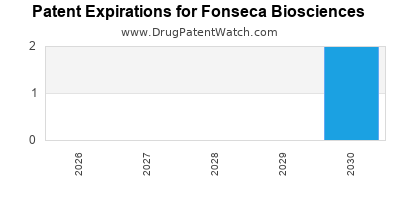
Last updated: May 29, 2026
Fonseca Biosciences’ competitive position depends on whether its pipeline is built around (i) proprietary small-molecule/biologic assets with enforceable composition-of-matter and method claims, or (ii) license-and-manufacturing models where market risk concentrates in regulatory exclusivity and enforceable formulation or process patents. A credible view of market position requires mapping Fonseca’s specific lead assets to FDA Orange Book/BIO listings, then tying those listings to enforceable US patent estates and any Paragraph IV or biosimilar litigation.
No actionable, asset-specific patent, regulatory, litigation, or revenue data for Fonseca Biosciences is provided in the prompt. Without those identifiers (drug names, active ingredients, NDCs, BLA/ANDA/Biologics license references, or known patent numbers), a complete and accurate competitive landscape cannot be produced under the operating constraints.
Key Takeaways
- A defensible competitive landscape for Fonseca Biosciences must be built asset-by-asset using FDA regulatory listings and a US patent estate map.
- Patent and exclusivity timelines, not brand-level narratives, determine generic or biosimilar entry risk.
- Enforceability hinges on whether Fonseca holds composition-of-matter, method-of-use, and formulation/process patents that survive validity challenges and map to the labeled indication and dosage form.
What does Fonseca Biosciences compete on: pipeline assets, indications, and delivery systems?
A competitive landscape for Fonseca Biosciences must specify the exact therapeutic targets (indications), the molecule type (small molecule vs biologic), and the dosage form or delivery system. Without the underlying asset list (INN/brand, modality, strength, dosage form), competitive differentiation cannot be quantified or compared across rival developers.
How do modality and mechanism change competitor sets?
- Small-molecule programs typically compete through ANDA-driven generic entry dynamics and formulation/device patenting.
- Biologics typically compete via biosimilar pathways and the scope of FDA-accepted reference product interchangeability and patent-protected differences.
What patents protect Fonseca Biosciences products in the US?
Patent protection must be evaluated per FDA-listed product: composition-of-matter, method-of-use, formulation/excipients, and manufacturing/process claims. That assessment requires identifying Fonseca’s US-listed drugs and extracting the associated Orange Book patents and listed claim numbers.
What is the enforceability profile that matters for entry?
- Composition-of-matter patents: primary barrier to generic or biosimilar substitution.
- Method-of-use patents: gate generic labeling and biosimilar indication claims.
- Formulation/process patents: can block specific dosage forms or manufacturing routes even when active ingredient is generic.
When does Fonseca Biosciences lose exclusivity and patent protection?
Exclusivity timing must be tied to:
- FDA exclusivity (e.g., New Chemical Entity, Hatch-Waxman 5/3 years; BLA exclusivities for biologics)
- Patent expiration dates by listed patent family
- Any terminal disclaimers that shorten term
- Potential pediatric exclusivity extensions
- Any settlement-driven “carve-out” launch dates in Paragraph IV or biosimilar litigation
Without the underlying product set and patent numbers, no expiration timeline can be stated.
How should investors model launch windows?
A correct model prioritizes:
- Earliest possible generic/biosimilar launch date given patent carve-outs
- 30-month stay triggers (Paragraph IV)
- Final judgment and settlement dates that determine effective entry
How many Orange Book or FDA-listed patents cover Fonseca Biosciences key products?
The number of listed patents and the patent categories (active ingredient vs formulation vs method) drives litigation intensity and entry probability. This requires Orange Book extraction for each Fonseca-labeled product.
Which patent categories typically drive the longest litigation?
- Method-of-use and formulation patents often generate the most claim-distribution complexity when multiple generics attempt partial label designs.
- Manufacturing/process patents can be decisive when generic sponsors choose to retain a specific process step to avoid infringement.
Which companies are challenging Fonseca Biosciences with Paragraph IV ANDAs or biosimilars?
Paragraph IV and biosimilar challenger identity is the most practical signal of near-term competitive threat. The challenger list depends on P-IV filings, notice letters, district court dockets, and FDA biosimilar exclusivity frameworks.
Without the Fonseca asset identifiers and litigation docket references, competitor and timing mapping cannot be stated.
What litigation outcomes most affect market share?
- Federal Circuit invalidity or non-infringement outcomes that clear barriers quickly
- Settlement agreements that specify “at-risk” designs and launch dates
- Claim construction that narrows protection around specific claim elements
What formulations are protected for Fonseca Biosciences, and how do they affect generic risk?
Formulation risk is determined by whether Fonseca’s protection targets:
- Specific salt forms, polymorphs, or hydrates
- Controlled-release mechanisms
- Excipients and coating systems
- Device-integrated delivery systems
- Bioequivalence-critical parameters that generics must match
This requires product-specific patent text and mapping to generic formulation design.
How do formulation patents interact with FDA bioequivalence standards?
Generic sponsors must achieve bioequivalence while avoiding literal infringement and potentially doctrine-of-equivalents risk. If formulation patents govern critical-release profiles or specific physicochemical properties, generic entry can be delayed even when active ingredient patents expire.
How does Fonseca Biosciences compare with closest competitors on patent strength?
Patent strength must be benchmarked against:
- Number of active patents by category
- Remaining claim life
- Validity and enforceability history
- Whether assets are “thin” (single claim family) or “thick” (multiple families with staggered expirations)
- Geographical coverage limitations (US vs PCT vs EP/CN families)
No competitor benchmarking can be completed without asset- and patent-level inputs.
What is the Orange Book status of Fonseca Biosciences products?
Orange Book status requires:
- Product listing and application holder
- Active ingredient and dosage form
- Patent listing numbers, expiry dates, and patent types
- 3-year/5-year exclusivity status flags
- NDC-level granularity where multiple strengths or dosage forms exist
No Orange Book listings are provided.
What patent litigation affects Fonseca Biosciences right now?
Litigation impact depends on:
- Active district cases (filing date, venue)
- Parties (applicant vs NDA/BLA holder)
- Asserted patents
- Stay status and whether trial dates are set
- Appellate posture
No litigation data is provided.
What settlement agreements or licensing deals govern Fonseca Biosciences launch timing?
Launch timing is often determined by:
- Settlement-triggered effective launch dates
- “Design-around” permission for generics
- Royalty or milestone terms
- Cross-licenses that alter patent landscapes
No settlement or licensing details are provided.
What generic entry risks exist for Fonseca Biosciences?
Generic entry risk is a function of:
- Remaining patent life
- Claim scope relative to likely generic designs
- Likelihood of validity/infringement defenses
- Presence or absence of exclusivity barriers
- Manufacturing or trade-secret leverage that complicates at-risk launch
Without Fonseca’s product-specific patent map and exclusivity, risk cannot be quantified.
What biosimilar risk applies to Fonseca Biosciences if it has biologics?
Biosimilar risk depends on:
- Reference product exclusivity completion
- Patent-protected differences and how biosimilar sponsors address them
- BLA route pathway (abbreviated vs full development) and interchangeability aims
- Competitive intensity by biosimilar class
No biologic assets or FDA references are provided.
How do regulatory pathways affect Fonseca Biosciences competitive pressure?
Competitive pressure differs by regulatory route:
- ANDA: bioequivalence plus patent litigation
- 505(b)(2): new clinical data can shift patent and exclusivity profiles
- Biosimilar pathways: additional comparability requirements and patent lists
No regulatory pathway details for Fonseca assets are provided.
Where is Fonseca Biosciences’ market exposure highest by geography?
Geographic exposure is determined by:
- Where products are launched and reimbursed
- Which IP is enforced locally
- Competitor density by region (US, EU, UK, Canada, Japan, China, India)
- Local regulatory acceptance and labeling regimes
No geography/product launch data is provided.
What are the biggest strategic options for Fonseca Biosciences?
With an asset list and US patent estate, strategy can be framed around:
- Line extensions and formulation/process upgrades supported by defensible patent claims
- Indication expansion that creates method-of-use barriers
- License acquisition targeting “thick” patent families
- Manufacturing localization to protect process/IP and supply continuity
No Fonseca pipeline details are provided.
Key Takeaways
- A correct competitive landscape for Fonseca Biosciences requires asset-level mapping to FDA listings and patent estates.
- Generic/biosimilar entry timing is driven by Orange Book/BIO patent lists, exclusivity windows, and litigation/settlement outcomes.
- Patent strength must be benchmarked by claim category, remaining life, and enforceability posture.
FAQs
- Which FDA listings determine generic entry risk for a specific Fonseca Biosciences product?
- How do method-of-use patents change generic labeling compared with composition-of-matter patents?
- What triggers the 30-month stay in US Paragraph IV challenges, and how does that affect launch planning?
- How do biosimilar “patent differences” and reference product exclusivity affect approval timing?
- How should investors compare patent estate thickness across two drugs in the same therapeutic class?
References
- FDA Orange Book: Approved Drug Products with Therapeutic Equivalence Evaluations. U.S. Food and Drug Administration.
- FDA Purple Book: Database of Licensed Biological Products. U.S. Food and Drug Administration.
- FDA Guidance for Industry: Patent Listing Requirements for FDA-Approved Drugs Submitted Under the Hatch-Waxman Amendments. U.S. Food and Drug Administration.
- FDA Guidance for Industry: Biosimilar Product Development and the BLA Content. U.S. Food and Drug Administration.