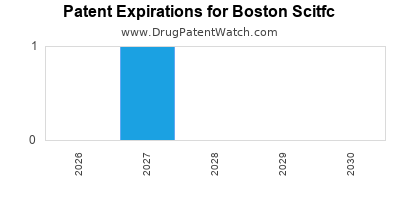
Last updated: July 4, 2026
Boston Scientific (BSX) is a leading global manufacturer of cardiovascular devices and endoscopy systems, with a portfolio shaped by (1) patent-protected platforms (implantable cardiac rhythm management, structural heart, interventional cardiology, urology, and gastroenterology), (2) recurring revenue from procedure volumes and installed base, and (3) defensible manufacturing processes and design-dependent claims. Competitive intensity is highest in structural heart valves, atrial fibrillation ablation, cardiac rhythm management timing algorithms and software, and GI endoscopy accessories where fast-follow products can erode price.
The competitive landscape is driven by three dynamics: (i) device life-cycle cycles where clinical evidence updates support incremental label expansions; (ii) regulatory and reimbursement constraints that slow generic or copycat entry; and (iii) patent estates that often protect specific design features and delivery systems rather than broad therapeutic concepts. Strategically, the highest-risk areas for share are product families where competitors have cleared regulatory pathways quickly and where BSX products face design-around opportunities. The strongest areas are where BSX combines clinical evidence, procedural training, and hardware-platform IP to maintain an installed-base advantage.
What patents protect Boston Scientific’s cardiovascular and endoscopy device platforms?
Boston Scientific’s patent protection is typically split across device architecture, specific components (delivery systems, catheters, electrodes, stents, valves, sheaths), software/algorithms where applicable, and manufacturing methods that affect durability, performance, and biocompatibility. For investors and challengers, the practical question is claim scope around (a) functional limitations that are hard to design around and (b) structural limitations tied to performance.
Which jurisdictions matter most for Boston Scientific device IP?
Boston Scientific’s enforceable rights usually cluster around the US (utility patents), Europe (EPO/EP validations), and select key markets through national phase filings. For competitive freedom-to-operate, US and EP filings are the most operational, but enforcement strategy can shift by country and litigation venue.
How strong is Boston Scientific’s patent estate versus Medtronic, Abbott, and Johnson & Johnson?
Device IP strength tends to correlate with (1) number of active filings for core platforms, (2) remaining life of granted patents tied to platform components, and (3) the share of claims that are not purely functional. In competitive terms, the key differentiator is whether rivals can redesign without losing clinical performance and without triggering infringement of device architecture claims.
Do Boston Scientific patents protect software or algorithms?
In cardiac rhythm management and mapping/ablation workflows, software-linked claims can appear in patents covering sensing, therapy decision logic, and signal processing. Competitive design-arounds often focus on replicating clinical outcomes using different sensing pathways or therapy-selection architectures rather than copying code.
When does Boston Scientific lose exclusivity for its key device lines?
Device “exclusivity” differs from drug exclusivity. There is no Orange Book equivalent; market exclusivity is driven by patent expiry, trade secret/know-how, and regulatory exclusivity periods for certain submissions or biologic-related devices. For a competitive forecast, the relevant “timeline” is the remaining life of the most enforceable patents per device platform and whether those patents are being actively asserted.
What is the effective timeline for patent-driven competition in devices?
Competition increases in waves:
- Pre-expiry (2 to 5 years before): competitors file design-around concepts and seek regulatory pathways.
- Expiry window (0 to 24 months): infringement risk changes, but lingering continuations can extend effective coverage.
- Post-expiry (0 to 5 years): share shifts to functionally similar systems unless new improvements generate new IP.
Which BSX platforms face the fastest competitive erosion risk?
Risk clusters where:
- the product is commoditizing (low differentiation),
- the clinical value is transferable to alternative hardware designs,
- or the delivery system is relatively easy to redesign.
In general, the highest pressure areas tend to be accessories and catheter-based families where rivals can match procedure outcomes.
Which BSX platforms typically have longer protection windows?
Platforms that embed performance-critical design in a complex architecture, including:
- structural heart delivery components and valve mechanics,
- rhythm management electrode and lead-related designs,
- and endoscopy imaging/working-channel integration where usability and reliability matter.
What generic or “copycat” entry risks exist for Boston Scientific devices?
Unlike generics, device competition is mostly “design-around” entry, plus regulatory clearance pathways that allow similar predicate-based submissions or, in some cases, PMA-based competition.
How does regulatory pathway impact competitive entry timing?
- 510(k)-type clearances for predicate-based device similarity can compress time-to-market.
- PMA-type pathways typically slow entry in high-risk categories.
- Clinical data refresh cycles influence label expansion and thus the competitive threat timeline.
Can competitors design around Boston Scientific patents without regulatory delay?
Often, yes. Patent design-around does not automatically require a new clinical program if the competitor can preserve safety and effectiveness. The practical constraint is whether the redesigned device still performs in the same clinical setting with comparable endpoints.
What manufacturing or quality system barriers slow “copycat” adoption?
Manufacturing methods that affect:
- coating uniformity,
- electrode durability,
- assembly tolerances,
- sterilization validation,
- and reliability testing
can be difficult to replicate at scale, especially where BSX invests in proprietary process control.
How does Boston Scientific compare with Medtronic, Abbott, and Johnson & Johnson in patent strength and product defensibility?
Competitive positioning in medtech is not only about patent count. It is about claim scope that ties directly to performance and about how tightly the product is integrated into a procedural ecosystem.
Boston Scientific vs Medtronic
- Medtronic is strong in broad cardiovascular portfolios and often competes directly on rhythm management and structural heart.
- BSX differentiation typically rests on procedural workflow, device handling characteristics, and platform-specific design features.
The patent battle tends to be fact-specific: competitors win when they can match clinical endpoints using non-infringing architectures.
Boston Scientific vs Abbott
Abbott competes across structural, electrophysiology adjacent categories, and interventional cardiology. The competitive leverage often turns on:
- procedural outcomes,
- device longevity,
- and economic contracts with hospital systems.
BSX’s strongest counter is usually an installed-base and training advantage plus continued platform improvements.
Boston Scientific vs Johnson & Johnson (J&J)
In many cardiovascular categories, J&J competes with strong clinical adoption networks. Patent defensibility matters, but access and physician preference also determine share capture. BSX’s strategic edge usually centers on device usability and compatibility with existing hospital practices.
What patent litigation has affected Boston Scientific competitive positioning?
Device patent litigation can influence competitive behavior through (i) preliminary injunction risk, (ii) licensing settlements, and (iii) customer procurement constraints during disputes. In practice, the competitive impact is highest when a dispute blocks supply or creates uncertainty that deters hospitals from stocking specific SKUs.
How do settlements and licensing deals change the competitive landscape?
When competitors enter licensing arrangements:
- BSX can reduce infringement exposure without halting market access,
- rivals can continue sales,
- and hospitals see reduced SKU uncertainty.
The market effect depends on license scope and geographic reach. Short licenses tied to specific components generally narrow settlement-driven stability.
Which components usually drive infringement disputes in devices?
Litigation commonly concentrates on:
- electrode and sensing structures (rhythm management, ablation),
- stent/valve mechanical design features (structural heart),
- and delivery catheter architectures (interventional).
What is the FDA status of Boston Scientific’s major device categories and how does it affect competition?
FDA status shapes competitive timing as much as patents. For example, label scope limits which patient populations a competing product can target immediately.
How do FDA label expansions alter competitive dynamics?
Competitors often enter with narrower indications. When BSX expands indications through supplemental approvals, it can widen addressable patient pools and reduce the immediate overlap with competitor offerings.
What matters most for procedural reimbursement and hospital adoption?
In many systems, competitive outcomes depend on:
- reimbursement alignment,
- bundled payment effects,
- and documented procedure success rates.
FDA clearance is necessary, but economics and reliability determine take-rate.
Which Boston Scientific product families face the highest competitive intensity?
Competitive intensity is highest where large installed bases and high procedure volumes exist and where rivals can match clinical endpoints.
Cardiac rhythm management and electrophysiology
Key competitive battlegrounds include:
- atrial fibrillation ablation platforms,
- ablation lesion sets and catheter control,
- and therapy decision logic tied to sensing and pacing.
Patent strength is typically strongest where design features directly control therapy efficacy.
Structural heart
Competition centers on:
- valve mechanics,
- delivery systems,
- and procedural usability.
The strategic fight often includes next-generation iterations that improve outcomes and reduce procedure complexity.
Interventional cardiology
Here the competition is often more price and contract-driven, with innovation cycles in:
- guidewires, balloons, and stents
- and imaging-enabled or workflow-integrated interventions.
What formulations and delivery systems are protected by Boston Scientific device patents?
For medtech, “formulation” maps to materials, coatings, and delivery architecture.
Materials and coatings
Coatings used for:
- thrombogenicity modulation,
- drug-elution functions (where applicable),
- anti-fouling surfaces,
- and biocompatibility and endothelialization
are common targets for IP. Competitors can design around at the material level but must preserve clinical performance.
Delivery and deployment mechanisms
Delivery patents often protect:
- sheath and catheter structure,
- deployment sequences,
- anchoring mechanisms,
- and mechanical tolerances.
These features are hard to replicate without performance losses.
What strategic insights does the Boston Scientific competitive landscape suggest for R&D and licensing?
The actionable strategy is to align R&D with the remaining “hard to design-around” claim areas and to time platform upgrades to stay ahead of competitor design-around filings.
R&D strategy
- Prioritize improvements that create new claimable architecture rather than incremental tweaks that are easy to replicate.
- Build evidence packages around usability and procedural endpoints to strengthen physician adoption and reduce switching.
Licensing strategy
- Where design-around is inevitable, use licenses that cover the most economically relevant components to prevent market fragmentation and procurement uncertainty.
- Focus on broadest practical scope across jurisdictions tied to hospital system procurement patterns.
Litigation strategy
- Target disputes that affect supply continuity or key SKUs, not only theoretical claim coverage.
- Use settlements to reduce market unpredictability for customers during transition periods.
Key Takeaways
- Boston Scientific’s competitive position is built on platform durability, installed-base effects, and device-specific IP tied to delivery systems and performance-critical architecture.
- Competitive erosion risk rises where device designs are easy to replicate and where competitors can match clinical endpoints via non-infringing architectures.
- Regulatory pathway and label scope are often decisive in determining how quickly competitors can translate clearance into share.
- The highest litigation impact typically comes from disputes that affect core components or limit supply of specific SKUs during the exclusivity-equivalent window.
FAQs
- How do device patent expiry timelines differ from drug patent exclusivity for Boston Scientific?
- Which Boston Scientific components are most often targeted for design-around in cardiovascular devices?
- What role do FDA label expansions play in defending Boston Scientific market share versus Medtronic and Abbott?
- How do hospital contracting practices amplify or reduce the effect of Boston Scientific patent litigation outcomes?
- What criteria best predict which Boston Scientific device platforms will face fastest competitive commoditization?
References
- FDA. “Premarket Notification 510(k).” U.S. Food and Drug Administration.
- FDA. “Premarket Approval (PMA).” U.S. Food and Drug Administration.
- EPO. “European Patent Office: Patent law and proceedings.” European Patent Office.