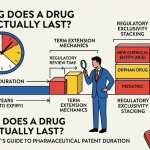
FDA approval of a generic drug is a regulatory milestone, not a commercial launch date. The gap between those two events can stretch from weeks to more than a decade, and the reasons are structurally distinct: some are legal, some are regulatory, some are purely economic, and some trace back to a 50-kilogram batch of API sitting in a Chennai warehouse that failed dissolution testing.
For IP teams at brand-name companies, understanding why generics delay their launch is as important as knowing when patents expire. For generic manufacturers, modeling that gap with precision determines whether an ANDA filing is a billion-dollar bet or a waste of regulatory resources. For portfolio managers and buy-side analysts, the difference between a generic entering Q1 versus Q3 of a given year can reprice a brand’s equity by 15 to 40 percent in a single session.
This article takes every factor the original DrugPatentWatch analysis identified and extends each one into its technical architecture, its IP valuation implications, and its predictive utility for analysts doing real-time launch forecasting. The framework draws on Hatch-Waxman case law, FDA regulatory guidance, Orange Book data structures, ANDA litigation statistics, and supply chain dynamics through 2025.
2. The ANDA Mechanism: What ‘Abbreviated’ Actually Means for Launch Risk
How the Hatch-Waxman Act Engineered the Generic Industry
The Drug Price Competition and Patent Term Restoration Act of 1984, universally called Hatch-Waxman, created a regulatory bargain. Brand-name companies got patent term restoration of up to five years to compensate for FDA review time lost during clinical development. Generic companies got a streamlined approval pathway that substituted bioequivalence data for the full clinical trial package already established for the Reference Listed Drug (RLD).
That bargain produced the Abbreviated New Drug Application (ANDA). The ‘abbreviated’ label refers specifically to the evidentiary standard: a generic applicant does not replicate safety and efficacy studies because those findings already belong to the scientific record via the original NDA. What the generic must prove is that its product delivers the same active moiety to the systemic circulation at the same rate and to the same extent as the RLD.
The practical effect is a cost structure transformation. A full NDA costs anywhere from $500 million to over $2 billion to support. An ANDA, by contrast, costs $1 million to $5 million for a straightforward small molecule, with complex generics (inhalation products, transdermal patches, extended-release injectables) running $10 million to $50 million or more when specialized bioequivalence studies are required.
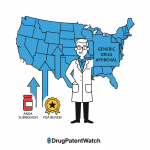
The FDA’s Office of Generic Drugs (OGD) within the Center for Drug Evaluation and Research (CDER) processes these applications. OGD received 1,286 ANDA submissions in fiscal year 2023 and approved 781 ANDAs, including 90 first-time generic approvals. The agency operates under a target of ten months for standard review and six months for priority review, though actual median review times have historically exceeded those targets, particularly for complex formulations.
Bioequivalence Standards: The Core Technical Hurdle
Bioequivalence (BE) is the evidentiary foundation of every ANDA. The FDA considers two drug products bioequivalent when the 90 percent confidence interval for the ratio of their pharmacokinetic parameters (area under the curve, or AUC, and peak plasma concentration, or Cmax) falls entirely within the 80 to 125 percent range. This statistical criterion applies to both the rate and extent of drug absorption.
For most immediate-release oral solid dosage forms, establishing BE is operationally routine: recruit 24 to 36 healthy volunteers in a crossover design, measure plasma concentrations, run the statistical model, and submit the data package. The FDA’s Generic Drug User Fee Amendments (GDUFA) program has streamlined the formal review of these packages substantially since 2012.
Where BE becomes technically and financially treacherous is with complex formulations. Consider the challenges specific to each major complex drug category:
Inhalation products (dry powder inhalers, metered-dose inhalers, nebulized solutions) require demonstrating BE at the device-product combination level. Airflow dynamics, particle size distribution, fine particle fraction, and spray pattern all become relevant variables. The FDA requires both in vitro and, in some cases, in vivo BE for these products. Restasis (cyclosporine ophthalmic emulsion, 0.05%) sat in tentative approval for nearly seven years in part because demonstrating BE for a complex emulsion ophthalmics product requires characterizing the formulation itself rather than just systemic exposure.
Extended-release formulations require BE testing across multiple time points, often including fed and fasted conditions and, for some products, studies in special populations. Products with narrow therapeutic indices (NTIs) such as warfarin, lithium, phenytoin, and carbamazepine face a tightened BE standard: the FDA mandates that the 90 percent CI for AUC and Cmax fall within 90 to 111 percent rather than the standard 80 to 125 percent range. NTI products consequently take longer to develop and carry higher clinical risk of failing BE.
Locally acting drugs (inhaled corticosteroids, topical dermatologics, vaginal products) present perhaps the hardest technical challenge because systemic plasma concentration is a poor surrogate for local tissue concentration at the site of action. FDA has issued product-specific guidance (PSGs) for hundreds of these drugs, specifying the required BE approach, but those approaches are often demanding and scientifically contested, which drives up development cost and time.
CGMP Inspections and Their Role in Approval Timelines
FDA approval of an ANDA depends on two parallel tracks converging: the chemistry, manufacturing, and controls (CMC) review and the facility inspection. The OGD reviews the CMC data in the ANDA. The FDA’s Office of Pharmaceutical Quality (OPQ) and the Office of Regulatory Affairs (ORA) inspect the manufacturing site through a pre-approval inspection (PAI), verifying that the facility can actually produce the drug as described.
If a facility receives a Warning Letter or an Official Action Indicated (OAI) classification from a prior inspection, the FDA will typically withhold ANDA approval until the facility demonstrates remediation. In practice, this means OAI facilities in India and China, which supply a disproportionate share of API and finished dosage form manufacturing capacity for U.S. generic drugs, can delay ANDA approvals by 12 to 36 months. Between 2014 and 2020, the FDA issued Warning Letters to a significant number of Indian API and finished-dose facilities, creating approval bottlenecks that had nothing to do with the applicant’s clinical or chemistry data.
The completeness of the initial ANDA submission also drives review cycle count. Applications that go through multiple review cycles, each triggered by a Complete Response Letter (CRL) from FDA, add 6 to 18 months per cycle. A GAO analysis found that over 40 percent of ANDAs required at least two review cycles, with the most common deficiencies in CMC data, labeling, and BE study design.
Key Takeaways: The ANDA Mechanism
FDA approval of an ANDA is necessary but not sufficient for market launch. The BE standard, though statistically defined, hides substantial technical complexity for inhalation products, ophthalmic emulsions, NTI drugs, and locally acting formulations. CGMP inspection status at both the API supplier and finished-dose manufacturer can delay final approval by years, independent of the quality of the scientific submission. Analysts modeling generic entry should track facility inspection status through FDA’s Establishment Inspection Report (EIR) database, not just ANDA approval dates.
3. The Orange Book as an IP Registry: How to Read It Like a Patent Attorney
What the Orange Book Records, and What It Misses
The FDA’s ‘Approved Drug Products with Therapeutic Equivalence Evaluations’ — the Orange Book — is the operative patent registry for the U.S. pharmaceutical market. Brand-name companies must list patents that claim the drug substance, the drug product, or a method of use, and that a generic applicant would need to certify against before the FDA can approve a competing ANDA. The Orange Book assigns each approved product a therapeutic equivalence (TE) code: an ‘A’ code means the FDA has determined the product therapeutically equivalent to the RLD; a ‘B’ code signals a potential BE problem.
What the Orange Book does not record is all patents that might be relevant. Patents protecting manufacturing processes are generally not listable. Intermediate compound patents are not listable. Trade secret protection on formulation details is obviously not in the Orange Book. And critically, the Orange Book relies on brand-name companies to self-certify patent relevance, which has produced considerable controversy: the FTC has challenged a number of Orange Book listings as improperly listed, and the FDA Omnibus Reform Act of 2022 required FDA to take a more active role in reviewing disputed listings.
The Orange Book is updated monthly, but patent listing changes and exclusivity updates can take weeks to appear after an NDA supplement or court order. For real-time intelligence, the primary data source is Drugs@FDA, which OGD updates daily and which contains tentative approval dates, approval dates, and applicant-level ANDA status.
Orange Book Data Architecture: A Technical Walk-Through
Each Orange Book entry has five data fields that matter for launch prediction: the NDA number, the patent number, the patent expiration date, the exclusivity code, and the exclusivity expiration date. The patent expiration date listed is the USPTO-calculated expiration, which is 20 years from the application filing date, adjusted for any Patent Term Extension (PTE) under 35 U.S.C. 156 (available for up to five additional years of patent term to compensate for FDA regulatory review time) and any Patent Term Adjustment (PTA) awarded by the USPTO for administrative delays during prosecution.
PTE is particularly important for high-value drugs. The maximum PTE is five years, but the total remaining patent life after approval cannot exceed 14 years. For a drug like apixaban (Eliquis), which went through a long clinical development cycle, PTE pushed the effective patent expiry well beyond the nominal 20-year term from earliest filing. Analysts who read only the ‘base’ patent expiry date without accounting for PTE will systematically underestimate brand exclusivity.
The exclusivity field records regulatory exclusivities (NCE, orphan, pediatric, etc.) separately from patents. These run independently and can outlast or undercut the patent expiration. When both a patent and an exclusivity protect the same drug, the effective date of possible generic entry is the later of the two dates, unless a generic applicant successfully invalidates the patent or successfully challenges the exclusivity on narrow statutory grounds.
Key Takeaways: Orange Book as Intelligence Tool
Reading the Orange Book with precision means tracking PTE-adjusted expiry dates, not nominal patent terms. It means cross-referencing the exclusivity codes against the actual statutory definitions. It means checking Drugs@FDA daily rather than monthly for ANDA status changes. And it means recognizing that what is absent from the Orange Book (process patents, trade secrets, improper listings that the FTC later challenges) can matter as much as what is listed.
4. Initial Composition-of-Matter Patents and Their IP Valuation Weight
How Composition-of-Matter Patents Anchor Drug IP Portfolios
A composition-of-matter (CoM) patent covers the chemical structure of the active ingredient itself. These are the strongest patents in pharmaceutical IP because they block every formulation, every dosage form, and every approved indication. No generic can work around a CoM patent — the only options are to wait for it to expire, invalidate it via inter partes review (IPR) at the USPTO or litigation in district court, or license it.
In IP portfolio valuation, a CoM patent is typically treated as the primary asset defining the drug’s economic moat. DCF models for branded pharmaceutical franchises discount cash flows to the CoM patent expiry date, then apply a steep terminal value haircut to reflect post-patent price erosion. The steepness of that haircut depends on the number of expected generic entrants: one study found that within a year of first generic entry, brand prices fall to roughly 15 to 20 percent of pre-generic levels when six or more generics compete.
Case Study: Apixaban (Eliquis) IP Valuation
Apixaban, marketed as Eliquis by Bristol-Myers Squibb and Pfizer, illustrates how CoM patent valuation works in practice. The compound patent for apixaban (U.S. Patent No. 6,967,208, held by BMS) had a nominal expiration date of May 2023. PTE extended it to December 2026. A Paragraph IV challenge from multiple generic manufacturers (including Mylan, Sigmapharm, and others) resulted in a 2019 settlement permitting generic entry in April 2028 in the U.S. market.
The IP valuation implications were enormous. Eliquis generated roughly $12 billion in global net revenues in fiscal year 2023. Generic entry in 2028 rather than 2023 or 2026 preserved approximately $35 billion to $50 billion in cumulative net revenues for BMS and Pfizer during that gap, purely from the settlement’s licensing restriction provisions. The settlement itself was not a reverse payment (it included no cash transfer from brand to generic), making it less susceptible to FTC challenge under the FTC v. Actavis framework. This is the type of IP valuation calculation that portfolio managers need to run against each compound patent listed in the Orange Book.
Patent Term Extension: The Calculation Methodology
Under 35 U.S.C. 156, a patent holder can apply for PTE once a drug product is approved by FDA. The regulatory review period (RRP) is calculated as the sum of the Phase 1 period (IND approval to NDA submission) and the Phase 2 period (NDA submission to NDA approval). The extension equals half the Phase 1 period plus the full Phase 2 period, minus any time the applicant ‘failed to act with due diligence.’ The statute caps the extension at five years and caps total post-approval life at 14 years.
For a drug with a long Phase 1 period (say, eight years of clinical development) and a one-year FDA review, the PTE could be four to five years. For a drug with a short Phase 1 period (e.g., a repurposed compound with a 505(b)(2) pathway), the PTE could be as little as six months. Analysts who want to predict the actual effective expiry date of a CoM patent must work through this calculation rather than relying on the face of the patent.
The USPTO maintains a public database of PTE applications and grants. Reviewing that database alongside the Orange Book listing provides the most accurate picture of a specific drug’s CoM patent life.
Investment Strategy: CoM Patent Cliff Modeling
Portfolio managers should map the PTE-adjusted CoM patent expiry dates for their top ten holdings annually. The calculation is not difficult once the methodology is understood, but it is rarely done correctly by generalist analysts. Common errors include using the filing date rather than the earliest priority date (which determines the nominal 20-year term), failing to subtract the time during prosecution when the applicant was responsible for delays, and confusing PTE with PTA (which applies only to the patent prosecution period, not post-approval exclusivity).
A CoM patent cliff model should also include a probability-weighted discount for IPR petition success rates. Since the America Invents Act (AIA) created the IPR process in 2012, IPR institution rates for pharmaceutical patents have been approximately 60 to 70 percent, with patent claims cancelled or amended in roughly 70 percent of instituted proceedings. However, IPR applies to CoM patents less often than to secondary patents, because generic applicants typically choose Paragraph IV litigation rather than IPR for CoM challenges. When generic companies do file IPRs against CoM patents, the FDA’s 30-month stay does not apply, meaning an IPR victory can accelerate generic entry faster than a district court Paragraph IV win.
5. The Evergreening Playbook: Secondary Patents, Formulation Filings, and Patent Thickets
The Mechanics of Evergreening
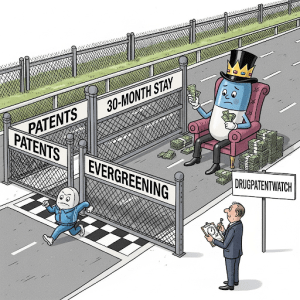
Evergreening refers to a brand-name company’s practice of filing additional patents covering aspects of a drug other than the original active ingredient, timed to create continuous layers of IP protection extending beyond the CoM patent expiry. The tactic is legal, widely used, and highly effective. A Commonwealth Fund analysis found that the median number of patents listed in the Orange Book per new drug tripled between 1985 and 2005, and the pace has continued since.
Secondary patents can cover an enormous range of things. Polymorphic forms of the active ingredient cover specific crystal structures, each of which may have distinct physical or bioavailability properties. Formulation patents cover specific ratios of excipients, coating compositions, or the combination of the drug with a specific inactive ingredient. Delivery system patents cover the device or mechanism through which the drug reaches the patient — the inhaler design, the patch matrix, the injectable microsphere architecture. Method-of-use patents cover new approved indications or specific patient subpopulations. Metabolite patents cover the pharmacologically active metabolites produced when the body processes the parent compound.
Each of these secondary patent types has a different probability of surviving a Paragraph IV challenge, and that probability should drive how generic companies sequence their challenges.
Patent Thicket Analysis: Real-World Density
The patent thicket concept describes a situation where a single drug is protected by so many overlapping patents that navigating them requires extraordinary resources. Humira (adalimumab), AbbVie’s monoclonal antibody for inflammatory diseases, had over 130 U.S. patents listed or related to its protection at various points, protecting everything from the antibody structure to the manufacturing process to specific dosing regimens. No single generic or biosimilar company could cost-effectively challenge all 130; AbbVie licensed biosimilar manufacturers on its own terms, determining launch timing through the license agreements rather than through patent expiry dates.
For small molecules, the thicket is usually less extreme but still material. Nexium (esomeprazole magnesium) carried formulation patents and method-of-use patents extending several years past the CoM patent, generating significant Paragraph IV litigation from Ranbaxy, Teva, Mylan, and others. Each secondary patent required its own challenge, its own litigation track, and its own 30-month stay calculation.
IP Valuation: Secondary Patent Portfolios
Secondary patents carry lower average valuation than CoM patents in DCF models because they are more vulnerable to invalidity challenges — they are often narrower in claim scope and face stronger prior art — and because generic manufacturers can sometimes design around them without triggering infringement. A formulation patent covering a specific polymorph can be designed around if the generic uses a different polymorph with equivalent bioequivalence. A delivery system patent can potentially be avoided if the generic uses a different device design.
However, secondary patents can carry very high option value in specific circumstances. A method-of-use patent covering a newly approved indication can block generic entry for the specific indication even after all other patents have expired, particularly if the indication represents a growing share of prescriptions. Extended-release formulation patents, which often require the generic to demonstrate BE for the specific modified-release mechanism, can extend exclusivity by five to ten years beyond the CoM expiry. In these cases, the secondary patents can protect 30 to 60 percent of peak annual revenues during the protection window.
Polymorphic Patents: The Nexium Paradigm
AstraZeneca’s conversion of omeprazole (Prilosec, whose CoM patents expired in 2001) into esomeprazole (Nexium) is the most taught example of secondary-patent-driven evergreening. AstraZeneca isolated the S-enantiomer of omeprazole and patented it as a new compound, obtaining a new CoM-like patent. This was not a mere formulation patent but a compound patent on a specific stereoisomer, which courts upheld. The practical outcome was that AstraZeneca maintained substantial market exclusivity on Nexium until 2014, generating cumulative U.S. revenues exceeding $20 billion during a period when generic omeprazole was selling for pennies per dose.
The esomeprazole strategy required FDA approval for a new NDA rather than relying solely on Paragraph IV certifications, which meant a five-year NCE exclusivity period layered on top of the new compound patent. This stacking effect, where a secondary patent effectively functions as a new CoM patent because it covers a genuinely distinct chemical entity, represents the highest-value evergreening outcome.
Key Takeaways: Evergreening and Patent Thickets
Secondary patents vary dramatically in their defensive strength. Polymorphic form patents and steroisomer patents are the hardest to challenge because they require proof that the claimed form has no novel properties (difficult to demonstrate convincingly). Formulation and delivery system patents are more vulnerable to design-around or invalidity arguments but can still delay generic entry by two to five years when litigation proceeds. Method-of-use patents are increasingly challenged through ‘skinny label’ ANDAs (carve-outs of patented indications), though recent case law — particularly GSK v. Teva — has complicated that strategy. Analysts should tier secondary patent risk by type, not treat all secondary patents as equivalent obstacles.
6. Hatch-Waxman Mechanics: Paragraph IV, the 30-Month Stay, and At-Risk Launches
The Four Patent Certification Options
An ANDA applicant must certify, for each patent listed in the Orange Book for the RLD, one of four positions designated by the Hatch-Waxman statute. A Paragraph I certification states that no patent information has been filed. A Paragraph II certification states the patent has expired. A Paragraph III certification states the applicant will not seek approval until the patent expires. A Paragraph IV certification asserts either that the listed patent is invalid, unenforceable, or will not be infringed by the generic applicant’s product.
The Paragraph IV certification is the mechanism that drives almost all generic patent litigation. Filing a Paragraph IV initiates a notification obligation: the generic applicant must formally notify both the NDA holder (the brand-name company) and the patent owner within 20 days of the FDA acknowledging the ANDA is substantially complete. That notification triggers the 45-day window during which the brand can file suit.
The decision to file a Paragraph IV rather than a Paragraph III is fundamentally an option valuation calculation. Filing Paragraph III means waiting for the patent to expire, which is certain but potentially far in the future. Filing Paragraph IV and winning in litigation means potential early entry, first-filer 180-day exclusivity (if the company is the first to file), and the ability to capture a large share of a still-sizable market before patent expiry-driven price collapse. Filing Paragraph IV and losing means paying damages if the company launched at-risk, or simply waiting for the patent to expire if it chose not to launch.
The 30-Month Stay: Mechanism and Real Behavior
When a brand-name company files suit within the 45-day window, the FDA is automatically prohibited from granting final ANDA approval for 30 months from the date of the generic applicant’s notice. This is the 30-month stay. It can be shortened if the court reaches a final decision before 30 months expire or if the parties settle. It can be extended by court order if the generic applicant is found to have failed to cooperate reasonably in expediting the case.
The 30-month stay’s practical effect in the 2013-2020 cohort has been studied carefully. A 2021 PMC study found that the median time from Paragraph IV notice to actual generic launch among first generics was substantially longer than 30 months in most cases, meaning the stay itself was not the binding constraint on launch timing. The patent litigation ran past the 30 months in many cases, or the parties reached a settlement that specified a negotiated entry date, or the generic manufacturer was not ready to launch commercially even after receiving tentative approval.
This finding has important implications for analysts. When a 30-month stay is set to expire, it does not mean generic entry is imminent unless there is also a court decision or settlement in place. The expiry of the stay removes the FDA regulatory barrier but does not resolve the underlying patent dispute. The generic company that launches after stay expiry but before final court resolution launches at-risk.
At-Risk Launches: The Financial Calculus
An at-risk launch occurs when a generic manufacturer has received FDA final or tentative approval, has no stay blocking launch, but has not yet obtained a court judgment or settlement clearing the patent. The generic launches commercially while litigation continues. If the court later finds infringement, the generic manufacturer owes the brand-name company damages equal to the ‘reasonable royalty’ on sales or, in exceptional cases, lost profits.
The financial calculus for an at-risk launch depends on the probability of infringement finding, the expected revenues during the at-risk period, the magnitude of potential damages, the competitor landscape (other generics that would dilute the market if they also launch), and the time horizon. Apixaban’s Paragraph IV filers modeled this extensively. Multiple generic companies received final approval in 2019, well before the negotiated 2028 entry date, and chose not to launch at-risk given the strength of BMS’s patent position and the magnitude of potential damages exposure.
The clearest historical example of an at-risk launch gone wrong is Teva’s launch of generic Protonix (pantoprazole) in 2007 after receiving final ANDA approval. When Wyeth later won a jury verdict that Teva’s generic infringed its patent, Teva faced a damages award exceeding $1.6 billion. That outcome, which was eventually reduced on appeal, has made generic manufacturers more cautious about at-risk launches for high-revenue products.
Key Takeaways: Hatch-Waxman Litigation Mechanics
The 30-month stay is a starting clock, not an ending event. Generic entry requires not just the stay’s expiry but also a cleared patent position (court win, settlement, or patent expiry). At-risk launches are rare for blockbuster products because the damage exposure is proportional to revenues. First-to-file status for 180-day exclusivity is the commercial prize that justifies most Paragraph IV filings, because it creates a period of duopoly pricing between the first generic and the brand-name product.
7. Pay-for-Delay Settlements: The FTC’s Lens and What It Means for Launch Forecasting
Reverse Payment Settlements: Structure and Prevalence
A reverse payment settlement (also called a pay-for-delay agreement) occurs when a brand-name company pays a generic applicant, in cash or in kind, to agree not to market its product until a specified date. The payment flows in the direction opposite to the normal settlement dynamic (where the losing party pays the winning party), which is why the FTC calls them reverse payments.
The economic logic is straightforward from the brand’s perspective: if the generic would win the patent litigation, early generic entry destroys far more brand revenue than the cost of the settlement payment. Paying the generic company to delay entry by three to five years can be worth hundreds of millions of dollars to the brand, even if the settlement payment itself runs to tens or hundreds of millions.
The Supreme Court addressed the antitrust status of reverse payment settlements in FTC v. Actavis (2013). The Court held that these settlements are not immune from antitrust scrutiny and should be evaluated under the rule of reason. Post-Actavis, the FTC has continued to challenge settlements it identifies as anticompetitive, though the litigation burden is substantial and outcomes have been mixed.
For launch forecasting, reverse payment settlements present a specific challenge: the negotiated entry date in the settlement is confidential in most cases. Analysts can detect a settlement has occurred (because the litigation terminates without a public court decision), but the launch date terms are often not publicly disclosed. Inference from the settlement announcement date, the remaining patent term, and the general settlement structure can bound the likely entry date but cannot pin it precisely.
Non-Cash Consideration: The Post-Actavis Evolution
After Actavis, brand-name companies moved toward settling Paragraph IV disputes with non-cash consideration to make the antitrust analysis harder. Common non-cash consideration in modern settlements includes authorized generic rights (the brand grants the generic applicant the right to sell an authorized generic version), supply agreements at favorable terms, and co-promotion rights for the brand in markets outside the United States.
Authorized generic rights as settlement currency are particularly important for launch forecasting. If a brand grants a generic company the right to market an authorized generic beginning on a specific date, that date is the effective generic entry date for pricing purposes, even if the terms of the authorized generic license prevent the company from simultaneously launching a full Paragraph IV ANDA. Investors should treat an authorized generic launch as equivalent to generic entry for revenue modeling purposes.
8. Regulatory Exclusivity Stacking: Every Type, Every Duration, Every Interaction
New Chemical Entity (NCE) Exclusivity
The FDA grants five years of NCE exclusivity to the first NDA for a drug product containing an active moiety that has never before been approved. During the five-year period, the FDA will not accept for filing any ANDA or 505(b)(2) application relying on the approved NCE’s safety and efficacy data, except that generic companies can file ANDAs with Paragraph IV certifications during the last year of the five-year exclusivity period (four years after NDA approval). If the generic files a Paragraph IV during that window, the 30-month stay operates from the date of the Paragraph IV notice, which can push the stay’s expiry into the post-exclusivity period.
NCE exclusivity is the single most powerful regulatory protection a brand-name drug can receive because it runs independently of patents and can provide five full years of market protection even if the CoM patent were somehow invalid or unenforceable.
Orphan Drug Exclusivity (ODE)
Seven years of ODE attaches to a drug approved for a rare disease or condition (fewer than 200,000 U.S. patients). ODE blocks the FDA from approving a competitor’s application for the same drug for the same indication. It does not block a competitor from seeking approval for a different drug with the same mechanism of action, nor does it block approval of the same drug for a different indication. ODE also does not block the FDA from approving an application if the original sponsor cannot ensure sufficient product supply or if the later applicant demonstrates clinical superiority over the ODE-protected drug.
For rare disease drugs, ODE is often the primary commercial protection because many of these drugs lack traditional CoM patent protection of long duration. The 7-year ODE for a drug like Sarepta’s eteplirsen (Exondys 51) or Alexion’s ravulizumab (Ultomiris) can be more economically significant than the patent portfolio alone.
Pediatric Exclusivity
A brand-name company that conducts pediatric studies in response to an FDA Written Request (WR) earns six additional months of exclusivity, which attaches to and extends each qualifying patent and regulatory exclusivity already in place for the drug. Pediatric exclusivity cannot stand alone; it is an add-on.
The financial value of pediatric exclusivity for a blockbuster drug is substantial. Six months of additional exclusivity for a drug generating $3 billion in annual U.S. revenues (roughly $750 million per quarter) is worth $1.5 billion in gross revenue protection, minus cannibalization from the authorized generic that typically launches simultaneously with the first Paragraph IV generic. Brand-name companies have been effective at using pediatric WRs strategically, timing their pediatric studies to expire just as the primary patent’s exclusivity approaches its final months.
New Clinical Investigation (3-Year) Exclusivity
Three years of exclusivity attaches to an NDA supplement for a new indication, new dosage form, new strength, or new route of administration, when that change required a new clinical investigation (other than bioavailability studies) essential to approval. This exclusivity covers only the specific change, not the entire drug. Generic companies can still obtain approval for the original approved indications and dosage forms during the 3-year exclusivity period; they simply cannot immediately replicate the specific new indication or formulation covered by the exclusivity.
The practical strategic use of 3-year exclusivity is to protect specific product upgrades — extended-release formulations, new indications that represent growing prescription volumes, combination products — from immediate generic copying. For a drug whose core patents are expiring, a timely NDA supplement with a clinically meaningful new investigation can buy three years of protection on the reformulated product, during which the brand can migrate prescribers from the old formulation to the new one.
180-Day First-Filer Exclusivity
The first ANDA applicant to file a substantially complete ANDA with a Paragraph IV certification against each listed patent for a given RLD earns 180 days of exclusivity during which the FDA cannot approve any other ANDA for the same drug product. This 180-day period begins upon the first commercial marketing of the first filer’s generic product.
The 180-day exclusivity period creates the most profitable window in the generic industry: a duopoly between the first-filer generic and the brand-name product (and often an authorized generic from the brand). During this period, the first-filer generic typically captures 85 to 90 percent of new generic prescriptions and prices its product at 10 to 20 percent below the brand rather than the 80 to 85 percent discount that appears once multiple generics compete. The revenue impact during those six months can represent as much as 50 percent of the total lifetime revenues a generic company will earn from that ANDA.
Losing first-filer status because another company filed its ANDA first by even a single day eliminates this advantage entirely. Generic companies assign significant R&D and regulatory resources to filing ANDAs on the day the four-year ‘early filing’ window opens for NCE drugs, specifically to secure first-filer status.
Competitive Generic Therapy (CGT) Exclusivity
CGT exclusivity is 180 days of market exclusivity granted to a single generic applicant for a drug product where there is currently inadequate generic competition (typically defined as fewer than three approved generics). The CGT designation also comes with expedited review. CGT exclusivity is analogous to first-filer 180-day exclusivity but applies in markets where competition is already approved but insufficient.
CGT has been used most actively in markets for complex generics where manufacturing barriers have kept the number of competitors low. Generic manufacturers who secure CGT exclusivity can price their products with higher margins than typical multi-competitor generic markets allow, making CGT ANDAs disproportionately attractive commercial opportunities.
GAIN Act Exclusivity
The Generating Antibiotic Incentives Now (GAIN) Act grants five additional years of exclusivity to qualified infectious disease products (QIDPs) targeting serious or life-threatening bacterial or fungal infections. Combined with NCE exclusivity, a QIDP can accumulate ten years of total NCE-plus-GAIN exclusivity. For the antibiotic market, where the patent and exclusivity duration is often the primary commercial protection (clinical trial timelines for new antibiotics are relatively short), GAIN exclusivity is the dominant IP valuation variable.
How Exclusivities Interact: Stacking Logic
When multiple exclusivities attach to the same drug, the FDA’s practice is to extend the effective date of generic entry to the latest expiring exclusivity or patent, whichever is later. Pediatric exclusivity adds to and extends whichever protection is already running. A drug with NCE exclusivity expiring in year five and a CoM patent expiring in year eight would have generic entry barred until year eight (plus any pediatric exclusivity add-on). A drug with NCE exclusivity expiring in year five and a CoM patent that expired in year three would have generic entry barred until year five.
The interaction of ODE with other protections can create unusual scenarios. If a drug earns both NCE exclusivity (5 years) and ODE (7 years), the ODE window extends two years past the NCE window. During those two years, a generic can file an ANDA but cannot receive approval for the ODE-protected indication. Generic companies often file ANDAs for non-ODE indications of orphan drugs during the ODE period to get into the queue early, anticipating ODE expiry.
Key Takeaways: Regulatory Exclusivity
The correct way to model generic entry barriers is to map all applicable exclusivities alongside all listed patents, calculate their respective expiry dates with any applicable add-ons, and identify the latest expiring protection as the binding constraint — while simultaneously tracking whether any Paragraph IV litigation has the potential to clear patents before their nominal expiry. Treating ‘patent expiry’ and ‘exclusivity expiry’ as synonymous is a recurring analytical error that causes systematic errors in generic entry forecasting.
9. Commercial Reasons Generics Sit on the Shelf After Approval
Market Economics and the 30 Percent Non-Launch Rate
Not all approved generics launch. Approximately 30 percent of ANDA approvals never result in a commercial product, and an additional significant fraction involve multi-year delays between approval and launch. The economic reasons fall into several distinct categories.
The most common driver of non-launch is post-approval market assessment. When a generic company filed its ANDA, it projected the number of competing generics, the expected price erosion trajectory, and the resulting unit economics. By the time the FDA grants approval, which may be three to seven years after filing, the market has evolved. Competitors have launched, price erosion has been steeper than projected, or the branded market has migrated to a successor formulation that diminished the original’s volume. If the NPV of launching is now negative or de minimis, the rational decision is to hold the approval without launching.
A 2018 KPMG analysis of approved but non-launched generics found that over 40 percent of drugs approved in 2016 had not launched by the end of 2018. The proportion was higher for drugs with multiple approved ANDAs, where price competition was projected to be most intense. Generic manufacturers facing these situations must also weigh the opportunity cost of manufacturing capacity: committing a production line to a low-margin product displaces capacity that could be used for a more profitable product.
Portfolio Sequencing and Strategic Delay
Large generic companies manage ANDA portfolios as integrated businesses. Teva, with more than 1,000 approved ANDAs globally, cannot launch all products simultaneously without overwhelming its commercial infrastructure. The company sequences launches by commercial priority: highest-revenue products, products with 180-day exclusivity, products with CGT designations, and products where competitive timing is critical get launched first. Products with low urgency, lower revenue potential, or manufacturing complexity sit in the queue.
This sequencing logic also applies to situations where a generic company holds an ANDA for a product that competes with another product in its own portfolio. A company that has both an approved generic and a branded specialty drug in the same therapeutic category may deliberately slow-roll the generic launch to protect the branded product’s market position. Analysts tracking launch timing should review the full portfolio of the ANDA holder, not just the specific ANDA in question.
First-Filer Hesitation: Waiting for Day 181
When a first-filer generic holds 180-day exclusivity, it can choose when to begin its 180-day clock by choosing when to begin commercial marketing. Starting the clock early means earlier generic competition from other approved ANDAs when the 180 days expire. Waiting to start the clock — ideally until just before the first Day 181 trigger event — means preserving the duopoly period for as long as possible.
However, the FDA has ‘forfeiture’ provisions that can terminate 180-day exclusivity before the first-filer chooses to launch. A first-filer forfeits its exclusivity if it fails to market within a specified period of a court decision or other triggering event, if it withdraws its ANDA, if it enters an agreement with the brand-name company that the FTC determines to be anticompetitive, or if approval of the first ANDA is not obtained within certain deadlines. Analysts tracking 180-day exclusivity situations must watch for forfeiture triggers, because forfeiture can allow Day 181 competition to begin earlier than the first-filer planned.
10. Authorized Generics: Strategic Function and Market Distortion Effects
What an Authorized Generic Is and How It Works
An authorized generic (AG) is the brand-name drug itself, sold without the brand name, either by the original NDA holder or by a company licensed by the NDA holder. The FDA does not consider AGs to be independent ANDA approvals; they operate under the original NDA. This means AGs can launch without any new approval requirement, at any time, including during the first-filer’s 180-day exclusivity period.
The AG’s launch during the 180-day window breaks the economic benefit of first-filer exclusivity. Instead of a brand-vs.-first-filer duopoly (where the brand holds price above the generic to maintain branded market share, and the generic prices 10 to 20 percent below), the market becomes a brand, an AG, and the first-filer generic — a triopoly that typically results in lower AG and first-filer generic pricing than the theoretical duopoly would produce. Studies have found that first-filer generics lose 20 to 40 percent of expected exclusivity-period revenues when an AG launches simultaneously.
Branded pharmaceutical companies use the AG strategically in several ways. The AG can be launched to maximize generic market capture for an affiliate or licensing partner while simultaneously being used as a settlement tool: in reverse payment disputes, the brand may agree to refrain from launching an AG during the first-filer’s 180-day period (a ‘no-AG’ commitment) in exchange for a longer agreed-upon entry date. This no-AG commitment has significant economic value and has been scrutinized by the FTC as a form of non-cash reverse payment under Actavis.
IP Valuation of Authorized Generic Agreements
For investors analyzing a brand-name company’s IP portfolio, AG launch rights are a meaningful but often overlooked asset. An AG launched on Day 1 of generic entry can capture 40 to 60 percent of new generic prescriptions during the 180-day period, depending on pricing and contracting. At aggressive pricing (50 percent below brand), the AG may undercut both the first-filer generic and other ANDAs approved after the 180-day period ends, potentially maintaining the brand franchise’s volume at a lower price point while preserving the relationship with formularies and pharmacy benefit managers.
The direct revenue from an AG during the 180-day period for a drug with $2 billion in annual U.S. revenues might be $150 million to $300 million, which is meaningful to the brand’s quarterly earnings at a moment when branded revenues are collapsing. Companies that fail to include AG launch rights in their patent expiry revenue models systematically underestimate post-patent revenues.
11. Manufacturing Scale-Up and CGMP Compliance as Launch Bottlenecks
The Gap Between Lab-Scale and Commercial Production
ANDA approval is based on manufacturing data from validation batches, which are production-scale batches demonstrating that the manufacturing process can consistently produce a product meeting specifications. However, validation batches are distinct from the steady-state commercial manufacturing cadence that will supply the market at launch.
Generic manufacturers frequently face challenges scaling validated processes to commercial output levels without generating quality deviations. Particle size distribution in a granulation process that is well-controlled at 500 kilograms per batch may drift at 2,000 kilograms per batch due to fluid dynamics differences in the blender. Dissolution profiles that meet specifications in validation may show batch-to-batch variation at commercial scale due to minor environmental fluctuations in temperature or humidity. These deviations trigger internal quality investigations that delay commercial release.
For complex generics requiring specialized manufacturing infrastructure (sterile injectables, lyophilized products, modified-release microparticles), the scale-up challenge is amplified. Vivitrol (naltrexone extended-release injectable microspheres) required a highly specialized polymeric microsphere manufacturing process. The first approved generic (April 2023) was approved approximately 14 years after Vivitrol’s original NDA approval, partly because the manufacturing technology for the specific PLGA microsphere matrix used in Vivitrol required extensive development time for generic manufacturers to replicate at commercial scale.
CGMP Warning Letters: The Approval Freeze Mechanism
When FDA ORA inspectors cite a facility with Form 483 observations following a PAI or surveillance inspection, the facility has the opportunity to respond with a Corrective and Preventive Action (CAPA) plan. If FDA is unsatisfied with the CAPA, it escalates to a Warning Letter, which triggers an import alert for foreign facilities and an Approval Hold for domestic facilities. While an Approval Hold or import alert is active, the FDA will not grant final ANDA approval to any product manufactured at that facility.
For generic manufacturers heavily reliant on a single API supplier or a single finished-dose manufacturing site, a Warning Letter to that facility can freeze the entire ANDA portfolio pending at that site. Between 2015 and 2019, major Warning Letters to Ranbaxy (Toansa and Ohm Labs), Sun Pharma (Halol), Wockhardt (Aurangabad), and Teva’s API facilities (multiple sites) delayed dozens of ANDA approvals for each company. In some cases, these approval holds persisted for 18 to 36 months while remediation was documented.
The strategic implications for brand-name companies are sometimes counterintuitive: a Warning Letter to a competitor’s key facility can extend effective exclusivity by a year or more without any patent or regulatory exclusivity extension. Brand IP teams and commercial analysts should monitor FDA’s Establishment Inspection Report database and Warning Letter database as part of their competitive intelligence routine.
Key Takeaways: Manufacturing and CGMP
CGMP status at both the API supplier and the finished-dose facility is a real-time constraint on launch timing that operates independently of patent and exclusivity status. Large ANDA portfolio holders are most exposed because a single Warning Letter to a shared facility can hold multiple products simultaneously. Analysts should check FDA’s Compliance Dashboard and import alert database monthly for their top competitive threats.
12. API Supply Chain Concentration and Geopolitical Risk
The India-China API Concentration Problem
Approximately 80 percent of active pharmaceutical ingredients used in U.S. generic drugs are manufactured in India and China. For specific compound categories — antibiotics, antifungals, anticancer agents, cardiovascular drugs — the concentration in a handful of Indian and Chinese facilities is even higher. This geographic concentration is a structural feature of the global generic supply chain built over 30 years of cost optimization.
The problem for launch timing is that disruption at any node in this concentrated network propagates directly to U.S. generic availability. A quality failure at a single Hyderabad API plant may supply the sole or primary API source for multiple U.S. ANDAs. An export restriction by Chinese authorities on a precursor chemical (as occurred with valsartan in 2018, when contamination at Zhejiang Huahai and other Chinese API manufacturers triggered a global recall) can halt production across dozens of finished dosage form manufacturers simultaneously.
The sartan crisis of 2018-2019 is the clearest recent example. NDMA and NDEA nitrosamine impurities found in valsartan, irbesartan, and losartan API from Chinese and Indian manufacturers triggered market-wide recalls, supply shortages, and effectively delayed ‘launch’ of many ANDA products that nominally had FDA approval — there was simply no compliant API to fill the bottles.
Geopolitical Risk Quantification for Launch Modeling
Building geopolitical risk into generic launch forecasting is operationally challenging because the relevant data (specific supplier identities, single-source versus multi-source status) is generally confidential ANDA information. However, several proxy signals help.
First, the FDA’s Drug Shortages database records active shortages and their stated causes. A product that appears in Drug Shortages while nominally ANDA-approved has a supply chain problem delaying commercial availability.
Second, the FDA’s Medical Product Imports database and the import alert system identify facilities facing compliance holds.
Third, for ANDAs involving complex APIs or specialized chemistry (e.g., highly potent oncology drugs, natural product-derived APIs), single-source API supply is far more common than for commodity APIs, and single-source status amplifies geopolitical disruption risk.
Generic manufacturers that have invested in U.S. or European API capacity, or that have dual-source API qualification, carry a meaningful supply chain risk premium relative to those relying on single-source Asian API. This risk differentiation is rarely captured in analyst models.
13. The Intelligence Playbook: Eight Data Signals for Predicting Generic Entry
Signal 1: Orange Book Patent and Exclusivity Expiration Mapping
Start with the Orange Book. Pull all patents listed for the NDA of interest, calculate the PTE-adjusted expiry for each, and identify the latest-expiring patent as the initial ceiling for generic entry. Separately pull all exclusivity codes and their expiry dates. The binding constraint is the later of these two ceilings. This calculation tells you the earliest possible generic entry date if all patents survive challenge — a baseline that is useful for bounding the range of outcomes.
Repeat this process quarterly, because patent listings can change. Brand-name companies sometimes add new patents (secondary patents granted during the drug’s commercial life) or delist patents following Orange Book challenges. Exclusivities can sometimes be extended (pediatric WR completion) or truncated (if the FDA determines an exclusivity was improperly granted).
Signal 2: ANDA and Tentative Approval Tracking via Drugs@FDA
Drugs@FDA is updated daily and contains the full list of ANDA approvals, tentative approvals, and pending approvals by product. A tentative approval for an ANDA is the highest-confidence signal that a generic is ready and waiting for patent or exclusivity clearance. The date of tentative approval establishes the outer bound on how long FDA review might delay launch once legal barriers clear: essentially no further FDA review is needed, and launch can follow within days of the legal barrier lifting.
Tracking the count of tentatively approved ANDAs for a given reference product tells you the likely competitive intensity at generic entry. Four tentatively approved ANDAs imply a highly competitive market at launch. One tentatively approved ANDA with 180-day first-filer status implies a very different commercial scenario.
Signal 3: Paragraph IV Certification Filings and Litigation Initiation
The FDA publishes a list of Paragraph IV certifications in its weekly notices in the Federal Register. Each new Paragraph IV filing is a signal that a generic company has formed the legal opinion that it can either design around or invalidate the Orange Book patents. Tracking the cumulative number of Paragraph IV filers for a given drug, and the timing of each filing relative to the earliest NCE filing window (four years post-NDA approval), gives a rough indicator of competitive intensity.
When a brand-name company files suit in response to a Paragraph IV notice, the litigation appears in federal district court PACER filings within days. Monitoring the litigation status (scheduling orders, claim construction orders, discovery deadlines, trial dates) gives a forward-looking timeline for when the 30-month stay will expire and whether a court decision is likely before or after stay expiry.
Signal 4: Court Docket Monitoring
Federal patent litigation schedules are public through PACER. Key docket events that carry predictive value for generic entry timing include: the Markman hearing order (claim construction, which predicts the scope of the patent and often foreshadows how litigation will proceed), summary judgment motions (a grant in favor of the generic is a near-certain launch accelerant), trial scheduling orders (trial dates set far out suggest long timelines; expedited trials suggest the court or parties want resolution quickly), and post-trial motions and appeals (a Federal Circuit appeal can add one to three years to the timeline).
Tracking these events manually is time-intensive. Several specialized legal intelligence platforms (Derwent Innovation, Innography, Lex Machina) aggregate PACER data for pharmaceutical patent cases and make the docket monitoring operationally feasible.
Signal 5: National Drug Code (NDC) Directory Appearance
The FDA’s National Drug Code (NDC) Directory lists every drug product marketed in the United States. NDC numbers for a specific ANDA product do not need to be listed in the NDC Directory before launch, but the appearance of an NDC for a product in drug wholesale databases (McKesson, Cardinal Health, AmerisourceBergen) or in pharmacy dispensing systems (NDC in a pharmacy’s formulary means the pharmacy has ordered or expects to order the product) is a reliable commercial launch signal. Tracking NDC appearances in wholesale distribution databases via pharmacy data providers can give a 2 to 4 week advance signal of impending commercial availability.
Signal 6: Company Earnings Calls and IR Presentations
Generic and brand-name pharmaceutical companies discuss competitive dynamics on quarterly earnings calls and at investor conferences. Generic manufacturers routinely comment on the timing of expected launches (often in the language of ‘we expect to launch in the second half of the year’ or ‘we expect to launch on Day 1 upon patent expiration’). Brand-name companies discuss expected generic entry in their guidance models, often providing the clearest public disclosure of when they expect competitive pricing pressure to begin.
Systematic review of earnings call transcripts and investor day presentations, using automated natural language processing to flag mentions of specific product names, ANDA terminology, or launch language, is a viable and relatively low-cost intelligence approach.
Signal 7: Settlement Announcement and Terms Analysis
Settlements in Paragraph IV litigation are always announced, even if the specific terms (entry dates, compensation) remain confidential. The announcement itself tells you the litigation is over and that some agreed-upon entry date exists. Inference from the context of the announcement (where the litigation stood in terms of claim construction, remaining patent term, number of competing ANDAs in queue) can narrow the range of likely agreed-upon entry dates.
When settlement terms are disclosed, either in the SEC 8-K filings of publicly traded companies or in FTC filings (which the FTC requires for any settlement involving a drug with $100 million or more in annual revenues), those terms are the most precise available data on launch timing. The FTC’s annual report on Hatch-Waxman settlements provides aggregate data on settlement types and terms.
Signal 8: Third-Party Pharmaceutical Intelligence Databases
Specialized platforms — DrugPatentWatch, IQVIA’s patent expiry tracking tools, Citeline’s Pharma Projects, Evaluate Pharma, and Clarivate’s Cortellis — aggregate patent, ANDA, litigation, and commercial launch data. These platforms provide structured, searchable data that reduces the manual effort of tracking across FDA databases, PACER, and company filings. Each platform has different strengths: DrugPatentWatch is strong on Orange Book patent linkage and ANDA approval tracking; Lex Machina is strong on litigation history and judge statistics; Evaluate Pharma is strong on commercial forecast modeling.
No single platform covers all signals. A robust generic entry intelligence operation uses at least two to three platforms in combination, with FDA primary sources for verification.
Key Takeaways: The Intelligence Playbook
Predicting generic launch timing requires an integrated signal framework that covers legal status (Paragraph IV filings, court docket events, settlements), regulatory status (ANDA and tentative approval counts, CGMP facility compliance), commercial status (NDC appearances in wholesale databases, company guidance), and structural IP status (PTE-adjusted patent expiry, exclusivity stacking). Each signal class alone gives an incomplete picture. The intersection of all signal classes gives the tightest possible prediction interval.
14. Investment Strategy: Positioning Around Generic Entry Timelines
Long Brand / Short Generic: The Pre-Entry Window
When CoM patent expiry or settlement-specified entry dates are more than 24 months away, the brand-name product’s revenue profile is relatively predictable. The primary analytical task in this window is verifying that no accelerating events (successful IPR petition, Federal Circuit invalidity ruling, FTC enforcement action against a settlement) will pull the entry date forward. Assuming the IP position is secure, long brand positions benefit from the full revenue stream through to entry.
The risk to this position is not primarily patent invalidity but rather pipeline-driven cannibalization: if the brand-name company’s own next-generation drug draws prescribers away from the at-risk product before generic entry, the entry event is less economically meaningful. Monitoring the brand’s own pipeline for successor compounds in the same therapeutic area is therefore as important as monitoring the generic competitive threat.
Pair Trading Around the Entry Event
In the 6 to 12 months before an expected generic entry date, pair trades between brand-name and first-filer generic manufacturers become analytically interesting. The brand equity typically prices in significant revenue erosion in advance of the entry date. If the market has overpriced the expected revenue impact (underestimating the brand’s ability to retain volume through patient assistance programs, formulary rebate agreements, or AG strategy), the brand is cheap relative to fundamentals. If the first-filer generic has overvalued its 180-day exclusivity period (underestimating the possibility of an AG launch or competitive ANDA approvals), the generic manufacturer’s equity is expensive.
The most precise pair trades occur when one of the signals in the intelligence playbook (e.g., a court scheduling order, an NDC appearing in a wholesale database) provides information asymmetry: the market hasn’t yet priced the signal, but a sophisticated investor who is monitoring those databases has already updated their expected value calculation.
After generic entry, brand revenues typically decline rapidly: 60 to 80 percent volume loss in the first year is common for oral solid dosage forms with multiple generic entrants. Residual brand volume tends to be concentrated in specific patient populations (patients who have been stable on the brand and are resistant to substitution, certain Medicaid formulary categories, and branded prescribers with strong brand-manufacturer relationships).
At this stage, the analytical opportunity shifts to the generic manufacturers. Post-180-day-exclusivity, price erosion is rapid. The IQVIA generic price erosion model shows that generic prices typically settle at 15 to 25 percent of brand price within 24 months of multi-generic entry, with continued gradual decline thereafter as older ANDA holders with recovered development costs continue producing at marginal cost.
In multi-generic markets, the companies with the lowest cost structure (fully depreciated equipment, low-cost API supply) maintain profitability longest. Companies that entered the generic market at high regulatory cost (expensive BE studies for complex formulations) or high manufacturing cost are most likely to exit the market within 36 to 60 months of entry. Tracking gross margin trajectories for generic product lines on company filings gives advance warning of which manufacturers are likely to withdraw their products, which can cause temporary supply shortages that affect pricing for remaining suppliers.
Biosimilar Entry: A Distinct but Parallel Framework
The biosimilar equivalent of the ANDA/Paragraph IV system is the Biologics Price Competition and Innovation Act (BPCIA) pathway, including its ‘patent dance’ information exchange process. Biosimilar entry dynamics are analytically similar to small-molecule generic entry but with important differences: the scientific complexity of demonstrating biosimilarity is higher, the IP portfolio for a reference biologic is typically even denser than for a small molecule, and biosimilar interchangeability designation (required for automatic pharmacy substitution in most states) adds a regulatory hurdle with no parallel in the small-molecule world.
For biologics with upcoming reference product exclusivity expiry (12 years from BLA approval under BPCIA, plus a 4-year early filing window), the same intelligence playbook applies but with specific additions: tracking the FDA’s biosimilar product action list, monitoring 351(k) BLA submissions, and following the patent dance notices filed under BPCIA’s litigation framework. The FTC’s interest in biosimilar competition is growing, and analysts should monitor FTC enforcement actions against reference product sponsors whose patent practices may delay biosimilar entry.
15. Annotated Launch Delay Case Studies
Case Study 1: Eliquis (Apixaban) — The Settled Exclusivity Premium
Apixaban received its first Paragraph IV challenge in 2017, triggering immediate litigation from BMS and Pfizer. The CoM patent had a PTE-extended term running to approximately December 2026. Multiple generic manufacturers (Mylan, Sigmapharm, and others) received final ANDA approval in December 2019. Rather than launching at-risk and facing damages exposure on a product generating over $10 billion annually, all Paragraph IV filers settled, accepting negotiated entry dates of April 2028. This is a 2028 entry date versus a 2019 final approval — a 9-year gap between approval and permitted launch, driven entirely by the settlement. Investors in BMS who modeled a 2026 entry (PTE-adjusted patent expiry) were more accurate than those modeling a 2019 entry (date of approval), but even the 2026 model underestimated actual exclusivity by two years.
Case Study 2: Restasis (Cyclosporine Ophthalmic Emulsion 0.05%) — Formulation Complexity Plus Trade Secret
Allergan’s Restasis received tentative ANDA approvals from multiple generics around 2015 to 2017, but final commercialization took until 2022 and beyond for most filers. The primary barriers were two-fold. First, the ophthalmic emulsion formulation required specialized manufacturing capabilities not widely available among generic manufacturers. Second, Allergan’s licensing arrangement with the St. Regis Mohawk Tribe (an attempted IPR shield using sovereign immunity, later invalidated by the Federal Circuit) created a several-year litigation distraction. The BE complexity for a cationic emulsion ophthalmic product remains one of the most technically demanding in the generic space, and even post-approval, only a handful of manufacturers achieved consistent commercial-scale production.
Case Study 3: Vivitrol (Naltrexone ER Injectable) — Manufacturing Technology Moat
Alkermes’s naltrexone extended-release injectable suspension (Vivitrol) was approved by FDA in 2006. The first generic ANDA approval came in April 2023. The 17-year gap between NDA and first generic approval was not primarily a patent story — it was a manufacturing story. The PLGA (poly-lactic-co-glycolic acid) microsphere technology required to produce a consistent, bioequivalent injectable formulation with the right in vivo release profile required years of process development for generic applicants. PLGA microsphere manufacturing is highly sensitive to polymer molecular weight, organic solvent selection, emulsification parameters, and lyophilization conditions. No generic applicant was able to achieve a consistent BE result and a compliant PAI simultaneously until nearly two decades after the RLD’s approval.
Case Study 4: Lipitor (Atorvastatin) — The 180-Day Exclusivity Battle
Pfizer’s atorvastatin (Lipitor) was the world’s best-selling drug for most of its commercial life, reaching peak annual revenues of approximately $13 billion. The first generic ANDA with a Paragraph IV certification was filed by Ranbaxy in 2002. Ranbaxy secured first-filer status and its associated 180-day exclusivity. Patent litigation ran for years, with courts ultimately finding in favor of Ranbaxy on the key CoM patent issues. Atorvastatin generics launched in November 2011, when the CoM patent expired, with Ranbaxy’s 180-day exclusivity beginning simultaneously. However, Ranbaxy’s manufacturing problems (the Toansa facility received a Warning Letter shortly after launch) compromised its ability to fully capitalize on the 180-day period, and Watson (now Actavis/Teva) and other generics were positioned to pick up market share. The Lipitor case illustrates that first-filer status means nothing if the manufacturing apparatus is not ready to capture the opportunity.
Generalized Launch Delay Classification Table
Delay Category
Mechanism
Typical Duration
Predictability
CoM Patent Protection
Hatch-Waxman 30-month stay plus litigation
2-10 years
High (Orange Book visible)
Secondary Patent Thicket
Multiple sequential Paragraph IV challenges
2-7 years
Medium (requires litigation tracking)
NCE Exclusivity
FDA bars ANDA filing for 4 years
5 years from NDA approval
High (Orange Book visible)
Orphan Drug Exclusivity
FDA bars approval for ODE indication
7 years from approval
High (Orange Book visible)
Pediatric Exclusivity Add-on
Extends existing protection by 6 months
6 months
High (written request tracking)
Reverse Payment Settlement
Contractual launch bar
2-8 years post-settlement
Low to Medium (terms often confidential)
CGMP / Warning Letter Hold
FDA approval freeze at facility
12-36 months
Medium (Warning Letter database visible)
API Supply Chain Failure
Manufacturing suspension
6-18 months
Low (supply chain opaque)
Commercial Non-Launch Decision
Market economics unfavorable
Indefinite
Low (internal decision)
First-Filer 180-Day Forfeiture
Clock not started, or forfeited
Adds 180 days of delay for others
Medium (FTC and FDA monitor)
Complex Formulation BE Challenge
Failed BE studies require redesign
2-7 years
Low to Medium
16. Frequently Asked Questions
Why does a generic drug get FDA approval but never launch?
The most common reason is commercial. The generic manufacturer conducted an ANDA filing when the projected market economics were attractive, but by the time approval arrived (often three to five years later), the market had changed: additional competitors had received approval, price erosion had exceeded projections, or the branded market had contracted as prescribers moved to newer agents. The manufacturer’s internal NPV model at the time of projected launch is negative, and the product sits in the ANDA portfolio without commercial activation.
What is the difference between a tentative approval and a final approval?
A tentative approval means the FDA has determined the generic drug meets all scientific requirements for approval but is legally prohibited from granting final approval because of an active patent or exclusivity covering the reference listed drug. The applicant has done everything right scientifically; the barrier is legal. Final approval converts to full approval the moment the applicable patent or exclusivity barrier is cleared, typically within days of the triggering event.
What is a Paragraph IV certification, and why does it matter for launch timing?
A Paragraph IV certification is the formal legal statement by a generic ANDA applicant that a listed Orange Book patent is either invalid, unenforceable, or will not be infringed by the generic product. Filing a Paragraph IV triggers a notification requirement to the brand-name company, which then has 45 days to file a patent infringement suit. If suit is filed, the FDA cannot grant final ANDA approval for 30 months. The Paragraph IV mechanism is the primary route through which generics attempt to enter before the nominal patent expiry date.
Can all Orange Book patents be challenged simultaneously?
Yes. A generic applicant can certify Paragraph IV against all listed patents simultaneously. The 30-month stay applies to the entire approval, not to individual patents. In practice, even when all patents are challenged simultaneously, the court often handles them on staggered schedules, with more central patents (e.g., the CoM patent) typically reaching trial first.
What is the 180-day exclusivity and who can lose it?
The first ANDA applicant to file a substantially complete application with Paragraph IV certifications against all listed patents earns 180 days during which the FDA cannot approve any other ANDA for the same product. This exclusivity can be forfeited if the first filer fails to commercially market within 75 days of a triggering event (final approval, court decision, or patent expiry), if the first filer withdraws its ANDA, or if the first filer’s settlement with the brand-name company is found to be anticompetitive by the FTC. Forfeiture can also occur under the failure-to-obtain-approval provision if the FDA has not granted approval by a specified deadline.
Does the 30-month stay guarantee generic entry 30 months after a Paragraph IV filing?
No. The 30-month stay prevents FDA final approval during that period. It does not guarantee that approval or launch will occur when the 30 months expire. Litigation often continues past the 30-month period, and the generic manufacturer may receive only tentative approval (if an exclusivity is still in force) or may choose not to launch at-risk while litigation continues. Statistical data shows that median time from Paragraph IV notice to actual launch for first generics has historically exceeded 30 months in most therapeutic categories.
How can analysts tell when a generic is about to launch before a formal announcement?
The most reliable early indicator is the appearance of an NDC number for the generic product in wholesale drug distribution databases (AmerisourceBergen, McKesson, Cardinal Health). Wholesalers load NDC numbers into their systems before a product launches commercially, typically two to four weeks in advance. Pharmacies also receive stocking notifications from their wholesale suppliers before retail availability. Monitoring these distribution signals requires either direct relationships with pharmacy data providers or access to commercial pharmacy intelligence platforms.
Appendix: Regulatory Exclusivity Quick Reference
Exclusivity Type
Duration
Who Qualifies
What It Blocks
New Chemical Entity (NCE)
5 years
First NDA for new active moiety
ANDA filing for 4 years; ANDA approval for 5 years
Orphan Drug (ODE)
7 years
Drug approved for rare disease (<200k patients)
ANDA/NDA approval for same drug, same indication
Pediatric
6 months (add-on)
NDA holder who conducts FDA-requested pediatric studies
Extends all existing patents and exclusivities
New Clinical Investigation
3 years
NDA supplement with new clinical investigation
ANDA approval for the specific change only
180-Day First-Filer
180 days
First substantially complete ANDA with Para. IV
FDA approval of all subsequent ANDAs for same product
Competitive Generic Therapy (CGT)
180 days
Single ANDA for drug with inadequate generic competition
FDA approval of all subsequent ANDAs
GAIN Act (QIDP)
5 years (add-on)
Qualified Infectious Disease Product
Extends NCE and 3-year exclusivities by 5 years
This analysis draws on publicly available FDA regulatory databases, Orange Book data, Hatch-Waxman statutory provisions (21 U.S.C. 355 and 35 U.S.C. 156), federal court litigation records, FTC enforcement data, and published academic and industry research. It does not constitute legal advice. IP teams and investors should conduct independent legal and regulatory due diligence before making decisions based on this framework.