Last Updated: November 3, 2026

xdemvy Drug Patent Profile


✉ Email this page to a colleague

« Back to Dashboard


Which patents cover Xdemvy, and when can generic versions of Xdemvy launch?

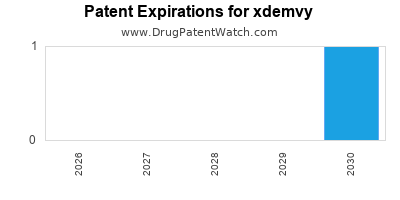
Xdemvy is a drug marketed by Tarsus and is included in one NDA. There are nine patents protecting this drug.

The generic ingredient in XDEMVY is lotilaner. There is one drug master file entry for this compound. One supplier is listed for this compound. Additional details are available on the lotilaner profile page.

DrugPatentWatch® Generic Entry Outlook for Xdemvy

Xdemvy will be eligible for patent challenges on July 24, 2027. This date may extended up to six months if a pediatric exclusivity extension is applied to the drug's patents.

By analyzing the patents and regulatory protections it appears that the earliest date for generic entry will be December 14, 2038. This may change due to patent challenges or generic licensing.

Indicators of Generic Entry

< Available with Subscription >

  Start Trial

AI Deep Research
Questions you can ask:
  • What is the 5 year forecast for xdemvy?
  • What are the global sales for xdemvy?
  • What is Average Wholesale Price for xdemvy?
Summary for xdemvy
US Patents:9
Applicants:1
NDAs:1
Finished Product Suppliers / Packagers: 1
Clinical Trials: 1
Patent Applications: 555
Drug Prices: Drug price information for xdemvy
What excipients (inactive ingredients) are in xdemvy?xdemvy excipients list
DailyMed Link:xdemvy at DailyMed
DrugPatentWatch® Estimated Loss of Exclusivity (LOE) Date for xdemvy
Generic Entry Date for xdemvy*:
Constraining patent/regulatory exclusivity:
NDA:
Dosage:

SOLUTION/DROPS;OPHTHALMIC

*The generic entry opportunity date is the latter of the last compound-claiming patent and the last regulatory exclusivity protection. Many factors can influence early or later generic entry. This date is provided as a rough estimate of generic entry potential and should not be used as an independent source.

Recent Clinical Trials for xdemvy

Identify potential brand extensions & 505(b)(2) entrants

SponsorPhase
Tarsus Pharmaceuticals, Inc.Phase 4

See all xdemvy clinical trials

Pharmacology for xdemvy
Drug ClassEctoparasiticide

US Patents and Regulatory Information for xdemvy

xdemvy is protected by nine US patents and one FDA Regulatory Exclusivity.

Based on analysis by DrugPatentWatch, the earliest date for a generic version of xdemvy is ⤷  Start Trial.

This potential generic entry date is based on patent ⤷  Start Trial.

Generics may enter earlier, or later, based on new patent filings, patent extensions, patent invalidation, early generic licensing, generic entry preferences, and other factors.

Applicant Tradename Generic Name Dosage NDA Approval Date TE Type RLD RS Patent No. Patent Expiration Product Substance Delist Req. Exclusivity Expiration
Tarsus XDEMVY lotilaner SOLUTION/DROPS;OPHTHALMIC 217603-001 Jul 24, 2023 RX Yes Yes ⤷  Start Trial ⤷  Start Trial ⤷  Start Trial
Tarsus XDEMVY lotilaner SOLUTION/DROPS;OPHTHALMIC 217603-001 Jul 24, 2023 RX Yes Yes ⤷  Start Trial ⤷  Start Trial Y ⤷  Start Trial
Tarsus XDEMVY lotilaner SOLUTION/DROPS;OPHTHALMIC 217603-001 Jul 24, 2023 RX Yes Yes ⤷  Start Trial ⤷  Start Trial ⤷  Start Trial
Tarsus XDEMVY lotilaner SOLUTION/DROPS;OPHTHALMIC 217603-001 Jul 24, 2023 RX Yes Yes ⤷  Start Trial ⤷  Start Trial Y ⤷  Start Trial
Tarsus XDEMVY lotilaner SOLUTION/DROPS;OPHTHALMIC 217603-001 Jul 24, 2023 RX Yes Yes ⤷  Start Trial ⤷  Start Trial ⤷  Start Trial
>Applicant >Tradename >Generic Name >Dosage >NDA >Approval Date >TE >Type >RLD >RS >Patent No. >Patent Expiration >Product >Substance >Delist Req. >Exclusivity Expiration

EU/EMA Drug Approvals for xdemvy

Company Drugname Inn Product Number / Indication Status Generic Biosimilar Orphan Marketing Authorisation Marketing Refusal
Elanco GmbH Credelio lotilaner EMEA/V/C/004247For the treatment of flea and tick infestations.Fleas and ticks must attach to the host and commence feeding in order to be exposed to the active substance.The veterinary medicinal product can be used as part of a treatment strategy for the control of flea allergy dermatitis (FAD).DogsThis veterinary medicinal product provides immediate and persistent killing activity for 1 month for fleas (Ctenocephalides felis and C. canis) and ticks (Rhipicephalus sanguineus, Ixodes ricinus, I. hexagonus and Dermacentor reticulatus).CatsThis veterinary medicinal product provides immediate and persistent killing activity for 1 month against fleas (Ctenocephalides felis and C. canis) and ticks (Ixodes ricinus). Authorised no no no 2017-04-23
>Company >Drugname >Inn >Product Number / Indication >Status >Generic >Biosimilar >Orphan >Marketing Authorisation >Marketing Refusal

International Patents for xdemvy

When does loss-of-exclusivity occur for xdemvy?

Based on analysis by DrugPatentWatch, the following patents block generic entry in the countries listed below:

Australia

Patent: 18385766
Estimated Expiration: ⤷  Start Trial

Patent: 23200843
Estimated Expiration: ⤷  Start Trial

Patent: 25204628
Estimated Expiration: ⤷  Start Trial

Brazil

Patent: 2020012018
Estimated Expiration: ⤷  Start Trial

Canada

Patent: 85787
Estimated Expiration: ⤷  Start Trial

China

Patent: 1655241
Estimated Expiration: ⤷  Start Trial

Patent: 9157876
Estimated Expiration: ⤷  Start Trial

Patent: 9174758
Estimated Expiration: ⤷  Start Trial

Denmark

Patent: 23739
Estimated Expiration: ⤷  Start Trial

European Patent Office

Patent: 23739
Estimated Expiration: ⤷  Start Trial

Patent: 97375
Estimated Expiration: ⤷  Start Trial

Finland

Patent: 23739
Estimated Expiration: ⤷  Start Trial

Hungary

Patent: 67461
Estimated Expiration: ⤷  Start Trial

Israel

Patent: 5339
Estimated Expiration: ⤷  Start Trial

Patent: 7992
Patent: פורמולציות קוטלות טפילים המכילות איזוקסאזולין ושיטות לטיפול בדלקת עפעפיים (Isoxazoline parasiticide formulations and methodsfor treating blepharitis)
Estimated Expiration: ⤷  Start Trial

Patent: 6352
Patent: פורמולציות קוטלות טפילים המכילות איזוקסאזולין ושיטות לטיפול בדלקת עפעפיים (Isoxazoline parasiticide formulations and methodsfor treating blepharitis)
Estimated Expiration: ⤷  Start Trial

Japan

Patent: 66369
Estimated Expiration: ⤷  Start Trial

Patent: 21506971
Patent: イソキサゾリン系寄生虫駆除剤及び眼瞼炎を治療する方法
Estimated Expiration: ⤷  Start Trial

Patent: 24038449
Patent: イソキサゾリン系寄生虫駆除剤及び眼瞼炎を治療する方法 (ISOXAZOLINE PARASITICIDE FORMULATIONS AND METHODS FOR TREATING BLEPHARITIS)
Estimated Expiration: ⤷  Start Trial

Patent: 26127691
Patent: イソキサゾリン系寄生虫駆除剤及び眼瞼炎を治療する方法
Estimated Expiration: ⤷  Start Trial

Mexico

Patent: 20006309
Patent: FÓRMULACIONES DE PARASITICIDA DE ISOXAZOLINA Y MÉTODOS PARA EL TRATAMIENTO DE LA BLEFARITIS. (ISOXAZOLINE PARASITICIDE FORMULATIONS AND METHODS FOR TREATING BLEPHARITIS.)
Estimated Expiration: ⤷  Start Trial

Patent: 24000828
Patent: FORMULACIONES DE PARASITICIDA DE ISOXAZOLINA Y METODOS PARA EL TRATAMIENTO DE LA BLEFARITIS. (ISOXAZOLINE PARASITICIDE FORMULATIONS AND METHODS FOR TREATING BLEPHARITIS.)
Estimated Expiration: ⤷  Start Trial

New Zealand

Patent: 6141
Patent: Isoxazoline parasiticide formulations and methods for treating blepharitis
Estimated Expiration: ⤷  Start Trial

Poland

Patent: 23739
Estimated Expiration: ⤷  Start Trial

Portugal

Patent: 23739
Estimated Expiration: ⤷  Start Trial

Russian Federation

Patent: 20122841
Patent: ИЗОКСАЗОЛИНОВЫЕ ПАРАЗИТИЦИДНЫЕ СОСТАВЫ И СПОСОБЫ ЛЕЧЕНИЯ БЛЕФАРИТА
Estimated Expiration: ⤷  Start Trial

Slovenia

Patent: 23739
Estimated Expiration: ⤷  Start Trial

South Africa

Patent: 2004155
Patent: ISOXAZOLINE PARASITICIDE FORMULATIONS AND METHODS FOR TREATING BLEPHARITIS
Estimated Expiration: ⤷  Start Trial

South Korea

Patent: 200111177
Patent: 안검염을 치료하기 위한 이속사졸린 구충제 제제 및 방법
Estimated Expiration: ⤷  Start Trial

Patent: 250057155
Patent: 안검염을 치료하기 위한 이속사졸린 구충제 제제 및 방법 (ISOXAZOLINE PARASITICIDE FORMULATIONS AND METHODS FOR TREATING BLEPHARITIS)
Estimated Expiration: ⤷  Start Trial

Patent: 250059552
Patent: 안검염을 치료하기 위한 이속사졸린 구충제 제제 및 방법 (ISOXAZOLINE PARASITICIDE FORMULATIONS AND METHODS FOR TREATING BLEPHARITIS)
Estimated Expiration: ⤷  Start Trial

Patent: 250065422
Patent: 안검염을 치료하기 위한 이속사졸린 구충제 제제 및 방법 (ISOXAZOLINE PARASITICIDE FORMULATIONS AND METHODS FOR TREATING BLEPHARITIS)
Estimated Expiration: ⤷  Start Trial

Spain

Patent: 81130
Estimated Expiration: ⤷  Start Trial

Generics may enter earlier, or later, based on new patent filings, patent extensions, patent invalidation, early generic licensing, generic entry preferences, and other factors.

See the table below for additional patents covering xdemvy around the world.

Country Patent Number Title Estimated Expiration
Australia 2018385766 ⤷  Start Trial
Australia 2023200843 ⤷  Start Trial
Australia 2025204628 ⤷  Start Trial
Brazil 112020012018 ⤷  Start Trial
Canada 3085787 ⤷  Start Trial
>Country >Patent Number >Title >Estimated Expiration

Supplementary Protection Certificates for xdemvy

Patent Number Supplementary Protection Certificate SPC Country SPC Expiration SPC Description
2379537 CR 2017 00034 Denmark ⤷  Start Trial PRODUCT NAME: LOTILANER OG SALTE DERAF; REG. NO/DATE: EU/2/17/206/001-015 20170427
2379537 300891 Netherlands ⤷  Start Trial PRODUCT NAME: LOTILANER EN ZOUTEN DAARVAN; REGISTRATION NO/DATE: EU/2/17/206 20170427
2379537 1790037-4 Sweden ⤷  Start Trial PRODUCT NAME: LOTILANER AND SALTS THEREOF; REG. NO/DATE: EU/2/17/206 20170427
2379537 LUC00030 Luxembourg ⤷  Start Trial PRODUCT NAME: LOTILANER ET SES SELS; AUTHORISATION NUMBER AND DATE: EU/2/17/206 20170427
2379537 17C0006 France ⤷  Start Trial PRODUCT NAME: LOTILANER; REGISTRATION NO/DATE: EU/2/17/206 20170427
>Patent Number >Supplementary Protection Certificate >SPC Country >SPC Expiration >SPC Description

XDEMVY Market Dynamics, Sales Trajectory, Patent Protection, and Competitive Outlook

Last updated: September 19, 2026

XDEMVY, Tarsus Pharmaceuticals’ lotilaner ophthalmic solution 0.25%, is the first FDA-approved prescription treatment for Demodex blepharitis. Its commercial profile differs from conventional ophthalmic drugs because it created a branded category with no approved prescription substitute at launch. The principal market drivers are diagnosis rates, optometrist and ophthalmologist adoption, payer coverage, repeat treatment, and the conversion of symptomatic eyelid disease into a pharmacologically treated condition.

Tarsus has reported rapid post-launch growth, but XDEMVY remains exposed to several risks: limited historical awareness of Demodex blepharitis, dependence on one commercial product, reimbursement variability, off-label use of lower-cost alternatives, and eventual generic entry after regulatory and patent exclusivity expire.

What is XDEMVY and what market does it address?

XDEMVY contains lotilaner, an antiparasitic agent that targets Demodex mites. The FDA approved XDEMVY on July 25, 2023, for the treatment of Demodex blepharitis in adults and pediatric patients aged 6 years and older.[1]

Demodex blepharitis is associated with infestation of the eyelash follicles and meibomian glands by Demodex mites. Clinical signs include collarettes, eyelid inflammation, ocular irritation, redness, and dry-eye symptoms. Before XDEMVY, treatment commonly relied on lid hygiene, tea tree oil products, mechanical debridement, antibiotics, corticosteroids, or compounded therapies. Those approaches did not provide an FDA-approved drug specifically indicated for Demodex infestation.

The commercial opportunity is therefore based on both treatment substitution and market creation. Tarsus has marketed XDEMVY through eye-care professionals, including ophthalmologists and optometrists, rather than relying only on traditional pharmaceutical retail promotion.

FDA-approved dosage and treatment duration

The approved regimen is one drop in each affected eye twice daily for six weeks.[1] The six-week course supports a finite prescription model, although some patients may receive retreatment or remain candidates for additional management of chronic eyelid disease.

The principal clinical endpoints in the registration program included collarette reduction and mite eradication. The FDA label identifies common adverse reactions including instillation-site irritation and chalazion or hordeolum-related events.[1]

How large is the XDEMVY addressable market?

The addressable population is materially larger than the number of current prescriptions. Tarsus has cited a substantial prevalence of Demodex blepharitis among adults with blepharitis and dry-eye symptoms, but prevalence does not equal treated demand.

The market funnel has four stages:

  1. Patients must present to an eye-care professional.
  2. The clinician must recognize Demodex blepharitis.
  3. The patient must receive a prescription rather than an over-the-counter or procedural treatment.
  4. The prescription must be filled and completed.

The principal commercial constraint is diagnosis and treatment conversion. Many patients are managed for nonspecific blepharitis, meibomian gland dysfunction, or dry eye without a confirmed Demodex diagnosis. XDEMVY demand should rise as clinicians use collarettes as a diagnostic marker and adopt slit-lamp examination and mite-focused treatment protocols.

What is the financial trajectory for XDEMVY?

XDEMVY generated an accelerated launch curve after its July 2023 approval. Tarsus’ reported revenue growth reflects rapid prescription adoption from a low initial base, expansion of the prescribing network, and increased payer and pharmacy access.

Financial period Commercial status Main revenue driver
2023 Initial launch year Early prescriptions and market education
2024 First full commercial year Broader prescriber adoption, repeat demand, improved access
2025 onward Expansion phase Penetration of optometry, ophthalmology, and managed-care channels

Tarsus’ financial trajectory is highly concentrated in XDEMVY. That concentration creates operating leverage if prescriptions continue to expand, but it also magnifies execution risk. Sales and marketing expense, patient-support programs, payer contracting, and field-force expansion can reduce near-term profitability even while prescription volume grows.

The key financial indicators are:

  • Gross-to-net deductions from rebates, discounts, co-pay support, and government programs.
  • New prescription volume and total prescription volume.
  • Refill and retreatment rates.
  • Average net revenue per treated patient.
  • Prescriber count and prescribing concentration.
  • Payer coverage and prior-authorization requirements.
  • Commercial sales and marketing expense as a percentage of revenue.
  • Cash consumption before operating profitability.

XDEMVY has a favorable product characteristic for revenue planning: the therapy is administered as a defined six-week course rather than indefinitely. Revenue growth therefore depends on adding new treated patients, securing repeat courses, and expanding the diagnosed population.

When does XDEMVY lose exclusivity?

XDEMVY’s regulatory exclusivity and patent exclusivity are separate.

The FDA granted XDEMVY new chemical entity exclusivity. That five-year period is expected to run through July 2028, subject to the precise statutory calculation and any applicable regulatory extensions.[2] During this period, the FDA generally cannot approve an abbreviated new drug application that relies on the active ingredient’s full clinical safety and efficacy package.

The commercial protection may extend beyond 2028 through Orange Book-listed patents and other patents covering the formulation, ophthalmic delivery system, dosing regimen, or treatment method. The relevant end date depends on the specific listed patent and any patent-term adjustment or extension.

Protection type Expected relevance
New chemical entity exclusivity Blocks certain abbreviated approvals through approximately July 2028
Orange Book formulation or method patents May delay approval or launch of an ANDA
Patent-term adjustment Can extend an individual U.S. patent beyond its base term
Pediatric exclusivity No separate six-month pediatric extension should be assumed without an FDA grant
Regulatory exclusivity outside the U.S. Depends on national approval and data-exclusivity rules

A precise generic-entry date cannot be determined from FDA exclusivity alone. It requires review of the current Orange Book, patent listings, patent expiration dates, any pediatric extension, and litigation outcomes.

What patents protect XDEMVY?

The protection strategy is expected to rely on more than the lotilaner molecule. Lotilaner itself was previously developed as an antiparasitic compound, including in veterinary medicine. The commercially important human-drug barriers are therefore likely to include:

  • The ophthalmic solution composition.
  • Concentration and excipient selection.
  • Delivery to the ocular surface and eyelid margin.
  • Treatment of Demodex blepharitis with lotilaner.
  • Dosing frequency and six-week treatment duration.
  • Manufacturing and stability characteristics.

The FDA’s Orange Book is the controlling public source for patents listed against an approved drug product.[3] The most relevant claims for a generic challenger would likely be formulation and method-of-use claims rather than a broad claim to lotilaner as a chemical entity.

Patent strength is strongest where claims cover a clinically necessary formulation or a commercially unavoidable dosing method. Method-of-use patents can be more difficult to enforce than composition patents because an ANDA applicant may attempt a carve-out from the patented indication. Formulation patents can be stronger if the generic cannot reproduce the product’s stability, tolerability, or delivery profile without practicing the claimed subject matter.

What Paragraph IV challenges and generic entry risks exist?

No major public Paragraph IV litigation should be treated as established without a current review of FDA litigation records, court dockets, and Tarsus’ latest SEC filings. XDEMVY’s earliest serious ANDA challenge is more likely after the NCE exclusivity period approaches expiration, although a challenger can file earlier if it relies on a certification strategy permitted by the Hatch-Waxman framework.

A generic launch could occur through four principal scenarios:

Scenario Commercial effect
No early challenge Branded XDEMVY retains exclusivity until the first valid regulatory or patent barrier expires
Paragraph IV challenge with settlement Entry date depends on the negotiated agreement
Successful Paragraph IV challenge Generic could launch before listed patent expiry
At-risk launch Generic enters before final patent resolution, exposing the challenger to damages and injunction risk

Because XDEMVY is a topical ophthalmic product, substitutability may depend on preservative systems, packaging, viscosity, drop size, sterility, and tolerability. An approved generic would still face clinician and payer acceptance issues, but pharmacy substitution and lower pricing could materially affect branded demand.

What is the Orange Book status of XDEMVY?

XDEMVY is an FDA-approved prescription drug listed under NDA 217343. The Orange Book should be used to confirm the current patent list, use codes, and any changes made after approval.[3]

The commercial importance of Orange Book listings is direct. A listed patent can trigger a 30-month stay if an ANDA applicant files a Paragraph IV certification and the NDA holder brings timely patent litigation. The stay does not guarantee ultimate patent validity or infringement, but it can delay FDA approval while litigation proceeds.

For investors and licensing parties, the relevant diligence questions are:

  • Which patents are currently listed?
  • Do the claims cover the drug product, formulation, or indication?
  • What is the expiration date for each patent?
  • Are use codes broad enough to capture the approved indication?
  • Has an ANDA applicant filed a Paragraph IV certification?
  • Has Tarsus initiated litigation?
  • Has Tarsus entered a settlement agreement?

Which companies compete with XDEMVY?

XDEMVY has no FDA-approved prescription competitor with the same Demodex blepharitis indication. Its practical competitors are treatment alternatives rather than direct labeled substitutes.

Competitive categories

  • Lid scrubs and hygiene products.
  • Tea tree oil and terpinen-4-ol products.
  • In-office lid debridement.
  • Warm compresses and meibomian gland procedures.
  • Topical antibiotics.
  • Topical corticosteroids.
  • Immunomodulatory dry-eye therapies.
  • Compounded or off-label antiparasitic treatments.

The closest competitive threat is not a single branded drug. It is clinician inertia and the use of lower-cost supportive care. XDEMVY must demonstrate that targeted prescription treatment produces better outcomes, greater convenience, or more predictable control than repeated office procedures and nonprescription regimens.

How does XDEMVY compare with other ophthalmic drugs?

Attribute XDEMVY Conventional blepharitis treatment
FDA indication Demodex blepharitis Often nonspecific or off-label
Active mechanism Antiparasitic against Demodex mites Anti-inflammatory, antimicrobial, or mechanical
Treatment duration Six weeks, twice daily Variable and often chronic
Commercial status Branded, single-product category Fragmented alternatives
Generic competition Not yet established Present in several component categories
Diagnosis requirement Demodex-focused diagnosis Often symptom-based

XDEMVY’s differentiation is greatest when the clinician identifies mite-related disease rather than treating eyelid inflammation generically.

What licensing and manufacturing issues affect XDEMVY?

Tarsus obtained rights to lotilaner for human ophthalmic use through an agreement with Novartis. The commercial value of that arrangement depends on territorial rights, royalties, milestone obligations, sublicensing terms, and manufacturing responsibilities disclosed in the applicable SEC filings.

Manufacturing barriers are meaningful but unlikely to be insurmountable for a capable ophthalmic-generic manufacturer. Relevant technical requirements include sterile manufacturing, preservative control, container-closure integrity, drop uniformity, extractables and leachables testing, and stability throughout the labeled shelf life.

The stronger barrier is the combination of formulation know-how, regulatory experience, manufacturing validation, and patent risk. A generic competitor must overcome all four.

What is the outlook for XDEMVY revenue?

The base-case commercial outlook remains growth-oriented through the current market-development phase. Revenue expansion should come from:

  • Increased Demodex diagnosis.
  • More optometrists prescribing XDEMVY.
  • Wider insurance coverage.
  • Greater patient awareness.
  • Repeat treatment for persistent or recurrent disease.
  • Expansion of the treatment protocol across integrated eye-care networks.

The main downside risks are slower diagnosis conversion, payer restrictions, reduced adherence to the six-week course, lower-than-expected retreatment, and rapid adoption of compounded or procedural alternatives.

Tarsus’ revenue exposure is unusually concentrated because XDEMVY is its primary commercial product. A sustained decline in XDEMVY prescriptions would therefore affect corporate revenue, cash flow, valuation, and financing needs more directly than it would affect a diversified pharmaceutical company.

Key Takeaways

  • XDEMVY is the first FDA-approved treatment specifically indicated for Demodex blepharitis.
  • Its market is being created through diagnosis, clinician education, and conversion from nonspecific blepharitis care.
  • FDA approval occurred on July 25, 2023.
  • Five-year new chemical entity exclusivity is expected to protect the product through approximately July 2028.
  • Patent protection may extend beyond regulatory exclusivity through formulation and method-of-use claims.
  • No direct FDA-approved prescription competitor has been established in the same indication.
  • The largest commercial competitors are lid hygiene, in-office procedures, off-label therapies, and compounded products.
  • Tarsus’ financial exposure is concentrated in XDEMVY, making prescription growth and payer access central valuation variables.
  • Generic-entry timing depends on Orange Book patents, Paragraph IV activity, litigation, and settlement terms.
  • XDEMVY’s strongest commercial advantage is its disease-specific FDA label, not simply the lotilaner molecule.

FAQs

Is XDEMVY a biologic or a small-molecule drug?

XDEMVY is a small-molecule ophthalmic drug containing lotilaner. Biosimilar competition does not apply. Any future competition would generally involve generic-drug pathways rather than the abbreviated biosimilar pathway.

Can XDEMVY be used for ordinary blepharitis?

Its FDA approval is for Demodex blepharitis. Use for other forms of blepharitis would be outside the approved indication unless the patient also has Demodex-related disease.

Does XDEMVY require prior authorization?

Coverage varies by insurer and plan. Some payers may require prior authorization, step therapy, or documentation of Demodex blepharitis. Coverage terms can change independently of FDA approval.

Is lotilaner protected by patents outside the United States?

Protection varies by country and depends on national patent grants, supplementary protection mechanisms, regulatory exclusivity, and local litigation. U.S. Orange Book status does not establish protection in Europe, Japan, Canada, or other markets.

What would most increase XDEMVY’s long-term value?

The most important variables are durable clinician adoption, broader payer coverage, repeat-treatment demand, evidence supporting treatment of recurrent disease, and a patent or settlement outcome that delays generic entry beyond the initial regulatory exclusivity period.

References

  1. U.S. Food and Drug Administration. (2023). XDEMVY (lotilaner ophthalmic solution) prescribing information.
  2. U.S. Food and Drug Administration. (2023). XDEMVY approval letter, NDA 217343.
  3. U.S. Food and Drug Administration. (2024). Approved drug products with therapeutic equivalence evaluations, Orange Book.
  4. Tarsus Pharmaceuticals, Inc. (2024). Form 10-K annual report. U.S. Securities and Exchange Commission.

More… ↓

⤷  Start Trial

Make Better Decisions: Try a trial or see plans & pricing

Drugs may be covered by multiple patents or regulatory protections. All trademarks and applicant names are the property of their respective owners or licensors. Although great care is taken in the proper and correct provision of this service, thinkBiotech LLC does not accept any responsibility for possible consequences of errors or omissions in the provided data. The data presented herein is for information purposes only. There is no warranty that the data contained herein is error free. We do not provide individual investment advice. This service is not registered with any financial regulatory agency. The information we publish is educational only and based on our opinions plus our models. By using DrugPatentWatch you acknowledge that we do not provide personalized recommendations or advice. thinkBiotech performs no independent verification of facts as provided by public sources nor are attempts made to provide legal or investing advice. Any reliance on data provided herein is done solely at the discretion of the user. Users of this service are advised to seek professional advice and independent confirmation before considering acting on any of the provided information. thinkBiotech LLC reserves the right to amend, extend or withdraw any part or all of the offered service without notice.