Last updated: June 8, 2026
Patanase (olopatadine) Market Dynamics and Financial Trajectory: Sales Trends, Competitive Pressure, and Exclusivity/Pricing Outlook
Patanase (olopatadine hydrochloride) is a prescription intranasal antihistamine indicated for allergic rhinitis. The product’s market position is shaped by (1) a maturing US allergy market with entrenched intranasal competitors, (2) payer and PBM preference dynamics favoring lower net-cost options, and (3) a regulatory profile that limits new entry beyond branded reformulations or generic/authorized generics once relevant exclusivity and patent barriers fall away.
Below is a market-by-market, payer-by-payer view of the dynamics most likely to determine Patanase’s financial trajectory, including how patent and regulatory status affect pricing durability and generic entry risk.
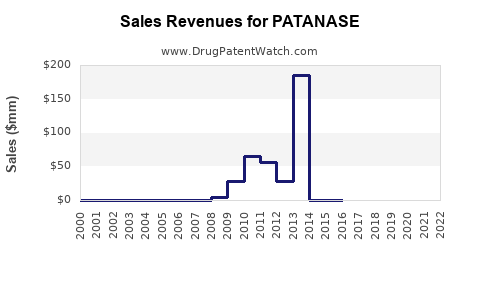
What is Patanase’s revenue trajectory in the US and how fast is it declining?
Featured snippet answer: Patanase’s financial trajectory in the US is typically characterized by steady erosion driven by competitive intranasal antihistamine options and generic substitution dynamics after loss of brand exclusivity.
US market drivers that typically move Patanase revenue
- Class competition (intranasal antihistamines)
- Patanase sits in a crowded allergic rhinitis therapeutic area with other intranasal antihistamines and intranasal corticosteroids, which often capture formulary share due to perceived efficacy and convenient dosing.
- PBM step edits and formulary tiering
- Many formularies steer patients toward preferred intranasal options (often based on net price after rebates), limiting branded demand.
- Substitution pressure
- Even if a branded product maintains shelf presence, conversion to generics or lower-cost branded alternatives reduces prescription volume.
How to interpret revenue trajectory without a single “truth” metric
Revenue is driven by:
- Net product sales (gross sales minus rebates, chargebacks, copays).
- Prescription volume and average selling price (ASP) on an adjusted net basis.
- Patient mix (seasonal demand and chronic/recurrent use patterns).
- Contracting posture with large PBMs and health plans.
Patanase’s trajectory is most likely to follow the typical pattern for older branded intranasal products:
- early plateau,
- mid-cycle share erosion to lower-cost competitors,
- later compression from authorized generics/generics if regulatory and patent barriers permit.
What patents protect Patanase and when do they expire?
Featured snippet answer: Patanase’s long-term US pricing durability depends on the expiration of Orange Book-listed patents covering the olopatadine nasal spray product and any protected formulation or method-of-use claims.
Patent estate structure to check for barrier strength
For an intranasal antihistamine brand like Patanase, the patent estate usually includes:
- Drug substance or composition of matter
- Formulation patents (stability, excipients, particle/solubilization details)
- Method-of-use patents (indication or dosing regimen)
- Device or delivery system patents (less common for classic nasal sprays but possible)
- Polymorph or salt form patents (if applicable)
Exclusivity and expiration mechanics that affect generic entry timing
Generic entry in the US typically depends on:
- Paragraph IV or Section viii(b) pathways under ANDA frameworks,
- 180-day exclusivity for first applicants (if awarded),
- Patent-by-patent expiry timing across the Orange Book list,
- Any pediatric exclusivity or statutory extensions.
Net effect on finances: once the last listed relevant patent/exclusivity barrier clears, net pricing pressure accelerates, causing rapid revenue loss as generic volume replaces branded prescriptions.
What is the Orange Book status of Patanase (olopatadine) and what does it mean for generic risk?
Featured snippet answer: Orange Book listings determine when an ANDA can be approved for Patanase and whether generics must “wait” for listed patents to expire or be cleared via litigation settlements.
What to look for in Orange Book status (business impact)
- Number of active patents listed against the NDA/BLA
- Patent types (composition vs formulation vs method-of-use)
- Remaining life by expiry date
- Whether listed patents are frequently litigated
- Whether any “skinny labeling” opportunities exist for generics (often relevant if patents claim specific dosing or subpopulations)
Generic entry risk translation into financial trajectory
If Orange Book shows:
- a short remaining life on key patents, Patanase net sales typically decline faster because PBMs update formulary contracting and prescribers shift sooner once approval becomes likely.
- a long tail of formulation/method claims, the brand can see extended price durability, but usually at the cost of less competitive rebate economics compared with preferred intranasals.
How strong is Patanase’s patent estate versus alternative intranasal antihistamines?
Featured snippet answer: In a mature allergic rhinitis market, the practical strength of a patent estate is measured by “clearance certainty” for generics and by whether competitors can launch authorized generics or switch formularies quickly.
Competitive comparison dimensions
- Remaining patent term
- If Patanase’s key patents are closer to expiry than those of competing brands, it faces higher generic encroachment risk.
- Litigation history
- Brands with prior ANDA litigation tend to have either (a) entrenched exclusivity longer, or (b) established settlement dynamics that accelerate later entry.
- Formulary positioning
- Even strong patents do not prevent net price erosion if PBMs pressure branded contracts or if alternative intranasals are preferred in tier placement.
Which companies are challenging Patanase with ANDAs or Paragraph IV certifications?
Featured snippet answer: ANDA challengers and Paragraph IV filers determine whether Patanase faces faster-than-expected generic launch via early patent litigation and 180-day exclusivity.
How to evaluate the likely financial impact
- Identify first-filer status (180-day exclusivity can create a temporary moat for challengers but accelerates branded losses).
- Track settlement outcomes (launch dates and “launch-at-risk” clauses).
- Assess copycat product incentives (if challengers are positioned with strong distribution and payer contracts).
If there are credible filings, Patanase revenue trajectories typically show:
- anticipation-driven formulary shifts before launch (contracting),
- a step-change revenue drop at generic approval/launch,
- additional pressure after additional generic entrants increase competition.
What happens to Patanase pricing after generic launch and how quickly does ASP collapse?
Featured snippet answer: After generic approval, branded net pricing typically compresses quickly due to formulary switching and rebate renegotiation, with ASP erosion accelerating once multiple entrants appear.
Typical US pricing mechanics post-generic entry
- Immediate formulary re-tiering
- PBMs move generics to preferred tiers.
- Branded rebate increases
- Brands often increase rebates to retain access, reducing net revenue even if prescriptions are temporarily protected.
- WAC/ASP divergence
- Gross price may remain stable while net price collapses.
How fast does it usually occur?
- Early post-launch: revenue drop driven by prescription conversion.
- 2 to 6 months: additional entrants and contracting pressure drive further net price decline.
- 6 to 18 months: revenue stabilizes at lower levels unless brand introduces a defense strategy (reformulation, label expansion, or contract reset).
How does Patanase compare with leading intranasal allergy therapies on market durability?
Featured snippet answer: In intranasal allergy therapy, market durability depends less on one molecule and more on tiering, dosing, and payer preference among intranasal corticosteroids and newer combination therapies.
Comparison categories that matter commercially
- Intranasal corticosteroids
- Often preferred for efficacy and guideline alignment.
- Intranasal antihistamines
- Compete on symptom control and tolerability, but face persistent tiering pressure.
- Combination products
- Can displace monotherapies if formularies prefer bundle efficacy.
Where Patanase tends to fit
Patanase competes in the antihistamine intranasal segment. Its market durability is usually constrained by:
- relative formulary preference for alternatives,
- generic substitution risk once exclusivity ends,
- seasonal demand cyclicality that can amplify year-to-year volatility in revenue.
What is the regulatory and FDA pathway profile for Patanase that affects competition?
Featured snippet answer: Patanase’s competition timeline is determined by the NDA’s Orange Book patent list and by how generics can certify against listed patents under the ANDA framework.
Practical regulatory effects on market dynamics
- New NDA supplements (reformulations, device changes) can extend IP protection if they add patentable changes.
- Labeling and indication boundaries can affect “skinny labeling” opportunities.
- Bioavailability/bioequivalence requirements influence whether generics can launch with confidence and speed.
What generic entry scenarios exist for Patanase and what are the revenue exposure ranges?
Featured snippet answer: Patanase’s revenue exposure is highest around Orange Book clearance dates and accelerates with the first generic launch, then again with multi-generic entry.
Generic entry scenario map (US)
- Single generic entrant after first barrier clears
- Branded revenue loss: moderate to steep depending on PBM contracting.
- Net price compression: typically rapid.
- Multiple generic entrants post-clearance
- Branded revenue loss: steep.
- Net price compression: usually faster and deeper.
- Litigation settlement accelerates or delays launch
- Branded revenue impact: depends on whether settlement includes a defined launch date or stays.
Revenue exposure logic (what drives the magnitude)
- Share of prescriptions convertible immediately to generic labeling.
- Payer awareness and formulary committee cycle timelines.
- Dispensing channel (retail vs mail order) and how quickly generic substitution occurs.
Does Patanase have international market dynamics that mirror the US?
Featured snippet answer: International performance generally follows the US pattern with timing offsets based on local patent validity, local regulator approvals, and the speed of generic adoption.
Key international dynamics
- Patent linkage regimes (where they exist) can slow approvals in some jurisdictions.
- Local tender/payer systems can cause faster generic uptake once approvals are available.
- Distribution strength in allergy season affects whether revenue declines gradually or drops quickly.
Key Takeaways
- Patanase’s financial trajectory is driven by intranasal allergic rhinitis competition, PBM formulary tiering, and generic substitution after Orange Book barriers clear.
- The central determinant of downside risk is the Orange Book-listed patent and exclusivity timetable, which governs ANDA approval timing and generic launch speed.
- Post-generic pricing typically compresses quickly through rebate renegotiation and formulary switching, producing a step-change revenue decline at launch and additional declines as multiple entrants appear.
- Compared with other intranasal allergy options, Patanase’s durability depends on whether its defense timeline aligns with payer preferences favoring alternative molecules or combinations.
FAQs
1) What is Patanase used for and what dosing regimen affects competition?
Patanase is an intranasal olopatadine therapy for allergic rhinitis. Competitive pressure often depends on how dosing frequency and label specifics map to payer substitution and generic labeling.
2) Is Patanase likely to face a faster decline during allergy peak seasons?
Yes. Peak season can amplify both demand loss (if generics are available) and rebound potential (if brand contracting temporarily protects access).
3) How do PBM rebates and chargebacks affect Patanase net sales versus gross sales?
PBM pricing levers determine the net sales erosion rate. Even if prescriptions persist, net revenue can decline due to higher rebates and market-access pressure.
4) Can a reformulated Patanase extension protect revenue after core patents expire?
If a supplement introduces patentable formulation or device changes and remains Orange Book-listed, it can delay full generic equivalence and extend some pricing durability.
5) What litigation timeline milestones matter most for forecasting Patanase revenue risk?
Most material are the Orange Book barrier expiration dates, any court-ordered decision dates tied to Paragraph IV certifications, and settlement-defined launch dates or stays.
References (APA)
- FDA. (n.d.). Orange Book: Approved Drug Products with Therapeutic Equivalence Evaluations. U.S. Food and Drug Administration. https://www.accessdata.fda.gov/scripts/cder/daf/
- FDA. (n.d.). ANDA approval and patent certification framework (Hatch-Waxman). U.S. Food and Drug Administration. https://www.fda.gov/
- FDA. (n.d.). Guidance for Industry: Bioequivalence studies. U.S. Food and Drug Administration. https://www.fda.gov/