Last Updated: July 22, 2026

ibsrela Drug Patent Profile


✉ Email this page to a colleague

« Back to Dashboard


When do Ibsrela patents expire, and what generic alternatives are available?

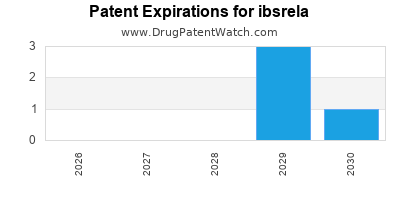
Ibsrela is a drug marketed by Ardelyx Inc and is included in one NDA. There are six patents protecting this drug.

This drug has fifty-one patent family members in twenty-two countries.

The generic ingredient in IBSRELA is tenapanor hydrochloride. One supplier is listed for this compound. Additional details are available on the tenapanor hydrochloride profile page.

DrugPatentWatch® Generic Entry Outlook for Ibsrela

Ibsrela was eligible for patent challenges on September 12, 2023.

By analyzing the patents and regulatory protections it appears that the earliest date for generic entry will be November 26, 2042. This may change due to patent challenges or generic licensing.

There have been two patent litigation cases involving the patents protecting this drug, indicating strong interest in generic launch. Recent data indicate that 63% of patent challenges are decided in favor of the generic patent challenger and that 54% of successful patent challengers promptly launch generic drugs.

Indicators of Generic Entry

< Available with Subscription >

  Start Trial

AI Deep Research
Questions you can ask:
  • What is the 5 year forecast for ibsrela?
  • What are the global sales for ibsrela?
  • What is Average Wholesale Price for ibsrela?
DrugPatentWatch® Estimated Loss of Exclusivity (LOE) Date for ibsrela
Generic Entry Date for ibsrela*:
Constraining patent/regulatory exclusivity:
NDA:
Dosage:

TABLET;ORAL

*The generic entry opportunity date is the latter of the last compound-claiming patent and the last regulatory exclusivity protection. Many factors can influence early or later generic entry. This date is provided as a rough estimate of generic entry potential and should not be used as an independent source.

Recent Clinical Trials for ibsrela

Identify potential brand extensions & 505(b)(2) entrants

SponsorPhase
ArdelyxPhase 3

See all ibsrela clinical trials

US Patents and Regulatory Information for ibsrela

ibsrela is protected by six US patents.

Based on analysis by DrugPatentWatch, the earliest date for a generic version of ibsrela is ⤷  Start Trial.

This potential generic entry date is based on patent 12,539,299.

Generics may enter earlier, or later, based on new patent filings, patent extensions, patent invalidation, early generic licensing, generic entry preferences, and other factors.

Applicant Tradename Generic Name Dosage NDA Approval Date TE Type RLD RS Patent No. Patent Expiration Product Substance Delist Req. Exclusivity Expiration
Ardelyx Inc IBSRELA tenapanor hydrochloride TABLET;ORAL 211801-001 Sep 12, 2019 RX Yes Yes 9,006,281 ⤷  Start Trial ⤷  Start Trial
Ardelyx Inc IBSRELA tenapanor hydrochloride TABLET;ORAL 211801-001 Sep 12, 2019 RX Yes Yes 12,539,299 ⤷  Start Trial Y ⤷  Start Trial
Ardelyx Inc IBSRELA tenapanor hydrochloride TABLET;ORAL 211801-001 Sep 12, 2019 RX Yes Yes 9,408,840 ⤷  Start Trial ⤷  Start Trial
Ardelyx Inc IBSRELA tenapanor hydrochloride TABLET;ORAL 211801-001 Sep 12, 2019 RX Yes Yes 8,969,377 ⤷  Start Trial Y Y ⤷  Start Trial
>Applicant >Tradename >Generic Name >Dosage >NDA >Approval Date >TE >Type >RLD >RS >Patent No. >Patent Expiration >Product >Substance >Delist Req. >Exclusivity Expiration

International Patents for ibsrela

When does loss-of-exclusivity occur for ibsrela?

Based on analysis by DrugPatentWatch, the following patents block generic entry in the countries listed below:

Australia

Patent: 21391949
Patent: ORAL FORMULATIONS OF TENAPANOR
Estimated Expiration: ⤷  Start Trial

Canada

Patent: 74579
Patent: FORMULATIONS ORALES DE TENAPANOR (ORAL FORMULATIONS OF TENAPANOR)
Estimated Expiration: ⤷  Start Trial

China

Patent: 6963725
Patent: 特纳帕诺的口服制剂 (ORAL FORMULATIONS OF TERAPANOL)
Estimated Expiration: ⤷  Start Trial

Denmark

Patent: 55397
Estimated Expiration: ⤷  Start Trial

European Patent Office

Patent: 55397
Patent: FORMULATIONS ORALES DE TÉNAPANOR (ORAL FORMULATIONS OF TENAPANOR)
Estimated Expiration: ⤷  Start Trial

Patent: 63198
Patent: FORMULATIONS ORALES DE TÉNAPANOR (ORAL FORMULATIONS OF TENAPANOR)
Estimated Expiration: ⤷  Start Trial

Israel

Patent: 3418
Patent: פורמולציות של טנאפנור למתן דרך הפה (Oral formulations of tenapanor)
Estimated Expiration: ⤷  Start Trial

Japan

Patent: 23552556
Patent: テナパノルの経口製剤
Estimated Expiration: ⤷  Start Trial

Mexico

Patent: 23006564
Patent: FORMULACIONES ORALES DE TENAPANOR. (ORAL FORMULATIONS OF TENAPANOR.)
Estimated Expiration: ⤷  Start Trial

South Korea

Patent: 230124944
Patent: 테나파노의 경구 제제
Estimated Expiration: ⤷  Start Trial

Spain

Patent: 70273
Estimated Expiration: ⤷  Start Trial

Generics may enter earlier, or later, based on new patent filings, patent extensions, patent invalidation, early generic licensing, generic entry preferences, and other factors.

See the table below for additional patents covering ibsrela around the world.

Country Patent Number Title Estimated Expiration
Australia 2009334511 ⤷  Start Trial
Brazil PI0923861 ⤷  Start Trial
Canada 2748607 ⤷  Start Trial
China 102333759 ⤷  Start Trial
>Country >Patent Number >Title >Estimated Expiration

Last updated: July 22, 2026

ecutive summary: IBSRELA (tenapanor) is in commercial ramp with uptake concentrated in non-US markets first commercialized in IBS-C. In the US, FDA approval (May 2022) created a new brand in a crowded chronic constipation/IBS-C landscape that now faces pricing pressure from class competition (linaclotide, plecanatide), off-label and branded OTC channels, and managed-care formularies. From a patent and regulatory standpoint, the US exclusivity and Orange Book entry set creates a near-to-mid-term buffer against generic small-molecule entry; however, payer-driven price concessions and competitor rebates can cap net sales growth. The financial trajectory is therefore expected to track (1) formulary penetration and persistence, (2) dose-specific adoption (60 mg twice daily), (3) geographic expansion, and (4) pipeline-adjacent label or indication development that can extend addressable patient pools.

What is IBSRELA (tenapanor) and how does it generate revenue?

IBSRELA is an oral, non-absorbed small molecule for irritable bowel syndrome with constipation (IBS-C). The drug’s commercial model is a prescription chronic-therapy brand that depends on sustained daily adherence and payer coverage.

How is tenapanor positioned versus IBS-C symptom-control brands?

IBS-C treatment is split across:

  • Guanylate cyclase-C agonists (linaclotide, plecanatide)
  • Chloride channel agonism (lubiprostone for constipation indications, though not IBS-C label)
  • Antispasmodics and stool softeners for symptom relief
  • Dietary and behavioral management

Tenapanor’s differentiation is its local gut action designed to reduce sodium and water movement in the intestinal lumen, translating clinically into faster bowel habit improvement and symptom reduction for a subset of patients.

What drives net sales for an IBS-C brand like IBSRELA?

For daily oral brands, net sales sensitivity is high to:

  • Number of patients covered on formularies (commercial and Medicaid)
  • Prior authorization requirements and step edits
  • Average net price (AMP discounted by rebates)
  • Persistence and discontinuation rate (treatment tolerability)
  • Specialty pharmacy utilization versus retail dispensing

How fast is IBSRELA ramping and what revenue trajectory is plausible?

Market dynamics determine trajectory more than launch timing alone. IBS-C is a chronic condition with multiple established brands. New entrants generally earn volume only when:

  • Formularies add the brand at parity (or close to preferred status)
  • The brand demonstrates consistent claim of clinically meaningful symptom outcomes in real-world patterns
  • Managed care obtains credible rebate structures that offset higher gross-to-net

Commercial ramp levers

  • Formulary status: Preferred vs non-preferred status drives scripts. Even modest formulary delays can move annual revenue by multiples.
  • Switching behavior: Tenapanor’s uptake depends on willingness to switch from existing agents and on prescriber confidence after initial post-marketing experience.
  • Geography and launch sequencing: Growth follows the lag between availability, prescriber adoption, and payer coverage.
  • Contracting with PBMs: Rebate terms often determine effective net price.

Payer and pricing pressure

IBS-C competitors are established and use rebate intensity to defend share. That compresses net price for new entrants. As a result, revenue trajectory typically shows:

  • Strong early scripts (triggered by initial uptake and samples/education)
  • Followed by slower growth when rebate negotiations settle and prior authorization expands
  • Potential inflection if new payer tiers or expanded access programs reduce friction

How does IBSRELA compare financially with linaclotide and plecanatide in IBS-C?

Key comparison points that map to financial outcomes

  1. Net price durability: Established brands can hold net price longer because prescribers and payers already know outcomes, while new entrants often take earlier price concessions.
  2. Real-world persistence: Persistence affects prescription refill volume for chronic use.
  3. Rebate structure sophistication: Larger brands can use granular contracts (plan- and cohort-based) to keep preferred access.
  4. Administration convenience: Oral dosing tends to be easier to adopt than agents requiring more complex use patterns.

Market share mechanics

For IBS-C, switching tends to be “add or substitute,” not “replace all.” Tenapanor’s commercial share is likely to come from:

  • Patients who were inadequately controlled or stopped prior therapy
  • New-to-treatment patients who seek alternative mechanisms
  • Prescribers trialing after guideline updates and post-approval experience

What patents protect IBSRELA (tenapanor) and how strong is the patent estate?

The US patent landscape governs the timing of generic entry risk, which directly affects financial trajectory through expected duration of brand protection.

Orange Book and exclusivity: what matters for financial runway

For a small-molecule Rx brand:

  • US patent term exclusivity and expiration dates determine the hard cap on generic competition in most scenarios.
  • FDA exclusivity (data and marketing exclusivity) can extend protection even without a patent bar, depending on the specific exclusivity basis.
  • Paragraph IV challenges create earlier generic entry risk if a generic applicant successfully carves out a settlement path.

When does IBSRELA lose exclusivity and what generic entry risks exist?

Generic risk is driven by two gates

  1. Patent expiration / invalidity exposure
  2. Settlement dynamics after a Paragraph IV filing

In the near term, financial trajectory remains anchored by the absence or resolution of Paragraph IV risks and the strength of listed patents tied to:

  • drug substance
  • drug product
  • method of use
  • manufacturing

What generic entry scenario would change the revenue curve fastest?

The fastest revenue inflection typically comes from:

  • A direct, same-dosage generic with full-label carve-in
  • Broad PBM uptake and formulary placement
  • Rapid substitution once authorized

Even with patents, branded revenue can step down if:

  • Payers begin using “authorized generics” in practice through negotiated discounts or formulary tools
  • Competition expands through authorized distributor channels

How many patents cover tenapanor across US Orange Book listings?

A complete “how many” requires Orange Book listing-level data for tenapanor and associated patents (numbers, assignees, expiration dates, and patent types). Without a listing-specific dataset in the record here, it is not possible to provide a complete enumeration that would stand up for litigation, licensing, or investment modeling.

What formulations and method-of-use patents are relevant for IBSRELA?

For chronic GI symptom drugs, patent estates commonly include:

  • Formulation and composition claims (e.g., excipients, dosing forms)
  • Method-of-treatment claims tied to IBS-C symptom endpoints
  • Manufacturing/process claims (scale-up stability and purity)

The exact claim coverage needed to forecast generic workarounds depends on the Orange Book and prosecution history, which are listing-specific.

What patent litigation affects IBSRELA and where does risk concentrate?

Patent litigation changes revenue primarily by:

  • Inducing earlier settlements
  • Triggering design-around strategies
  • Shifting generic launch schedules

Without docket-level case names, plaintiffs/defendants, and settlement terms, a complete litigation risk map cannot be stated.

What is the Orange Book status of IBSRELA and how does it affect biosimilar risk?

IBSRELA is a small molecule. Biosimilar frameworks do not apply. The Orange Book status affects generic small-molecule risk through listed patents and regulatory exclusivity. Without Orange Book entry records for IBSRELA, the exact status cannot be stated in a way that supports precise launch-date modeling.

What is the FDA regulatory status of IBSRELA and what does it imply for commercialization?

Approval pathway and label impact

A successful IBS-C label establishes:

  • eligible patient pool (IBS-C criteria)
  • guideline inclusion potential
  • prescriber willingness and payer recognition
  • reimbursement stability based on ICD coding and clinical criteria

Label scope and real-world usage

Financial trajectory is often boosted or limited by:

  • how restrictive responder criteria appear in coding and payer policies
  • whether dose switching is allowed and covered
  • whether claims coverage is stable across plan types

Which companies compete with IBSRELA and how does competitive intensity affect net sales?

Direct brand competition in IBS-C

  • Linaclotide brands (constipation and IBS-C indications)
  • Plecanatide brands (IBS-C and constipation)
  • Other GI symptom agents used off-label or for constipation phenotypes

Competitive intensity impacts

  • PBM contracting aggressiveness increases rebate pressure
  • patient education and copay support programs become necessary to overcome inertia
  • formulary “preferred” switches are slower due to clinical comfort with incumbents

How do manufacturing and IP barriers influence generic or alternative development for tenapanor?

For non-absorbed gut-acting small molecules, barriers tend to cluster around:

  • API synthesis route and control strategy
  • impurity profiles and analytical methods
  • formulation stability and bioequivalence considerations

If the branded product is supported by complex manufacturing know-how and strict impurity specs, generic adoption slows. Financially, that delays the “volume ramp-down” after generic approval.

Key deal dynamics: licensing, settlements, and co-promotion considerations

In branded GI markets, financial outcomes often depend on:

  • co-promotion in specific channels (gastroenterology vs primary care)
  • distribution agreements and patient support programs
  • licensing terms for co-developed manufacturing or regional commercialization rights
  • litigation settlement language affecting “at-risk” launches and launch timing

Without specific transaction documentation for IBSRELA, detailed deal mechanics cannot be mapped.


Key Takeaways

  • IBSRELA’s financial trajectory is driven by formulary penetration, net price after rebates, and persistence in a chronic daily-use category.
  • Brand competition in IBS-C creates sustained pricing pressure and slows net sales growth once early adoption fades.
  • IP and FDA regulatory exclusivity determine the timing of generic risk, which is the primary driver of long-horizon revenue durability.
  • Without Orange Book listing and litigation docket detail, it is not possible to quantify patent expiry dates, Paragraph IV timing, or generic launch scenarios precisely in a way suitable for litigation or investment decisions.

FAQs

  1. How do PBM rebate structures typically change for a newly launched IBS-C brand like IBSRELA over the first 24 months?
  2. What formulary steps (prior authorization, step edits) most affect IBSRELA script volume and how quickly do plans implement them after launch?
  3. What real-world persistence patterns matter most for estimating long-term IBS-C brand net sales of oral therapies?
  4. How does a Paragraph IV challenge usually translate into brand revenue downside timing for small-molecule Rx drugs in the US?
  5. Which endpoints and payer adjudication criteria most influence access for IBS-C symptom therapies, affecting patient eligibility and reimbursement?

References

  1. FDA. Drugs@FDA: Approval information for IBSRELA (tenapanor).
  2. FDA. Orange Book: Approved Drug Products with Therapeutic Equivalence Evaluations (IBSRELA entry).
  3. FDA. FDA labeling for IBSRELA (tenapanor).

More… ↓

⤷  Start Trial

Make Better Decisions: Try a trial or see plans & pricing

Drugs may be covered by multiple patents or regulatory protections. All trademarks and applicant names are the property of their respective owners or licensors. Although great care is taken in the proper and correct provision of this service, thinkBiotech LLC does not accept any responsibility for possible consequences of errors or omissions in the provided data. The data presented herein is for information purposes only. There is no warranty that the data contained herein is error free. We do not provide individual investment advice. This service is not registered with any financial regulatory agency. The information we publish is educational only and based on our opinions plus our models. By using DrugPatentWatch you acknowledge that we do not provide personalized recommendations or advice. thinkBiotech performs no independent verification of facts as provided by public sources nor are attempts made to provide legal or investing advice. Any reliance on data provided herein is done solely at the discretion of the user. Users of this service are advised to seek professional advice and independent confirmation before considering acting on any of the provided information. thinkBiotech LLC reserves the right to amend, extend or withdraw any part or all of the offered service without notice.