You're using a free limited version of DrugPatentWatch: Upgrade for Complete Access

Last Updated: March 27, 2026

IBSRELA Drug Patent Profile


✉ Email this page to a colleague

« Back to Dashboard


When do Ibsrela patents expire, and what generic alternatives are available?

Ibsrela is a drug marketed by Ardelyx Inc and is included in one NDA. There are six patents protecting this drug.

This drug has forty-eight patent family members in twenty-two countries.

The generic ingredient in IBSRELA is tenapanor hydrochloride. One supplier is listed for this compound. Additional details are available on the tenapanor hydrochloride profile page.

DrugPatentWatch® Generic Entry Outlook for Ibsrela

Ibsrela was eligible for patent challenges on September 12, 2023.

By analyzing the patents and regulatory protections it appears that the earliest date for generic entry will be August 1, 2033. This may change due to patent challenges or generic licensing.

There have been two patent litigation cases involving the patents protecting this drug, indicating strong interest in generic launch. Recent data indicate that 63% of patent challenges are decided in favor of the generic patent challenger and that 54% of successful patent challengers promptly launch generic drugs.

Indicators of Generic Entry

< Available with Subscription >

  Start Trial

AI Deep Research
Questions you can ask:
  • What is the 5 year forecast for IBSRELA?
  • What are the global sales for IBSRELA?
  • What is Average Wholesale Price for IBSRELA?
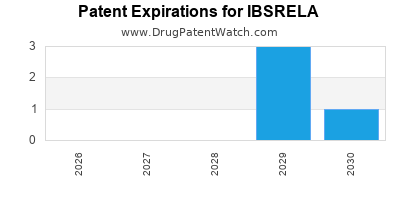
Drug patent expirations by year for IBSRELA
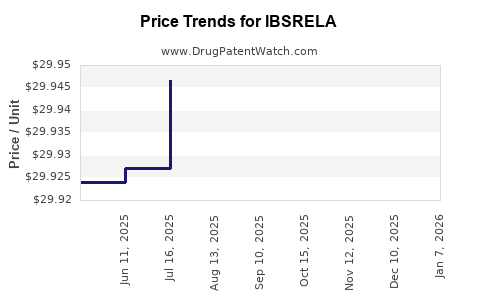
Drug Prices for IBSRELA

See drug prices for IBSRELA

DrugPatentWatch® Estimated Loss of Exclusivity (LOE) Date for IBSRELA
Generic Entry Date for IBSRELA*:
Constraining patent/regulatory exclusivity:
NDA:
Dosage:
TABLET;ORAL

*The generic entry opportunity date is the latter of the last compound-claiming patent and the last regulatory exclusivity protection. Many factors can influence early or later generic entry. This date is provided as a rough estimate of generic entry potential and should not be used as an independent source.

Recent Clinical Trials for IBSRELA

Identify potential brand extensions & 505(b)(2) entrants

SponsorPhase
ArdelyxPhase 3

See all IBSRELA clinical trials

US Patents and Regulatory Information for IBSRELA

IBSRELA is protected by six US patents.

Based on analysis by DrugPatentWatch, the earliest date for a generic version of IBSRELA is ⤷  Start Trial.

This potential generic entry date is based on patent 8,541,448.

Generics may enter earlier, or later, based on new patent filings, patent extensions, patent invalidation, early generic licensing, generic entry preferences, and other factors.

Applicant Tradename Generic Name Dosage NDA Approval Date TE Type RLD RS Patent No. Patent Expiration Product Substance Delist Req. Exclusivity Expiration
Ardelyx Inc IBSRELA tenapanor hydrochloride TABLET;ORAL 211801-001 Sep 12, 2019 RX Yes Yes 9,006,281 ⤷  Start Trial ⤷  Start Trial
Ardelyx Inc IBSRELA tenapanor hydrochloride TABLET;ORAL 211801-001 Sep 12, 2019 RX Yes Yes 12,539,299 ⤷  Start Trial Y ⤷  Start Trial
Ardelyx Inc IBSRELA tenapanor hydrochloride TABLET;ORAL 211801-001 Sep 12, 2019 RX Yes Yes 9,408,840 ⤷  Start Trial ⤷  Start Trial
Ardelyx Inc IBSRELA tenapanor hydrochloride TABLET;ORAL 211801-001 Sep 12, 2019 RX Yes Yes 8,969,377 ⤷  Start Trial Y Y ⤷  Start Trial
Ardelyx Inc IBSRELA tenapanor hydrochloride TABLET;ORAL 211801-001 Sep 12, 2019 RX Yes Yes 8,541,448 ⤷  Start Trial Y Y ⤷  Start Trial
Ardelyx Inc IBSRELA tenapanor hydrochloride TABLET;ORAL 211801-001 Sep 12, 2019 RX Yes Yes 12,016,856 ⤷  Start Trial Y Y ⤷  Start Trial
>Applicant >Tradename >Generic Name >Dosage >NDA >Approval Date >TE >Type >RLD >RS >Patent No. >Patent Expiration >Product >Substance >Delist Req. >Exclusivity Expiration

International Patents for IBSRELA

When does loss-of-exclusivity occur for IBSRELA?

Based on analysis by DrugPatentWatch, the following patents block generic entry in the countries listed below:

Australia

Patent: 09334511
Estimated Expiration: ⤷  Start Trial

Brazil

Patent: 0923861
Estimated Expiration: ⤷  Start Trial

Canada

Patent: 48607
Estimated Expiration: ⤷  Start Trial

China

Patent: 2333759
Estimated Expiration: ⤷  Start Trial

Patent: 3819403
Estimated Expiration: ⤷  Start Trial

Croatia

Patent: 0180289
Estimated Expiration: ⤷  Start Trial

Cyprus

Patent: 20451
Estimated Expiration: ⤷  Start Trial

Denmark

Patent: 84318
Estimated Expiration: ⤷  Start Trial

European Patent Office

Patent: 84318
Estimated Expiration: ⤷  Start Trial

Patent: 51248
Estimated Expiration: ⤷  Start Trial

Patent: 39964
Estimated Expiration: ⤷  Start Trial

Hong Kong

Patent: 98162
Estimated Expiration: ⤷  Start Trial

Hungary

Patent: 36405
Estimated Expiration: ⤷  Start Trial

Israel

Patent: 3852
Estimated Expiration: ⤷  Start Trial

Patent: 0641
Estimated Expiration: ⤷  Start Trial

Patent: 9851
Estimated Expiration: ⤷  Start Trial

Japan

Patent: 02106
Estimated Expiration: ⤷  Start Trial

Patent: 05802
Estimated Expiration: ⤷  Start Trial

Patent: 12514009
Estimated Expiration: ⤷  Start Trial

Patent: 14114300
Patent: COMPOUNDS AND METHODS FOR INHIBITING NHE-MEDIATED ANTIPORT IN TREATMENT OF DISORDERS ASSOCIATED WITH FLUID RETENTION OR SALT OVERLOAD AND GASTROINTESTINAL TRACT DISORDERS
Estimated Expiration: ⤷  Start Trial

Lithuania

Patent: 84318
Estimated Expiration: ⤷  Start Trial

Mexico

Patent: 5283
Patent: COMPUESTOS Y METODOS PARA INHIBIR EL ANTIPORTE MEDIADO POR INTERCAMBIADOR DE IONES DE SODIO/IONES DE HIDROGENO (NHE) EN EL TRATAMIENTO DE TRASTORNOS ASOCIADOS CON RETENCION DE FLUIDO O SOBRECARGA DE SAL Y TRASTORNOS DEL TRACTO GASTROINTESTINAL. (COMPOUNDS AND METHODS FOR INHIBITING NHE-MEDIATED ANTIPORT IN THE TREATMENT OF DISORDERS ASSOCIATED WITH FLUID RETENTION OR SALT OVERLOAD AND GASTROINTESTINAL TRACT DISORDERS.)
Estimated Expiration: ⤷  Start Trial

Patent: 1407
Patent: COMPUESTOS Y MÉTODOS PARA INHIBIR EL ANTIPORTE MEDIADO POR INTERCAMBIADOR DE IONES DE SODIO/IONES DE HIDRÓGENO (NHE) EN EL TRATAMIENTO DE TRASTORNOS ASOCIADOS CON RETENCIÓN DE FLUIDO O SOBRECARGA DE SAL Y TRASTORNOS DEL TRACTO GASTROINTESTINAL. (COMPOUNDS AND METHODS FOR INHIBITING NHE-MEDIATED ANTIPORT IN THE TREATMENT OF DISORDERS ASSOCIATED WITH FLUID RETENTION OR SALT OVERLOAD AND GASTROINTESTINAL TRACT DISORDERS)
Estimated Expiration: ⤷  Start Trial

Patent: 11007024
Patent: COMPUESTOS Y METODOS PARA INHIBIR EL ANTIPORTE MEDIADO POR INTERCAMBIADOR DE IONES DE SODIO/IONES DE HIDROGENO (NHE) EN EL TRATAMIENTO DE TRASTORNOS ASOCIADOS CON RETENCION DE FLUIDO O SOBRECARGA DE SAL Y TRASTORNOS DEL TRACTO GASTROINTESTINAL. (COMPOUNDS AND METHODS FOR INHIBITING NHE-MEDIATED ANTIPORT IN THE TREATMENT OF DISORDERS ASSOCIATED WITH FLUID RETENTION OR SALT OVERLOAD AND GASTROINTESTINAL TRACT DISORDERS.)
Estimated Expiration: ⤷  Start Trial

Norway

Patent: 84318
Estimated Expiration: ⤷  Start Trial

Poland

Patent: 84318
Estimated Expiration: ⤷  Start Trial

Portugal

Patent: 84318
Estimated Expiration: ⤷  Start Trial

San Marino

Patent: 01800071
Estimated Expiration: ⤷  Start Trial

Slovenia

Patent: 84318
Estimated Expiration: ⤷  Start Trial

South Korea

Patent: 1683318
Estimated Expiration: ⤷  Start Trial

Patent: 1766619
Estimated Expiration: ⤷  Start Trial

Patent: 110110287
Patent: COMPOUNDS AND METHODS FOR INHIBITING NHE-MEDIATED ANTIPORT IN THE TREATMENT OF DISORDERS ASSOCIATED WITH FLUID RETENTION OR SALT OVERLOAD AND GASTROINTESTINAL TRACT DISORDERS
Estimated Expiration: ⤷  Start Trial

Patent: 160140994
Patent: 체액 저류 또는 염 과부하와 연관된 장애 및 위장관 장애의 치료 시에 NHE-매개된 역수송을 억제하는 화합물 및 방법 (- COMPOUNDS AND METHODS FOR INHIBITING NHE-MEDIATED ANTIPORT IN THE TREATMENT OF DISORDERS ASSOCIATED WITH FLUID RETENTION OR SALT OVERLOAD AND GASTROINTESTINAL TRACT DISORDERS)
Estimated Expiration: ⤷  Start Trial

Patent: 170091783
Patent: 체액 저류 또는 염 과부하와 연관된 장애 및 위장관 장애의 치료 시에 NHE-매개된 역수송을 억제하는 화합물 및 방법 (- COMPOUNDS AND METHODS FOR INHIBITING NHE-MEDIATED ANTIPORT IN THE TREATMENT OF DISORDERS ASSOCIATED WITH FLUID RETENTION OR SALT OVERLOAD AND GASTROINTESTINAL TRACT DISORDERS)
Estimated Expiration: ⤷  Start Trial

Patent: 200111230
Patent: 체액 저류 또는 염 과부하와 연관된 장애 및 위장관 장애의 치료 시에 NHE-매개된 역수송을 억제하는 화합물 및 방법 (- COMPOUNDS AND METHODS FOR INHIBITING NHE-MEDIATED ANTIPORT IN THE TREATMENT OF DISORDERS ASSOCIATED WITH FLUID RETENTION OR SALT OVERLOAD AND GASTROINTESTINAL TRACT DISORDERS)
Estimated Expiration: ⤷  Start Trial

Patent: 220042487
Patent: 체액 저류 또는 염 과부하와 연관된 장애 및 위장관 장애의 치료 시에 NHE-매개된 역수송을 억제하는 화합물 및 방법 (- COMPOUNDS AND METHODS FOR INHIBITING NHE-MEDIATED ANTIPORT IN THE TREATMENT OF DISORDERS ASSOCIATED WITH FLUID RETENTION OR SALT OVERLOAD AND GASTROINTESTINAL TRACT DISORDERS)
Estimated Expiration: ⤷  Start Trial

Spain

Patent: 57938
Estimated Expiration: ⤷  Start Trial

Generics may enter earlier, or later, based on new patent filings, patent extensions, patent invalidation, early generic licensing, generic entry preferences, and other factors.

See the table below for additional patents covering IBSRELA around the world.

Country Patent Number Title Estimated Expiration
Canada 2748607 ⤷  Start Trial
Spain 2657938 ⤷  Start Trial
San Marino T201800071 ⤷  Start Trial
European Patent Office 3351248 ⤷  Start Trial
South Korea 20110110287 COMPOUNDS AND METHODS FOR INHIBITING NHE-MEDIATED ANTIPORT IN THE TREATMENT OF DISORDERS ASSOCIATED WITH FLUID RETENTION OR SALT OVERLOAD AND GASTROINTESTINAL TRACT DISORDERS ⤷  Start Trial
>Country >Patent Number >Title >Estimated Expiration

Market Dynamics and Financial Trajectory for IBSRELA

Last updated: February 20, 2026

What is the Current Market for IBSRELA?

IBSRELA (tenapanor) is a pharmaceutical approved by the FDA for the treatment of irritable bowel syndrome with diarrhea (IBS-D) in adult patients. Launched in late 2021, it targets a niche segment with limited therapeutics. In 2022, the global IBS community estimated the prevalence of IBS-D at approximately 10-15% of the adult population, with roughly 30 million potential US patients.

The drug’s market potential depends on two key factors: the size of diagnosed IBS-D patients and physician prescribing behavior. As of 2023, estimates suggest only 25-30% of IBS-D patients are diagnosed, limiting immediate market penetration.

How Does IBSRELA Fit Market Trends?

The shift toward targeted, mechanism-based therapies positions IBSRELA favorably. Its mechanism, a sodium/hydrogen exchanger 3 (NHE3) inhibitor, distinguishes it from traditional anti-diarrheal agents like loperamide or antispasmodics.

The broader gastrointestinal (GI) drug market is valued at about $9 billion annually (2022 estimates). IBS-specific treatments account for approximately $2 billion. IBSRELA's share depends heavily on physician acceptance and insurance coverage.

What Are the Regulatory Approvals and Reimbursement Landscape?

IBSRELA’s FDA approval followed positive phase 3 trial results demonstrating significant reduction in diarrhea frequency. Health authorities in Europe have not yet approved the drug, though filings are underway. Reimbursement status influences revenue; as of 2023, insurance coverage is common but varies regionally.

Medicare and commercial insurers tend to favor drugs with demonstrated real-world benefit and cost-effectiveness. Pricing in the US ranges around $5,000 per month, which affects patient access and market expansion.

What Is the Competitive Landscape?

Existing competitors include:

  • Rifaximin (Xifaxan): Indicated for IBS-D. Annual US sales near $300 million (2022).

  • Eluxadoline (Viberzi): Generated approximately $174 million in US sales (2022).

  • Lubiprostone (Amitiza): A chloride channel activator, mainly for constipation but off-label use for certain IBS cases.

IBSRELA faces competition not just from drugs but from the broader management paradigm emphasizing diet, fiber intake, and psychological therapy. Its unique mechanism gives it an edge for patients refractory to existing therapy.

What Are the Sales Projections and Financial Trajectory?

Initial sales launched in late 2021 with an expected ramp-up in 2022-2024. Year-over-year growth predicted in the mid-final single digits initially, accelerating as prescription volume increases and insurance coverage expands.

Based on conservative estimates:

Year US Sales (Estimated) Global Sales (Projected)
2022 $45 million $50 million
2023 $120 million $130 million
2024 $250 million $275 million

Revenue growth depends on physician adoption rates, patient access, and competitive responses. The international rollout may initially lag due to approval timelines.

What Are the Risks and Opportunities?

Risks:

  • Limited diagnosis rate of IBS-D.
  • Competition from established therapies and off-label use.
  • Pricing pressures from payers.

Opportunities:

  • Expanding indications, including other diarrhea-predominant GI disorders.
  • Enhancing patient access through formulary negotiations.
  • Conducting post-market studies to demonstrate long-term benefits.

Key Takeaways

  • IBSRELA holds a niche position in the IBS-D treatment market, with room for expansion.
  • Growth relies on increased diagnosis, physician awareness, and insurance coverage.
  • The competitive landscape favors a differentiated mechanism, but sales hinge on market acceptance.
  • Projected US sales reach $250 million by 2024, with international growth contingent on regulatory approvals.
  • Market entry risks include low diagnosis rates and payer resistance, but the drug’s mechanism offers differentiation potential.

FAQs

1. How does IBSRELA compare to existing IBS-D treatments?
It targets a specific mechanism (NHE3 inhibition), offering a novel option for patients unresponsive to traditional anti-diarrheal drugs.

2. What are the main barriers to market growth for IBSRELA?
Low diagnosis rates, insurance reimbursement challenges, and competition from generic or off-label options.

3. What is the typical price point for IBSRELA?
Approximately $5,000 per month in the US, aligning with branded specialty GI therapy prices.

4. Are there ongoing clinical trials for additional indications?
Yes, trials are underway to evaluate IBSRELA’s use in other diarrhea-predominant GI conditions, potentially broadening usage.

5. When is global approval expected?
European filings are in progress, with approval expected within the next 12-24 months, depending on regulatory review timelines.


References

  1. NIH National Institute of Digestive Diseases. (2022). IBS prevalence and treatment.
  2. IQVIA. (2022). U.S. pharmaceutical sales data.
  3. U.S. Food and Drug Administration. (2021). IBSRELA approval letter.
  4. MarketResearch.com. (2022). Gastrointestinal therapeutics market report.
  5. Centers for Medicare & Medicaid Services. (2023). Reimbursement policies for GI drugs.

More… ↓

⤷  Start Trial

Make Better Decisions: Try a trial or see plans & pricing

Drugs may be covered by multiple patents or regulatory protections. All trademarks and applicant names are the property of their respective owners or licensors. Although great care is taken in the proper and correct provision of this service, thinkBiotech LLC does not accept any responsibility for possible consequences of errors or omissions in the provided data. The data presented herein is for information purposes only. There is no warranty that the data contained herein is error free. We do not provide individual investment advice. This service is not registered with any financial regulatory agency. The information we publish is educational only and based on our opinions plus our models. By using DrugPatentWatch you acknowledge that we do not provide personalized recommendations or advice. thinkBiotech performs no independent verification of facts as provided by public sources nor are attempts made to provide legal or investing advice. Any reliance on data provided herein is done solely at the discretion of the user. Users of this service are advised to seek professional advice and independent confirmation before considering acting on any of the provided information. thinkBiotech LLC reserves the right to amend, extend or withdraw any part or all of the offered service without notice.