Last updated: September 17, 2026
Zafirlukast is a mature, low-revenue leukotriene receptor antagonist marketed originally by AstraZeneca as Accolate. The U.S. product was approved in 1996, but its commercial position deteriorated as montelukast became the dominant oral leukotriene therapy and inhaled corticosteroids remained the preferred controller treatment for persistent asthma. Zafirlukast has no meaningful current U.S. patent barrier, no biosimilar risk, and limited pricing power. Its remaining market is primarily generic, low volume, and sensitive to manufacturing interruptions.
What is the FDA regulatory status of zafirlukast?
Zafirlukast is an FDA-approved oral leukotriene receptor antagonist for the prophylaxis and chronic treatment of asthma. The original product, Accolate, was approved under NDA 020547 in 1996. It is supplied in 10 mg and 20 mg tablets and is generally administered twice daily on an empty stomach (FDA, 1996).
| Regulatory item |
Status |
| Active ingredient |
Zafirlukast |
| Drug class |
Leukotriene receptor antagonist |
| Original brand |
Accolate |
| Original sponsor |
AstraZeneca |
| U.S. approval |
1996 |
| Dosage forms |
10 mg and 20 mg tablets |
| FDA pathway for competitors |
ANDA generic approval |
| Biologic status |
Small molecule; biosimilar pathway does not apply |
| Current commercial status |
Generic and limited-market product |
| Primary indication |
Chronic asthma control and prophylaxis |
Zafirlukast is not a rescue medicine for acute bronchospasm. Its label requires administration at least one hour before or two hours after meals because food can reduce exposure. This dosing requirement is commercially disadvantageous compared with once-daily montelukast, which can be taken without the same fasting restriction (FDA, 1996).
When did zafirlukast lose market exclusivity?
Zafirlukast lost practical U.S. market exclusivity after the expiration of its original small-molecule patent estate and regulatory exclusivity period. The five-year new chemical entity exclusivity associated with the 1996 approval ended in the early 2000s. Any pediatric extension was commercially immaterial to the long-term lifecycle.
The core patent estate is no longer a barrier to generic entry. The current U.S. market is governed primarily by abbreviated new drug applications, manufacturing economics, supply reliability, and prescribing demand rather than by branded patent enforcement.
| Exclusivity category |
Approximate status |
| New chemical entity exclusivity |
Expired |
| Core composition patent protection |
Expired |
| Pediatric exclusivity |
Expired |
| Formulation patent barrier |
No material current barrier identified |
| Method-of-use patent barrier |
No material current barrier identified |
| Orange Book blocking patent |
No active barrier relevant to ordinary generic entry |
| Generic entry |
Established |
The original Accolate patents were filed before the modern 20-year-from-earliest-effective-filing regime became the standard for later applications. Patent term depended on the applicable filing and grant dates, with the relevant protection expiring years ago. The commercial conclusion is straightforward: zafirlukast is an off-patent product in the United States.
What patents protect zafirlukast today?
No commercially significant active U.S. patent protection appears to protect the zafirlukast active ingredient, standard tablet strengths, or ordinary asthma treatment use. The historic estate focused on the compound and related pharmaceutical compositions. Those rights supported AstraZeneca’s original Accolate franchise but do not prevent current ANDA competition.
Are formulation patents still relevant?
Zafirlukast’s conventional 10 mg and 20 mg immediate-release tablets do not present a meaningful current formulation moat. The product has no commercially important extended-release delivery system, device platform, or complex dosage form that would materially raise generic development costs.
Potential formulation work could involve:
- Improving food-effect performance.
- Developing once-daily dosing.
- Improving tablet stability.
- Reducing tablet size.
- Creating pediatric liquid or dispersible presentations.
These opportunities have limited value because the market is mature, the active ingredient is inexpensive, and competing asthma therapies are well established.
Are method-of-use patents relevant?
Method-of-use protection is not a major current risk for ordinary zafirlukast products. Generic applicants can generally pursue the approved asthma indication through a standard ANDA, subject to any applicable patent certifications and labeling requirements. No current method-of-use estate is known to create a meaningful commercial barrier comparable to an active branded patent.
How many patents cover zafirlukast?
Historically, multiple U.S. patents covered the zafirlukast compound, pharmaceutical compositions, and related uses. The exact historical count depends on whether continuation patents, foreign counterparts, and expired Orange Book listings are included. That distinction has little commercial effect today because the relevant U.S. rights have expired.
For current market analysis, the operative patent count is effectively zero for blocking U.S. generic entry. Historical patent volume should not be confused with current exclusionary strength.
What is the Orange Book status of zafirlukast?
The FDA Orange Book identifies approved drug products and relevant patent and exclusivity information. Zafirlukast’s current commercial position is that of an old, off-patent small molecule with generic approvals. The original Accolate product is no longer the principal source of U.S. supply.
Orange Book implications include:
- Generic manufacturers can rely on the reference product’s safety and efficacy findings through the ANDA pathway.
- No active composition patent creates a routine 30-month stay risk for ordinary generic entry.
- Any residual patent listings would need to be evaluated individually, but they do not appear to support a meaningful current exclusivity position.
- The primary risks are commercial and operational rather than legal.
FDA records also distinguish between products that are approved and products that are currently marketed. A product can remain approved while the sponsor stops commercial distribution. That distinction matters for Accolate because historical approval does not establish current branded availability (FDA, n.d.-a).
Which companies are challenging zafirlukast exclusivity?
The main competitive challenge occurred through generic manufacturers using the ANDA pathway after branded exclusivity ended. Publicly visible generic suppliers have included companies such as Teva and other abbreviated-application holders, although availability has varied by year, dosage strength, wholesaler inventory, and manufacturing decisions.
The competitive field is fragmented rather than dominated by one large generic franchise. Generic zafirlukast has limited strategic value because:
- The market is small.
- The product competes with inexpensive alternatives.
- Demand is mature or declining.
- The label has food-administration restrictions.
- Inventory interruptions can make the product commercially unattractive.
- Retail reimbursement is highly price-sensitive.
No significant recent Paragraph IV litigation appears to define the U.S. zafirlukast market. The principal Paragraph IV opportunity was historical, when generic companies sought entry before or around the end of the relevant patent and exclusivity period. Current entrants would more likely pursue ordinary off-patent ANDA approval than litigate against an active branded estate.
What is the financial trajectory of zafirlukast?
Zafirlukast’s financial trajectory followed the standard pattern for an older branded respiratory drug:
- Initial branded growth after the 1996 approval.
- Commercial pressure from montelukast and inhaled therapies.
- Generic entry after patent and regulatory exclusivity expired.
- Rapid erosion of branded pricing and market share.
- Residual low-value generic demand.
- Reduced manufacturer participation and intermittent availability.
AstraZeneca does not generally disclose Accolate revenue as a standalone line item in its annual reports. The product was grouped within broader respiratory and historical portfolio reporting. A precise annual revenue series therefore cannot be established from AstraZeneca’s public financial statements alone (AstraZeneca, 1997-2010).
| Financial phase |
Market effect |
| 1996 to early 2000s |
Branded revenue supported by prescription asthma demand |
| Early to mid-2000s |
Competitive pressure from montelukast and inhaled controller therapies |
| Late 2000s to early 2010s |
Generic entry and branded price erosion |
| 2010s |
Accolate franchise became commercially marginal |
| 2020s |
Generic-only or limited-supply economics in the United States |
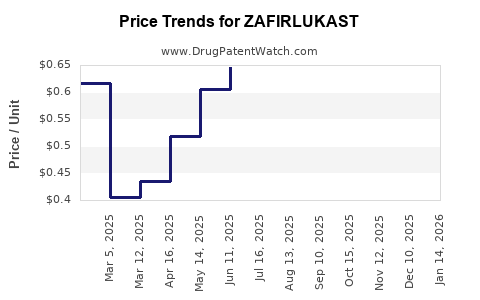
The drug’s revenue exposure is now low. It is unlikely to have a material impact on AstraZeneca’s consolidated results, and it is not a major revenue driver for generic manufacturers. The main financial opportunity is not brand growth but niche supply, hospital contracting, or regional distribution where competitors temporarily exit.
How does zafirlukast compare with montelukast?
Montelukast is the more commercially successful leukotriene receptor antagonist. The difference is driven by convenience, prescribing familiarity, market timing, and broader product positioning.
| Factor |
Zafirlukast |
Montelukast |
| Dosing |
Usually twice daily |
Once daily |
| Food restriction |
Yes |
No comparable fasting requirement |
| Market adoption |
Limited |
Broad |
| Brand history |
Accolate |
Singulair |
| Generic status |
Generic |
Generic |
| Safety differentiation |
Hepatotoxicity concerns and drug interactions |
FDA boxed warning for serious neuropsychiatric events |
| Current commercial strength |
Low |
Higher residual generic demand |
| Pediatric positioning |
More limited |
Strong historical pediatric presence |
Zafirlukast has clinically relevant interaction and tolerability disadvantages. It can inhibit CYP2C9 and has been associated with liver enzyme abnormalities and rare severe hepatic injury. These issues increase monitoring concerns and reduce its attractiveness when alternatives are available (FDA, 1996).
Montelukast also carries significant safety concerns. In 2020, the FDA required a boxed warning for serious neuropsychiatric events and advised restricting use for allergic rhinitis when alternatives are available (FDA, 2020). That action created a safety disadvantage for montelukast but did not produce a material resurgence of zafirlukast because zafirlukast has its own tolerability, dosing, and convenience limitations.
What is the competitive landscape for zafirlukast?
Zafirlukast competes across several treatment categories rather than only against other leukotriene antagonists.
Inhaled corticosteroids
Inhaled corticosteroids remain foundational controller therapy for persistent asthma. They have stronger guideline positioning than oral leukotriene antagonists for many patients and are available in numerous generic and combination products.
Combination inhalers
Inhaled corticosteroid and long-acting beta agonist combinations compete directly for controller-treatment budgets. These products have stronger device, formulation, and brand differentiation than zafirlukast.
Montelukast
Montelukast remains the closest oral pharmacologic substitute. Its once-daily dosing and broad historical use give it a stronger commercial position despite the boxed warning.
Biologics
Biologics such as omalizumab, mepolizumab, benralizumab, dupilumab, and tezepelumab address severe or specialized asthma populations. They do not directly replace zafirlukast for routine patients but reduce the strategic importance of older oral controller products in severe disease.
Zafirlukast may retain use in patients who cannot tolerate or do not respond to alternatives. That segment is clinically real but commercially narrow.
What generic entry risks exist for zafirlukast?
Generic entry risk is no longer the main threat to the brand because branded exclusivity has already ended. The more relevant risks are supply and market-structure risks.
Price compression
Generic competition limits price increases. Any manufacturer attempting to raise prices risks losing formulary placement or wholesaler demand.
Supplier exits
Low-volume products can become uneconomic when manufacturing, quality, serialization, or regulatory costs rise. A supplier exit can create temporary shortages without restoring durable pricing power.
Demand substitution
Prescribers can substitute montelukast, inhaled corticosteroids, or other controller therapies. Zafirlukast therefore has weak demand resilience.
Regulatory compliance
The product requires quality control for dose uniformity, stability, impurity management, and tablet performance. These requirements are routine but can be disproportionately costly for a low-volume product.
Manufacturing and IP barriers
Manufacturing complexity is modest compared with biologics, sterile injectables, or complex inhaled products. The active ingredient is a small molecule and the dosage form is a conventional tablet. Intellectual property does not create a meaningful barrier. The remaining barrier is whether expected volume supports commercial production.
What patent litigation and settlement agreements affect zafirlukast?
No current major U.S. patent litigation or settlement agreement appears to affect zafirlukast’s commercial market. The important litigation period was associated with historical generic entry and the expiration of the original patent estate. Because the branded product no longer has a meaningful exclusivity position, settlement economics are not central to present-day market access.
There is also no biosimilar litigation pathway because zafirlukast is not a biologic. Any future competitor would use the small-molecule generic framework rather than the Biologics Price Competition and Innovation Act pathway.
What is the outlook for zafirlukast revenue?
The outlook is stable to declining at the market level, with occasional supply-driven volatility. A significant revenue rebound would require one of three events:
- A sustained shortage of competing leukotriene products.
- A new formulation with meaningful adherence or tolerability advantages.
- A targeted commercial strategy in a region where generic competition is limited.
None is a strong base-case assumption. The conventional product has limited differentiation, no active patent moat, and a declining role in asthma treatment. Revenue is more likely to remain dispersed among generic suppliers than to consolidate into a high-margin franchise.
Commercial valuation view
| Asset characteristic |
Assessment |
| Patent strength |
Weak to nonexistent for current U.S. entry |
| Regulatory complexity |
Low to moderate |
| Manufacturing complexity |
Low |
| Pricing power |
Very low |
| Prescriber demand |
Limited |
| Substitution risk |
High |
| Biosimilar exposure |
None |
| Litigation exposure |
Low |
| Revenue growth potential |
Low |
| Shortage-driven upside |
Possible but temporary |
Key Takeaways
- Zafirlukast is an old, off-patent oral asthma therapy originally commercialized as Accolate.
- U.S. approval dates to 1996, and its NCE and core patent exclusivity have expired.
- The current market is generic and commercially small.
- No active patent estate appears to block ordinary U.S. ANDA entry.
- No biosimilar risk applies because zafirlukast is a small molecule.
- Montelukast, inhaled corticosteroids, combination inhalers, and biologics limit demand.
- AstraZeneca does not provide a standalone public revenue series for Accolate.
- Current financial value lies mainly in niche supply and regional distribution, not branded growth.
- Litigation and settlement risk are low relative to manufacturing, demand, and supplier-exit risk.
- The long-term revenue trajectory is flat to declining, with possible temporary volatility from generic shortages.
FAQs About Zafirlukast Market and Exclusivity
Is zafirlukast still sold in the United States?
Generic zafirlukast has remained available through limited suppliers and distribution channels, although availability can vary. The original Accolate brand is not the primary U.S. commercial product.
Can a company launch a generic zafirlukast product without patent litigation?
Yes. Because the relevant branded exclusivity and core patent protection have expired, a conventional ANDA strategy is generally more relevant than a Paragraph IV litigation strategy.
Does zafirlukast have a 30-month stay risk?
A 30-month stay is generally associated with a timely patent-infringement action following a Paragraph IV certification. Zafirlukast does not appear to have a current patent estate that creates a material routine stay risk.
Is zafirlukast a candidate for a 505(b)(2) reformulation?
Potentially, but commercial value would depend on meaningful clinical or adherence improvement. A once-daily or food-independent formulation could be differentiated, but development costs would be difficult to justify against low generic pricing and strong therapeutic substitutes.
Could montelukast safety concerns revive zafirlukast demand?
Montelukast’s boxed warning creates a potential clinical opening, but it has not eliminated the structural disadvantages of zafirlukast, including twice-daily dosing, fasting administration, hepatic risk, and limited market familiarity.
References
AstraZeneca. (1997-2010). Annual reports and financial statements. AstraZeneca PLC.
U.S. Food and Drug Administration. (1996). Accolate (zafirlukast) prescribing information. U.S. Department of Health and Human Services.
U.S. Food and Drug Administration. (2020, March 4). FDA requires boxed warning about serious mental health side effects for montelukast. U.S. Department of Health and Human Services.
U.S. Food and Drug Administration. (n.d.-a). Approved drug products with therapeutic equivalence evaluations, commonly known as the Orange Book. U.S. Department of Health and Human Services.
U.S. Food and Drug Administration. (n.d.-b). Drugs@FDA: FDA-approved drugs database. U.S. Department of Health and Human Services.