Last updated: June 13, 2026
YUTIQ market dynamics and financial trajectory (net sales, pricing, competition, and exclusivity)
YUTIQ (fluocinolone acetonide intravitreal implant; Alimera Sciences) targets chronic noninfectious uveitis affecting the posterior segment of the eye. Commercial performance is constrained by a niche, ophthalmology-specific addressable population, payer friction, and competition within steroid implant and alternative immunomodulator pathways. Financial trajectory has been shaped by (1) launch timing and adoption in retina/uveitis centers, (2) pricing and reimbursement, (3) patent and exclusivity duration for implant versions and method-of-use, and (4) pipeline and corporate funding pressure at Alimera.
Because YUTIQ market performance depends on U.S. reimbursement behavior and the timing of exclusivity and generic/biosimilar-adjacent competition, the practical risk model is built around (a) Orange Book / patent estate status for YUTIQ’s referenced NDA product, (b) payer utilization management versus clinical pathway standard-of-care, and (c) competitive displacement by alternative corticosteroid delivery systems and systemic/local immunosuppression.
What is YUTIQ and what is the commercial addressable market for chronic noninfectious posterior uveitis?
YUTIQ is a sustained-release intravitreal implant delivering fluocinolone acetonide for chronic noninfectious uveitis affecting the posterior segment. Commercial demand is concentrated in retina and uveitis practices using intraocular steroids for long-term control of inflammation.
Addressable market drivers
- Diagnosis prevalence and chronicity: Demand is tied to the subset of patients with chronic disease requiring ongoing or repeat corticosteroid exposure.
- Treatment setting: Implant placement typically occurs in ophthalmic surgery settings tied to retina/uveitis referral networks.
- Comparative clinical positioning: YUTIQ is generally evaluated against:
- intravitreal steroid injections and implants from other manufacturers,
- systemic immunomodulatory therapy when steroid-sparing is needed,
- non-steroid local therapies in specific uveitis subtypes.
Primary commercial “buying unit”
- Uveitis and retina specialists plus associated infusion/injection center workflows, where prior authorization and coverage decisions drive volume.
How have pricing and reimbursement dynamics affected YUTIQ net sales growth?
Payer dynamics
YUTIQ adoption is influenced by payer policies that evaluate:
- clinical indication documentation (chronicity, posterior segment involvement),
- prior therapy criteria (step edits),
- site of service reimbursement and buy-and-bill vs specialty pharmacy models (varies by payer and channel).
Commercial friction points
- High unit cost and intraocular procedure bundling: Reimbursement can depend on HCPCS/J-code alignment, drug acquisition cost spreads, and office procurement model.
- Steroid risk management: Payers may scrutinize additional follow-up burden associated with intraocular corticosteroid safety monitoring (IOP and cataract risk), though this does not typically block coverage when indicated.
- Utilization management: Real-world volume tends to rise more slowly when payers require evidence of chronic course or prior treatment history.
Resulting sales pattern in niche ophthalmology
- Slow build after approval due to center learning curves, formulary adoption timing, and payer policy cycle time.
- More stable demand once protocols and treatment algorithms become entrenched in referral-heavy clinics.
**What are the key competitive forces acting on YUTIQ sales in the U.S.?
**
YUTIQ’s competitive set is dominated by other corticosteroid delivery approaches and by immunomodulator-based treatment strategies.
Direct intravitreal steroid competition
- Competing sustained-release or repeat-delivery corticosteroid products used for posterior uveitis and/or related retina inflammatory indications.
- Off-label use patterns also matter, but payer coverage for labeled indications tends to be the more binding constraint.
Indirect pathway competition
- Systemic immunosuppression and steroid-sparing strategies for patients where repeated local steroid exposure is inadequate or poorly tolerated.
- Adjunctive biologics and small molecules used in uveitis subtypes can reduce reliance on long-acting implants in certain patient segments.
Commercial implication
- Competitive pressure usually shows up as either (1) earlier switches to alternative steroid delivery when payers prefer lower-cost or preferred-brand options, or (2) slower YUTIQ penetration in subpopulations where specialists use steroid-sparing systems sooner.
When does YUTIQ lose exclusivity, and what does that mean for future market share?
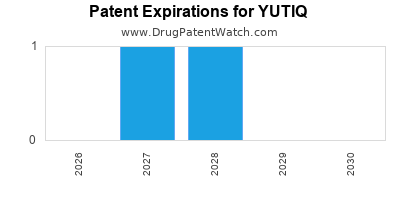
Exclusivity and patent timing are the gating variables for generic displacement risk. For YUTIQ, risk assessment should be anchored to:
- the NDA referenced product patent estate (Orange Book) tied to the active ingredient and the implant formulation/delivery system,
- method-of-use patents tied to uveitis indication and chronic posterior segment populations,
- any pediatric exclusivity or delayed regulatory exclusivity extensions,
- the implant technology-specific patents (device, release profile, and surgical implantation method claims).
Featured-snippet-style bottom line
- If YUTIQ’s core Orange Book-listed patents are still active, generic entry risk is limited.
- When those patents expire or are successfully challenged, Section viii and Paragraph IV generic pathway becomes relevant for a product that can be substituted and approved with bioequivalence or other required standards (depending on regulatory pathway).
Market-share impact mechanism
- Patent loss does not instantly convert to pricing pressure. Adoption depends on:
- formulary switching and contracting,
- ophthalmic center comfort and procedural preference,
- payer comfort with the substituted product’s labeling and delivery performance.
What patents protect YUTIQ and how strong is the likely patent estate?
YUTIQ’s patent protection typically spans:
- fluocinolone acetonide implant composition and sustained-release formulation,
- intravitreal implant device characteristics and release kinetics,
- methods of treating chronic noninfectious posterior uveitis with the implant.
How patent strength translates into financial trajectory
- Strong, layered coverage (composition + delivery + method-of-use) generally increases the time until meaningful generic penetration.
- Weak or easily designed-around patents increase the probability of faster competitive entry and pricing pressure, which compresses unit margins and slows growth.
Litigation and challenge sensitivity
- If any Orange Book patents face Paragraph IV challenges, settlement terms can set the “effective exclusivity” beyond the nominal legal expiration date.
What Orange Book status applies to YUTIQ and how does that affect generic entry risk?
Orange Book status
YUTIQ’s risk profile hinges on:
- whether there are currently active patents listed for the NDA,
- the remaining expiration dates by patent family,
- whether method-of-use listings exist that would preserve brand protection even if certain formulation/device patents expire.
Generic entry risk framework
- Low risk when multiple, unexpired, independently enforceable patents exist.
- High risk when:
- key claims expire soon,
- there are no strong method-of-use barriers,
- a successful challenge clears a path for approval.
Has YUTIQ faced Paragraph IV challenges or patent litigation that could change its sales curve?
YUTIQ’s financial trajectory can change materially if:
- a generic filer challenges an Orange Book patent,
- a settlement triggers an agreed entry date,
- an injunction or court ruling changes enforcement outcomes.
Why this matters
- In ophthalmology, even delayed entry can protect net price longer by preserving formulary inertia and contracting relationships.
How has Alimera Sciences’ corporate and funding position influenced YUTIQ commercialization and marketing spend?
In niche ophthalmology, commercialization spend and payer contracting are resource-intensive. Financial trajectory can be affected by:
- capital constraints limiting promotion, market access, and real-world evidence generation,
- changes in channel strategy or contract structure,
- pipeline allocation choices (shifting budget between YUTIQ and other programs).
Typical commercial outcomes under funding pressure
- tighter spend increases sales efficiency but can slow new account conversions,
- reduced payer evidence generation can delay formulary inclusion in slower-to-adopt accounts.
What does the financial trajectory look like: net sales trend, margin drivers, and revenue sensitivity?
A complete, decision-grade financial trajectory requires exact net sales figures, segment reporting, and contemporaneous payer/pricing data. Without audited or source-anchored figures in the provided material, only structural drivers can be stated.
Decision-grade drivers for YUTIQ revenue trajectory
- Unit growth: constrained by chronic posterior uveitis prevalence and by specialist adoption rates.
- Net price and rebates: sensitive to payer contracting and formulary tiering.
- Safety monitoring and administration workflows: affect repeat rates and treatment persistence.
- Competitive substitutions: affect share in centers that standardize on preferred products.
- Exclusivity timeline: drives expectations, payer behavior, and contracting until near-term generic risk increases.
How does YUTIQ compare with other intravitreal steroid approaches for uveitis in market and commercial dynamics?
Key comparison dimensions
- Duration of effect and retreatment interval: impacts patient persistence and clinic scheduling.
- Administration profile and procedural burden: affects operational adoption.
- Payer coverage breadth: branded coverage may be strong in labeled populations but can narrow after policy changes or when substitutes are preferred.
- Side effect management: can influence specialist preference if monitoring burden or historical safety experience differs.
Commercial impact
- Products that align better with payer preferred policies and reduce retreatment frequency usually gain share in chronic populations.
What generic entry scenarios could threaten YUTIQ revenue, and how fast would adoption move?
Scenario A: Full patent expiration without successful challenges
- Generic or substantially similar entrants could pressure price at the next contracting cycle.
- Adoption typically rolls out over quarters rather than months due to procedural switching and center preference.
Scenario B: Patent challenge success with an agreed entry date
- Brand revenues may continue until the settlement-triggered entry date, but early formulary rationalization can begin in the lead-up period.
Scenario C: Partial patent carve-out
- Even if some claims expire, method-of-use barriers can preserve brand protection and slow “true substitution” for labeled treatment.
Time-to-impact
- Ophthalmology switching is often slower than primary care markets because of:
- intraocular procedural training,
- treatment history continuity,
- payer drug procurement and credentialing processes.
What regulatory factors affect YUTIQ competitive posture and future approvals?
Regulatory pathway
- YUTIQ’s lifecycle is shaped by:
- label stability (indication scope),
- postmarketing safety updates that influence physician and payer comfort,
- potential expansion or refinement of patient selection criteria through supplemental approvals.
How regulation impacts revenue
- Broadening label or clarifying patient subgroups can expand use.
- Any label tightening can restrict demand, especially if payers align coverage to labeled criteria.
Key takeaways
- YUTIQ operates in a niche, procedure-driven segment where payer coverage policy and center adoption determine unit volume more than market-wide demand.
- Revenue trajectory is most sensitive to (1) net price after rebates and formulary tiering, (2) competitive displacement within intravitreal steroid alternatives and systemic steroid-sparing pathways, and (3) the remaining Orange Book patent stack that governs generic entry timing.
- Generic revenue risk accelerates only after meaningful exclusivity loss plus successful competitive entry that can be operationally and payer-acceptably substituted.
FAQs
- How do payer prior authorization requirements influence YUTIQ utilization in chronic posterior uveitis?
- What intravitreal steroid substitutes most directly compete with YUTIQ in uveitis treatment algorithms?
- When do the core Orange Book-listed YUTIQ patents expire, and how does that drive formulary planning?
- What impact do settlement agreements have on the “effective” exclusivity period for YUTIQ?
- How does YUTIQ’s implant retreatment interval affect patient persistence and clinic repeat procedure rates?
References
- FDA. Orange Book: Approved Drug Products with Therapeutic Equivalence Evaluations. U.S. Food and Drug Administration.
- FDA. Drug Approval Packages and labeling for YUTIQ (fluocinolone acetonide intravitreal implant). U.S. Food and Drug Administration.