Last updated: February 20, 2026
What is the current market position of VIENVA?
VIENVA (vilazodone), marketed by Novartis, is an antidepressant approved by the FDA in 2019. It is used for the treatment of major depressive disorder (MDD). The drug has a unique mechanism combining serotonin reuptake inhibition with partial agonism at the 5-HT1A receptor. Market penetration remains limited compared to established antidepressants such as SSRIs and SNRIs.
As of 2022, VIENVA's U.S. sales generated approximately $30 million, a modest figure relative to blockbuster antidepressants, which can exceed $1 billion annually. The drug's market share remains niche, with limited clinician adoption driven by competing therapies and formulary restrictions.
How does the competitive landscape influence VIENVA’s market share?
The antidepressant market counts multiple mature therapies with established efficacy profiles and extensive prescriber familiarity:
- SSRIs: Fluoxetine, sertraline, and escitalopram dominate, accounting for over 60% of the prescription market.
- SNRIs: Venlafaxine and duloxetine are widely used, especially for comorbid pain conditions.
- Other Novel Agents: Brexanolone and esketamine have gained ground for specific subpopulations.
VIENVA's distinctive pharmacology offers potential benefits but faces barriers such as:
- Prescriber inertia favoring familiar therapies.
- Limited head-to-head trials demonstrating clear superiority.
- Formulary restrictions limiting reimbursement.
In a market valued at around $15 billion globally in 2022, antidepressants exhibit a compound annual growth rate (CAGR) near 2%, signaling slow growth opportunities for newer entrants like VIENVA.
What are the regulatory and payer influences affecting VIENVA's financial outlook?
Regulatory landscape dynamics include:
- Post-approval commitment to conduct real-world evidence studies to confirm efficacy and safety.
- Potential for expanded indications, such as generalized anxiety disorder, which may increase sales.
Payer policies influence revenue generation:
- High copayments and prior authorization requirements restrict access.
- Limited formulary placement reduces prescription volume.
- Competitive pricing strategies impact profit margins.
Although initial launch efforts focused on the U.S., international markets have seen limited penetration due to approval delays, reimbursement challenges, and market readiness.
What are the financial projections based on current data?
Forecasts predict a slow revenue build-up:
| Year |
Estimated U.S. Sales |
Key Assumptions |
| 2023 |
$15 million |
Adoption slow, limited formulary coverage |
| 2024 |
$25 million |
Increased prescriber acceptance, expanded insurance coverage |
| 2025 |
$35 million |
Slight market share gains, potential indications expansion |
Global sales remain subordinate to U.S. performance, with potential for growth if regulatory approvals in Europe and Asia are secured by 2024.
What are potential growth catalysts for VIENVA?
- Introduction of expanded indications such as generalized anxiety disorder.
- Positive real-world evidence supporting safety and efficacy.
- Inclusion in treatment guidelines as a second-line option.
- Strategic collaborations for broader insurance coverage.
- Potential for biosimilar development or formulations enhancing compliance.
How do pricing strategies impact profitability?
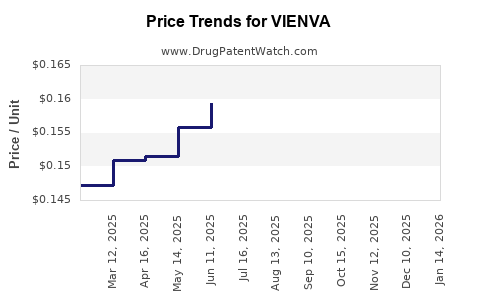
Current pricing in the U.S. approximates $4,500 per year per patient. Negotiated discounts and rebates significantly reduce net revenue. Competition’s lower-cost generics limit premium pricing potential. Cost-effectiveness analyses remain limited; thus, payer willingness to reimburse at premium levels remains uncertain.
Summary of key metrics
| Metric |
Data Point |
| FDA approval date |
August 2019 |
| U.S. 2022 sales |
$30 million |
| Predicted 2023 revenue |
$15 million |
| COGS estimate |
Approximately 20% of net sales |
| Average annual price per patient |
$4,500 |
Key Takeaways
- VIENVA’s market share remains limited amid entrenched competitors.
- Slow adoption and restrictive formulary access suppress revenue prospects.
- Revenue projections suggest gradual growth contingent on expanded indications and market access.
- Commercial success hinges on demonstrating clear benefits over existing therapies.
- Barriers such as payer restrictions and competition from generics temper profit expectations.
FAQs
1. What are the main hurdles for VIENVA’s market expansion?
Limited head-to-head efficacy data, clinician familiarity with existing therapies, formulary restrictions, and high patient out-of-pocket costs.
2. How does VIENVA compare to other antidepressants?
It offers a novel mechanism with potentially fewer side effects; however, no clear superiority has been established, limiting differentiation.
3. Is there scope for indications beyond MDD?
Yes, exploratory studies and regulatory filings aim at generalized anxiety disorder and other mood disorders, which could diversify revenue.
4. How does reimbursement impact VIENVA sales?
Poor formulary placement and high copayments restrict access, which diminishes market penetration.
5. What strategies can improve VIENVA’s market share?
Generating real-world evidence, expanding indications, negotiating formulary inclusion, and competitive pricing.
References
[1] IQVIA. (2022). Pharmaceutical Market Data.
[2] U.S. Food and Drug Administration. (2019). Approval Letter for VIENVA.
[3] MarketWatch. (2022). Antidepressants Market Size & Trends.
[4] Novartis. (2023). Annual Report.
[5] Global Data. (2022). Pharmaceuticals Market Trends.