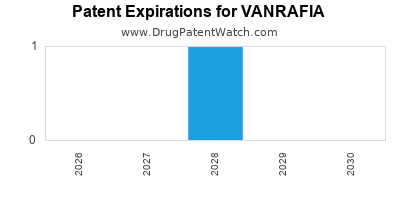
Last updated: September 28, 2026
Vanrafia is atacicept, a subcutaneous TACI-Fc biologic developed by Vera Therapeutics for primary IgA nephropathy. Its commercial opportunity is defined by a large diagnosed patient population, limited disease-modifying options, and competition from established and emerging complement- and B-cell-directed therapies. The principal risks are confirmatory-trial execution, payer restrictions, treatment-duration requirements, manufacturing scale-up, and competition from Filspari, Fabhalta, targeted-release budesonide, and other IgA nephropathy therapies.
What is Vanrafia and what is it approved to treat?
Vanrafia is a recombinant fusion protein that binds and neutralizes B-cell activating factor and a proliferation-inducing ligand, two cytokines involved in B-cell survival and antibody production.
The product is administered subcutaneously and is intended for adults with primary IgA nephropathy who are at risk of disease progression. FDA approval was based principally on proteinuria reduction, a surrogate endpoint used in IgA nephropathy drug development. The product’s long-term commercial and regulatory profile depends on confirmation that this effect translates into preservation of kidney function.
| Attribute |
Vanrafia |
| Active ingredient |
Atacicept |
| Sponsor |
Vera Therapeutics |
| Modality |
TACI-Fc biologic fusion protein |
| Administration |
Subcutaneous injection |
| Target pathway |
BAFF and APRIL |
| Disease |
Primary IgA nephropathy |
| FDA pathway |
Biologic approval based on proteinuria reduction |
| Primary commercial market |
U.S. IgA nephropathy |
| Biosimilar framework |
Biologics Price Competition and Innovation Act |
| Orange Book status |
Not listed as a conventional small-molecule product |
| Relevant FDA reference source |
Purple Book and biologic approval records |
Vanrafia is not a traditional small-molecule generic product. A competing manufacturer would generally pursue a biosimilar or interchangeable biosimilar pathway rather than an abbreviated new drug application.
How large is the Vanrafia market opportunity?
The U.S. IgA nephropathy market has a commercially attractive structure: the disease affects a substantial number of patients, progression is clinically serious, and many patients remain inadequately controlled with supportive care.
Vera has estimated that IgA nephropathy affects hundreds of thousands of people in the United States, although only a subset is diagnosed, followed by nephrologists, and eligible for advanced treatment. The near-term addressable population is therefore smaller than total prevalence.
Commercial penetration will depend on four filters:
- Confirmed diagnosis, often requiring kidney biopsy.
- Persistent proteinuria despite optimized supportive care.
- Sufficient kidney-function reserve for treatment.
- Payer approval for a high-cost biologic administered chronically.
The most valuable segment is likely to consist of patients with persistent proteinuria and elevated risk of progression despite renin-angiotensin system blockade, sodium-glucose cotransporter-2 therapy, or other standard interventions.
Which companies compete with Vanrafia in IgA nephropathy?
Vanrafia enters a market with both approved products and late-stage pipeline competition.
| Product |
Company |
Mechanism or approach |
Commercial relevance |
| Filspari |
Travere Therapeutics |
Endothelin-angiotensin receptor antagonist |
Direct approved competitor for IgAN |
| Tarpeyo |
Calliditas Therapeutics, acquired by Novartis |
Targeted-release budesonide |
Approved disease-directed therapy |
| Fabhalta |
Novartis |
Factor B inhibitor |
Complement-directed competitor |
| Jardiance |
Eli Lilly and Boehringer Ingelheim |
SGLT2 inhibitor |
Supportive and kidney-protective treatment |
| Farxiga |
AstraZeneca |
SGLT2 inhibitor |
Supportive and kidney-protective treatment |
| Atacicept |
Vera Therapeutics |
BAFF/APRIL inhibition |
Vanrafia’s active ingredient |
| Other APRIL or BAFF programs |
Multiple companies |
B-cell and cytokine pathway inhibition |
Pipeline pressure |
Filspari and Fabhalta are particularly relevant because both are positioned around slowing kidney disease progression rather than treating proteinuria as an isolated symptom. Tarpeyo benefits from earlier market entry and physician familiarity.
What is the financial trajectory for Vanrafia?
Vanrafia’s financial trajectory follows a staged biologic-launch model rather than an established-product model.
Pre-launch phase
Before approval, Vera’s financial profile was primarily driven by research spending, clinical-trial costs, regulatory expenses, and capital raises. The company did not have a mature commercial revenue base comparable with large pharmaceutical companies.
The key financial event was the conversion of atacicept from an R&D asset into a commercial product. That transition creates near-term expenses for:
- Specialty pharmacy and distribution infrastructure.
- Medical affairs and nephrology sales teams.
- Patient-support services.
- Pharmacovigilance.
- Manufacturing inventory.
- Market-access negotiations.
- Post-approval studies.
Launch phase
Initial Vanrafia revenue is likely to ramp gradually because IgA nephropathy treatment requires diagnosis confirmation, nephrologist adoption, payer authorization, and recurring patient persistence.
The first commercial year will be more informative through prescription volume, new-patient starts, refill rates, payer mix, and gross-to-net deductions than through reported revenue alone. Specialty biologics often experience a lag between prescription, insurance approval, patient onboarding, and recognized net sales.
Scale phase
The product’s revenue ceiling depends on four variables:
| Variable |
Commercial effect |
| Eligible U.S. patients |
Determines the treatment pool |
| Annual net price |
Determines revenue per treated patient |
| Market share |
Determines competitive capture |
| Persistence |
Determines recurring revenue and lifetime value |
A durable launch would require Vanrafia to become a preferred option for patients with persistent proteinuria and high progression risk. A weaker launch would result if payers require failure on Filspari, Tarpeyo, Fabhalta, or supportive therapy before approving Vanrafia.
What revenue indicators matter most?
Investors and licensing counterparties should monitor:
- Product revenue growth by quarter.
- New prescription starts.
- Refill and discontinuation rates.
- Gross-to-net percentage.
- Prior-authorization denial rates.
- Number of contracted payer lives.
- Average time from prescription to first dose.
- Manufacturing cost per dose.
- Selling, general and administrative spending.
- Cash burn and financing requirements.
- Enrollment and timing of confirmatory studies.
Because Vanrafia is a first commercial product for Vera, sales-force efficiency and cash runway are material valuation variables. A strong product launch can transform Vera from a development-stage company into a commercial biotechnology company. A slower launch can increase dilution risk if additional financing is required before the company reaches operating breakeven.
When does Vanrafia lose exclusivity?
Vanrafia’s principal regulatory exclusivity is biologic exclusivity rather than small-molecule drug exclusivity.
For a newly licensed reference biologic, the BPCIA generally provides 12 years of reference-product exclusivity from the date of first licensure, subject to statutory interpretation and FDA determinations. If Vanrafia received first U.S. licensure in 2025, the principal biologic exclusivity period would generally extend into approximately 2037. The exact date depends on the FDA’s formal first-licensure determination.
Biosimilar applicants may begin certain development and submission activities before the end of the 12-year period. FDA approval and commercial launch remain constrained by applicable exclusivity and patent rights.
What patents protect Vanrafia?
Vanrafia’s protection is expected to involve several patent categories:
- Atacicept composition and protein-engineering claims.
- Nucleic-acid and host-cell claims.
- Formulation and stability claims.
- Subcutaneous dosing regimens.
- Treatment methods for IgA nephropathy.
- Patient-selection or biomarker claims.
- Manufacturing and purification processes.
The commercial value of the estate depends on whether the claims cover the marketed product itself or only narrower dosing, formulation, manufacturing, or method-of-use features.
A biologic can retain substantial patent protection after statutory exclusivity, but patent term, terminal disclaimers, prosecution history, obviousness risk, written-description support, and enablement remain critical. No reliable public conclusion on final Vanrafia patent expiry should be drawn without the FDA-approved product record, patent-family review, and applicable Orange Book-equivalent biologic disclosures.
What is the Orange Book status of Vanrafia?
Vanrafia is not expected to have a conventional Orange Book listing because it is a biologic rather than a small-molecule drug approved under section 505 of the Federal Food, Drug, and Cosmetic Act.
For Vanrafia:
- Paragraph IV certification is generally not the principal generic-challenge mechanism.
- Abbreviated new drug applications are not the standard route for competing biologics.
- Biosimilar applicants use the BPCIA framework.
- Patent disputes can arise through the BPCIA patent-exchange and litigation process.
- FDA biologic records and the Purple Book are more relevant than an ordinary Orange Book entry.
This distinction matters for launch forecasting. Vanrafia does not face the same automatic 30-month-stay structure that commonly affects small-molecule products after an ANDA Paragraph IV filing.
Are there Paragraph IV challenges to Vanrafia?
No conventional Paragraph IV challenge is expected to apply to Vanrafia because it is a biologic product. A competitor seeking to enter with a similar biological product would normally pursue a biosimilar application rather than an ANDA.
The relevant future risks are:
- Biosimilar applications.
- BPCIA patent litigation.
- Declaratory-judgment actions.
- Patent invalidity or non-infringement claims.
- Challenges to formulation or manufacturing patents.
- Contract disputes involving licensed technology.
As of the initial commercial period, the principal threat is more likely to come from competing IgA nephropathy therapies than from immediate biosimilar substitution.
What is the biosimilar risk for Vanrafia?
Near-term biosimilar risk is low because Vanrafia is a newly commercialized biologic and biosimilar development requires substantial clinical, analytical, manufacturing, and regulatory investment.
Longer-term biosimilar risk is meaningful because:
- Atacicept is a protein biologic with potentially reproducible manufacturing characteristics.
- IgA nephropathy is a sizable chronic-treatment market.
- The product is administered repeatedly, creating recurring revenue for a biosimilar entrant.
- Payers may encourage substitution if clinical interchangeability is established.
The first biosimilar entrant would likely target high-volume nephrology channels and compete through discounts, contracting, and patient-support services. The commercial impact would depend on whether FDA designates the product interchangeable and whether state substitution rules apply.
What formulation and manufacturing protections matter?
Vanrafia’s subcutaneous route creates potential barriers beyond active-ingredient patents. Relevant protections may include:
- Concentration and injection-volume claims.
- Protein aggregation control.
- Buffer and excipient combinations.
- Container-closure systems.
- Cold-chain stability.
- Prefilled syringe or autoinjector configurations.
- Cell-line and purification processes.
- Scalable commercial manufacturing.
Manufacturing is a material barrier for biologics because a biosimilar sponsor must demonstrate analytical similarity and establish a reliable supply chain. The most defensible estate would combine product claims with formulation, device, dosing, and manufacturing claims.
What is the regulatory risk for Vanrafia?
The principal regulatory risk is confirmatory evidence.
Approval based on proteinuria reduction creates an obligation to establish clinical benefit through a post-approval study. If the confirmatory program fails, is delayed, or produces an ambiguous kidney-function result, FDA could impose labeling restrictions, require additional studies, or reconsider the approval pathway.
Key regulatory variables include:
- Durability of proteinuria reduction.
- Effect on estimated glomerular filtration rate.
- Time to kidney failure or major kidney-function decline.
- Infection risk from B-cell pathway modulation.
- Immunogenicity.
- Vaccination and infection-monitoring requirements.
- Use in patients with advanced kidney disease.
- Pregnancy and reproductive safety.
- Long-term treatment persistence.
A strong clinical benefit-risk profile would support premium positioning. A safety signal or weak confirmatory result would reduce payer coverage and impair valuation.
What licensing deals affect Vanrafia?
Vera obtained rights to atacicept from Merck KGaA and developed the asset for IgA nephropathy. The commercial economics are therefore affected by any upfront payments, milestone obligations, royalties, territorial rights, or sublicensing provisions in the underlying transaction.
Licensing obligations can reduce product-level profitability even if gross sales grow rapidly. The main diligence questions are:
- Whether Vera holds worldwide commercial rights.
- Whether rights are limited by territory or indication.
- The royalty rate on net sales.
- Remaining milestone payments.
- Manufacturing rights and technology-transfer obligations.
- Co-promotion or sublicensing provisions.
- Rights retained by the original licensor.
The absence of a large pharmaceutical co-commercialization partner leaves Vera with greater control over pricing and launch execution, but also exposes it to higher commercial infrastructure costs.
What patent litigation affects Vanrafia?
There is no established small-molecule-style Paragraph IV litigation pathway for Vanrafia. The likely litigation risks are later-stage biosimilar disputes and challenges to patent validity or scope.
Potential disputes could involve:
- Whether a biosimilar infringes composition claims.
- Whether a dosing regimen is patent-protected.
- Whether a formulation patent covers the commercial presentation.
- Whether manufacturing claims are enabled and non-obvious.
- Whether a patent is improperly extended through continuation practice.
- Whether the reference product qualifies for statutory protections.
Litigation timing will depend on the first biosimilar filing and the scope of Vera’s issued patent portfolio. Patent strength should be assessed claim by claim rather than by counting the number of patent families.
How does Vanrafia compare with Filspari and Fabhalta?
| Factor |
Vanrafia |
Filspari |
Fabhalta |
| Sponsor |
Vera Therapeutics |
Travere Therapeutics |
Novartis |
| Modality |
Biologic fusion protein |
Small molecule |
Small molecule |
| Primary target |
BAFF and APRIL |
Endothelin and angiotensin pathways |
Alternative complement pathway |
| Administration |
Subcutaneous |
Oral |
Oral |
| Market position |
New biologic entrant |
Established IgAN therapy |
Large-pharma complement entrant |
| Generic or biosimilar path |
Biosimilar |
ANDA generic pathway |
ANDA generic pathway |
| Key risk |
Confirmatory benefit and launch execution |
Safety, monitoring, market competition |
Competitive differentiation and access |
| Commercial advantage |
Novel immune-pathway mechanism |
Earlier market presence |
Scale, infrastructure, and payer reach |
Vanrafia has a potential differentiation advantage through dual BAFF/APRIL inhibition and a biologic mechanism aimed at the underlying immune disease. Filspari and Fabhalta have an oral-administration advantage and may be easier for some patients and payers to adopt.
What generic launch scenarios exist for Vanrafia?
The most plausible scenarios are:
Base case
Vanrafia achieves moderate adoption among high-risk patients with persistent proteinuria. Payers impose step therapy, and Vera gradually expands nephrologist use as confirmatory evidence matures.
Upside case
The product demonstrates meaningful kidney-function preservation, secures broad payer coverage, and becomes a preferred therapy for high-risk IgA nephropathy. Recurring treatment creates a growing revenue base and supports operating leverage.
Downside case
Payers favor oral competitors, physician uptake is slow, confirmatory evidence is inconclusive, or manufacturing and patient-support expenses remain high. Vera requires additional capital before reaching profitability.
What is the geographic coverage for Vanrafia?
The U.S. is the primary commercial market because FDA approval provides the first major regulatory basis for launch. International expansion would require separate submissions and local reimbursement negotiations.
Key geographic variables include:
- European Medicines Agency approval.
- Japan and other high-income-market filings.
- Local orphan-drug or rare-disease incentives.
- National reimbursement decisions.
- Distribution through specialty pharmacies.
- Local biologics manufacturing requirements.
- Patent term and supplementary protection certificates.
A global launch could materially expand the addressable market, but it would also increase regulatory, manufacturing, and market-access costs.
Key Takeaways
- Vanrafia is atacicept, a BAFF/APRIL-directed biologic for adults with primary IgA nephropathy.
- Its commercial opportunity is concentrated in patients with persistent proteinuria and high risk of kidney-function decline.
- Filspari, Tarpeyo, Fabhalta, and supportive SGLT2 therapies create immediate competitive pressure.
- Vanrafia is not expected to follow a conventional Orange Book or Paragraph IV pathway.
- Biosimilar risk is limited in the near term but becomes relevant after the biologic exclusivity period and patent barriers weaken.
- The principal regulatory issue is confirmation of clinical benefit beyond proteinuria reduction.
- Vera’s financial trajectory depends on launch speed, payer access, persistence, gross-to-net performance, manufacturing cost, and cash burn.
- The strongest commercial patent position would combine product, formulation, dosing, device, and manufacturing claims.
- A successful confirmatory trial could support premium positioning; a weak result would sharply reduce market potential.
Frequently Asked Questions
Is Vanrafia a biologic or a generic drug?
Vanrafia is a biologic fusion protein. Competing products would generally be developed under the biosimilar pathway rather than as conventional generic drugs.
Does Vanrafia have an Orange Book listing?
Vanrafia is not expected to have a standard Orange Book listing because it is regulated as a biologic. The Purple Book and FDA biologic records are more relevant.
What is Vanrafia’s mechanism of action?
Atacicept binds BAFF and APRIL, cytokines that support B-cell survival and antibody production. The mechanism is intended to reduce pathogenic immune activity associated with IgA nephropathy.
What is the biggest commercial risk for Vanrafia?
The largest risk is failure to convert proteinuria reduction into durable evidence of preserved kidney function, combined with payer preference for oral competitors.
Can a biosimilar launch immediately after Vanrafia approval?
No. A biosimilar sponsor must complete development, obtain FDA approval, and address applicable biologic exclusivity and patent barriers before commercial launch.
References
-
U.S. Food and Drug Administration. (n.d.). Purple Book: Database of licensed biological products. https://purplebooksearch.fda.gov/
-
U.S. Food and Drug Administration. (n.d.). Orange Book: Approved drug products with therapeutic equivalence evaluations. https://www.accessdata.fda.gov/scripts/cder/ob/
-
U.S. Food and Drug Administration. (n.d.). Biologics Price Competition and Innovation Act. https://www.fda.gov/drugs/therapeutic-biologics-applications-bla/biosimilar-and-interchangeable-products
-
Vera Therapeutics, Inc. (n.d.). Corporate filings and investor disclosures. U.S. Securities and Exchange Commission. https://www.sec.gov/
-
Vera Therapeutics, Inc. (n.d.). Atacicept clinical-development and regulatory materials. https://veratherapeutics.com/
-
National Institute of Diabetes and Digestive and Kidney Diseases. (n.d.). IgA nephropathy. https://www.niddk.nih.gov/