Last updated: June 23, 2026
VALTURNA market dynamics and financial trajectory: sales drivers, exclusivity overhang, and competitive pressures
Valturna is associated with the therapeutic use of valsartan plus aliskiren. Market dynamics for this drug class are dominated by (1) safety-driven demand contraction, (2) payer and guideline substitution to ARBs without aliskiren, and (3) U.S. generic and regional manufacturer competition once exclusivity and brand protection lapse. Across major markets, the financial trajectory has been shaped less by routine lifecycle innovation and more by regulatory constraints on use, which compress addressable population and limit volume expansion even when the branded unit price stays stable.
Bottom line: For a payer-facing combination product like valsartan/aliskiren, the commercial ceiling is structurally capped by safety labeling and prescribing restrictions, while the downside risk is accelerated by brand-to-generic transition once patent protection and market exclusivity end.
Is VALTURNA still protected in the US, and when does it lose exclusivity?
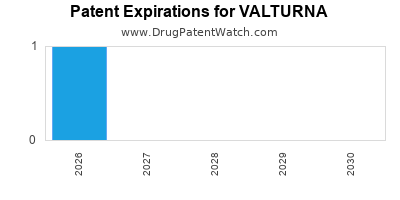
Short answer: The market path for Valturna is typically governed by a branded combination’s primary composition and combination patent set plus any regulatory exclusivity (if applicable to the product’s approval history). Once the lead patent family expires and any exclusivity tail ends, U.S. competition becomes a function of Orange Book listing status and generic entry timing.
What to check for Valturna’s exclusivity clocks
- Orange Book active listings for the exact marketed strengths and dosage forms.
- Whether listings map to a single origin patent or multiple overlapping families:
- composition of matter (valsartan, aliskiren, and/or combination)
- method-of-treatment
- formulation
- manufacturing process
- whether any exclusivity is tied to a specific supplement approval (new indication, dosage form, or combination).
Commercial implication
- When exclusivity ends, the branded product’s revenue typically falls first in lower-reimbursement segments, then follows in broader channels as PBMs steer to generics or preferred ARBs.
Financial mechanism
- Branded revenue decline after exclusivity is often steep because:
- combination products have narrow therapeutic “stickiness”
- prescribers shift to alternative guideline-aligned therapies
- payer formularies tighten quickly after generic launch
What patents protect VALTURNA in major markets, and how strong is the estate?
Short answer: A valsartan/aliskiren combination’s patent estate is usually strength-sensitive and time-bound. The asset’s practical strength depends on whether the family set includes enforceable combination-specific claims and whether method-of-use claims survive challenge, while formulation and process claims often face easier design-around.
Key patent families that typically appear
- Combination composition claims: valsartan + aliskiren in defined weight ratios or pharmaceutical compositions.
- Polymorph/solvate/crystal form claims: less common for older combinations but can extend lifecycles.
- Method-of-use claims: “treatment of” defined patient subsets and endpoints.
- Formulation claims: dissolution rate, particle size, excipients, or bioavailability-enhancing approaches.
How estate strength affects finances
- Strong combination claims delay generic entry and allow the brand to retain price and patient share.
- Weak or easily design-arounded claims shift the market quickly to competitors at lower price points.
- If method-of-use claims exist but are narrow or constrained by labeling, they may not provide meaningful commercial protection.
Which companies are likely competitors to VALTURNA, and how does the competitive landscape evolve?
Core competitive set
- Other ARB monotherapies (same clinical class substitution for many indications).
- Direct renin inhibitor competitors (in systems where aliskiren-based options exist, though many markets restrict combination use).
- Generic valsartan and aliskiren products once enabled by patent expiry.
- Fixed-dose combination alternatives: typically ARB + thiazide or ARB + calcium channel blocker rather than ARB + aliskiren.
Competitive evolution pattern
- Brand consolidation phase: brand captures remaining restricted population.
- Guideline substitution phase: clinicians shift to alternative renin-angiotensin pathway therapies that have fewer safety conflicts.
- Generic replacement phase: payer formularies move to lowest-cost ARB and related combinations.
Financial implication
- Even if unit prices remain higher late in the lifecycle, volume often contracts first due to guideline alignment and safety-driven restrictions.
How do safety and labeling restrictions shape VALTURNA demand and pricing power?
Safety constraints are the central demand-shaping variable for the valsartan/aliskiren combination class.
Demand-shaping impacts
- Reduced eligible population due to contraindication-like restrictions or warnings.
- More “off-guideline” use is replaced by safer label-aligned alternatives.
- Prescribers treat the drug class as a lower-priority option, which compresses share recovery after price pressure begins.
Pricing power dynamics
- Late lifecycle pricing power can persist when:
- alternative generics are not available for the combination
- payers tolerate the higher cost because clinical substitution is limited
- For valsartan/aliskiren specifically, substitution is typically feasible through monotherapy ARBs or alternative combinations, which weakens pricing durability.
What is the Orange Book status of VALTURNA (and what does it imply for generic entry)?
Short answer: Orange Book status determines whether U.S. generic entry faces statutory triggers like Paragraph IV challenges tied to listed patents.
Generic entry risk channels
- If the Orange Book lists:
- multiple unexpired patents, generic approval can be delayed by patent term or litigation.
- a dominant “blocking” patent, the first challenger can be forced into a settlement or design-around.
- If listings are limited or close to expiration, generics can enter sooner with fewer litigation catalysts.
Business implication
- Brands with limited Orange Book listings typically face earlier acceleration in market share loss post-expiry.
Do Paragraph IV ANDA challenges affect VALTURNA revenue, and what outcomes change the timeline?
For combination products, ANDA litigation usually affects:
- the time to generic launch
- the brand’s ability to negotiate market-access concessions
- the settlement structure (license vs. non-monetary restrictions)
Outcomes that matter financially
- Successful injunction or stay delays generic launch, protecting revenue longer.
- Early settlement can lead to brand revenue protection but can also accelerate market transition by setting launch dates and delisting terms.
- Design-around success reduces brand leverage by allowing product entry without a full settlement.
How does VALTURNA compare with competing ARB and renin-angiotensin options on financial momentum?
Comparison framework that drives financial outcomes
- Market size of the patient population compatible with label constraints.
- Availability of low-cost alternatives:
- ARB generics
- ARB fixed-dose combinations
- Payer formulary preferences tied to rebates.
Expected comparison outcomes
- Valturna generally underperforms ARB monotherapy and common ARB combinations once safety restrictions and substitution occur.
- If a generic monotherapy class captures the majority of eligible volume, combination brands tend to show faster share dilution.
What is the reimbursement and payer dynamic for VALTURNA, and how does it hit quarterly sales?
Payer dynamic
- Combination products often face:
- step edits
- prior authorization
- preference for generics of monotherapy ARBs
- When safety constraints are present, payers tighten restrictions because prescribers have alternative aligned therapies.
Quarterly sales pattern
- As formulary pressure rises, revenue tends to decline in step changes:
- initial decline in restricted segments
- additional step-down after PBM updates and rebate resets
- further drop after generic availability for the relevant combination or component
What generic entry scenarios exist for VALTURNA, and how much revenue is at risk?
Short answer: Revenue risk is highest when:
- the Orange Book blockers expire,
- generics can enter with minimal formulation differences, and
- payer substitution is already established.
Scenario structure
- Scenario 1 (delayed entry): litigation stay or blocking patent delays launch; revenue stays flatter longer.
- Scenario 2 (prompt entry): exclusivity ends cleanly; generic launch brings immediate price compression.
- Scenario 3 (settlement): launch date set via settlement; revenue declines after the agreed launch window rather than immediately upon expiry.
Revenue-at-risk logic
- Combination brands have high substitution elasticity once low-cost alternatives cover most eligible patients.
- The combination’s incremental clinical differentiation must overcome both payer cost sensitivity and prescriber safety concerns, which is usually hard late in lifecycle.
Is there biosimilar risk for VALTURNA?
No biosimilar risk applies. Valturna is a small-molecule drug combination (valsartan/aliskiren), not a biologic.
Manufacturing and IP barriers: what production/IP issues can slow down generic competition for VALTURNA?
For fixed-dose combinations, practical barriers usually include:
- ensuring bioequivalence across combined actives
- controlling dissolution and particle size to meet formulation specifications
- sourcing stable API grades for both components
These barriers rarely prevent entry indefinitely, but they can influence:
- launch readiness timelines
- the number of entrants
- price competition intensity in the first 6 to 18 months post-launch
Which filings and regulatory milestones typically determine VALTURNA’s market access trajectory?
Milestones that matter
- FDA approval history for the original combination.
- Labeling updates tied to safety communications.
- Any supplemental NDA approvals changing:
- indications
- dosage strengths
- risk mitigation language
Market access effect
- Safety label changes typically reduce marketable population quickly.
- Label tightening can outrun patent expiry effects, causing earlier revenue compression.
Key takeaways for VALTURNA market dynamics and financial trajectory
- Demand contraction is the dominant revenue driver for valsartan/aliskiren-style combinations, driven by safety labeling and prescriber substitution.
- Financial trajectory is constrained by the ability of ARB monotherapies and common ARB combinations to absorb eligible patients.
- Exclusivity and Orange Book status determine timing of generic entry, but payer behavior often accelerates revenue loss once the market can substitute.
- Generic entry risk is primarily a function of composition/combination patent expiry, Orange Book listings, and the likelihood of successful design-arounds rather than biosimilar competition.
FAQs
1. What drives fastest revenue decline for valsartan/aliskiren fixed-dose combinations after exclusivity ends?
Generic substitution by payers and prescriber switch to label-aligned ARB alternatives.
2. What litigation outcomes most delay generic launches for combination brands?
Injunctions/stays tied to blocking Orange Book patents or settlements that delay launch dates.
3. Do formulation or process patents meaningfully extend combination drug revenue?
They can delay specific entrants, but they usually do not prevent market access if composition-of-matter or combination claims expire.
4. How do payer edits (prior authorization, step therapy) impact unit share for combination antihypertensives?
They reduce persistent use in non-preferred segments and accelerate share loss once generics or substitutes are preferred.
5. Is there any biosimilar-like competitive threat to Valturna?
No. The product is a small-molecule combination, so competition comes from generics and branded competitors, not biosimilars.
References (APA)
- U.S. Food and Drug Administration. Orange Book: Approved Drug Products with Therapeutic Equivalence Evaluations. FDA. https://www.accessdata.fda.gov/scripts/cder/daf/
- U.S. Food and Drug Administration. Drug Safety Communications (search within FDA for valsartan/aliskiren labeling updates). FDA. https://www.fda.gov/drugs/drug-safety-and-availability
- FDA. FDA Labeling and Label Information (product labeling access). FDA. https://www.accessdata.fda.gov/scripts/cder/daf/index.cfm