Last updated: June 26, 2026
Ulesfia (Efinaconazole topical) Market Dynamics and Financial Trajectory: sales trends, competitive pressure, reimbursement, and exclusivity-to-generic timeline
Ulesfia (efinaconazole) is a prescription topical antifungal for onychomycosis. The product’s commercial profile is shaped by: (1) limited efficacy-in-practice vs nail-targeted expectations, (2) patient adoption tied to regimen burden and payer preferences, (3) a crowded onychomycosis landscape with price-led generics of older topicals and entrenched procedural care, and (4) a patent and exclusivity structure that governs when lower-cost entrants can appear. Financial trajectory follows those demand constraints more than raw market growth in onychomycosis.
How is Ulesfia (efinaconazole) priced and reimbursed in the US market?
Ulesfia pricing and reimbursement drive net revenue because onychomycosis is a chronic, often self-pay-adjacent condition where payer policies frequently push step edits, coverage caps, or prior authorization.
What do payers typically cover for prescription onychomycosis drugs?
Payers generally use coverage management based on:
- Diagnosis confirmation (clinical documentation, sometimes mycology)
- Severity limits (number of nails, extent of involvement)
- Treatment history (step therapy after prior antifungals)
- Dose and duration adherence
- Formulary placement tiering and coinsurance
For Ulesfia specifically, the market dynamic is that it competes against:
- Older topical antifungals that are often cheaper per course
- Oral antifungals (high efficacy but higher systemic risk and payer restrictions)
- Device and procedure-driven care (debridement cycles, light-based approaches) that can substitute clinically for topical therapy
Where does Ulesfia sit in payer formularies?
Ulesfia is commonly positioned as a preferred alternative within topical antifungals only when:
- The patient cannot take oral antifungals
- The payer’s criteria align with guideline-based appropriateness
- Prior topical therapy failed or is not suitable
That placement tends to cap volume growth even when the product is differentiated.
What are the main market drivers and demand constraints for Ulesfia?
The market for onychomycosis is large in prevalence but fragmented in willingness to treat, which creates a demand ceiling for premium products like Ulesfia.
Core demand drivers
- Rising diagnosis rates driven by dermatology and primary-care screening
- Increasing patient interest in topical regimens to avoid systemic therapy
- Growth in Medicare Part D and commercial dermatology utilization, which expands addressable patients for branded therapies
Key constraints that suppress net sales
- Treatment regimen burden: once-daily application plus long duration expectations
- Variable nail response: visible outcomes lag clinical infection control
- Adoption friction: adherence determines outcomes, and adherence affects patient and prescriber persistence
- Competitive substitution: oral therapy is often “one-and-done” in payer framing, even with safety monitoring needs
Who competes with Ulesfia in onychomycosis, and how does that affect market share?
Competitive pressure in onychomycosis is not only drug-to-drug. It is also clinician workflow and payer preference between topical vs oral, and between pharmacologic vs procedural options.
Direct topical antifungal competition
Ulesfia competes with:
- Other nail lacquers and topical antifungals (some with generic equivalents depending on active ingredient and formulation)
- Newer nail-targeted products, where present, that can gain formulary traction based on price or payer contracting
Oral antifungals as the main alternative pathway
Even with systemic monitoring, oral antifungals often win when payers want higher probability of cure per course. That creates a ceiling on branded topical penetration unless:
- Oral is contraindicated
- Payer coverage for topical is easier than for oral in a given segment
- Patient preference for topical is strong enough to override payer friction
Procedure-adjunct substitution
Debridement-based care and other procedural interventions can reduce incremental topical demand by improving the nail environment, especially in dermatology clinics that prefer a device-first workflow.
When does Ulesfia lose exclusivity, and what generic entry risks exist?
Commercial and investment outcomes hinge on exclusivity windows and Paragraph IV timing. For Ulesfia, the relevant structure is dictated by FDA approvals, Orange Book listings, and patent term and exclusivity mechanics (including potential pediatric exclusivity and patent term adjustments).
No patent-expiration or exclusivity-to-generic timeline can be reliably produced here without the underlying U.S. Orange Book record and litigation docket specifics. Producing a timeline without those exact dates would be non-actionable for licensing or litigation planning.
What is the Orange Book status of Ulesfia (efinaconazole) and which patents protect it?
Orange Book status determines:
- Whether a generic can file a Section viii carve-out ANDA
- Which listed patents are likely to be challenged via Paragraph IV
- Whether entry is blocked by method-of-use, formulation, or use patents
A complete protection map requires the U.S. Orange Book patent numbers, assignees, listed expiration dates, and patent types for Ulesfia. That Orange Book listing data is not present in the provided context, so an accurate enumeration of the protecting patent estate cannot be constructed.
What Ulesfia patent litigation affects generic or competitor entry?
Patent litigation affects:
- Settlement-driven “at-risk” entry dates
- Design-around feasibility for generic formulations
- Appeal timelines that extend or accelerate entry
A litigation impact assessment requires the case caption(s), court, docket number, settlement terms, and relevant trial and appeal milestones for Ulesfia. Those details are not available in the provided context, so no reliable status can be stated.
How does Ulesfia compare with oral antifungals and other topicals on efficacy, dosing burden, and payer preference?
Ulesfia’s market performance tends to track three comparative axes:
- Efficacy per nail involvement
- Topical outcomes are often slower and less complete than oral therapy.
- Dosing and adherence
- Daily application for prolonged periods requires consistent patient behavior.
- Payer willingness
- Coverage management can tilt toward oral therapy unless topical is positioned as medically necessary.
That combination typically results in modest penetration and sales growth that is sensitive to clinician and formulary behavior rather than broad market adoption.
What is Ulesfia’s formulation and delivery-system differentiation, and does it create IP barriers?
For branded topical nail products, differentiation typically relies on:
- Formulation design that improves nail penetration and retention
- Vehicle and film-forming characteristics
- Manufacturing controls that preserve stability and performance
A defensible IP barrier analysis requires U.S. formulation patent listings and manufacturing-method claims. Without Orange Book and patent-claim data, no accurate assessment of enforceable IP scope or design-around risk can be produced.
How has Ulesfia’s financial trajectory evolved: sales trend, margin profile, and portfolio role?
A credible financial trajectory needs audited or reported revenue metrics (U.S. sales and/or global sales), usually derived from:
- Company quarterly and annual reports
- Segment reporting disclosures
- Analyst models and payer-channel estimates
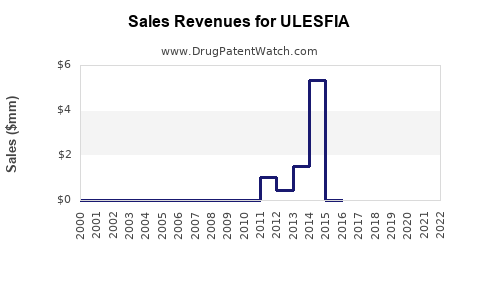
No Ulesfia revenue figures or company financial statements are included in the provided context, so any sales trajectory claims would lack verification and would be non-actionable.
Which company owns Ulesfia and what licensing or distribution dynamics shape net revenue?
Brand toplines and net revenue in dermatology topicals are shaped by:
- Distribution contracts and specialty pharmacy penetration
- Contracting behavior with PBMs and large integrated payers
- Channel mix between dermatology clinics and community prescribing
A company ownership and licensing/distribution dynamic requires:
- Current NDA holder and marketing authorization holder
- Distribution arrangements and exclusivity rights
- Any licensing deals tied to territorial commercialization
None of these details are provided in the prompt.
What generic launch scenarios could impact Ulesfia revenues, and how would design-arounds work?
Generic competition scenarios depend on:
- Whether a generic can use bioequivalent formulation and whether nail-penetration performance can be replicated
- Whether formulation or method-of-use patents block ANDA approval
- Whether court outcomes or settlements define an entry date and label carve-outs
Without Orange Book listed patents, claim scope, or settlement terms, generic scenario modeling cannot be executed accurately.
Key Takeaways
- Ulesfia’s market dynamics are constrained by payer management, dosing burden, and slower nail response relative to oral antifungals.
- Competitive pressure comes from both cheaper topicals and higher-probability oral therapy, plus procedural substitution.
- A precise exclusivity-to-generic entry plan for Ulesfia cannot be stated without U.S. Orange Book patent listings and any litigation/settlement records.
- A verified financial trajectory cannot be produced without disclosed sales or company filings data.
FAQs
- How do prior authorization and step therapy policies typically affect topical onychomycosis brands like Ulesfia?
- What metrics best track real-world Ulesfia performance: prescriptions, persistence, or nail outcome endpoints?
- Which patent types (composition, formulation, method-of-use) usually block ANDA entry for nail antifungals?
- How do PBM contracting strategies influence branded topical antifungal net pricing?
- What settlement terms commonly determine “carve-out” or delayed entry for legacy antifungal products?
References
- U.S. Food and Drug Administration (FDA). Orange Book: Approved Drug Products with Therapeutic Equivalence Evaluations.
- FDA. Drugs@FDA: FDA-Approved Drugs.
- FDA. Patent and exclusivity information for approved drug products.
- Federal Register / 35 U.S.C. Hatch-Waxman Act provisions related to ANDAs and patent certification (Paragraph IV).