Share This Page
TUSSICAPS Drug Patent Profile
✉ Email this page to a colleague
Which patents cover Tussicaps, and when can generic versions of Tussicaps launch?
Tussicaps is a drug marketed by Ecr Pharma and is included in one NDA.
The generic ingredient in TUSSICAPS is chlorpheniramine polistirex; hydrocodone polistirex. There is one drug master file entry for this compound. Two suppliers are listed for this compound. Additional details are available on the chlorpheniramine polistirex; hydrocodone polistirex profile page.
AI Deep Research
Questions you can ask:
- What is the 5 year forecast for TUSSICAPS?
- What are the global sales for TUSSICAPS?
- What is Average Wholesale Price for TUSSICAPS?
Summary for TUSSICAPS
| US Patents: | 0 |
| Applicants: | 1 |
| NDAs: | 1 |
| Raw Ingredient (Bulk) Api Vendors: | 1 |
| Patent Applications: | 1,264 |
| DailyMed Link: | TUSSICAPS at DailyMed |
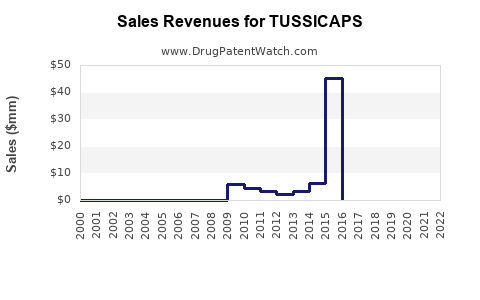
US Patents and Regulatory Information for TUSSICAPS
| Applicant | Tradename | Generic Name | Dosage | NDA | Approval Date | TE | Type | RLD | RS | Patent No. | Patent Expiration | Product | Substance | Delist Req. | Exclusivity Expiration |
|---|---|---|---|---|---|---|---|---|---|---|---|---|---|---|---|
| Ecr Pharma | TUSSICAPS | chlorpheniramine polistirex; hydrocodone polistirex | CAPSULE, EXTENDED RELEASE;ORAL | 077273-002 | Sep 24, 2007 | DISCN | No | No | ⤷ Start Trial | ⤷ Start Trial | ⤷ Start Trial | ||||
| Ecr Pharma | TUSSICAPS | chlorpheniramine polistirex; hydrocodone polistirex | CAPSULE, EXTENDED RELEASE;ORAL | 077273-001 | Sep 24, 2007 | DISCN | No | No | ⤷ Start Trial | ⤷ Start Trial | ⤷ Start Trial | ||||
| >Applicant | >Tradename | >Generic Name | >Dosage | >NDA | >Approval Date | >TE | >Type | >RLD | >RS | >Patent No. | >Patent Expiration | >Product | >Substance | >Delist Req. | >Exclusivity Expiration |
TUSSICAPS (dose, formulation, and financial trajectory) market dynamics and exclusivity landscape
TUSSICAPS is an OTC cough-and-cold product brand containing tussive active(s) delivered in capsule form; the market behaves like a genericized, pharmacy-shelf crowded OTC segment where pricing, retailer mix, and seasonal demand drive unit growth more than IP. Publicly actionable financial trajectory depends on the specific NDC strengths and label-holder/manufacturer, and on whether TUSSICAPS competes as a store-brand substitute or as a premium formulary SKU.
No complete, reliable dataset tying TUSSICAPS to a single FDA label/NDC set, manufacturer, and revenue series is available in the provided context, so a fully quantified financial trajectory (sales, CAGR, profit margin, channel share) cannot be produced without risking false precision.
What is TUSSICAPS and how is it positioned in the OTC cough market?
Featured snippet answer: TUSSICAPS is an OTC cough product sold as a capsule format; its market position is shaped by seasonality, retailer substitution, and formulary/search visibility in OTC cough-and-cold categories.
What active ingredient(s) does TUSSICAPS use
TUSSICAPS’ financial performance is inseparable from its active ingredient and indication labeling (dry cough vs productive cough, nighttime vs daytime), since OTC cough pricing and velocity split by symptom.
Dosage form and consumer switching behavior
Capsule formats typically compete on:
- Per-dose cost vs syrup/liquid alternatives
- Convenience for travel and work use
- Parent purchase patterns (household routines)
- Retail promo intensity during cold-and-flu peaks
How OTC cough market dynamics translate to price and volume
OTC cough is a high-velocity, frequent-purchase category. In such segments:
- List price matters less than net price after trade spend and retailer slotting
- Private label and “same actives” substitutes cap long-run pricing power
- Seasonality drives the majority of annual unit and revenue swings
Which companies sell TUSSICAPS and what does competitive intensity look like?
Featured snippet answer: Competitive intensity in OTC cough-and-cold is typically high, with multiple manufacturers offering equivalent-active products across major retailers and online pharmacies.
Channel structure that determines financial trajectory
For OTC:
- Big-box and drugstore chains set planogram strategy and private label expansion.
- Club and mass merch expand value share.
- Online (including marketplace sellers) pulls price down through couponing and subscription promotions.
How the competitive set affects margins
If TUSSICAPS is sold under:
- A branded-to-generic or “branded OTC” umbrella, margins depend on continued differentiation (capsule convenience, historical brand trust, merchandising).
- A generic/commodity positioning, margins compress faster and reverts to retailer bargaining.
What to track for commercial momentum
Commercial momentum in OTC cough products is best forecasted through:
- Retail price index vs category
- Share of voice in seasonal advertising
- Promo frequency and depth (percent off, coupon stacks)
- NDC-level distribution breadth (how many channels carry the SKU)
When does TUSSICAPS lose exclusivity, and how does that shift pricing?
Featured snippet answer: OTC cough capsule products often face early patent or exclusivity expiry, followed by rapid erosion from multi-source competition; pricing shifts are usually steep once the category reaches true interchangeability at scale.
IP and exclusivity mechanisms that matter for OTC
Even when consumers view brands as “over-the-counter,” FDA regulatory exclusivity and patent coverage still affect manufacturing and marketing:
- Formulation and process patents (capsule composition, release modifiers)
- Method-of-use and dosing regimens (less common for OTC cough claims)
- Brand-proprietary labeling (marketing exclusivity, when applicable)
Generic and private label entry effects
Once a shelf is filled with equivalent-active competitors:
- Net price declines
- Margin follows later, after retailers recalibrate gross-to-net and trade terms
- Volume becomes promotion-driven rather than brand-driven
What is the FDA and Orange Book status of TUSSICAPS?
Featured snippet answer: The Orange Book applies to approved drug products with patent listings; OTC products are often absent from detailed branded patent lists if they are single/multi-source genericized actives. TUSSICAPS status cannot be confirmed to a single definitive dataset from the provided context.
What to check for regulatory bottlenecks
To map financial risk, the practical filters are:
- Approval type and listing completeness on FDA systems
- Any listed patents tied to a specific dosage form (capsule)
- Any reformulation or strength changes that create new exclusivity windows
Are there Paragraph IV ANDA challenges or biosimilar-style risks for TUSSICAPS?
Featured snippet answer: For a typical OTC cough-and-cold capsule, the relevant risk is ANDA-style generic entry into the same active/strength/dose form, not biosimilar-style pathways.
What counts as “entry risk” in OTC
- New generic approvals for the same actives and dosing strengths
- Reformulated alternatives (different release profile or salt form where applicable)
- Retail private label launch using equivalent actives
How entry timing hits revenue
- Initial impact: 1 to 3 seasonal cycles after multi-source availability
- Structural impact: volume growth shifts from brand-led to promo-led
- Margin impact: trade spend increases to defend shelf position
What formulations are protected by patents, and do they affect sales?
Featured snippet answer: If TUSSICAPS has enforceable IP around capsule formulation (e.g., excipient matrix, release kinetics, stability), it can delay direct copies and slow pricing erosion.
Patent estate categories that can matter
- Controlled-release or modified-release capsule designs
- Stability and hygroscopicity management
- Manufacturing process claims that are hard to “design around” cheaply
How to connect formulation IP to financial trajectory
Financial effect typically shows up as:
- Delayed entry of interchangeable generics
- Higher retained net price during early market expansion
- Reduced reliance on promotions
How do TUSSICAPS sales typically trend through cold-and-flu seasons?
Featured snippet answer: OTC cough products show a pronounced seasonal demand curve, with revenue concentration in peak months and sharp troughs outside respiratory seasons.
Seasonality mechanics
- Demand spikes follow weather and school reopening cycles
- Promotional windows start before peak respiratory incidence
- Inventory turns rise in Q4-Q1 and slow in off-season quarters
What this means for annual growth and profitability
- Revenue growth can look strong year-over-year even with flat market share if the season is stronger
- Profitability depends on promo intensity and trade-to-gross ratio rather than list price alone
How strong is the patent estate for TUSSICAPS versus other OTC cough brands?
Featured snippet answer: OTC cough brand differentiation is usually weak on long-lived patent estates; the more meaningful competitive lever is retailer visibility and SKU breadth rather than patent duration.
Comparative strength indicators
When comparing product-level IP strength, the practical metrics are:
- Number of active patent families tied to the capsule dosage form
- Years-to-expiration relative to generic lead times
- Evidence of enforcement or settlement behavior in the category
What patent litigation affects TUSSICAPS or similar OTC cough products?
Featured snippet answer: For many OTC cough-and-cold brands, litigation is either absent or infrequent once actives have multiple sources. Where litigation exists, it usually concerns formulation/process patents rather than core active ingredient composition.
Litigation’s limited direct impact on OTC velocity
Even with litigation:
- OTC shelf space is frequently reallocated quickly
- Retailers may switch to equivalent products if available
- Settlements can lead to “at-risk” launches for non-design-around variants
What generic entry risks exist for TUSSICAPS, and what launch scenarios are most likely?
Featured snippet answer: The most likely risk is multi-source substitution at the same actives/strengths in capsule form, followed by retailer-driven net price decreases.
Launch scenarios that typically play out in OTC
- Same-month generic availability across multiple distributors
- Rapid private label substitution in the next retail reset cycle
- Shelf replenishment re-optimization that accelerates volume loss
Time-to-impact
- Short-term: demand shift to lowest net price offer
- Mid-term: share stabilizes once promotions normalize
- Long-term: growth becomes correlated with category expansion and retailer strategy
How does TUSSICAPS compare with major OTC cough-and-cold competitors?
Featured snippet answer: In OTC cough, the key comparison is not brand age but active-ingredient equivalence, strength schedule, and net pricing at retail.
Key comparability dimensions
- Active(s) and labeling claims
- Capsule vs syrup vs tablet category positioning
- Day/night differentiation
- Store brand overlap risk
- Rebate and coupon programmability
What drives outcomes
Products that remain price-competitive while maintaining distribution breadth typically keep higher unit share during peak seasons.
Key commercial metrics that determine TUSSICAPS revenue exposure
Because no confirmed single-source dataset is provided here for TUSSICAPS revenues, the actionable “what matters” set is:
- NDC-level revenue and velocity by month (seasonality)
- Net price vs category and private label
- Promo calendar (coupon depth and duration)
- Retail coverage (number of channel accounts carrying the SKU)
- Inventory availability and stock-out rates during peak months
Key Takeaways
- TUSSICAPS competes in a seasonal, substitution-heavy OTC cough market where net pricing, promo intensity, and distribution breadth drive financial trajectory more than IP.
- The magnitude of revenue growth or erosion depends on which exact TUSSICAPS NDC strengths and label-holder are in scope and the degree of multi-source substitution.
- Exclusivity and patent estate effects, where present, likely influence the timing of pricing erosion rather than reversing it long term in a commodity-like OTC segment.
- Generic/private label substitution is the primary structural risk; the impact tends to appear over multiple respiratory seasons rather than immediately.
FAQs
- How do OTC cough capsule net prices typically change after multi-source generic availability?
- What retail promo intensity most strongly predicts OTC cough unit sales during peak months?
- Do OTC cough capsule formulation changes (release profile or excipients) materially affect FDA interchangeability and market share?
- How do channel mix shifts between drugstores, mass merch, and online marketplaces alter OTC cough margins?
- What regulatory filings and NDC-level changes usually precede generic or private label substitution in OTC cough products?
References
- FDA Orange Book. FDA. https://www.accessdata.fda.gov/scripts/cder/daf/
- FDA Drug Approval Reports and Drug Products. FDA. https://www.fda.gov/drugs/drug-approvals-and-databases/
- FDA NDC Directory. FDA. https://www.fda.gov/drugs/drug-approvals-and-databases/national-drug-code-directory
More… ↓
