Last Updated: October 26, 2026

TRUQAP Drug Patent Profile


✉ Email this page to a colleague

« Back to Dashboard


Which patents cover Truqap, and what generic alternatives are available?

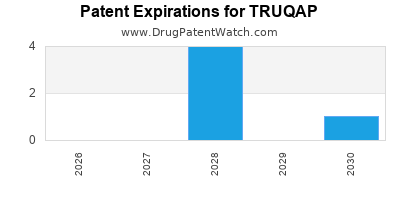
Truqap is a drug marketed by Astrazeneca and is included in one NDA. There are nine patents protecting this drug.

The generic ingredient in TRUQAP is capivasertib. There is one drug master file entry for this compound. One supplier is listed for this compound. Additional details are available on the capivasertib profile page.

DrugPatentWatch® Generic Entry Outlook for Truqap

Truqap will be eligible for patent challenges on November 16, 2027. This date may extended up to six months if a pediatric exclusivity extension is applied to the drug's patents.

By analyzing the patents and regulatory protections it appears that the earliest date for generic entry will be April 16, 2033. This may change due to patent challenges or generic licensing.

There has been one patent litigation case involving the patents protecting this drug, indicating strong interest in generic launch. Recent data indicate that 63% of patent challenges are decided in favor of the generic patent challenger and that 54% of successful patent challengers promptly launch generic drugs.

Indicators of Generic Entry

< Available with Subscription >

  Start Trial

AI Deep Research
Questions you can ask:
  • What is the 5 year forecast for TRUQAP?
  • What are the global sales for TRUQAP?
  • What is Average Wholesale Price for TRUQAP?
DrugPatentWatch® Estimated Loss of Exclusivity (LOE) Date for TRUQAP
Generic Entry Date for TRUQAP*:
Constraining patent/regulatory exclusivity:
NDA:
Dosage:

TABLET;ORAL

*The generic entry opportunity date is the latter of the last compound-claiming patent and the last regulatory exclusivity protection. Many factors can influence early or later generic entry. This date is provided as a rough estimate of generic entry potential and should not be used as an independent source.

US Patents and Regulatory Information for TRUQAP

TRUQAP is protected by ten US patents and two FDA Regulatory Exclusivities.

Based on analysis by DrugPatentWatch, the earliest date for a generic version of TRUQAP is ⤷  Start Trial.

This potential generic entry date is based on patent ⤷  Start Trial.

Generics may enter earlier, or later, based on new patent filings, patent extensions, patent invalidation, early generic licensing, generic entry preferences, and other factors.

Applicant Tradename Generic Name Dosage NDA Approval Date TE Type RLD RS Patent No. Patent Expiration Product Substance Delist Req. Exclusivity Expiration
Astrazeneca TRUQAP capivasertib TABLET;ORAL 218197-001 Nov 16, 2023 RX Yes No ⤷  Start Trial ⤷  Start Trial ⤷  Start Trial
Astrazeneca TRUQAP capivasertib TABLET;ORAL 218197-002 Nov 16, 2023 RX Yes Yes ⤷  Start Trial ⤷  Start Trial ⤷  Start Trial
Astrazeneca TRUQAP capivasertib TABLET;ORAL 218197-001 Nov 16, 2023 RX Yes No ⤷  Start Trial ⤷  Start Trial Y Y ⤷  Start Trial
Astrazeneca TRUQAP capivasertib TABLET;ORAL 218197-001 Nov 16, 2023 RX Yes No ⤷  Start Trial ⤷  Start Trial ⤷  Start Trial
Astrazeneca TRUQAP capivasertib TABLET;ORAL 218197-002 Nov 16, 2023 RX Yes Yes ⤷  Start Trial ⤷  Start Trial ⤷  Start Trial
>Applicant >Tradename >Generic Name >Dosage >NDA >Approval Date >TE >Type >RLD >RS >Patent No. >Patent Expiration >Product >Substance >Delist Req. >Exclusivity Expiration

Expired US Patents for TRUQAP

Applicant Tradename Generic Name Dosage NDA Approval Date Patent No. Patent Expiration
Astrazeneca TRUQAP capivasertib TABLET;ORAL 218197-002 Nov 16, 2023 ⤷  Start Trial ⤷  Start Trial
Astrazeneca TRUQAP capivasertib TABLET;ORAL 218197-001 Nov 16, 2023 ⤷  Start Trial ⤷  Start Trial
Astrazeneca TRUQAP capivasertib TABLET;ORAL 218197-002 Nov 16, 2023 ⤷  Start Trial ⤷  Start Trial
Astrazeneca TRUQAP capivasertib TABLET;ORAL 218197-001 Nov 16, 2023 ⤷  Start Trial ⤷  Start Trial
>Applicant >Tradename >Generic Name >Dosage >NDA >Approval Date >Patent No. >Patent Expiration

International Patents for TRUQAP

When does loss-of-exclusivity occur for TRUQAP?

Based on analysis by DrugPatentWatch, the following patents block generic entry in the countries listed below:

Australia

Patent: 13204533
Patent: Crystalline forms
Estimated Expiration: ⤷  Start Trial

Brazil

Patent: 2014025586
Patent: Forma cristalina de (s)-4-amino-n-(1-(4-clorofenil)-3-hidroxipropil)-1-(7h-pirrolo[2,3-d]pirimidin4-il)piperidina-4-carboxamida, composições farmacêuticas compreendendo a mesma, seu uso e comprimido farmacêutico compreendendo a mesma
Estimated Expiration: ⤷  Start Trial

Canada

Patent: 69936
Patent: FORMES CRISTALLINES DU (S)-4-AMINO-N-(1-(4-CHLOROPHENYL)-3-HYDROXYPROPYL)-1-(7H-PYRROLO[2,3-D]PYRIMIDIN-4-YL)PIPERIDINE-4- CARBOXAMIDE (CRYSTALLINE FORMS OF (S) -4-AMINO-N- (1-(4 - CHLOROPHENYL) - 3 - HYDROX YPROPYL) -1- (7H - PYRROLO [2, 3-D] PYRIMIDI N-4-YL) PIPERIDINE-4-CARBOXAMIDE)
Estimated Expiration: ⤷  Start Trial

China

Patent: 4203953
Estimated Expiration: ⤷  Start Trial

European Patent Office

Patent: 47194
Patent: FORMES CRISTALLINES DU (S)-4-AMINO-N-(1-(4-CHLOROPHÉNYL)-3-HYDROXYPROPYL)-1-(7H-PYRROLO[2,3-D]PYRIMIDIN-4-YL)PIPÉRIDINE-4- CARBOXAMIDE (CRYSTALLINE FORMS OF (S)-4-AMINO-N-(1-(4-CHLOROPHENYL)-3-HYDROXYPROPYL)-1-(7H-PYRROLO[2,3-D]PYRIMIDIN-4-YL)PIPERIDINE-4-CARBOXAMIDE)
Estimated Expiration: ⤷  Start Trial

Hong Kong

Patent: 06337
Estimated Expiration: ⤷  Start Trial

Japan

Patent: 15514741
Patent: 結晶形態の(S)−4−アミノ−N−(1−(4−クロロフェニル)−3−ヒドロキシプロピル)−1−(7H−ピロロ[2,3−d]−ピリミジン−4−イル)ピペリジン−4−カルボキサミド
Estimated Expiration: ⤷  Start Trial

Patent: 18039807
Patent: 結晶形態の(S)−4−アミノ−N−(1−(4−クロロフェニル)−3−ヒドロキシプロピル)−1−(7H−ピロロ[2,3−d]−ピリミジン−4−イル)ピペリジン−4−カルボキサミド ((S)-4-AMINO-N-(1-(4-CHLOROPHENYL)-3-HYDROXYPROPYL)-1-(7H-PYRROLO[2,3-D]-PYRIMIDINE-4-YL)PIPERIDINE-4-CARBOXAMIDE IN CRYSTAL FORM)
Estimated Expiration: ⤷  Start Trial

Malaysia

Patent: 5052
Patent: CRYSTALLINE FORMS OF (S) -4-AMINO-N- (1- (4 - CHLOROPHENYL) - 3 - HYDROXYPROPYL) -1- (7H - PYRROLO [2, 3-D] PYRIMIDI N-4-YL) PIPERIDINE-4-CARBOXAMIDE
Estimated Expiration: ⤷  Start Trial

Mexico

Patent: 14012642
Patent: FORMAS CRISTALINAS DE (S) -4-AMINO-N- (1- (4-CLOROFENIL) -3-HIDROXIPROPIL) -1- (7H-PIRROLO [2,3-D] PIRIMIDIN-4-IL) PIPERIDINA-4-CARBOXAMIDA. (CRYSTALLINE FORMS OF (S) -4-AMINO-N- (1- (4 - CHLOROPHENYL) - 3 - HYDROXYPROPYL) -1- (7H - PYRROLO [2, 3-D] PYRIMIDI N-4-YL) PIPERIDINE-4-CARBOXAMIDE.)
Estimated Expiration: ⤷  Start Trial

Russian Federation

Patent: 52377
Patent: Кристаллические формы (S)-4-амино-N-(1-(4-хлорфенил)-3-гидроксипропил)-1-(7Н-пирроло[2,3-d]пиримидин-4-ил)пиперидин-4-карбоксамида (CRYSTALLINE FORMS OF (S)-4-AMINO-N-(1-(4-CHLOROPHENYL)-3-HYDROXYPROPYL)-1-(7H-PYRROLO[2,3-D]PYRIMIDIN-4-YL)PIPERIDINE-4-CARBOXAMIDE)
Estimated Expiration: ⤷  Start Trial

Patent: 14143529
Patent: Кристаллические формы (S)-4-амино-N-(1-(4-хлорфенил)-3-гидроксипропил)-1-(7Н-пирроло[2, 3-d]пиримидин-4-ил)пиперидин-4-карбоксамида (CRYSTALLINE FORMS OF (S)-4-AMINO-N-(1-(4-CHLOROPHENYL)-3-HYDROXYPROPYL)-1-(7H-PYRROLO[2,3-D]PYRIMIDIN-4-YL)PIPERIDINE-4-CARBOXAMIDE)
Estimated Expiration: ⤷  Start Trial

Singapore

Patent: 201405963Y
Patent: CRYSTALLINE FORMS OF (S) -4-AMINO-N- (1- (4 - CHLOROPHENYL) - 3 - HYDROXYPROPYL) -1- (7H - PYRROLO [2, 3-D] PYRIMIDI N-4-YL) PIPERIDINE-4-CARBOXAMIDE
Estimated Expiration: ⤷  Start Trial

South Korea

Patent: 150002767
Patent: CRYSTALLINE FORMS OF (S)-4-AMINO-N-(1-(4-CHLOROPHENYL)-3-HYDROXYPROPYL)-1-(7H-PYRROLO[2,3-D]PYRIMIDIN-4-YL)PIPERIDINE-4-CARBOXAMIDE
Estimated Expiration: ⤷  Start Trial

Spain

Patent: 50797
Estimated Expiration: ⤷  Start Trial

Taiwan

Patent: 1345913
Patent: Crystalline forms
Estimated Expiration: ⤷  Start Trial

Patent: 05046
Estimated Expiration: ⤷  Start Trial

Generics may enter earlier, or later, based on new patent filings, patent extensions, patent invalidation, early generic licensing, generic entry preferences, and other factors.

See the table below for additional patents covering TRUQAP around the world.

Country Patent Number Title Estimated Expiration
Australia 2013204533 Crystalline forms ⤷  Start Trial
Brazil 112014025586 Forma cristalina de (s)-4-amino-n-(1-(4-clorofenil)-3-hidroxipropil)-1-(7h-pirrolo[2,3-d]pirimidin4-il)piperidina-4-carboxamida, composições farmacêuticas compreendendo a mesma, seu uso e comprimido farmacêutico compreendendo a mesma ⤷  Start Trial
Canada 2869936 FORMES CRISTALLINES DU (S)-4-AMINO-N-(1-(4-CHLOROPHENYL)-3-HYDROXYPROPYL)-1-(7H-PYRROLO[2,3-D]PYRIMIDIN-4-YL)PIPERIDINE-4- CARBOXAMIDE (CRYSTALLINE FORMS OF (S) -4-AMINO-N- (1-(4 - CHLOROPHENYL) - 3 - HYDROX YPROPYL) -1- (7H - PYRROLO [2, 3-D] PYRIMIDI N-4-YL) PIPERIDINE-4-CARBOXAMIDE) ⤷  Start Trial
China 104203953 (S)‑4‑氨基‑N‑(1‑(4‑氯苯基)‑3‑羟丙基)‑1‑(7H‑吡咯并[2,3‑D]嘧啶‑4‑基)哌啶‑4‑甲酰胺的晶型 (Crystalline forms of (s) -4-amino-n- (1- (4 - chlorophenyl) - 3 - hydroxypropyl) -1- (7h - pyrrolo [2, 3-d] pyrimidi n-4-yl) piperidine-4-carboxamide) ⤷  Start Trial
European Patent Office 2847194 FORMES CRISTALLINES DU (S)-4-AMINO-N-(1-(4-CHLOROPHÉNYL)-3-HYDROXYPROPYL)-1-(7H-PYRROLO[2,3-D]PYRIMIDIN-4-YL)PIPÉRIDINE-4- CARBOXAMIDE (CRYSTALLINE FORMS OF (S)-4-AMINO-N-(1-(4-CHLOROPHENYL)-3-HYDROXYPROPYL)-1-(7H-PYRROLO[2,3-D]PYRIMIDIN-4-YL)PIPERIDINE-4-CARBOXAMIDE) ⤷  Start Trial
Spain 2650797 ⤷  Start Trial
>Country >Patent Number >Title >Estimated Expiration

Supplementary Protection Certificates for TRUQAP

Patent Number Supplementary Protection Certificate SPC Country SPC Expiration SPC Description
2201012 C02201012/01 Switzerland ⤷  Start Trial PRODUCT NAME: CAPIVASERTIBUM; REGISTRATION NO/DATE: SWISSMEDIC-ZULASSUNG 69300 19.03.2024
2201012 301299 Netherlands ⤷  Start Trial PRODUCT NAME: CAPIVASERTIB, EVENTUEEL IN DE VORM VAN EEN FARMACEUTISCH AANVAARDBAAR ZOUT; REGISTRATION NO/DATE: EU/1/24/1820 20240618
2201012 PA2024532 Lithuania ⤷  Start Trial PRODUCT NAME: KAPIVASERTIBAS IR JO FARMACINIU POZIURIU PRIIMTINA DRUSKA; REGISTRATION NO/DATE: EU/1/24/1820 20240617
2201012 CA 2024 00047 Denmark ⤷  Start Trial PRODUCT NAME: CAPIVASERTIB, EVENTUELT I FORM AF ET FARMACEUTISK ACCEPTABELT SALT DERAF; REG. NO/DATE: EU/1/24/1820 20240618
2201012 2024C/543 Belgium ⤷  Start Trial PRODUCT NAME: CAPIVASERTIB, EVENTUELLEMENT SOUS LA FORME D'UN SEL PHARMACEUTIQUEMENT ACCEPTABLE; AUTHORISATION NUMBER AND DATE: EU/1/24/1820 20240610
2201012 CR 2024 00047 Denmark ⤷  Start Trial PRODUCT NAME: CAPIVASERTIB, EVENTUELT I FORM AF ET FARMACEUTISK ACCEPTABELT SALT DERAF; REG. NO/DATE: EU/1/24/1820 20240618
>Patent Number >Supplementary Protection Certificate >SPC Country >SPC Expiration >SPC Description

TRUQAP Market Dynamics, Financial Trajectory, Patent Exclusivity, and Competitive Outlook

Last updated: October 1, 2026

TRUQAP, AstraZeneca’s capivasertib, is a targeted oral AKT inhibitor approved with fulvestrant for adults with hormone receptor-positive, HER2-negative advanced or metastatic breast cancer carrying PIK3CA, AKT1, or PTEN alterations after progression on at least one endocrine-based regimen. Its commercial opportunity is substantial but execution-sensitive. Growth depends on biomarker testing, adoption after CDK4/6 inhibitor therapy, physician confidence in the CAPItello-291 data, and the ability to compete against established endocrine combinations and other targeted therapies.

The drug has five years of U.S. new chemical entity exclusivity from its November 16, 2023 FDA approval, subject to statutory extensions. Its principal commercial advantage is a broader AKT-pathway label than PIK3CA-only therapies. Its principal risks are toxicity management, diagnostic friction, competition from Novartis’ KISQALI, Eli Lilly’s VERZENIO, Stemline’s ORSERDU, and Novartis’ PIQRAY, as well as the possibility that biomarker-defined prescribing limits the addressable population.

What is TRUQAP approved to treat?

TRUQAP is approved in combination with fulvestrant for adults with HR-positive, HER2-negative advanced or metastatic breast cancer whose tumors have one or more PIK3CA, AKT1, or PTEN alterations, following progression on at least one endocrine-based regimen in the metastatic setting or recurrence during or within 12 months after adjuvant therapy.[1]

The FDA approval was based primarily on CAPItello-291, a randomized Phase 3 study of capivasertib plus fulvestrant versus placebo plus fulvestrant. In the overall population, median progression-free survival was 7.2 months with the capivasertib combination versus 3.6 months with fulvestrant alone. In the AKT-pathway-altered population, median progression-free survival was 7.3 months versus 3.1 months.[1]

Metric TRUQAP
Active ingredient Capivasertib
Manufacturer AstraZeneca
FDA approval November 16, 2023
FDA pathway Standard approval
Indication HR-positive, HER2-negative advanced or metastatic breast cancer
Combination partner Fulvestrant
Biomarker requirement PIK3CA, AKT1, or PTEN alteration
Dosage 400 mg orally twice daily, four days on and three days off
Key trial CAPItello-291
Companion diagnostic FoundationOne CDx for relevant genomic alterations
U.S. launch Late 2023

The regimen’s intermittent dosing schedule is designed to manage adverse events while preserving pathway inhibition. Diarrhea, rash, hyperglycemia, nausea, and fatigue are important tolerability considerations in commercial use.[1]

How large is the TRUQAP market opportunity?

The addressable market is the post-endocrine, HR-positive/HER2-negative advanced breast cancer population, narrowed by the presence of PIK3CA, AKT1, or PTEN alterations and by physician willingness to use an AKT inhibitor after prior therapy.

The target population is commercially attractive for four reasons:

  1. HR-positive/HER2-negative disease is the largest breast cancer subtype.
  2. Patients commonly receive multiple lines of treatment.
  3. Molecular testing is increasingly integrated into metastatic breast cancer treatment decisions.
  4. TRUQAP can address alterations across three components of the AKT pathway rather than a single gene.

The market is constrained by sequencing. Many patients receive a CDK4/6 inhibitor with an aromatase inhibitor or fulvestrant before TRUQAP. Subsequent treatment can include oral SERDs, PI3K inhibitors, chemotherapy, antibody-drug conjugates, and other endocrine combinations.

AstraZeneca’s commercial strategy is likely to focus on patients who have progressed after CDK4/6-based therapy and remain suitable for endocrine-based treatment. That position gives TRUQAP a large opportunity but places it in a crowded second-line and later-line treatment environment.

What is the TRUQAP pricing and revenue trajectory?

AstraZeneca launched TRUQAP in the United States at an announced list price of approximately $14,760 for a 28-day supply, excluding fulvestrant and other treatment costs.[2] Actual net pricing depends on rebates, payer mix, government discounts, patient assistance, and treatment duration.

The initial revenue curve is expected to be gradual rather than immediate. TRUQAP entered the market with:

  • A new biomarker-defined treatment category.
  • A required companion-diagnostic workflow.
  • A combination regimen involving fulvestrant.
  • Competition from established targeted therapies.
  • The need to educate physicians on AKT-pathway testing and interpretation.

AstraZeneca reported only limited early commercial contribution after the late-2023 launch. The product was not large enough at launch to materially affect group revenue, which exceeded $45 billion in 2023.[3]

Key financial drivers

Driver Effect on TRUQAP revenue
Biomarker testing rate Determines how many eligible patients are identified
CDK4/6 inhibitor penetration Expands the post-CDK4/6 treatment pool
Duration of therapy Directly increases revenue per patient
Fulvestrant use Supports the combination regimen but adds administration costs
Payer restrictions Can delay or restrict access
Toxicity management Can reduce persistence or require dose interruption
International reimbursement Determines launch speed outside the United States
Label expansion Could materially increase the patient pool

The product’s financial profile will depend more on patient duration and line-of-therapy penetration than on first-year launch volume. A rapidly growing diagnostic base could produce a steep revenue curve after the initial adoption period. Conversely, if physicians reserve TRUQAP for later lines, annual sales may remain below the level required to become a major AstraZeneca oncology franchise.

How does TRUQAP compare with competing breast cancer drugs?

TRUQAP competes across several mechanisms rather than against a single direct substitute.

Drug Company Primary biomarker or positioning Key competitive issue
TRUQAP AstraZeneca PIK3CA, AKT1, or PTEN alterations Broad AKT-pathway label; toxicity and testing burden
PIQRAY Novartis PIK3CA-mutated HR-positive disease Earlier market entry; hyperglycemia and tolerability concerns
ORSERDU Stemline Therapeutics ESR1-mutated HR-positive disease Oral SERD positioning and biomarker specificity
KISQALI Novartis CDK4/6 inhibition across broad HR-positive disease Strong first-line and adjuvant positioning
VERZENIO Eli Lilly CDK4/6 inhibition Established prescribing and broad clinical use
Faslodex AstraZeneca Fulvestrant endocrine therapy Combination backbone for TRUQAP
Trodelvy and other ADCs Gilead and others Later-line metastatic disease Potential displacement after endocrine resistance

TRUQAP’s clearest differentiation is the combination of AKT inhibition with a three-gene pathway biomarker. PIQRAY targets PIK3CA alterations, while TRUQAP’s label includes PIK3CA, AKT1, and PTEN. The practical advantage depends on how frequently clinicians identify actionable AKT1 or PTEN alterations and whether those findings change treatment selection.

KISQALI and VERZENIO are broader competitors because they are used earlier and across wider patient populations. They can reduce the number of patients reaching TRUQAP, even when TRUQAP is clinically appropriate later.

What regulatory exclusivity protects TRUQAP?

TRUQAP received five years of U.S. new chemical entity exclusivity beginning on the FDA approval date, November 16, 2023. The base NCE period therefore runs to November 16, 2028, subject to applicable statutory adjustments.[4]

Exclusivity or regulatory right Date or status
FDA approval November 16, 2023
U.S. NCE exclusivity Expected through November 16, 2028
Orphan-drug exclusivity Not applicable to the approved broad breast cancer indication
Pediatric exclusivity No six-month pediatric extension publicly established in the approval record
Biosimilar exclusivity Not applicable; TRUQAP is a small-molecule drug
Generic pathway ANDA, not biosimilar, after applicable barriers expire

Because TRUQAP is a small molecule, future competition will come through abbreviated new drug applications rather than biosimilar applications. The commercial defense will therefore rely on patents, regulatory exclusivity, formulation or manufacturing rights, and the cost and complexity of developing a substitutable product.

What patents protect TRUQAP and when could generic entry occur?

The relevant intellectual-property estate is expected to include compound, formulation, method-of-use, and manufacturing claims. The strongest commercial protection usually comes from claims covering capivasertib itself or its use in treating specific cancer populations. Formulation and dosing patents may provide secondary protection but are more vulnerable to design-around strategies.

The key dates are:

Protection category Commercial relevance
Compound patents Potentially the strongest barrier to generic launch
Method-of-use patents May protect biomarker-defined treatment or combination use
Formulation patents Can protect dosage form, release profile, or excipient composition
Manufacturing patents May increase development and supply-chain complexity
NCE exclusivity Blocks ANDA approval until the statutory period ends
Patent-term extension Could extend one eligible patent by up to five years, subject to statutory limits

No reliable public patent-number and expiration-date table is established here. The FDA Orange Book and current USPTO records control the operative patent landscape, including listed patents, certifications, terminal disclaimers, and any patent-term extension.

Generic entry is unlikely before the expiration of valid blocking patents and NCE exclusivity. A Paragraph IV challenge could occur before the relevant patent expiration dates if a generic applicant asserts that the patents are invalid, unenforceable, or not infringed. No publicly established, market-moving Paragraph IV litigation against TRUQAP is identified in the approval-era record.

What is the Orange Book status of TRUQAP?

TRUQAP is an FDA-approved small-molecule prescription drug and is eligible for Orange Book listing. The commercially relevant Orange Book questions are whether AstraZeneca has listed patents covering the active ingredient, approved uses, dosage form, or method of administration, and whether any listed patent has an adjusted expiration date.

Orange Book status affects generic timing in three ways:

  1. A generic applicant must address listed patents in its ANDA certification.
  2. A Paragraph IV notice can trigger patent litigation.
  3. A timely patent suit can delay ANDA approval for up to 30 months under the Hatch-Waxman framework, subject to statutory exceptions and court outcomes.[5]

Method-of-use patents can be significant because a generic label may attempt to carve out patented indications. That strategy becomes more difficult when the approved use, biomarker selection, dosing regimen, and combination therapy are closely linked.

Which companies could challenge TRUQAP?

Potential challengers would be generic-drug manufacturers with oncology capabilities and experience filing Paragraph IV ANDAs. The most relevant commercial candidates would be large generic companies such as Teva, Sandoz, Viatris, Dr. Reddy’s Laboratories, Sun Pharma, and Zydus, although no specific challenger should be treated as active without a filed notice or litigation record.

A challenge would face several economic barriers:

  • Development of a complex oncology product before market exclusivity expires.
  • Need to establish pharmaceutical equivalence and bioequivalence.
  • Potential patent litigation costs.
  • Limited value if the drug’s market remains concentrated in biomarker-selected patients.
  • Possible difficulty matching AstraZeneca’s supply, diagnostic, and medical-affairs infrastructure.

How strong is the TRUQAP commercial and patent estate?

TRUQAP has a strong clinical differentiation argument but a still-developing commercial estate.

Strengths

  • CAPItello-291 demonstrated a clinically meaningful progression-free survival benefit.
  • The label covers PIK3CA, AKT1, and PTEN alterations.
  • AstraZeneca has substantial breast cancer and oncology commercialization capabilities.
  • TRUQAP can be paired with an established endocrine backbone.
  • The drug is positioned in a large metastatic breast cancer market.

Risks

  • The regimen has clinically important adverse events, including diarrhea, rash, and hyperglycemia.
  • Biomarker testing must be available and reimbursed.
  • The drug enters after strong CDK4/6 inhibitor use.
  • PIQRAY already occupies part of the pathway-targeted market.
  • Oral SERDs and antibody-drug conjugates may take share in later-line disease.
  • The ultimate patent term and listed-claim scope determine generic timing.

The clinical estate is stronger than a narrowly biomarker-specific product because the label recognizes three pathway alterations. The commercial estate is less certain because prescribing depends on molecular testing, treatment sequencing, and tolerability.

What licensing deals affect TRUQAP?

TRUQAP is primarily an AstraZeneca product. The asset originated from AstraZeneca’s internal oncology research and was developed through the CAPItello program. No major third-party licensing transaction is required to explain the product’s core commercial ownership.

The principal external dependency is the companion-diagnostic relationship involving Foundation Medicine’s FoundationOne CDx. Diagnostic access, reimbursement, and laboratory turnaround time can affect treatment adoption even when the drug’s patent and regulatory rights remain with AstraZeneca.[1]

What geographic markets are important for TRUQAP?

The United States is the highest-value launch market because of its oncology drug pricing, molecular testing infrastructure, and commercial insurance coverage. Europe, Japan, and other developed markets are important but generally have slower reimbursement and health-technology-assessment processes.

Geographic performance will vary by:

  • Availability of comprehensive genomic testing.
  • Reimbursement for the diagnostic.
  • National pricing controls.
  • Access to fulvestrant.
  • Adoption of post-CDK4/6 treatment algorithms.
  • Local approval and label wording.

AstraZeneca’s global oncology infrastructure can support broad launches, but international revenue realization is likely to lag U.S. uptake.

What generic launch scenarios exist for TRUQAP?

The most likely scenarios are:

Scenario Market effect
No early Paragraph IV challenge AstraZeneca retains a relatively stable protected market through the key patent period
Paragraph IV challenge with settlement Generic entry may occur on a negotiated date before the final patent expiration
Successful invalidity or non-infringement ruling Earlier generic competition and rapid price erosion
Successful AstraZeneca litigation Delayed generic entry until the blocking patent expires
Narrow label carve-out Generic competes for unpatented uses but may not fully substitute for TRUQAP
Patent expiry with multiple entrants Sharp net-price decline and rapid volume migration

Small-molecule oncology products can experience steep post-exclusivity erosion when multiple generic suppliers enter. The magnitude will depend on whether the market remains concentrated in specialist oncology practices and whether payers impose substitution or preferred-product policies.

Key Takeaways

  • TRUQAP is AstraZeneca’s capivasertib, approved with fulvestrant for biomarker-selected HR-positive, HER2-negative advanced or metastatic breast cancer.
  • The drug’s core differentiation is coverage of PIK3CA, AKT1, and PTEN alterations.
  • FDA approval occurred on November 16, 2023, with expected five-year NCE exclusivity through November 16, 2028.
  • Revenue growth depends on post-CDK4/6 treatment penetration, diagnostic testing, treatment duration, and toxicity management.
  • The main competitive threats are PIQRAY, ORSERDU, KISQALI, VERZENIO, and later-line antibody-drug conjugates.
  • TRUQAP is a small molecule, so future competitors will use ANDA filings rather than biosimilar applications.
  • Patent strength will depend on the scope and expiration of compound, method-of-use, formulation, and manufacturing claims.
  • No established market-moving Paragraph IV challenge is identified in the approval-era record.
  • The largest commercial upside comes from broad AKT-pathway testing and earlier adoption after CDK4/6 inhibitor progression.

FAQs About TRUQAP Market Exclusivity and Commercial Risk

Is TRUQAP a biologic or a small-molecule drug?

TRUQAP is an orally administered small-molecule drug. Future competitors would generally file abbreviated new drug applications rather than biosimilar applications.

What biomarker test is used before prescribing TRUQAP?

The FDA-approved companion diagnostic is FoundationOne CDx, which identifies relevant PIK3CA, AKT1, and PTEN alterations for the approved treatment setting.[1]

Can TRUQAP be used without fulvestrant?

The FDA-approved regimen is TRUQAP in combination with fulvestrant. Use outside that regimen would depend on additional regulatory evidence and approval.

Does TRUQAP compete directly with PIQRAY?

Yes. Both drugs target the PI3K-AKT pathway in HR-positive, HER2-negative advanced breast cancer, but TRUQAP has a broader biomarker label that includes AKT1 and PTEN alterations in addition to PIK3CA.

What is the principal investment risk for TRUQAP?

The principal risk is slower-than-expected adoption after CDK4/6 inhibitor therapy because of diagnostic limitations, toxicity, competition from oral endocrine agents and antibody-drug conjugates, and payer restrictions.

References

  1. U.S. Food and Drug Administration. (2023). FDA approves capivasertib with fulvestrant for breast cancer. https://www.fda.gov
  2. AstraZeneca. (2023). TRUQAP approved in the US for patients with HR-positive, HER2-negative advanced breast cancer. https://www.astrazeneca.com
  3. AstraZeneca. (2024). Annual report and Form 20-F 2023. https://www.astrazeneca.com
  4. U.S. Food and Drug Administration. (2024). Approved drug products with therapeutic equivalence evaluations, Orange Book. https://www.accessdata.fda.gov
  5. U.S. Code. (2024). Drug Price Competition and Patent Term Restoration Act, 21 U.S.C. § 355. https://uscode.house.gov

More… ↓

⤷  Start Trial

Make Better Decisions: Try a trial or see plans & pricing

Drugs may be covered by multiple patents or regulatory protections. All trademarks and applicant names are the property of their respective owners or licensors. Although great care is taken in the proper and correct provision of this service, thinkBiotech LLC does not accept any responsibility for possible consequences of errors or omissions in the provided data. The data presented herein is for information purposes only. There is no warranty that the data contained herein is error free. We do not provide individual investment advice. This service is not registered with any financial regulatory agency. The information we publish is educational only and based on our opinions plus our models. By using DrugPatentWatch you acknowledge that we do not provide personalized recommendations or advice. thinkBiotech performs no independent verification of facts as provided by public sources nor are attempts made to provide legal or investing advice. Any reliance on data provided herein is done solely at the discretion of the user. Users of this service are advised to seek professional advice and independent confirmation before considering acting on any of the provided information. thinkBiotech LLC reserves the right to amend, extend or withdraw any part or all of the offered service without notice.