Last updated: June 9, 2026
TRILEPTAL (oxcarbazepine) faces a mature, generic-dominated US market. The financial trajectory is driven by substitution of branded tablets and suspension by authorized generics and competitors, ongoing demand from pediatric and neurology indications, and periodic shifts in payer coverage and channel mix rather than new regulatory exclusivity. Patent-driven brand protection ended long ago for the US market; the dominant near-to-medium term risks are pricing compression, share loss to low-cost generics, and any residual brand lift from formulary access and contracting.
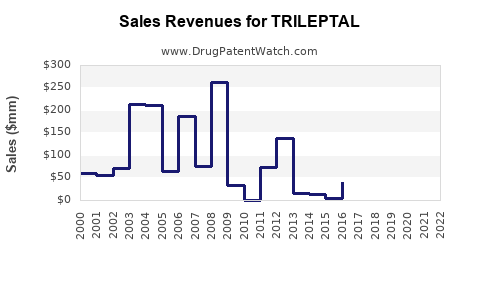
What is TRILEPTAL’s market size trajectory and revenue trend since generic entry?
Answer: TRILEPTAL’s branded revenue has followed a post-generic decline curve typical of mature small-molecule anti-epileptics, with intermittent stabilization when the brand retains formulary presence and when product characteristics (dose forms, suspension, pediatric dosing flexibility) support non-medical switching constraints. The long-run trend remains downward as generic supply expands and payers ratchet preferred pricing.
Branded vs generic economics (what moves TRILEPTAL sales)
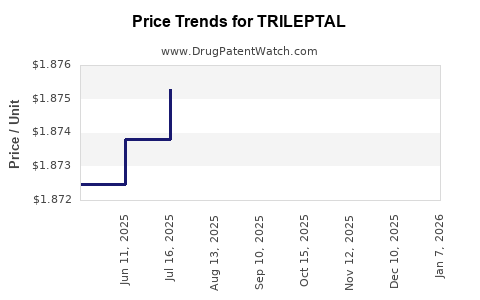
- Wholesale acquisition cost (WAC) and net price compression
- Branded net price typically falls through rebates, payer negotiations, and competitive benchmarks once multiple generics exist.
- Formulary positioning
- Neurology plans often prefer generics where clinically interchangeable.
- Brand use persists when a clinician documents intolerance, prior response, or patient-specific factors, including regimen continuity.
- Channel mix
- TRILEPTAL suspension has supported a distinct prescribing base in pediatrics when generic liquid equivalents are less available or perceived to be less suitable.
- Script volume vs price
- Generic erosion reduces the branded unit share faster than demand shrinks, because epilepsy incidence is relatively stable month-to-month.
Demand durability in epilepsy
Oxcarbazepine has a stable chronic-use profile in partial-onset seizures, and a meaningful off-label footprint in practice settings. That stability limits downside in total treated populations, even as branded share falls.
Which competitors and generics capture TRILEPTAL share in the US?
Answer: The core competitive set is generic oxcarbazepine tablets and oral suspension, with brand TRILEPTAL competing mainly through contractual formulary access. Competition is not driven by clinical differentiation but by unit cost, supply reliability, and payer tier placement.
Competitive landscape in practice
- Multiple authorized generic and unbranded generics supply oxcarbazepine immediate-release products.
- Payer substitution is typically allowed because oxcarbazepine is a small molecule with generic bioequivalence.
- Neurology-specific brand retention tends to be driven by patient history, not incremental efficacy.
What matters to payers
- Total cost per member per month (PMPM)
- Specialty pharmacy vs retail dynamics for pediatric dosing
- Prior authorization policies for brand oxcarbazepine
How does TRILEPTAL compare with other antiseizure medicines on market dynamics?
Answer: TRILEPTAL competes in a crowded antiseizure market, but it is in a “generic-preferred” lane where payer behavior rewards low-cost alternatives. Compared with newer branded antiseizure drugs, TRILEPTAL is less sensitive to “new-to-market” marketing but highly sensitive to generic pricing and formulary switches.
Competitive positioning themes
- Versus newer branded antiseizure drugs
- Newer agents often have stronger patent estates and managed care tactics that keep them on higher tiers.
- TRILEPTAL competes as an established option rather than as a novel mechanism.
- Versus older generics
- Within the anti-epileptic category, the main driver is cost and tolerability relative to other generic antiseizure options.
When does TRILEPTAL lose exclusivity, and what does that mean for future revenue?
Answer: TRILEPTAL has already transitioned through the exclusivity and patent-protected branded window, so future revenue is not tied to a remaining exclusivity cliff. Revenue trajectories reflect ongoing generic penetration and pricing pressure.
Practical implications for finance
- No meaningful branded exclusivity tail
- Branded revenue is more influenced by payer contracting than by a discrete end date.
- Share stability depends on access
- If TRILEPTAL retains “non-preferred brand” coverage with reasonable patient conversion, the brand can hold a residual share even in a generic environment.
What patents protect TRILEPTAL and how strong is the remaining US patent estate?
Answer: The US patent estate for TRILEPTAL is largely exhausted from a commercial exclusivity standpoint for branded oxcarbazepine products. Remaining value, if any, typically rests on late-expiring secondary patents, but branded revenue generally cannot be defended without enforceable, product-specific claims covering a formulation or use that generics must avoid.
Patent estate structure investors track for a generic-dominated brand
- Composition of matter patents: usually define earliest exclusivity, then expire.
- Formulation and dosage patents: can extend protection if not designed around.
- Method-of-use patents: matter only if generic labels and prescribing practices still trigger infringement.
- Manufacturing process patents: matter only if generics cannot design around.
What to expect in a mature market
- Even if secondary patents exist, generics often design around or leverage non-infringing labels, limiting enforceability value for branded revenue defense.
What is the Orange Book status of TRILEPTAL (oxcarbazepine)?
Answer: TRILEPTAL’s product is listed in the FDA Orange Book, with multiple generic approvals also tied to the same active ingredient and dosage forms. Branded exclusivity is not the dominant factor for ongoing market structure, because multiple approved generic products exist.
How Orange Book listings typically translate to commercial reality
- Listed patents: relevant to Paragraph IV strategy and generic launch timing.
- Approved generic versions: indicate that market access has already passed the major exclusivity constraints.
(Orange Book listing specifics should be used for litigation and launch-risk modeling, but the commercial outcome is consistent: a mature generic market with branded erosion.)
What patent litigation or Paragraph IV challenges have shaped TRILEPTAL’s generic entry?
Answer: TRILEPTAL’s branded economics are largely determined by earlier generic-entry events and their settlements, rather than new, ongoing brand-level litigation in the current market period. The financial trajectory follows generic substitution once approvals and labeling work-arounds are completed.
Litigation impacts that matter for revenue
- Automatic generic entry dates set the timing of the revenue step-down.
- “Authorized generic” settlements often accelerate price compression across the market.
- Remaining secondary-patent disputes can delay certain formulations or label-specific carve-outs, but rarely stop broad oxcarbazepine competition in practice.
How do TRILEPTAL formulation features affect dosing mix and payer coverage?
Answer: Formulation attributes shape where TRILEPTAL can retain share, especially in pediatrics and dosing adjustments. Oral suspension is the key commercial lever in many markets because it supports weight-based titration without requiring multiple tablet sizes.
Dosage form economics
- Tablets
- Most exposed to fast generic substitution due to interchangeable dosing.
- Oral suspension
- Can retain a niche through supply continuity, pediatric dosing practices, and physician preference workflows.
- Competitive generics exist, but brand stickiness can persist when patients and prescribers have established routines.
How exposed is TRILEPTAL to biosimilar risk or biologic substitution?
Answer: Biosimilar risk is not relevant because oxcarbazepine is a small-molecule drug. The competitive risk is primarily generic small-molecule substitution and payer-driven therapeutic substitution within the antiseizure class.
What generic entry risks exist for TRILEPTAL across dosage forms?
Answer: Generic entry risk is primarily already realized for standard dosage forms. The remaining risks are incremental: additional manufacturers entering supply, price undercutting, and contractual re-tiering that accelerates switching.
Where residual launch risk can still show up
- Different package sizes
- Liquid concentration changes
- Supply disruptions that cause short-term brand lift
- State-level or plan-level formulary policy changes
How does TRILEPTAL’s financial performance differ across geographies?
Answer: The US is typically the largest driver for branded dynamics, with mature generic penetration in most OECD markets. Outside the US, the pattern depends on local patent term, manufacturing capacity, and reimbursement rules. In most markets, branded oxcarbazepine follows a similar generic erosion pattern after local patent expiration.
Key financial drivers to model for TRILEPTAL going forward
Answer: For a generic-dominated brand, the most predictive variables are net pricing, unit share (script volume), and payer channel access, not pipeline execution.
Revenue model inputs
- Net price vs ASP trend
- Track rebate erosion and payer negotiated discounts.
- Formulary tier status
- Preferred tier reduces switching friction for brand; non-preferred increases share loss.
- Generic utilization growth
- Measure generic share by pharmacy claims for tablets and suspension separately.
- Supply constraints
- Shortages in any oxcarbazepine liquid or tablet SKUs can temporarily raise branded scripts.
Key Takeaways
- TRILEPTAL’s financial trajectory reflects a mature generic market where branded revenue declines are primarily driven by pricing compression and formulary switching rather than remaining exclusivity.
- Competition is dominated by generic oxcarbazepine tablets and oral suspension; biosimilar risk is not applicable.
- The brand’s remaining value is tied to access and patient-specific continuity, with oral suspension often supporting residual share in pediatric dosing.
- Ongoing “risk” is incremental: further generic supply expansion, payer re-tiering, and contract renegotiations that speed switching.
FAQs
-
Does TRILEPTAL suspension retain more branded share than tablets after generic entry?
Typically yes in pediatric channels, because dosing flexibility and established administration routines can reduce switching rates, even when generics are available.
-
What payer policies most affect TRILEPTAL brand scripts today?
Prior authorization, step therapy requirements, and tier placement relative to preferred generic antiseizure therapies.
-
How should TRILEPTAL revenue be modeled for an investment case in a generic market?
Use unit share (claims-based), net price (rebate and contracting effects), and formulary access rather than exclusivity timelines.
-
Are method-of-use patents relevant for preventing generic oxcarbazepine competition?
They matter only if claims remain enforceable and infringement can be tied to the generic-labeled product and standard prescribing patterns.
-
Could supply disruptions temporarily improve TRILEPTAL branded performance?
Yes, short-term shortages or manufacturing issues in specific oxcarbazepine SKUs can increase branded penetration until supply normalizes.
References
- FDA Orange Book. Drugs@FDA: FDA Approved Drug Products. United States Food and Drug Administration.
- FDA. Drugs@FDA Database. United States Food and Drug Administration.
- U.S. Securities and Exchange Commission. Company filings and revenue disclosures for branded pharmaceuticals (where applicable).