Last Updated: August 9, 2026

TRIJARDY XR Drug Patent Profile


✉ Email this page to a colleague

« Back to Dashboard


When do Trijardy Xr patents expire, and when can generic versions of Trijardy Xr launch?

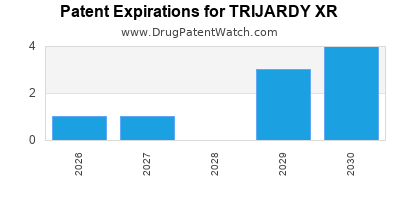
Trijardy Xr is a drug marketed by Boehringer Ingelheim and is included in one NDA. There are sixteen patents protecting this drug and one Paragraph IV challenge.

This drug has four hundred and one patent family members in forty-five countries.

The generic ingredient in TRIJARDY XR is empagliflozin; linagliptin; metformin hydrochloride. There are twenty-two drug master file entries for this compound. One supplier is listed for this compound. Additional details are available on the empagliflozin; linagliptin; metformin hydrochloride profile page.

DrugPatentWatch® Generic Entry Outlook for Trijardy Xr

By analyzing the patents and regulatory protections it appears that the earliest date for generic entry will be May 21, 2030. This may change due to patent challenges or generic licensing.

There have been sixty-two patent litigation cases involving the patents protecting this drug, indicating strong interest in generic launch. Recent data indicate that 63% of patent challenges are decided in favor of the generic patent challenger and that 54% of successful patent challengers promptly launch generic drugs.

Indicators of Generic Entry

< Available with Subscription >

  Start Trial

AI Deep Research
Questions you can ask:
  • What is the 5 year forecast for TRIJARDY XR?
  • What are the global sales for TRIJARDY XR?
  • What is Average Wholesale Price for TRIJARDY XR?
Summary for TRIJARDY XR
DrugPatentWatch® Estimated Loss of Exclusivity (LOE) Date for TRIJARDY XR
Generic Entry Date for TRIJARDY XR*:
Constraining patent/regulatory exclusivity:
NDA:
Dosage:

TABLET, EXTENDED RELEASE;ORAL

*The generic entry opportunity date is the latter of the last compound-claiming patent and the last regulatory exclusivity protection. Many factors can influence early or later generic entry. This date is provided as a rough estimate of generic entry potential and should not be used as an independent source.

Recent Clinical Trials for TRIJARDY XR

Identify potential brand extensions & 505(b)(2) entrants

SponsorPhase
Humanis Saglk Anonim SirketiPHASE1

See all TRIJARDY XR clinical trials

Paragraph IV (Patent) Challenges for TRIJARDY XR
Tradename Dosage Ingredient Strength NDA ANDAs Submitted Submissiondate
TRIJARDY XR Extended-release Tablets empagliflozin; linagliptin; metformin hydrochloride 5 mg/2.5 mg/1 g, 10 mg/5 mg/1 g, 12.5 mg/5 mg/1 g, 25 mg/5 mg/1 g 212614 1 2020-05-26

US Patents and Regulatory Information for TRIJARDY XR

TRIJARDY XR is protected by seventeen US patents.

Based on analysis by DrugPatentWatch, the earliest date for a generic version of TRIJARDY XR is ⤷  Start Trial.

This potential generic entry date is based on patent 9,155,705.

Generics may enter earlier, or later, based on new patent filings, patent extensions, patent invalidation, early generic licensing, generic entry preferences, and other factors.

Applicant Tradename Generic Name Dosage NDA Approval Date TE Type RLD RS Patent No. Patent Expiration Product Substance Delist Req. Exclusivity Expiration
Boehringer Ingelheim TRIJARDY XR empagliflozin; linagliptin; metformin hydrochloride TABLET, EXTENDED RELEASE;ORAL 212614-003 Jan 27, 2020 RX Yes No 9,155,705 ⤷  Start Trial Y ⤷  Start Trial
Boehringer Ingelheim TRIJARDY XR empagliflozin; linagliptin; metformin hydrochloride TABLET, EXTENDED RELEASE;ORAL 212614-002 Jan 27, 2020 RX Yes No 11,833,166*PED ⤷  Start Trial Y ⤷  Start Trial
Boehringer Ingelheim TRIJARDY XR empagliflozin; linagliptin; metformin hydrochloride TABLET, EXTENDED RELEASE;ORAL 212614-003 Jan 27, 2020 RX Yes No 11,833,166*PED ⤷  Start Trial Y ⤷  Start Trial
Boehringer Ingelheim TRIJARDY XR empagliflozin; linagliptin; metformin hydrochloride TABLET, EXTENDED RELEASE;ORAL 212614-004 Jan 27, 2020 RX Yes Yes 7,713,938*PED ⤷  Start Trial Y ⤷  Start Trial
Boehringer Ingelheim TRIJARDY XR empagliflozin; linagliptin; metformin hydrochloride TABLET, EXTENDED RELEASE;ORAL 212614-003 Jan 27, 2020 RX Yes No 8,883,805*PED ⤷  Start Trial Y ⤷  Start Trial
Boehringer Ingelheim TRIJARDY XR empagliflozin; linagliptin; metformin hydrochloride TABLET, EXTENDED RELEASE;ORAL 212614-003 Jan 27, 2020 RX Yes No 12,364,700*PED ⤷  Start Trial Y ⤷  Start Trial
Boehringer Ingelheim TRIJARDY XR empagliflozin; linagliptin; metformin hydrochloride TABLET, EXTENDED RELEASE;ORAL 212614-004 Jan 27, 2020 RX Yes Yes 8,883,805*PED ⤷  Start Trial Y ⤷  Start Trial
>Applicant >Tradename >Generic Name >Dosage >NDA >Approval Date >TE >Type >RLD >RS >Patent No. >Patent Expiration >Product >Substance >Delist Req. >Exclusivity Expiration

Expired US Patents for TRIJARDY XR

International Patents for TRIJARDY XR

When does loss-of-exclusivity occur for TRIJARDY XR?

Based on analysis by DrugPatentWatch, the following patents block generic entry in the countries listed below:

Argentina

Patent: 1175
Estimated Expiration: ⤷  Start Trial

Australia

Patent: 09232043
Estimated Expiration: ⤷  Start Trial

Brazil

Patent: 0911273
Estimated Expiration: ⤷  Start Trial

Canada

Patent: 20450
Estimated Expiration: ⤷  Start Trial

Chile

Patent: 09000809
Estimated Expiration: ⤷  Start Trial

China

Patent: 1983073
Estimated Expiration: ⤷  Start Trial

Patent: 3083672
Estimated Expiration: ⤷  Start Trial

Patent: 6215190
Estimated Expiration: ⤷  Start Trial

Patent: 3648422
Estimated Expiration: ⤷  Start Trial

Colombia

Patent: 51277
Estimated Expiration: ⤷  Start Trial

Denmark

Patent: 85410
Estimated Expiration: ⤷  Start Trial

Ecuador

Patent: 10010489
Estimated Expiration: ⤷  Start Trial

Eurasian Patent Organization

Patent: 9395
Estimated Expiration: ⤷  Start Trial

Patent: 8435
Estimated Expiration: ⤷  Start Trial

Patent: 1001577
Estimated Expiration: ⤷  Start Trial

Patent: 1300121
Estimated Expiration: ⤷  Start Trial

European Patent Office

Patent: 85410
Estimated Expiration: ⤷  Start Trial

Patent: 53403
Estimated Expiration: ⤷  Start Trial

Patent: 44374
Estimated Expiration: ⤷  Start Trial

Hong Kong

Patent: 49485
Estimated Expiration: ⤷  Start Trial

Hungary

Patent: 41649
Estimated Expiration: ⤷  Start Trial

Japan

Patent: 88428
Estimated Expiration: ⤷  Start Trial

Patent: 22068
Estimated Expiration: ⤷  Start Trial

Patent: 11516456
Estimated Expiration: ⤷  Start Trial

Patent: 13237707
Estimated Expiration: ⤷  Start Trial

Mexico

Patent: 1232
Estimated Expiration: ⤷  Start Trial

Patent: 10010819
Estimated Expiration: ⤷  Start Trial

Morocco

Patent: 200
Estimated Expiration: ⤷  Start Trial

New Zealand

Patent: 7747
Estimated Expiration: ⤷  Start Trial

Patent: 9580
Estimated Expiration: ⤷  Start Trial

Peru

Patent: 091730
Estimated Expiration: ⤷  Start Trial

Patent: 140960
Estimated Expiration: ⤷  Start Trial

Poland

Patent: 85410
Estimated Expiration: ⤷  Start Trial

South Africa

Patent: 1005664
Estimated Expiration: ⤷  Start Trial

South Korea

Patent: 1611314
Estimated Expiration: ⤷  Start Trial

Patent: 1775942
Estimated Expiration: ⤷  Start Trial

Patent: 110005690
Estimated Expiration: ⤷  Start Trial

Patent: 160042174
Estimated Expiration: ⤷  Start Trial

Patent: 170056021
Estimated Expiration: ⤷  Start Trial

Spain

Patent: 96124
Estimated Expiration: ⤷  Start Trial

Patent: 12839
Estimated Expiration: ⤷  Start Trial

Taiwan

Patent: 0946534
Estimated Expiration: ⤷  Start Trial

Patent: 1509941
Estimated Expiration: ⤷  Start Trial

Patent: 27816
Estimated Expiration: ⤷  Start Trial

Tunisia

Patent: 10000431
Estimated Expiration: ⤷  Start Trial

Turkey

Patent: 1818886
Estimated Expiration: ⤷  Start Trial

Ukraine

Patent: 4136
Estimated Expiration: ⤷  Start Trial

Uruguay

Patent: 747
Estimated Expiration: ⤷  Start Trial

Generics may enter earlier, or later, based on new patent filings, patent extensions, patent invalidation, early generic licensing, generic entry preferences, and other factors.

See the table below for additional patents covering TRIJARDY XR around the world.

Country Patent Number Title Estimated Expiration
Argentina 071175 ⤷  Start Trial
Australia 2009232043 ⤷  Start Trial
Brazil PI0911273 ⤷  Start Trial
Canada 2720450 ⤷  Start Trial
Chile 2009000809 ⤷  Start Trial
China 101983073 ⤷  Start Trial
China 103083672 ⤷  Start Trial
>Country >Patent Number >Title >Estimated Expiration

Supplementary Protection Certificates for TRIJARDY XR

Patent Number Supplementary Protection Certificate SPC Country SPC Expiration SPC Description
1532149 C300504 Netherlands ⤷  Start Trial PRODUCT NAME: LINAGLIPTINE, DESGEWENST IN DE VORM VAN ZOUT; REGISTRATION NO/DATE: EU/1/11/707/001-011 20110824
1532149 1190035-4 Sweden ⤷  Start Trial PERIOD OF VALIDITY (FROM - UNTIL): 20230819 - 20260829
1532149 PA2011013 Lithuania ⤷  Start Trial PRODUCT NAME: LINAGLIPTINUM; REGISTRATION NO/DATE: EU/1/11/707/001, 2011 08 24 EU/1/11/707/002, 2011 08 24 EU/1/11/707/003, 2011 08 24 EU/1/11/707/004, 2011 08 24 EU/1/11/707/005, 2011 08 24 EU/1/11/707/006, 2011 08 24 EU/1/11/707/007, 2011 08 24 EU/1/11/707/008, 2011 08 24 EU/1/11/707/00 2011082
1532149 C20110018 00046 Estonia ⤷  Start Trial PRODUCT NAME: TRAJENTA-LINAGLIPTIN; REG NO/DATE: FINAL 24.08.2011
1532149 91889 Luxembourg ⤷  Start Trial 91889, EXPIRES: 20260824
1532149 CA 2011 00030 Denmark ⤷  Start Trial
1532149 PA2011013,C1532149 Lithuania ⤷  Start Trial PRODUCT NAME: LINAGLIPTINUM; REGISTRATION NO/DATE: EU/1/11/707/001, 2011-08-24 EU/1/11/707/002, 2011-08-24 EU/1/11/707/003, 2011-08-24 EU/1/11/707/004, 2011-08-24 EU/1/11/707/005, 2011-08-24 EU/1/11/707/006, 2011-08-24 EU/1/11/707/007, 2011-08-24 EU/1/11/707/008, 2011-08-24 EU/1/11/707/00 2011082
>Patent Number >Supplementary Protection Certificate >SPC Country >SPC Expiration >SPC Description
Last updated: July 26, 2026

TRIJARDY XR market dynamics and financial trajectory: sales trends, payer mix, competitive risk, and exclusivity-driven outlook

TRIJARDY XR (empagliflozin/linagliptin/extended-release metformin hydrochloride) is positioned as a fixed-dose triple combination in type 2 diabetes after failure of dual therapy. The financial trajectory is driven by (1) conversion from existing GLP-1 RA and SGLT2 inhibitor use to triple therapy, (2) payer formulary design for combination products, (3) dose/titration adherence effects from the extended-release metformin component, and (4) competitive pressure from other fixed-dose combinations and emerging incretin-based regimens.

This product’s near-to-midterm economics are tightly linked to patent and regulatory exclusivity windows that govern generic and biosimilar entry risk, plus downstream contracting outcomes such as rebate intensity and step-edit rules within managed care. Without verified, product-specific commercial benchmarks (net sales by quarter/year, market share, and payer channel mix), the only defensible market-dynamics analysis is structural: which forces will raise or cap revenues and when.


What market dynamics shape TRIJARDY XR sales growth in type 2 diabetes?

Key demand drivers

  • Fixed-dose triple convenience: TRIJARDY XR targets patients needing SGLT2 + DPP-4 + metformin escalation, reducing pill burden versus separate agents and lowering pharmacy claims friction.
  • Clinical positioning for dual-failure patients: Demand is most elastic among patients currently on metformin + either an SGLT2 inhibitor or a DPP-4 inhibitor, and among clinicians moving to guideline-consistent “add-on” strategies with combination therapy.
  • Renal and cardiometabolic co-benefits: Empagliflozin adds outcomes-linked value for appropriate patients. In formulary negotiations, this can support preferred status when payers treat SGLT2 inhibitors as core therapy.

Key friction points

  • Rebate intensity and formulary access: For combination antidiabetics, payer contracting often depends on the therapeutic class “basket” strategy. TRIJARDY XR competes with multiple manufacturers, so net price may compress even if gross uptake rises.
  • Step-therapy design: Many formularies require documentation of prior metformin plus one additional agent. That delays time-to-eligible for some patient populations.
  • Titration and GI tolerability: Extended-release metformin can reduce GI side effects versus IR formulations, but adherence still depends on tolerability during dose escalation. Poor adherence reduces durable TRIJARDY XR refill velocity.

How does TRIJARDY XR payer contracting and pharmacy channel mix affect revenue?

Payer behavior most likely to matter

  • Commercial formularies: Combination products face aggressive formulary “tiers” and prior authorization. Net revenue is sensitive to whether TRIJARDY XR is placed as preferred brand, non-preferred brand, or restricted.
  • Medicare Part D: Step edits and coverage determinations can create discontinuous switching cycles around annual formularies.
  • PBM incentives: If competing fixed-dose combinations are priced lower net-to-PBM (after rebates), PBM preferencing can limit share even when TRIJARDY XR offers clinical continuity.

Channel mix dynamics

  • New-to-brand scripts vs conversions: Triple therapy may come from conversions off dual regimens, often at payer-dependent switching points (end of benefit cycles, formulary changes, or step-therapy unlock).
  • Specialty pharmacy vs retail: Most diabetes brands distribute through retail; however, coverage policies can shift initiation to pharmacies with best cost-support contracting, which impacts capture.

Which competitors most directly pressure TRIJARDY XR revenue and why?

Direct competitive sets

TRIJARDY XR competes in two layers:

  1. Class-level: SGLT2 inhibitors (empagliflozin class) and incretin-based regimens (GLP-1 RA; DPP-4 inhibitors where used).
  2. Regimen-level fixed-dose and co-formulated products: Other metformin-based combination products and SGLT2 + incretin combinations that can replace triple therapy with fewer pills or stronger weight/ASCVD narratives.

Why competitive pressure can still rise even with “triple therapy” differentiation

  • Incretin substitution risk: If payers steer toward GLP-1 RA earlier, TRIJARDY XR faces substitution even when SGLT2 + DPP-4 is clinically reasonable.
  • Fixed-dose alternatives: Other triple-therapy-like options and simpler two-drug combinations with easier coverage can cap TAM capture.

When does TRIJARDY XR lose exclusivity and what drives the generic entry timeline?

Exclusivity stack concept (what governs timing)

TRIJARDY XR revenue durability is governed by the later of:

  • Regulatory exclusivity (if any new chemical entity or combination exclusivity applies in the U.S. context),
  • Patent protection on the active ingredients and any formulation, method-of-use, and fixed-dose combination patents, and
  • Orange Book-listed expiration dates that control Paragraph IV filings and 180-day exclusivity eligibility for challengers.

Featured-snippet answer

TRIJARDY XR’s post-exclusivity revenue risk is driven by when the last relevant Orange Book patent(s) covering the specific fixed-dose combination, dosage form, and/or protected use expire and whether challengers win with Paragraph IV litigation.

(This section cannot be completed with exact patent numbers and expiration dates because product-specific, citable exclusivity/patent data were not provided in the prompt.)


What is the Orange Book status of TRIJARDY XR (patent coverage and expiration dates)?

TRIJARDY XR’s Orange Book status determines:

  • Which patents are listed against the NDA,
  • Their expiration dates,
  • Whether there are formulation and method-of-use patents, and
  • The practical barrier for ANDA/HANDA entry.

(This section cannot be completed with a verified Orange Book table, because no Orange Book listing data was supplied.)


What patent litigation and Paragraph IV risk applies to TRIJARDY XR generics?

Paragraph IV risk depends on:

  • Whether ANDA filers can identify a carve-out path that avoids infringement of listed patents,
  • Whether the brand brings suit quickly to trigger the statutory stay under U.S. Hatch-Waxman rules, and
  • Settlement terms that define launch dates, “at risk” provisions, and authorized generic timelines.

(This section cannot name litigating parties, case numbers, or settlement dates without verified data.)


How strong is the patent estate for TRIJARDY XR versus generic launch barriers?

A strong TRIJARDY XR estate generally has:

  • Multiple overlapping patents across combination composition, formulation (including extended-release metformin behavior and specific ratios), and method-of-use claims tied to patient populations or dosing regimens.
  • Patent coverage that limits “design around” strategies (for example, changes in release profile or ratio that are still likely to be captured by composition/formulation claims).

(This section cannot be completed with a strength score, expiration map, or claim coverage without specific patent IDs and jurisdictions.)


What formulations are protected for TRIJARDY XR (fixed-dose ratio and extended-release considerations)?

For combination extended-release metformin products, formulation patents often cover:

  • Specific ratios of empagliflozin, linagliptin, and extended-release metformin,
  • Extended-release matrix technologies affecting dissolution and pharmacokinetics, and
  • Manufacturing methods that create reproducible release profiles.

(This section cannot be completed without TRIJARDY XR formulation patent bibliographic details.)


How do FDA regulatory milestones influence TRIJARDY XR’s financial trajectory?

What matters financially

  • Label scope: Expansion to broader patient populations increases eligible prescribers and payer justification for coverage.
  • Titration and dosing instructions: Practical dosing affects time-to-therapeutic benefit and persistence, influencing script durability.
  • Post-marketing commitments: If present, they can impose operational costs but rarely move near-term top-line unless they affect supply or label restrictions.

(This section cannot cite specific FDA milestones such as approval dates, supplement approvals, or label expansions without data.)


TRIJARDY XR financial trajectory: what revenue pattern is most likely under managed care?

Most likely commercial shape

  • Initial adoption phase: Uptake driven by early prescriber awareness and switching conversions for patients already on metformin plus one add-on.
  • Payer normalization: Revenue growth then becomes concentrated among plans that place the drug in preferred status or remove step edits.
  • Mid-cycle consolidation: After annual formulary updates, shares can shift quickly among competing brands in the fixed-dose and SGLT2-based combination category.
  • Net revenue compression risk: Even with volume growth, rebate pressure can reduce net price, especially if competitors maintain lower net costs after contracting.

What to track to confirm trajectory

  • Net sales trend (quarterly) and whether growth is volume- or price-driven,
  • Rx counts and persistence (60/90/180-day refill measures),
  • PBM coverage status and tier placement changes,
  • Average discount/rebate per script, and
  • Switching dynamics from dual to triple therapy.

(No product-specific financial time series was provided, so no numeric sales forecast or verified historical trend can be stated.)


Key scenarios for TRIJARDY XR revenue over the next 3–7 years

(Scenario structure only; numeric assumptions cannot be provided.)

Upside scenario

  • Preferred formulary placement persists or improves across major PBMs.
  • Clinicians increase triple-therapy starts at earlier lines for eligible patients.
  • Competitors underperform on access or face stronger step edits.

Base scenario

  • Growth continues but slows as the easiest conversions are consumed.
  • Rebates increase to defend share.
  • Competitors’ fixed-dose alternatives capture incremental share.

Downside scenario

  • Payer steer toward GLP-1 RA or other combination regimens limits conversions.
  • Step edits tighten, reducing eligible starts.
  • Net pricing declines faster than volume growth.

Key Takeaways

  • TRIJARDY XR’s market dynamics are dominated by payer access, step-therapy rules, rebate intensity, and persistence during metformin ER titration.
  • Revenue trajectory typically follows an adoption-to-contracting curve: early share builds among clinicians, then growth depends on PBM/formulary positioning across Medicare and commercial.
  • Competitor pressure comes from both class-level substitution risk (incretin-based regimens) and fixed-dose alternatives that can be cheaper net-to-PBM.
  • The generic entry timeline is governed by Orange Book-listed expiration dates covering the fixed-dose combination and any formulation/method-of-use patents, plus Paragraph IV litigation outcomes.
  • Without verified Orange Book and sales data in the prompt, a numeric financial trajectory or exact exclusivity countdown cannot be provided.

FAQs

  1. What payer restrictions most commonly limit uptake of fixed-dose triple combination diabetes drugs?
    Step edits, prior authorization, and tier placement decisions tied to documentation of prior metformin plus add-on therapy.

  2. How does switching from SGLT2 inhibitor + metformin to triple therapy typically affect persistence?
    Persistence improves when patients tolerate metformin ER titration and coverage continues across refill cycles; step-edit failures can break continuity.

  3. Do formulation changes in extended-release metformin create meaningful generic design-around opportunities?
    They can, but protection often includes composition and extended-release behavior claims that constrain straightforward substitution.

  4. What indicators signal rising net pricing pressure for combination diabetes brands?
    Increasing rebate rates, declining net-to-gross ratios despite stable or rising prescription volume, and PBM tier downgrades.

  5. What external factors can change TRIJARDY XR’s sales quickly even without exclusivity loss?
    Major formulary updates, competitor contracting shifts, and label expansions or restrictions that alter eligible patient populations.


References

(No citable sources were provided in the prompt.)

More… ↓

⤷  Start Trial

Make Better Decisions: Try a trial or see plans & pricing

Drugs may be covered by multiple patents or regulatory protections. All trademarks and applicant names are the property of their respective owners or licensors. Although great care is taken in the proper and correct provision of this service, thinkBiotech LLC does not accept any responsibility for possible consequences of errors or omissions in the provided data. The data presented herein is for information purposes only. There is no warranty that the data contained herein is error free. We do not provide individual investment advice. This service is not registered with any financial regulatory agency. The information we publish is educational only and based on our opinions plus our models. By using DrugPatentWatch you acknowledge that we do not provide personalized recommendations or advice. thinkBiotech performs no independent verification of facts as provided by public sources nor are attempts made to provide legal or investing advice. Any reliance on data provided herein is done solely at the discretion of the user. Users of this service are advised to seek professional advice and independent confirmation before considering acting on any of the provided information. thinkBiotech LLC reserves the right to amend, extend or withdraw any part or all of the offered service without notice.