You're using a free limited version of DrugPatentWatch: Upgrade for Complete Access

Last Updated: December 28, 2025

TORISEL Drug Patent Profile


✉ Email this page to a colleague

« Back to Dashboard


Which patents cover Torisel, and when can generic versions of Torisel launch?

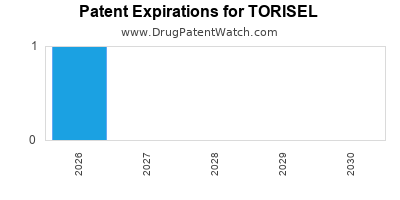
Torisel is a drug marketed by Pf Prism Cv and is included in one NDA. There are two patents protecting this drug and one Paragraph IV challenge.

This drug has seventy-six patent family members in thirty-three countries.

The generic ingredient in TORISEL is temsirolimus. There are five drug master file entries for this compound. Five suppliers are listed for this compound. Additional details are available on the temsirolimus profile page.

DrugPatentWatch® Litigation and Generic Entry Outlook for Torisel

A generic version of TORISEL was approved as temsirolimus by ACCORD HLTHCARE on July 30th, 2018.

  Get Started Free

AI Deep Research
Questions you can ask:
  • What is the 5 year forecast for TORISEL?
  • What are the global sales for TORISEL?
  • What is Average Wholesale Price for TORISEL?
Drug patent expirations by year for TORISEL
Drug Prices for TORISEL

See drug prices for TORISEL

Recent Clinical Trials for TORISEL

Identify potential brand extensions & 505(b)(2) entrants

SponsorPhase
Ivy Brain Tumor CenterEarly Phase 1
Barrow Neurological InstituteEarly Phase 1
Nader SanaiEarly Phase 1

See all TORISEL clinical trials

Paragraph IV (Patent) Challenges for TORISEL
Tradename Dosage Ingredient Strength NDA ANDAs Submitted Submissiondate
TORISEL Injection temsirolimus 25 mg/mL, 1.8 mL vial 022088 1 2011-05-25

US Patents and Regulatory Information for TORISEL

Applicant Tradename Generic Name Dosage NDA Approval Date TE Type RLD RS Patent No. Patent Expiration Product Substance Delist Req. Exclusivity Expiration
Pf Prism Cv TORISEL temsirolimus SOLUTION;INTRAVENOUS 022088-001 May 30, 2007 AP RX Yes Yes ⤷  Get Started Free ⤷  Get Started Free Y ⤷  Get Started Free
>Applicant >Tradename >Generic Name >Dosage >NDA >Approval Date >TE >Type >RLD >RS >Patent No. >Patent Expiration >Product >Substance >Delist Req. >Exclusivity Expiration

Expired US Patents for TORISEL

Applicant Tradename Generic Name Dosage NDA Approval Date Patent No. Patent Expiration
Pf Prism Cv TORISEL temsirolimus SOLUTION;INTRAVENOUS 022088-001 May 30, 2007 ⤷  Get Started Free ⤷  Get Started Free
>Applicant >Tradename >Generic Name >Dosage >NDA >Approval Date >Patent No. >Patent Expiration

EU/EMA Drug Approvals for TORISEL

Company Drugname Inn Product Number / Indication Status Generic Biosimilar Orphan Marketing Authorisation Marketing Refusal
Pfizer Europe MA EEIG Torisel temsirolimus EMEA/H/C/000799Renal-cell carcinomaTorisel is indicated for the first-line treatment of adult patients with advanced renal-cell carcinoma (RCC) who have at least three of six prognostic risk factors.Mantle-cell lymphomaTorisel is indicated for the treatment of adult patients with relapsed and / or refractory mantle-cell lymphoma (MCL). Authorised no no no 2007-11-19
>Company >Drugname >Inn >Product Number / Indication >Status >Generic >Biosimilar >Orphan >Marketing Authorisation >Marketing Refusal

International Patents for TORISEL

See the table below for patents covering TORISEL around the world.

Country Patent Number Title Estimated Expiration
Brazil 9507323 ⤷  Get Started Free
Ukraine 82328 ПАРЕНТЕРАЛЬНАЯ КОМПОЗИЦИЯ НА ОСНОВЕ ГИДРОКСИЭСТЕРА РАПАМИЦИНА (ВАРИАНТЫ) И СПОСОБ ЕЕ ПРИГОТОВЛЕНИЯ;ПАРЕНТЕРАЛЬНА КОМПОЗИЦІЯ НА ОСНОВІ ГІДРОКСІЕСТЕРУ РАПАМІЦИНУ (ВАРІАНТИ) ТА СПОСІБ ЇЇ ПРИГОТУВАННЯ (PARENTERAL FORMULATIONS OF RAPAMYCIN HYDROXYESTER (VARIANTS) AND A METHOD FOR ITS PREPARATION) ⤷  Get Started Free
Mexico 2009010954 ⤷  Get Started Free
>Country >Patent Number >Title >Estimated Expiration

Supplementary Protection Certificates for TORISEL

Patent Number Supplementary Protection Certificate SPC Country SPC Expiration SPC Description
0763039 SPC017/2008 Ireland ⤷  Get Started Free SPC017/2008: 20090911, EXPIRES: 20200413
0763039 91438 Luxembourg ⤷  Get Started Free 91438, EXPIRES: 20200414
0763039 PA2008009 Lithuania ⤷  Get Started Free PRODUCT NAME: TEMSIROLIMUSUM; REG. NO/DATE: EU/1/07/424/001 20071119
>Patent Number >Supplementary Protection Certificate >SPC Country >SPC Expiration >SPC Description

Market Dynamics and Financial Trajectory for the Pharmaceutical Drug: TORISEL

Last updated: July 27, 2025


Introduction

TORISEL (temsirolimus) is an intravenously administered mTOR (mammalian target of rapamycin) inhibitor marketed primarily for the treatment of relapsed or refractory renal cell carcinoma (RCC). Since its approval by the FDA in 2007, TORISEL has experienced fluctuating market dynamics driven by regulatory, clinical, and competitive forces. This analysis explores the current market landscape, financial trajectories, and future prospects of TORISEL within the evolving oncology therapeutics sector.


Market Overview and Therapeutic Positioning

TORISEL’s initial indication targeted advanced RCC, where it competed against existing therapies such as sunitinib and pazopanib. The drug’s mechanism — inhibiting mTOR pathway signals critical for tumor growth — positioned it as a targeted therapy in the burgeoning precision oncology market. Its approval marked a significant milestone for mTOR inhibitors, placing TORISEL among the pioneering drugs in this class.

The global RCC treatment market is projected to grow at a CAGR of approximately 6-8% over the next decade, driven by increasing incidence rates, improved diagnostic techniques, and evolving targeted therapy protocols [1]. However, TORISEL’s market share faces intense competition from newer agents like nivolumab, cabozantinib, and emerging immuno-oncology combinations, which often demonstrate improved efficacy and safety profiles.

Market Dynamics Influencing TORISEL

Regulatory Landscape and Approvals

TORISEL's initial dominance solidified post-approval, but subsequent regulatory reviews and new indications have influenced its market trajectory. Notably, the FDA’s approval of newer immune checkpoint inhibitors, such as nivolumab (Opdivo), changed the standard of care for RCC, reducing TORISEL’s early market share. Regulatory shifts affecting dosing protocols and labeling updates also impact the drug’s usage patterns.

Clinical Efficacy and Safety Profile

While TORISEL demonstrated significant efficacy in clinical trials for RCC, comparative studies revealing superior outcomes with immune checkpoint inhibitors and VEGF inhibitors have contributed to declining reliance on mTOR inhibitors alone [2]. Safety concerns including stomatitis, metabolic disturbances, and pulmonary toxicity have further limited its preference, especially in combination regimens.

Competitive Landscape

The competitive pressure from immunotherapies such as nivolumab, pembrolizumab, and combination therapies including axitinib plus pembrolizumab has relegated TORISEL to a secondary position. The superior response rates and durability offered by these newer agents have diminished TORISEL's appeal, especially considering convenience and toxicity profiles.

Pricing and Reimbursement Policies

Market penetration depends heavily on pricing strategies and reimbursement policies. As more efficacious options entered the market, payers have favored agents with better profiles, often reducing reimbursement for TORISEL or making access contingent on specific clinical criteria. This has hampered its revenue growth.


Financial Trajectory & Revenue Trends

Historical Revenue Performance

Initially, TORISEL commanded robust sales during its first few years post-approval, with peak revenues reaching over $200 million annually globally. According to IQVIA and company disclosures, revenues declined steadily after 2010, largely due to competition and incremental clinical benefits favoring alternative therapies [3].

Recent Market Performance

In recent years, TORISEL’s sales have plateaued or declined sharply in mature markets like the US and Europe. Analyses indicate a 20-25% year-over-year revenue decline since 2018, attributable to shrinking market share in RCC, restricted use cases, and off-label substitution by newer agents.

Pipeline and Repurposing

Efforts to expand TORISEL’s indications for other cancers, such as breast and neuroendocrine tumors, have met limited success, often constrained by marginal efficacy data and regulatory hurdles. Some ongoing trials aim to explore combination regimens, but commercialization prospects remain uncertain.

Impact of Patent and Exclusivity Status

TORISEL’s primary patent protections have long expired, exposing it to generic competition. The availability of biosimilar or generic versions reduces pricing power and compresses margins. Consequently, revenue streams have become increasingly reliant on market share retention rather than innovative growth.

Future Financial Outlook

Given current market conditions, TORISEL’s financial outlook remains subdued unless it successfully secures new indications or combination strategies demonstrating definitive clinical advantages. The drug’s revenue trajectory is expected to remain in decline unless strategic repositioning occurs.

However, niche markets or specific patient subsets who do not respond to newer therapies could sustain some demand. Additionally, licensing or partnership agreements—such as with emerging biotech firms—may offer alternative revenue avenues.

Key Market Drivers and Constraints

Drivers Constraints
Growing RCC incidence Competition from immunotherapy agents
Advances in personalized medicine Limited efficacy beyond initial indications
Increasing acceptance of combination regimens Patent expirations and biosimilar entry
Potential for repositioning in other cancers Clinical trial failures or marginal benefits
Improved biomarker-driven patient selection Payer restrictions and reimbursement challenges

Conclusion

TORISEL’s market dynamics are emblematic of the broader evolution within oncology targeted therapies. Its initial success was fueled by unmet clinical needs and pioneering mTOR inhibition strategies, but subsequent advancements in immune checkpoint inhibitors and VEGF pathway agents have curtailed its market share.

Financially, TORISEL faces a challenging outlook dominated by generic competition and declining revenues. Its future hinges on strategic repositioning, exploring combination therapies, and securing new indications. For stakeholders, understanding these dynamics facilitates informed decision-making regarding investment, licensing, and potential market entry strategies.


Key Takeaways

  • Market Weakening: TORISEL’s market share has diminished considerably amid the rise of immunotherapies and newer targeted agents for RCC.
  • Revenue Challenges: Sales have declined due to patent expirations, generic competition, and superior efficacy of alternative treatments.
  • Strategic Opportunities: Repositioning through combination regimens or new indications, particularly if supported by compelling clinical data, could revitalize its therapeutic relevance.
  • Competitive Landscape: The shift toward immuno-oncology necessitates adaptation; standing out requires differentiation through novel therapeutic synergies.
  • Long-term Outlook: Without substantial repositioning, TORISEL’s financial trajectory predicts continued decline, emphasizing the importance of innovation and strategic licensing.

FAQs

1. Why did TORISEL initially succeed in the RCC market?
TORISEL was among the first mTOR inhibitors approved for RCC, providing an effective targeted approach when options were limited, and fulfilling an unmet clinical need.

2. What factors have contributed to TORISEL’s decline in market share?
The rise of immunotherapies, better safety profiles of newer agents, patent expiry leading to generics, and limited efficacy in newer indications are primary factors.

3. Is there potential for TORISEL in other cancer indications?
Some clinical trials explore its use in breast and neuroendocrine tumors, but evidence remains limited. Strategic repositioning may be required to unlock new markets.

4. How do patent expirations impact TORISEL’s revenues?
Patent expirations open doors for biosimilars or generics, reducing exclusivity-driven pricing power and directly affecting revenue streams.

5. What strategies could extend TORISEL’s market relevance?
Combining TORISEL with immunotherapies, identifying biomarker-driven patient subsets, or obtaining new regulatory approvals for additional indications could prolong its market presence.


References

[1] MarketWatch. "Global Renal Cell Carcinoma Therapeutics Market Forecast." 2022.
[2] Clinical trials and comparative studies published in Journal of Clinical Oncology on mTOR inhibitors versus immunotherapies.
[3] IQVIA reports on oncology drug sales, 2022.

More… ↓

⤷  Get Started Free

Make Better Decisions: Try a trial or see plans & pricing

Drugs may be covered by multiple patents or regulatory protections. All trademarks and applicant names are the property of their respective owners or licensors. Although great care is taken in the proper and correct provision of this service, thinkBiotech LLC does not accept any responsibility for possible consequences of errors or omissions in the provided data. The data presented herein is for information purposes only. There is no warranty that the data contained herein is error free. We do not provide individual investment advice. This service is not registered with any financial regulatory agency. The information we publish is educational only and based on our opinions plus our models. By using DrugPatentWatch you acknowledge that we do not provide personalized recommendations or advice. thinkBiotech performs no independent verification of facts as provided by public sources nor are attempts made to provide legal or investing advice. Any reliance on data provided herein is done solely at the discretion of the user. Users of this service are advised to seek professional advice and independent confirmation before considering acting on any of the provided information. thinkBiotech LLC reserves the right to amend, extend or withdraw any part or all of the offered service without notice.